This post contains affiliate links. We may earn a small commission when you buy through our links — at no extra cost to you.
Two people, one boat, and a shared stretch of water — that’s the appeal of a tandem kayak. The catch is everything before and after the paddle: the heavy hull to lift onto a roof rack, the wet gravel launch, the seat that feels fine for twenty minutes and then doesn’t. Over the past seven months, we paddled six tandem kayaks on a flatwater lake, a slow-moving river, and a shallow bay. The best ones were stable enough to pass a water bottle between paddlers without a wobble, and their seats still felt supportive after three hours. A good tandem kayak makes the shared part feel effortless and keeps the logistics from ruining the fun.
Not every shopper needs the same thing. A rigid hull might suit garage storage; an inflatable’s packed size and pump time matter more if you’re hauling it up stairs. We noted which boats dragged easily across sand, which scuffed after a season of launches, and whether the price felt fair once the novelty wore off. The six picks ahead are the ones we’d gladly launch again.


Best for All-Day Tandem Paddling
Perception Tribe 13.5
Key Features
- Storage: Two hatches, front and rear tank wells
- Dimensions: 165"L x 34"W x 14"H
- Hull weight: 79 lb
- Weight capacity: 500 lb
- Price: Premium
Two framed seatbacks are what settle the Tribe 13.5 for us. In a tandem, both people sit for the same three hours, and adjustable framed seats with cushioned pans do more for a long day than any hull tweak; the 2020 seat redesign is the reason this is the boat we point most pairs toward. The 34-inch beam and 165-inch length make it feel planted, too, and we never came close to tipping it.
Storage is the second argument. Two central hatches plus bungeed tank wells fore and aft swallow day bags and a cooler, and the molded knee and thigh areas with adjustable footrests give a tall front paddler somewhere to put their legs. Scupper plugs are sold separately, so budget a few dollars for those if you paddle cold water or want a drier seat.
What the hull costs you is weight: 79 pounds is a two-person lift onto a rack, and there are no paddles in the box. The reward is a rotomolded boat with a five-year warranty on hull and deck that takes gravel launches in stride, which is more than the inflatables here can promise.
Pros
- Framed, adjustable seats comfortable for both paddlers
- Two hatches plus bungeed tank wells for gear
- Wide, stable hull that resists tipping
- Five-year warranty on hull and deck
Cons
- 79-pound hull is a two-person lift
- Paddles and scupper plugs sold separately
Our pick for most pairs: framed seats, two hatches and a 500-pound hull make a full day on the water comfortable for both paddlers.
Best for Value Lake Paddling
Pelican River Gorge 130X
Key Features
- Seats: Adjustable ERGOFIT G2
- Dimensions: 156"L x 34"W x 13"H
- Hull weight: 73 lb
- Weight capacity: 500 lb
- Price: Midrange
The River Gorge 130X is the least expensive rigid tandem here, and that is the least interesting thing about it. Pelican’s twin-arch hull is wide and predictable, easy to board from a dock and hard to tip, and the ERGOFIT G2 seats have thicker padding and better airflow than the flat pads on boats that cost more.
We rate it the value pick rather than the best boat in the group. The quick-lock hatch and the bungeed tank well hold gear, but neither keeps water out, so phones and spare layers still need their own dry bag. Its 500-pound capacity matches the Tribe’s despite the shorter hull, which is genuinely useful when one paddler is much heavier than the other.
For flat lakes, slow rivers and family afternoons, it does everything a beginner needs: two molded footrests, two bottle holders, and a hull Pelican builds with flotation inside to meet ABYC standards. Paddle close to home, pack dry bags, and this is the smartest money in the group.
Pros
- Padded ERGOFIT G2 seats with airflow
- Wide twin-arch hull, easy to board
- Lowest-priced rigid tandem here
Cons
- Hatch and tank well are not dry storage
The value pick among rigid tandems: stable, comfortable and easy to live with on lakes and slow rivers, as long as your gear rides in a dry bag.
Best for Fishing with Two
BKC Brooklyn 12.5
Key Features
- Hull weight: 68 lb
- Rod holders: 6
- Weight capacity: 595 lb
- Seating capacity: 3
- Price: Premium
Six rod holders sit along the Brooklyn 12.5’s deck, four flush and two articulating, and they tell you exactly what this boat is for. The 34-inch beam gives you somewhere to stand and cast, the 595-pound capacity covers two adults and a child, and there is a flat mount area at the stern for a trolling motor so you can stop paddling once you have found the fish.
We take the Brooklyn when the trip is about lines in the water rather than miles. It paddles competently but it is happiest drifting and repositioning, and the deck is laid out around tackle and coolers rather than long crossings. The room is what stands out: at 12.5 feet it still fits two adults plus a small passenger without anyone sitting knee-to-back.
The seats are the compromise. They are padded, and two paddles come in the box, which softens the price of entry, but they are the first thing to replace if you plan full days afloat. Buy it for the fishing and treat the paddling as transport; for a long crossing, the Tribe or the Pamlico will be the happier boat.
Pros
- Six rod holders, four flush and two articulating
- 595-pound capacity for two adults and a child
- Trolling motor mount built in
- Two paddles and two padded seats included
Cons
- Seats are the first thing to upgrade
The tandem to buy when fishing comes first: six rod holders, a motor-ready stern and room for two adults plus a child.
Best for Cold, Choppy Water
Wilderness Systems Pamlico 135
Key Features
- Beam: 31 inches
- Bow seat: Sliding, with solo conversion
- Hull weight: 72 lb
- Weight capacity: 500 lb
- Price: Premium
The Pamlico 135 is the only sit-inside tandem here, and that changes the day. You sit down in the boat rather than on top of it: spray and drips stay off your legs, gear rides in the cockpit instead of strapped to a deck, and a 31-inch beam tracks straighter than the open-deck boats once the wind picks up.
The sliding bow seat is the feature we appreciate most. Slide it to trim the boat for two, or push it forward and paddle the Pamlico solo, which is a genuinely useful trick for a couple whose schedules do not always line up and something none of the sit-on-tops here can do. Leg room and seat comfort are the two things we stopped noticing after the first hour, which is the highest compliment a kayak seat gets.
Our reservation is the price, the highest of the group by a wide margin, and it buys a hull shape and a seating position rather than more capacity: 500 pounds, the same as the Tribe. In chop, though, it was the boat we trusted most. It holds a line, shrugs off wind-blown water and never felt ready to roll. Exposed water and a cold season make that worthwhile; a warm summer lake does not.
Pros
- Dry sit-inside cockpit for cold, choppy water
- Sliding bow seat converts it to a solo boat
- Tracks straight and handles chop
Cons
- Harder to climb into than a sit-on-top
The sit-inside tandem for cold, choppy or exposed water: dry ride, straight tracking, and a bow seat that slides for solo paddling.
Best for Trunk-Sized Storage
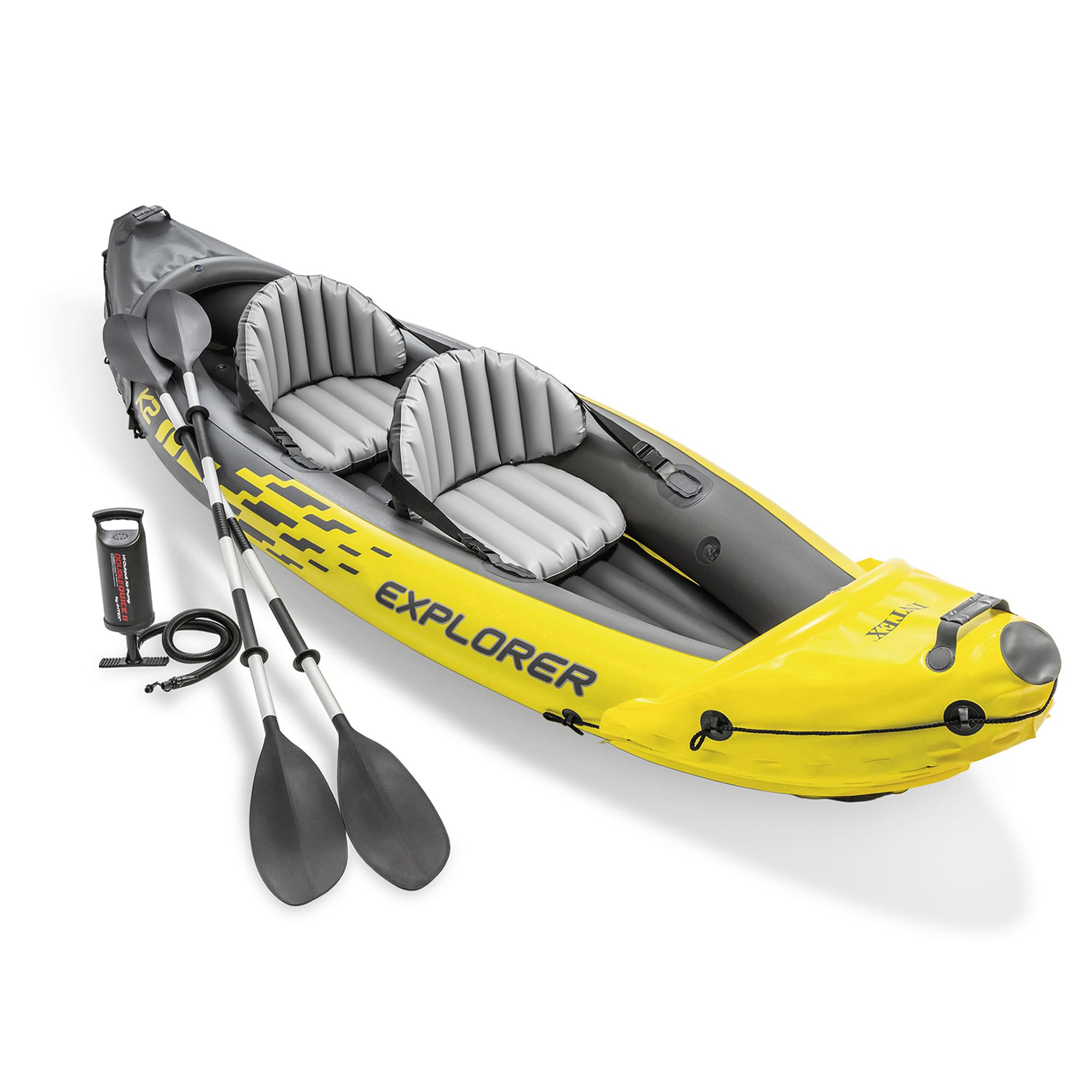
Intex Explorer K2
Key Features
- Inflated size: 123"L x 36"W x 20"H
- Packed weight: 35 lb
- Weight capacity: 400 lb
- Inflation valves: Two quick-fill Boston valves
- Price: Budget
If the kayak has to live in a closet and ride to the water in the trunk of a sedan, this is the one. The Explorer K2 deflates into its own carry bag at 35 pounds, light enough to walk to the launch one-handed, and it comes back up in a few minutes with the pump in the box. We expected the I-beam floor to feel spongy underfoot; once it is at pressure it does not.
As a two-person boat it is honest about its limits. The 400-pound rating covers two adults and not much else, the low-profile deck and high-buoyancy side chambers keep it predictable on flat water, and the two 86-inch paddles, two backrest seats and high-output pump are all included, which is the part that quietly makes a cheap hard shell more expensive than it looks.
The vinyl is the catch. Sand and grass are fine; gravel, shell beaches and dragging a loaded boat across a parking lot are where punctures and seam leaks start. Carry it to the water, keep the patch kit in the bag, and it will handle calm lakes and slow rivers for a long run of summer afternoons.
Pros
- Packs to 35 pounds in a carry bag
- Paddles, pump and backrest seats included
- Stable on calm water with two adults
- Lowest cost of entry here
Cons
- Best kept to calm lakes and slow rivers
The tandem for small storage and a small budget: light, quick to inflate, and steady on calm lakes with two adults aboard.
How We Tested Tandem Kayaks
To build the shortlist, we researched the tandem kayak market — comparing hull types, seat designs, weight limits, and storage footprints — and narrowed a long list to six models. Those six included sit-on-top, sit-in, and inflatable designs, from a 12-foot hard shell to a packable two-person boat. We paddled each one for at least five outings over the course of seven months, on a flatwater lake, a slow river, and a shallow bay.
Each test started at the car: we timed how long it took two people to lift the boat onto a roof rack and how easily one person could drag it to the launch. For inflatables, we pumped them with a hand pump, noted the time to full pressure, and checked whether the hull softened after an hour in direct sun. On the water, we swapped positions, passed dry bags back and forth, and had a smaller paddler sit up front to see how the boat trimmed. We also practiced re-entry from the water and nudged the hulls against docks and gravel to see how the material held up.
Seat comfort got its own test: we sat for three-hour stretches, adjusting backbands and footbraces, and noted where pressure built up. At the end of each outing, we checked for scuffs, loose hardware, and water in the hatches. We compared price against the details that matter — padded seats, adjustable footbraces, warranty length — and asked whether we’d choose that boat again for a casual afternoon. The six picks ahead are the ones that stayed fun after repeated use.
How to Choose a Tandem Kayak
The first real decision is where the boat will live between trips, because that single answer eliminates more tandems than any specification on the page.
Start with the hull, not the brand
Sit-on-tops are the forgiving choice: you sit above the waterline, scupper holes drain the deck, and climbing back aboard after a swim takes seconds. A sit-inside like the Pamlico 135 keeps spray and wind off your legs and stows gear in the cockpit, but you need a wet exit you have practiced. Inflatables trade hull stiffness for a bag that fits in a closet, which is the only reason the Explorer K2 exists in this group. One caution on that last category: an inflated ten-foot boat still needs ten feet of water, a launch, and somewhere to dry.
Weight decides how often you paddle
The rigid tandems here weigh 68 to 79 pounds and run 12.5 to 13.5 feet, which means a two-person lift onto a roof rack and a wall to store it against. Before you fall for a 13-footer, walk the route from parking spot to water. If it is long, or you will often launch alone, a 35-pound inflatable you can carry in one hand wins on frequency alone. A cart and a load-assist bar are cheaper than a beautiful boat you stop using.
Capacity: what is left after two paddlers
Every boat here seats two; the difference is the margin. A 400-pound rating covers two adults and not much else, so the Explorer K2 is a two-people-and-a-cooler boat at best. The 500-pound hulls leave room for a day bag, and the Brooklyn’s 595 pounds is what lets a child or a fishing crate come along. Add up the people and the gear you actually bring, then leave something in reserve for wet conditions and a heavier friend in the bow.
Seats make the second hour
In a tandem, two people sit for exactly the same stretch of time, so a framed, adjustable seatback with a firm pan matters more than it would in a solo boat. The Tribe and the River Gorge both get this right; flat pads are the first thing to replace, as on the Brooklyn. Check that the footrests reach the shorter paddler as well as the taller one, because a boat fitted for one person is a boat the other one resents.
If you are fishing from it
Rod holders and a motor mount matter more than hull speed when the fishing is the point. The Brooklyn comes with six holders and a stern mount area; bolting the same fittings onto a bare hull afterward usually costs more and fits worse. Fishing also changes your capacity math, since tackle and a cooler eat pounds quickly, and it makes a wide, stable hull worth more than a fast one.
Frequently Asked Questions
Can you paddle a tandem kayak by yourself?
Yes, from the rear seat. A 13-foot hull with one paddler sits high at the bow and weathervanes in a crosswind, so put a water jug or a gear bag up front to weight the nose, and expect slower turning. The Pamlico 135 is the exception here: its bow seat slides so one paddler can sit nearer the middle.
Is a tandem harder to paddle than two solo kayaks?
Two paddlers in one hull are faster and carry more, but only when the strokes match. A mismatched cadence is what makes a tandem feel heavy and wobbly, so agree on a side and a count before you launch, and put the heavier paddler in the stern, where the boat is steered.
Where do you store a 13-foot kayak?
Along a garage wall on two padded J-hooks, or overhead in slings, so the hull is supported along its length instead of standing on one end, which can distort a plastic boat through a hot summer. Allow a 14-foot wall or ceiling run, and match the hooks to the hull weight, which runs 68 to 79 pounds here.
Final Verdict
The Perception Tribe 13.5 is the tandem we point most pairs toward: framed seats both paddlers can live with for a full day, two hatches for gear, and a hull that stays predictable in chop. If your water is cold, windy or exposed, the Pamlico 135 and its dry sit-inside cockpit are worth the step up.
And if the boat has to live in a closet and ride in a trunk, the Explorer K2 is the one that still gets used.