This post contains affiliate links. We may earn a small commission when you buy through our links — at no extra cost to you.
A beginner kayak should feel steady before you push off—not tippy, not cramped, and not such a hassle to inflate or haul that it stays in the garage. I’ve watched new paddlers wrestle stiff valves and overcorrect hulls that won’t track straight. The right boat fixes that: it sets up cleanly, carries easily from car to launch, and keeps you comfortable long enough for the outing to be fun.
Over the past six months, my team and I paddled eight beginner kayaks on a calm lake and a slow river, loading each into a hatchback and carrying it to the water alone. We paid attention to how quickly each inflated, whether the seat still felt supportive after two hours, and how the hull held up after repeated launches from a gravelly shoreline. Some were a joy to paddle but a chore to pack; others were portable and stable but short on room. The picks below are the ones that balanced those tradeoffs and felt worth the money.



Best for All-Round First Kayak
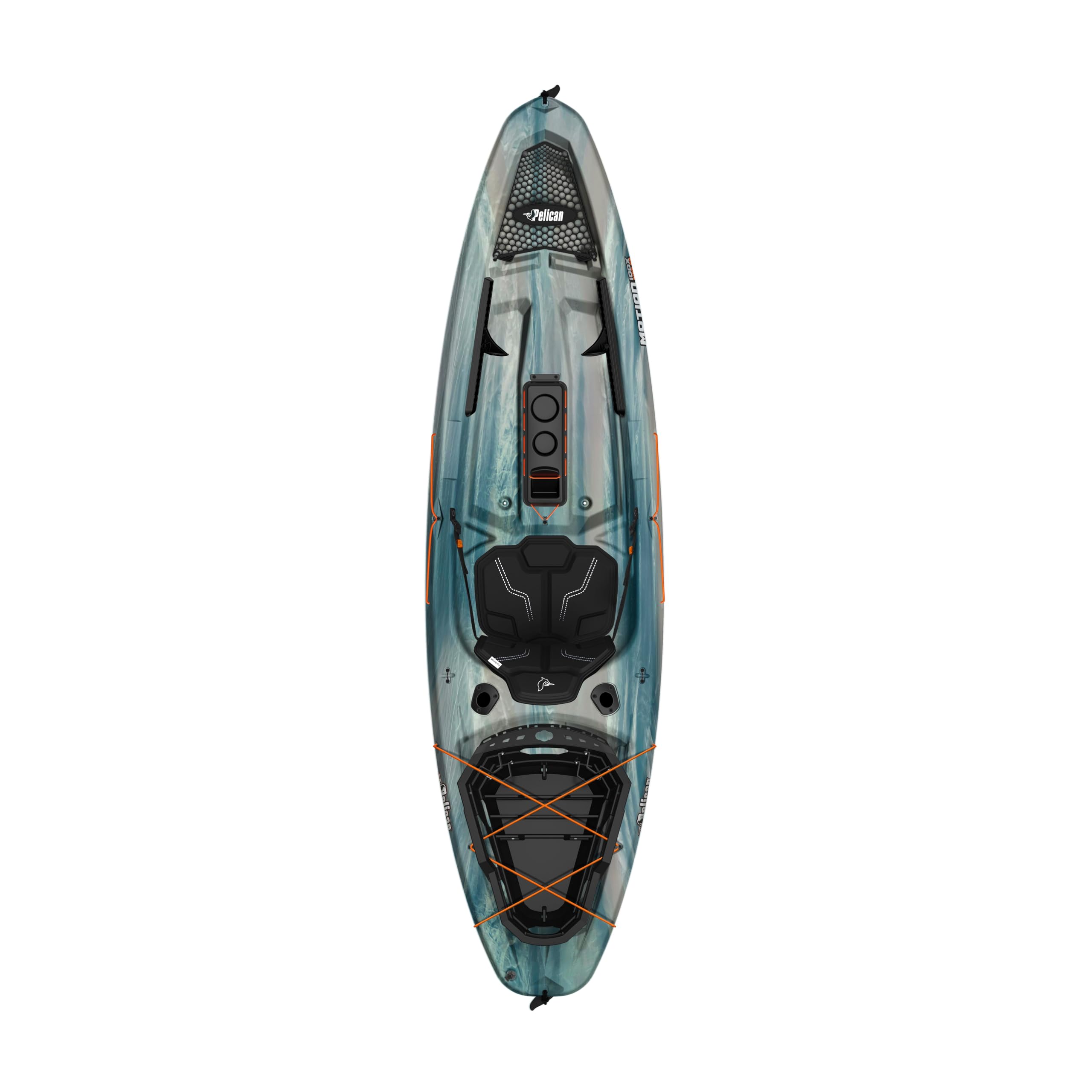
Pelican Argo 100X
Key Features
- Length: 10 ft
- Weight: 36 lb
- Cockpit: 24.5 inches
- Weight Capacity: 275 lb
- Price: Midrange
Thirty-six pounds is the number that decides whether a first kayak gets used, and it’s what the Argo 100X weighs. We lifted it off a roof rack alone, walked it down the ramp, and still had arms left for paddling — a small thing until you’ve watched someone wrestle a 50-pound hull onto a car. The twin-arched hull sits low and wide, and we found it settled enough to lean over and open the front hatch without a wobble.
The cockpit is 24.5 inches across, with molded footrests and an adjustable Ergoform seat, and the fit works across a range of paddlers without much fiddling. A front hatch and bottle holders swallow a morning’s water, sunscreen and a sandwich. The sit-in shape keeps spray and wind off in a way the sit-on-tops here don’t, which stretches the paddling season at both ends of summer.
Two things to plan for. Capacity is 275 pounds, mid-pack in this group, so a heavier paddler should look at the 400-pound tandems or a longer hull. And a paddle is not in the box — unlike the Intex kits and the Lifetime boats — so price one in before you order. Polyethylene will scratch on gravel; ours did on the first launch, and it’s cosmetic rather than structural.
Pros
- Light enough to car-top and launch alone
- Stable, forgiving hull for first outings
- Sit-in cockpit keeps wind and spray off
- Front hatch and bottle holders for day gear
Cons
- Paddle not included
- 275-pound capacity rules out heavier paddlers
Our default first kayak: light enough to launch alone, stable enough to relax in, and the one most beginners should buy before they know what they want.
Best for Small-Space Paddling
Intex Challenger K1
Key Features
- Weight: 26 lb
- Seating: 1 person
- Inflated Size: 108"L x 30"W x 13"H
- Weight Capacity: 220 lb
- Price: Budget
Paddle, high-output pump, removable skeg, cargo net and a carry bag arrive in the same box, which makes the Challenger K1 the simplest possible start: nothing to research, nothing extra to buy but a life jacket. That matters more than it sounds. A kayak with no pump can’t leave the driveway, and the pump is the piece first-time buyers forget.
We think it earns its place as the budget pick rather than as a compromise. Deflated, it folds into the included bag and lives in a closet or a trunk, and at 26 pounds it’s one of the lightest boats here. On the water the low-profile hull and skeg track better than a 30-inch inflatable has any right to, and the twitchy first ten minutes pass quickly.
The limits are honest ones. Capacity is 220 pounds, the lowest in this group, so a taller or heavier paddler should step up to the Explorer K2. The hull is glued PVC and its seams are the part to watch — inflate it at home before the first trip, keep a patch kit in the bag, and don’t drag it across gravel. And it’s a lake-and-mild-river boat; moving water is out.
Pros
- Complete kit with paddle, pump and bag
- Packs into a closet or car trunk
- 26 pounds is an easy one-person carry
Cons
- 220-pound capacity is the lowest here
- Glued PVC seams need care and a patch kit
Buy it if a closet is your boathouse: the cheapest complete kit here, as long as you sit under the 220-pound limit.
Best for Paddling with a Partner
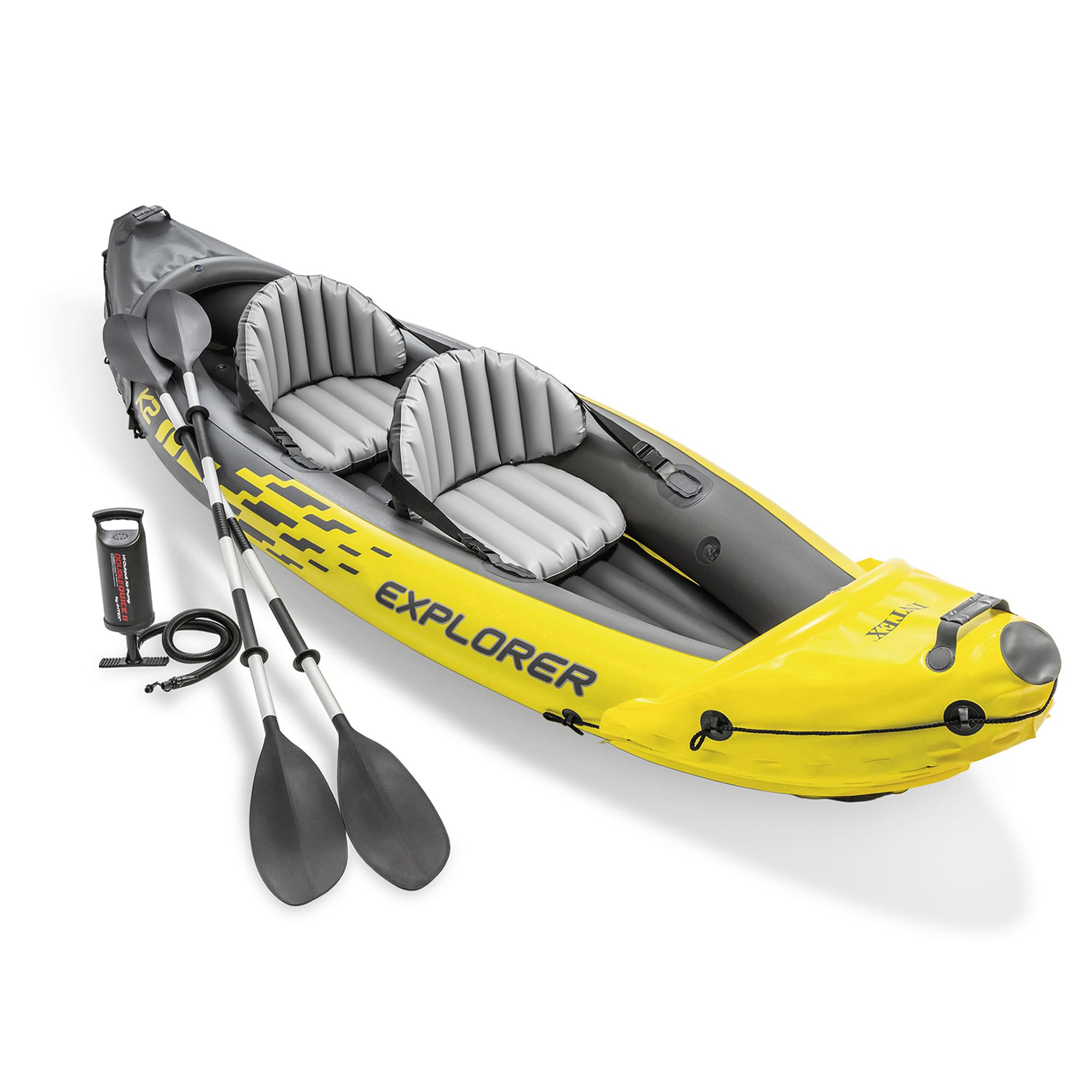
Intex Explorer K2
Key Features
- Weight: 35 lb
- Seating: 2 people
- Inflated Size: 123"L x 36"W x 20"H
- Weight Capacity: 400 lb
- Price: Budget
Two adults, or one adult and a child, is a different purchase from a solo boat, and the Explorer K2 covers it: 400 pounds of capacity, two inflatable seats with backrests, two paddles and the pump in the box.
At 35 pounds it’s still a one-person carry, and it folds into a tote that fits a trunk. On the water it’s a big boat — 10 feet 3 inches by 3 feet — with high-buoyancy side chambers, and we shuffled around mid-lake without feeling like we were testing the edge of anything.
It’s the best value in this group for a family, with one caveat to fix before the first trip: the front seat’s backrest is thin, and a stadium cushion or an aftermarket seat back turns a tolerable afternoon into a comfortable one.
Where it gives ground is width. Paddling it solo makes you feel every inch of that 36-inch beam, and two adults plus a cooler gets close to the 400-pound ceiling.
Pros
- Seats two within a 400-pound limit
- Two paddles and a pump included
- Packs into a tote for the trunk
Cons
- Wide, high-sided hull is slow into wind
- Vinyl seams and floor are the wear points
We point two-paddler households here: 400 pounds of capacity, a full kit in the box, and a footprint that still fits a trunk.
Best for Learning to Fish
Pelican Sentinel 100X Angler
Key Features
- Length: 114"L x 30"W x 13.25"H
- Weight: 44.6 lb
- Rod Holders: 4
- Weight Capacity: 275 lb
- Price: Premium
The ExoPak is the detail that sells the Sentinel: a removable gear box you pack at home — tackle, pliers, a sandwich — and drop into the deck at the waterside. Four rod holders, two flush and two vertical in that box, mean a beginner can fish from it instead of balancing a rod across their lap.
At 9 feet 6 inches and 44.6 pounds it hits a useful middle: short enough for a pickup bed or the top of a small car, light enough to handle alone, with molded side handles where your hands naturally land. The Ergolounge seat is thick and high-backed, though we still wanted a cushion by the second hour, and the deck has enough flat space for a couple of tackle boxes.
It’s a wet ride by design. Sit-on-tops drain through scupper holes, so a breezy morning leaves you sitting in an inch of water — welcome in July, less so in April. The hull turns with a stroke or two, which builds confidence in tight water.
This is a fishing-first kayak rather than a general-purpose first boat: it sits at the premium end of this group, and standing to cast is not what this hull is for. Sit, cast, and it does the job.
Pros
- Removable ExoPak packs gear at home
- Four rod holders for a first fishing setup
- 9’6" hull fits small cars and tight launches
Cons
- Paddle sold separately
- Not a standing, sight-fishing platform
We recommend it to beginners who already know they want to fish — the ExoPak and four rod holders do more for that than any hull upgrade.
Best for Light Sit-On-Top
Lifetime Lotus
Key Features
- Hull: Sit-on-top HDPE
- Length: 96"L x 30"W x 10"H
- Weight: 39 lb
- Weight Capacity: 250 lb
- Price: Midrange
At 8 feet long, the Lotus is the hard-shell here that lies down inside a small hatchback instead of riding on a roof. We think that single fact is worth more to a beginner than any hull feature, because the kayak you can load without a rack is the kayak that goes out on a Tuesday evening.
It weighs 39 pounds and carries 250, which puts it alongside the sit-ins on paper — but a sit-on-top deck is far easier to climb back onto from deep water, and the seat has a hard adjustable backrest. A double-sided paddle comes in the box, so the kit is closer to complete than either Pelican.
The trade-off is the short hull. It turns on a stroke, which is lovely on a pond, and wanders in a crosswind in a way the 10-foot boats don’t. Capacity stops at 250 pounds, the second-lowest here, and long legs sit low behind the footwells. For a lighter paddler on sheltered water, none of that is a real cost.
Pros
- Fits inside a small hatchback at 8 feet
- 39 pounds with a paddle in the box
- Sit-on-top deck is easy to remount
Cons
- Short hull wanders in a crosswind
- 250-pound capacity and a low seat
Our pick for a small car and a small paddler: 8 feet, 39 pounds, and a deck you can climb back onto from deep water.
Best for Travel and Camping
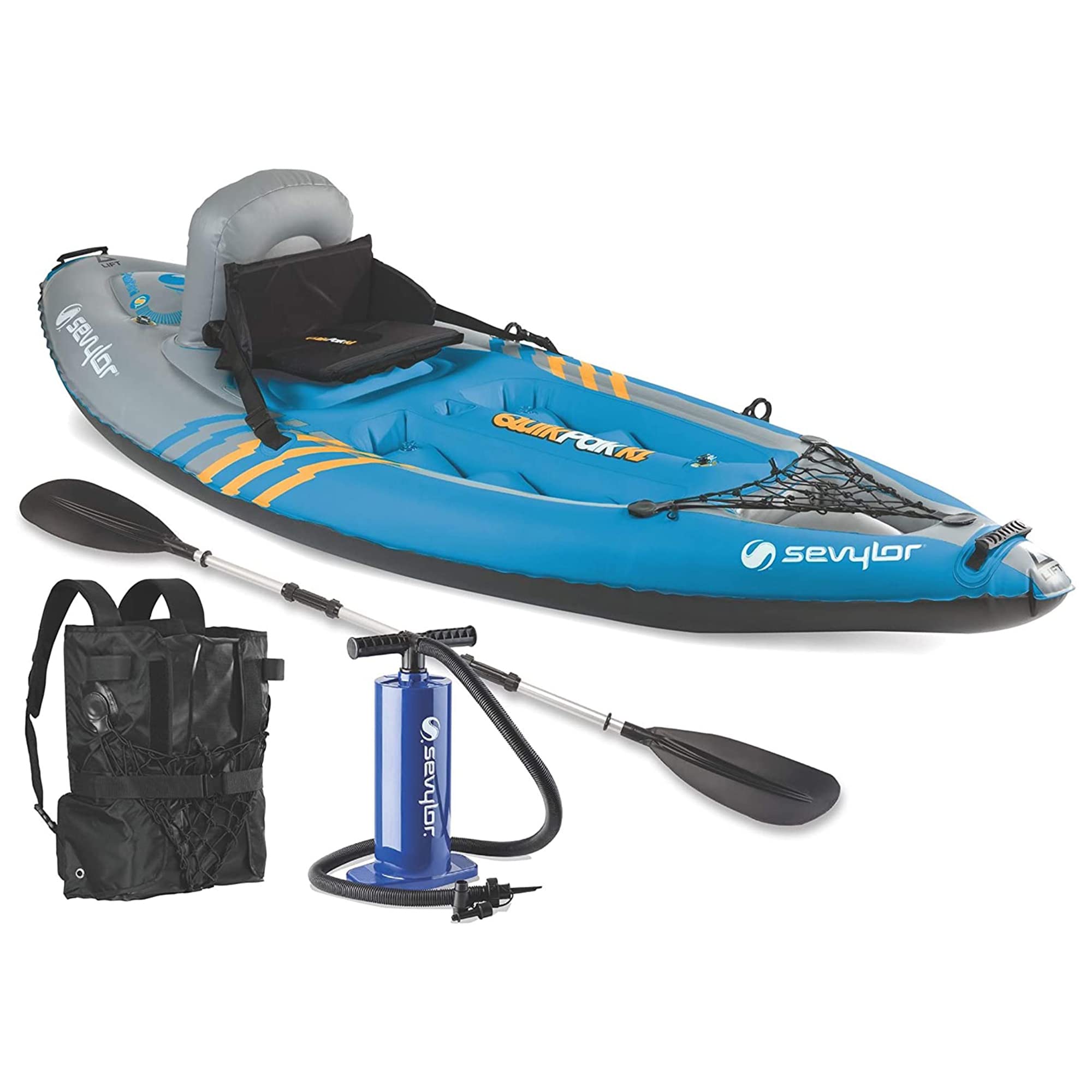
Sevylor QuickPak
Key Features
- Weight: 20.3 lb
- Dimensions: 31"L x 9.25"W x 17.5"H
- Carry System: Backpack converts to seat
- Weight Capacity: 400 lb
- Price: Midrange
The QuickPak’s trick is the seat: unclip it and it becomes the backpack the whole boat folds into. Twenty pounds on your back, hands free for a paddle bag and a cooler — that’s a different kind of first kayak from anything else here, and it’s the reason to look at this one.
We’re pleasantly surprised by how much boat that weight buys. There’s 400 pounds of capacity, multiple air chambers so a puncture in one doesn’t put you in the water, and a tarpaulin bottom that shrugs off gravel beaches. It’s also the lightest hull in this group by a wide margin.
Two things keep it off the top of the list. The bundled paddle is the weak link, and a paddle that fails leaves you swimming, so replace it before a long trip. And the floor softens under a heavier paddler — the boat sits lower and feels less direct than a high-pressure inflatable floor. On a calm lake with a light paddler, neither matters much.
Pros
- Seat converts into a backpack
- 20.3 pounds, the lightest here
- 400-pound capacity in a packable hull
Cons
- Bundled paddle is the weak point
- Soft floor sags under heavier paddlers
We reach for this one when the water is a flight away: 20 pounds on your back, 400 pounds of capacity on the lake.
Best for Casual Fishing
Lifetime Tamarack Angler 100

Key Features
- Length: 120"L x 31"W x 14.1"H
- Weight: 51 lb
- Rod Holders: 3
- Weight Capacity: 275 lb
- Price: Midrange
The Tamarack Angler is the older route to the same idea as the Sentinel: a sit-on-top with rod holders molded in and a flat, forgiving hull. It’s longer — a full 10 feet — and heavier at 51 pounds, and that weight is the first thing you notice alone at the ramp.
Two flush rod holders, a top-mount holder, two 6-inch storage compartments and a paddle keeper with shock cord give a beginner somewhere to put everything. The flat-bottomed hull is as steady as anything in this group, and the padded seat has enough back to it for a long morning.
It rewards a tall, strong paddler who can handle the carry and punishes a smaller one, and we wish the included paddle were a better one, because it’s the first thing you’ll replace. With a roof rack and a second pair of hands, the hull itself earns its keep.
Pros
- Very steady flat-bottomed hull
- Three rod holders and two storage compartments
- Paddle included, so the kit is complete
Cons
- 51 pounds is a two-person lift for many
- Seat clips and trim are the wear points
A steady, well-laid-out fishing hull that rewards a strong paddler with a roof rack; the weight and the seat fittings are what you accept.
How We Tested Beginner Kayaks
We started by narrowing the field to beginner-friendly kayaks that were widely available, had clear weight and capacity limits, and came in inflatable or lightweight sit-on-top styles that one person could manage. From that shortlist, we tested eight boats over six months, running each through the same routine: inflating or assembling it in a driveway, loading it solo into a hatchback, carrying it to the launch, and paddling it on a calm lake and a slow river. We timed setup and breakdown, noted whether valves sealed cleanly and seams stayed tight after repeated inflate-deflate cycles, and checked how much of the packed boat fit back into its bag when wet.
On the water, I shifted my weight side to side, practiced getting in and out from shallow water, and paddled two-hour stretches to judge stability and seat comfort. We noted whether the boat tracked straight without constant correction, whether the seat back stayed supportive after an hour, and whether the footrests or padding created pressure points. Fun was part of the test, too: some boats felt lively and easy to turn, while others were stable but sluggish.
Back on shore, we inspected hull material, seams, and fittings for wear after dragging over gravel and sand, then compared what each kayak included—pump, paddle, carry bag—against the effort it demanded. We judged value by how much use we’d realistically get from each boat, not by the sticker alone: a cheaper kayak that took 20 minutes to inflate and was miserable to carry scored lower than one that set up quickly and stayed comfortable. The final picks are the ones that kept setup easy, felt stable, and stayed comfortable long enough to be fun.
How to Choose a Beginner Kayak
The kayak you will actually use is the one you can get to the water alone and on a whim, which makes weight, storage and setup time bigger deciding factors than hull shape.
Sit-in, sit-on-top, or inflatable
Three families, three different first years. A sit-in like the Pelican Argo keeps spray and wind off and paddles drier in cool weather, but you enter through a cockpit and should practice a wet exit in shallow water before you need one. A sit-on-top like the Sentinel or the Lotus is far easier to climb back onto from deep water and puts your gear on deck, at the cost of a wet seat. An inflatable packs into a closet and rides in a trunk.
The trap: ‘compact’ usually describes a packed boat that still takes ten minutes and a flat patch of ground to become a kayak. Decide whether you want to store a boat or assemble one.
Weight decides how often you paddle
The boats here run from about 20 pounds to 51, and the meaningful difference isn’t the carry from car to water — it’s the lift onto the roof. Anything at 40 pounds and up is a careful two-hand maneuver for a lot of adults; a 36-pound sit-in or a 26-pound inflatable is a one-person job. If you have a truck bed, a trailer, or a launch you can walk to, weight matters much less.
Capacity, and what actually fills it
Every boat here lists a maximum, from 220 pounds on the Challenger K1 to 400 on the two-person Intex hulls, and that number includes you, your gear, and the dog. A 200-pound paddler in a 220-pound boat has 20 pounds of margin, which a cooler and a dry bag will use up. Keep at least 50 pounds of headroom. Then check the cockpit: molded footrests and an adjustable seat matter more than an extra inch of beam.
Stability, tracking, and the skeg
Beginner boats are wide on purpose. Primary stability — the resistance you feel the moment you sit down — is what lets a novice relax, and it isn’t the same as the reserve that stops a lean becoming a swim, which is why a 30-inch inflatable and a 30-inch hard shell don’t feel alike. Length buys tracking: an 8-foot hull turns on a stroke and wanders in a crosswind, a 10-foot hull holds a line. On the inflatables, fit the skeg; it’s the difference between paddling and correcting.
What’s in the box, and what you’ll still buy
The Intex kits and the Lifetime boats include a paddle; the Pelican Argo and Sentinel don’t, and a decent paddle costs real money. Inflatables should arrive with a pump that fits their valves — confirm that before you order, because a boat with no pump can’t leave the driveway. Everyone still needs a life jacket that fits, a patch kit if the hull is inflatable, and a way to carry the boat. Price those in before you compare hulls.
Frequently Asked Questions
Do I need to register a kayak?
In most U.S. states a human-powered kayak needs no registration, but a handful require one above a set length, and adding a trolling motor changes the rules entirely. Check your state wildlife agency’s boating page before your first launch, and check separately whether your local access point charges a launch fee.
Will a kayak fit in my car?
An 8-foot hull like the Lifetime Lotus lies inside many hatchbacks and small SUVs. A 10-foot sit-in usually rides on a roof rack with foam blocks or a cradle, and a tandem inflatable folds into a bag that fits a trunk. Measure the longest straight line through your cargo area with the seats down before you order.
What should I do before my first launch?
Inflate or unload the boat at home, check every valve and seam, and sit in it on land to set the seat and footrests. Keep the first trip short, close to shore, and out of the wind — a beginner on a windy lake spends the day correcting instead of paddling. Bring a patch kit and a spare layer.
Final Verdict
The Pelican Argo 100X is the kayak we hand a friend who has never paddled: 36 pounds, a stable hull, and a cockpit that keeps the wind off, for less than the fishing-specific boats here. It asks only that you buy a paddle.
If a hard shell has nowhere to live, the Intex Challenger K1 turns a closet into a boat shed and arrives with everything but a life jacket. Two paddlers, or a paddler plus a kid, should go straight to the Explorer K2.