This post contains affiliate links. We may earn a small commission when you buy through our links — at no extra cost to you.
If your feet ache by mid-afternoon, the problem is often not your shoes but the flimsy liner inside them. A good insole adds arch support, cushions the heel, and makes a pair of boots or sneakers feel custom-fit without a podiatrist visit. The wrong one can crowd your toes, slip at the heel, or flatten in a month. Over four months, my team and I wore 14 pairs through commutes, dog walks, long shifts, and weekend hikes.
The first surprise: thicker is not better. An insole has to match your arch height and the volume of your shoe, or it feels like a pebble underfoot. Comfort is personal, but pain relief, fit, and value are not—we noted how firm each pair felt out of the box, whether it stayed put during quick turns, and how the top layer held up after weeks of daily wear. What follows are the pairs that earned a permanent spot by our doors, from cushioned options for standing all day to firmer supports for flat feet.



Best for Everyday Support
PowerStep Pinnacle
Key Features
- Size: Men 10-10.5 / Women 12-12.5
- Length: Full length
- Cushioning: Dual-layer over the shell
- Arch support: Firm, full-length orthotic shape
- Price: Premium
Heel pain is what sends most people shopping for insoles, and this is the pair we point to first. The Pinnacle is built as an orthotic rather than a pillow: a full-length shell with a shaped arch and a cushioned heel, so your foot rests on something that holds its shape instead of sinking through it. Of everything in this group, it is the most balanced mix of support and padding.
Ordering takes a minute of attention. This is a sized insole, not a one-size pair you cut down, and the arch is placed for that length, so match the size on the listing to your shoe rather than guessing. It is designed for shoes where the factory footbed lifts out, which covers most athletic shoes, walking shoes and work boots. In a tight dress shoe the volume will be too much.
The firmness is the thing to know before you buy. It does not feel like a gel cushion and it is not supposed to; the first few days can feel like standing on a shaped board, and feet that have been living in soft insoles notice it most. Give it short wears before you decide. Once your arch settles onto the shape, what you feel is the support rather than the hardness, and the 30-day money-back guarantee takes most of the risk out of trying a firmer insole for the first time.
If your feet are flat and roll inward, the Pinnacle Maxx below is the better shape for you. This one suits medium and high arches.
Pros
- Balanced support and cushioning for all-day wear
- Strong record on heel and plantar fasciitis pain
- Backed by a 30-day money-back guarantee
Cons
- Firm, board-like underfoot for the first few days
We tell anyone with heel pain to start here: a firm, full-length orthotic that most feet adapt to within a week or so of wear.
Best for High Arches
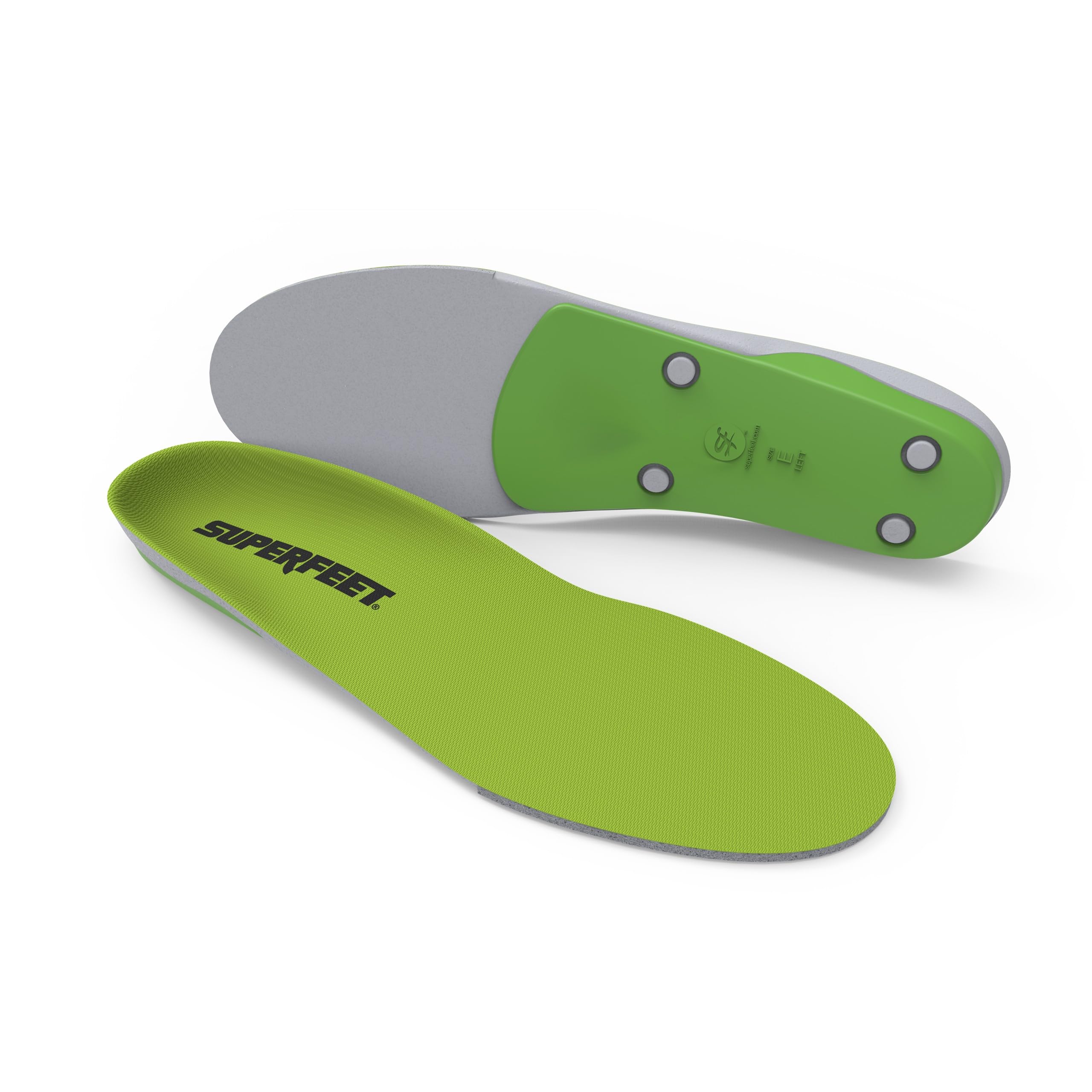
Superfeet Green
Key Features
- Fit: Trim to fit
- Heel: Deep heel cup
- Size: Men 7.5-9 / Women 8.5-10
- Arch height: High
- Price: Premium
Superfeet’s Green insole is what we reach for when a boot has a floppy, undefined footbed and a high arch to fill. It is a rigid shell with a deep heel cup rather than a cushion, and that is the whole point: it gives your foot a platform to sit on instead of letting the shoe’s soft liner decide the shape.
We think it is the best high-arch pick here, and the least forgiving one. With a medium or high arch the shelf lands where it should, and a long day on concrete is noticeably easier to take. With a flat foot, that same shelf sits under the middle of your arch and feels like standing on a rail. Buy it for the foot you have, not the foot you want.
Sizing has one rule: if you are between sizes, size up and trim down. The trim lines are generous, and an insole that comes out slightly long can be cut, while a short one cannot be fixed. It takes up real room, so it belongs in a boot or a roomy walking shoe where the factory footbed lifts out, and a snug sneaker will feel tighter with it in. Durability is where the price makes sense to us, because the shell does not pack down the way foam does; the top cloth is what wears out first, not the support.
Pros
- High, rigid arch that fills a sloppy boot
- Deep heel cup keeps the foot centered
- Trim-to-fit covers a wide size range
Cons
- Punishing under flat or low arches
- Adds noticeable volume to a snug shoe
If you have high arches and a pair of boots with a mushy footbed, this rigid, deep-cupped insole is the one we buy again and again.
Best for All-Day Standing
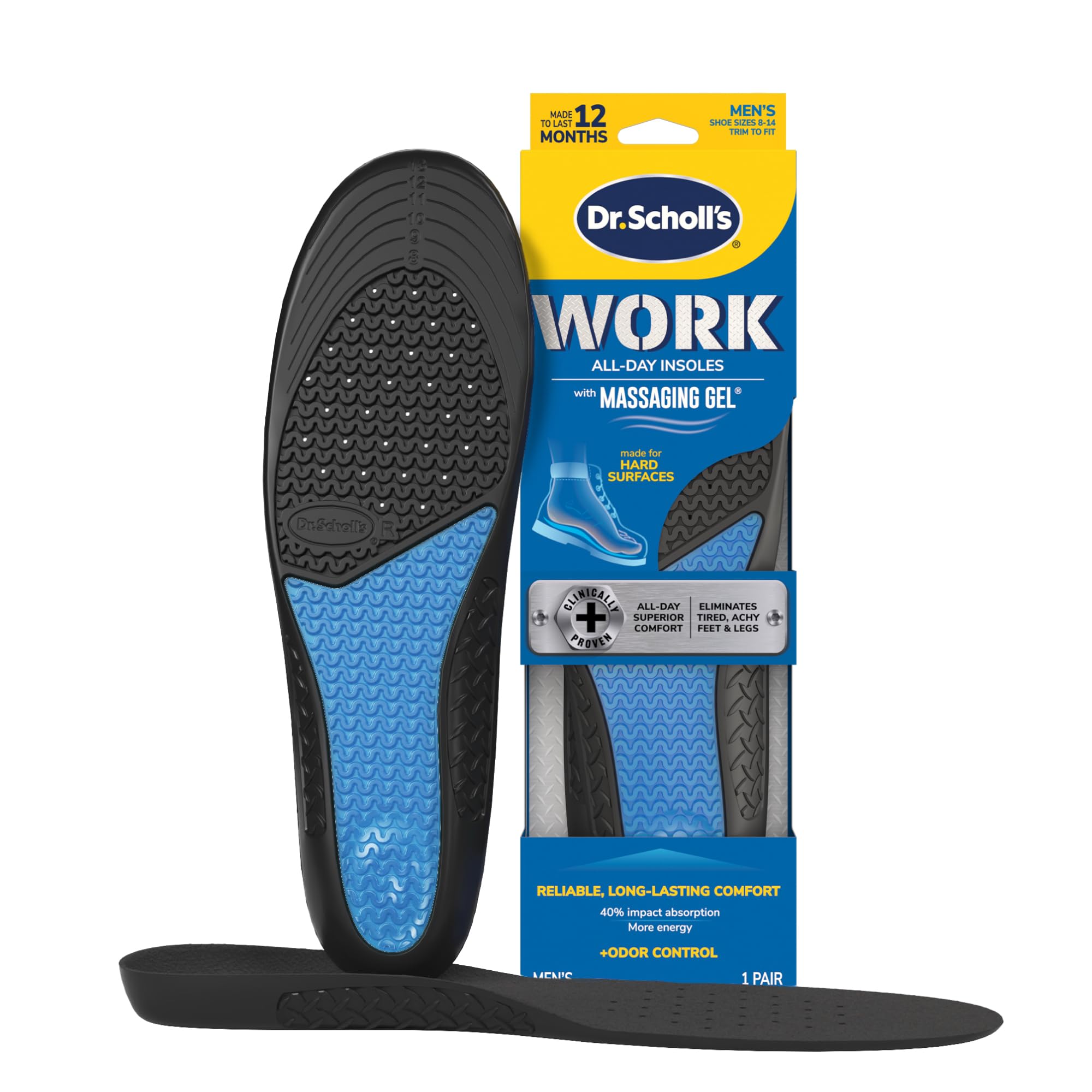
Dr. Scholl’s Work All-Day
Key Features
- Fit: Trim to fit
- Weight: 4.8 oz
- Cushioning: Massaging gel, full length
- Odor control: Polygiene StayFresh
- Price: Budget
Ten hours on concrete is its own problem, and the Work All-Day is the cheapest serious answer here. It is a full-length gel insole with a soft top layer, and its job is shock absorption rather than correction: it takes the hard edge off a floor and gives your heels something to land on.
Two practical details earn it a place. It is trim-to-fit, so cut from the toe a little at a time with the insole sitting in the shoe, because you can always take more off and you cannot put it back. And the top layer carries Polygiene, an odor-control finish that matters in a work boot you wear five days a week and cannot easily air out.
Where it stops is arch support. There is a mild rise under the midfoot and nothing more, so if your arch collapses or your heel hurts when you first get out of bed, put the money toward the Pinnacle instead. What this one does well is make a hard, flat boot bearable for the length of a shift, and at this price that is a fair trade rather than a compromise.
Pros
- Gel cushioning that softens hard floors
- Odor control built into the top layer
- The lowest-priced pair in this group
Cons
- Gel packs down under daily wear
Buy these if your feet ache from standing on hard floors and you want to spend as little as possible doing something about it.
Best for Flat Feet
PowerStep Pinnacle Maxx
Key Features
- Design: Angled heel stability shell
- Length: Full length
- Weight: 5.29 oz
- Arch support: Firm, shaped for flat feet
- Price: Premium
Take the Pinnacle and angle the heel, and you have the shape of the Maxx. The difference is not cosmetic: the angled heel is designed to control how your foot lands, and the shell is built for maximum stability rather than maximum cushioning. For a foot that rolls inward, that is the part that matters.
This is the pair we recommend for flat feet and overpronation, and it is the one place in this group where we struggled to find a common complaint worth warning you about. Arch support, fit and pain relief all land on the positive side without the split verdicts that show up elsewhere here. It goes in the same shoes as the standard Pinnacle: athletic shoes, walking shoes and work boots with a removable footbed.
The Maxx costs about the same as the standard Pinnacle, so the choice between them comes down to your foot rather than your budget. If you have a high, rigid arch and no rolling, the extra correction is more than you need and you will feel it; the standard Pinnacle is the calmer shape. If your shoes wear unevenly on the inner edge, start here.
Pros
- Stability shell for flat, rolling feet
- Angled heel guides how the foot lands
- Consistent record on pain relief and fit
Cons
- More correction than a high-arch foot needs
If your feet are flat and your shoes wear on the inside edge, this is the pair we hand over: a stability orthotic with an angled heel.
Best for Running and Walking
Sof Sole Athlete
Key Features
- Length: Full length
- Weight: 5.61 oz
- Cushioning: PU foam and gel, heel to toe
- Moisture control: Built into the top layer
- Price: Midrange
Cushioning costs room, and that is the first thing to understand about the Sof Sole Athlete. It is one of the thicker insoles here, and in a snug running shoe the top of your foot meets the upper sooner than it did before. In a roomy trainer or a work shoe with space to give, you do not notice it at all.
What you get for that volume is heel-to-toe padding: a PU foam base with gel through it and a top layer built for moisture control. It is a replacement for the flat, packed-out insole that came with your shoes rather than a correction for anything. There is a mild arch under the midfoot and no rigidity behind it, which is exactly right for a shoe you are going to run or walk in.
We keep these for athletic shoes where comfort is the entire brief: long walks, easy runs, and the sneakers you stand around in at the starting line. They drop into a shoe and stay put, and they are the pair we reach for when a shoe is fine except for being hard.
If what you actually need is your arch held up, this is not the pick. A soft insole cannot do that job and this one does not pretend to. What it does is turn a tired, unforgiving shoe into a comfortable one, and that is a real thing to buy.
Pros
- Heel-to-toe foam and gel cushioning
- Moisture control in the top layer
- Built for running and walking shoes
Cons
- Too thick for tight-fitting athletic shoes
- Foam packs down with heavy mileage
For runners and walkers who want their shoes softer rather than corrected, we reach for this cushioned pair first.
Best for Heavy Wearers
VALSOLE Heavy Duty

Key Features
- Build: Shock-absorbing heel cup
- Length: Full length
- Arch support: High and firm
- Designed for: 220+ lbs
- Price: Midrange
The 220+ on the box is not a ceiling. It is the weight class VALSOLE designed this insole around, and that is a more useful way to read it: heavier bodies push more load through a footbed, and foam that is fine at 150 pounds bottoms out under more. So this one is built firm, with a high arch and a heel that wraps around the foot instead of flattening under it.
In a work boot it does what it promises. The arch stays up, the heel does not squirm, and the whole thing feels planted rather than spongy. Fit is the part to check: in a shoe with a shallow heel counter it can sit your heel high enough that the foot slips, so put it in the boot you wear most and walk a lap before you commit it to a full shift.
We see it as the heavy-duty option in this group rather than an everyday insole. If you are over that weight and on your feet for a living, the firmness is the point, and the price sits well below the orthotics here. If you are lighter or you want cushioning, it is more insole than you need and your feet will tell you so by the end of the day.
Pros
- Designed around wearers over 220 pounds
- High, firm arch that holds in work boots
- Hugs the heel instead of flattening
Cons
- Firm with very little give underfoot
If you are over 220 pounds and on your feet all day, this firm, high-arched pair is built around exactly that load.
Best for Budget Support
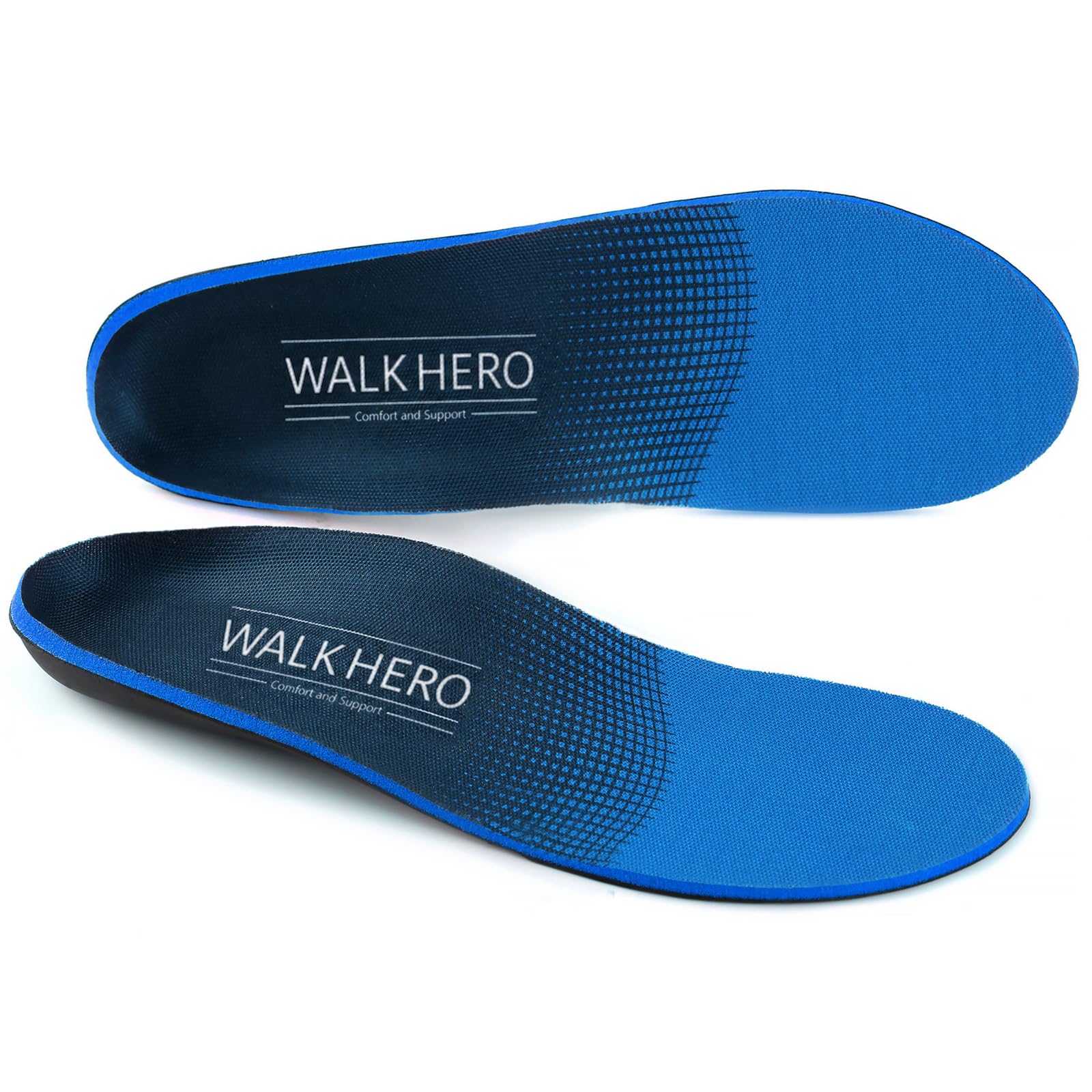
WalkHero Plantar Fasciitis
Key Features
- Heel: Deep heel cup
- Best in: Wider, high-volume shoes
- Material: EVA
- Arch support: High
- Price: Midrange
This is a hard insole, and that is the honest place to start. There is almost no give in the EVA under your heel, which is either the reason you want it or the reason you will dislike it. What the hardness buys you is a high arch and a deep heel cup that stay where they are when you put your weight down, instead of squashing flat the way a soft gel pad does.
We think it is the best value in this group for anyone who needs real arch height without paying orthotic money. The shape is there from the first step, it suits a wide, high-volume shoe, and it does not fold under a heavy stride. What you give up is cushioning: there is no pillow under the ball of your foot, and long days on concrete will feel long.
The other thing to know is that it can shift. In a boot with a loose interior it slides forward as you walk, and you will be fishing it back out to reposition it. Put it in a shoe that grips it, with a snug footbed, and that problem largely goes away.
Pros
- Firm, high arch that holds under weight
- Deep heel cup stabilizes the foot
- Much cheaper than the orthotics here
Cons
- Slides forward inside loose boots
Buy these if you want a firm, genuinely supportive arch and you are not willing to pay orthotic prices to get it.
Best for Dress Shoes
Dr. Scholl’s Tri-Comfort

Key Features
- Fit: No trimming, adhesive back
- Length: 3/4 length
- Sizing: Women 6-11
- Cushioning: Soft foam
- Price: Budget
Half an insole is not a mistake. The Tri-Comfort stops before the ball of your foot, which is exactly why it fits into shoes a full-length insole will not touch: a shallow toe box, a loafer, anything built close to the foot. If you have ever forced a full-length insert into a shoe and felt your toes curl, this is the format that solves it.
It comes with an adhesive back, so it stays where you put it when you kick the shoe off, and there is no trimming to do because it is cut for women’s sizes 6 to 11 out of the box. The cushioning is soft foam under the heel and the ball of the foot, thin enough that it does not change how the shoe fits.
The shoes that take it are the reason to keep a pair around: the dress shoes you wear to work, the flats that look good and feel like nothing, the sneakers that are fine except for being thin underfoot. In those, half an insole that actually fits beats a full one that does not.
We keep ours for exactly that job. It is not the pick when your arches are the problem, but it is the only thing here that goes into a shoe with no spare room, and it is the least expensive way to soften a pair you already own.
Pros
- Three-quarter length fits where full-length will not
- Adhesive back keeps it in place
- No trimming needed out of the box
Cons
- Arch support is a gentle rise, not real support
For dress shoes and tight toe boxes that will not take a full insole, we keep a pair of these on hand: comfort, not correction.
How We Tested the Best Insoles for Everyday Shoes
We started with a shortlist of 40 insoles sold for everyday shoes, then narrowed it by reading specs and customer reviews, checking arch heights, thicknesses, available sizes, and replacement policies. Price mattered, but we filtered out anything that looked like a disposable insert with no shape. The final 14 pairs included cushioned gel options, firmer orthotic-style supports, and trim-to-fit models at a range of prices.
For four months, a team of five testers wore each pair through at least three full days of normal life: commutes on foot, eight-hour shifts on hard floors, dog walks, grocery runs, and a few weekend hikes. We rotated them between sneakers, work boots, and casual shoes to see how each pair functioned—some insoles ate up too much volume and made the toe box tight, while others slid forward or bunched at the heel. Each tester kept a daily note on comfort, arch support, and whether any foot, knee, or back pain eased over the first week.
We also checked firmness by pressing a thumb into the heel and forefoot, then comparing how each insole felt after a full day on feet. Durability got a simpler test: we pulled the insoles out every two weeks, looked for flattened foam, cracked gel, worn top fabric, and lingering odor, and noted whether the shape sprang back. At the end, we ranked them on pain relief, fit across shoe types, quality of materials, and value—a pair that felt great but went flat in a month did not make the list.
How to Choose Insoles for Your Shoes
The right insole is the cheapest way to change how a shoe feels, but only if you match it to your arch and to the inside of the shoe; the label on the box tells you very little.
Start With Your Arch, Not the Label
Insoles fall into two families: cushioning, which means foam, gel or memory foam, and orthotic support, which means a firmer shell shaped under the arch. Which one you need depends on your foot. Wet your foot, stand on a piece of paper, and look at the print: a narrow band down the outside means a high arch that wants a shaped shelf under it, a broad near-complete footprint means a flat foot that benefits from a stability shape, and something in between takes cushioning with a mild rise.
Buy the shape for the foot you have. A rigid high-arch insole under a flat foot is genuinely uncomfortable rather than something you break in, and a soft gel pad under a collapsing arch does nothing at all.
Full Length, Three-Quarter, and What Your Shoe Can Hold
Full-length insoles replace the whole footbed and support you from heel to toe. Three-quarter insoles stop before the ball of the foot: they fit in shallow shoes where a full-length one crowds your toes, but they do nothing for the front of your foot. If your shoes are already snug, thickness matters more than any other figure, because a thick gel insole can turn a comfortable shoe into one you cannot wear.
Test before you commit: drop the insole into the shoe, put your foot in, and walk a few steps. If your heel sits high enough to lift, the shoe and the insole are not a match.
Cushioning Wears Out; Shells Do Not
Gel and foam feel wonderful on day one and flatten with use, which is the part you are replacing. A shell-based orthotic costs more and holds its arch for far longer, with the top cover wearing through first. If your problem is impact and hard floors, spend on cushioning and plan to replace it; if your problem is arch collapse or heel pain, spend on the shell. Paying a premium for a soft insole mostly buys a better cover, not better support.
Sizing and Trimming: Cut Less Than You Think
Trim-to-fit means the insole arrives long and you take material off the toe. Cut a little, try it in the shoe, and cut again, because a pair cut short is a pair you cannot use. Between sizes, buy the larger and trim down. Pre-sized insoles skip that step but give you less room to fine-tune, so get the range right on the first order.
Whichever route you take, an insole that makes your heel lift when you walk is the wrong size, not a break-in problem.
Frequently Asked Questions
How long should a pair of insoles last?
Test them rather than counting months. Press your thumb into the heel pad: if it springs back there is life left, and if the dent stays the foam is finished. Shell-based orthotics outlast their foam covers, but the cover is what your foot feels. A gel insole worn daily in a work boot will need replacing well before a firm shell will, and the same pair in a dress shoe worn twice a week lasts far longer.
Can I use the same insoles in more than one pair of shoes?
You can, but most people end up buying a second pair. Moving an insole wears its edges, and on adhesive-backed three-quarter models it destroys the tack that keeps it in place. Put a pair in the shoes you wear most and leave it there, then add another for the next most-used pair. A firm full-length orthotic tolerates transfer better than soft foam does.
Should I remove the factory insole first?
If it lifts out, yes. That is the layer the new insole is meant to replace, and leaving it in costs you room. If it is glued down, the new insole sits on top, which means the shoe needs volume to spare. Either way, check the heel before you commit: if your foot sits higher and the heel slips when you walk, this insole and this shoe are not going to work together.
Do I need a custom orthotic instead?
Not necessarily. A firm over-the-counter orthotic covers much of what a prescription does for common arch and heel complaints, at a fraction of the cost, which is why we start there. Custom orthotics earn their keep when the shape of your foot is unusual or a clinician has diagnosed something specific. If the pain is sharp, one-sided, or getting worse, get it looked at rather than buying another insole.
Final Verdict
Most people should start with the PowerStep Pinnacle. It is the most balanced insole here: firm enough to hold an arch, cushioned enough to wear all day, and the pick with the strongest record on heel pain. If you have high arches and a pair of boots that need a platform rather than padding, the Superfeet Green is the better shape and the one that lasts.
And if the problem is simply hard floors rather than your arches, the Dr. Scholl’s Work All-Day does most of that job for the least money.