This post contains affiliate links. We may earn a small commission when you buy through our links — at no extra cost to you.
Somewhere around hour eight of a concrete-floor shift, your feet stop being something you don’t think about. Work boots are built to survive a jobsite, not to be kind to the person standing in them, and the stock footbed that comes in the box is usually a thin slab that packs out within weeks. A good insole is the cheapest fix in the equation: cushioning under the heel and ball, an arch that doesn’t sag by lunch, and a boot you tolerate turned into one you can wear all day.
I’ve been swapping insoles into my own boots for years, mostly out of stubbornness about a pair I refuse to retire, so I know what a well-shaped one does by the second shift. Over the last six months, my team and I wore 14 pairs through full shifts, weekend yard work, and long walks. Two things surprised me: thickness matters more than cushioning (a plush insole can make a steel-toe boot too tight across the instep), and arch support has to match your arch — the highest, firmest one isn’t automatically the best. What follows are the pairs that held up, grouped by what your feet are asking for.




Best for Arch Support
PowerStep Pinnacle Maxx
Key Features
- Heel: Angled and flexible
- Origin: Made in USA
- Stability: Maximum
- Arch support: Firm orthotic
- Price: Premium
A stiff work boot with a flat factory footbed gives your arch nothing to push against, and that is where the PowerStep Pinnacle Maxx earns its keep. This is a firm orthotic insert with an angled heel and a flexible arch, built for flat feet and overpronation. We reach for it when the complaint is arch or heel pain rather than general tiredness, because it changes the way the foot sits in the boot instead of just softening the step.
The trade-off is room. This is a substantial insert, so a close-fitting boot can start to feel crowded; test it in the boots you wear most before you commit a second pair. Once it is seated, though, the support is immediate, and that is what you are paying for.
Against the Dr. Scholl’s Heavy Duty Support, the PowerStep feels more like a proper orthotic and less like a cushioned work insert. The Dr. Scholl’s is easier to justify for a heavy worker on a budget; the PowerStep is for the worker who has already tried soft insoles and still has arch or heel pain. That is the narrow decision.
We also appreciate that it is made in the USA and built as a heavy-duty insert rather than a one-season comfort pad. If your boots are already snug, start with a thinner option; if your arches need real support, this is the one that feels like it is doing a job.
Pros
- Firm orthotic arch for flat feet
- Angled heel adds stability
- Made in the USA
Cons
- Premium price tier
- Firm orthotic feel takes adjustment
We recommend the PowerStep Pinnacle Maxx for workers whose arch or heel pain outlasts soft gel insoles; it is the firmest, most orthotic-feeling support here.
Best for Heavy Work Boots
Dr. Scholl’s Heavy Duty Support
Key Features
- Fit: Trim to fit
- Use: Work boots and shoes
- Designed for: 200 lbs+ and wide feet
- Heel cushioning: Extra supportive
- Price: Budget
The Dr. Scholl’s Heavy Duty Support is the most work-boot-specific insole in this group: it is sized for men over 200 pounds, tall wearers, and wide feet, with extra heel cushioning around the back of the foot. That brief is why it belongs in a work-boot roundup at all.
We think it is our first stop for a heavy worker who wants more support without jumping to a premium orthotic. The heel cushioning is the useful part—it takes the sting out of standing on concrete—and the trim-to-fit shape gives you a chance to match it to a roomy boot. It is not as refined as the PowerStep, but it speaks the language of a work boot more directly.
Durability is the question mark. The support is real out of the box, but this is not the pair we count on for months of daily concrete if you are hard on insoles; some pairs flatten faster than the price suggests. For a worker who replaces insoles regularly, that is acceptable; for someone hoping to buy once a year, the PowerStep is the safer spend.
Compared with the softer Work All-Day, this is the more supportive choice for heavier workers; the Work All-Day is the one for cushioned relief on a tighter budget. The Heavy Duty is not the most refined insole here, but it is the one that most clearly expects to live inside a work boot.
Pros
- Designed for 200 lbs+ and wide feet
- Extra heel cushioning
- Trim-to-fit work-boot shape
Cons
- Can make a snug boot feel tight
Buy the Dr. Scholl’s Heavy Duty Support if you are a heavier worker who wants a work-boot-specific fit and stronger heel cushioning without paying orthotic prices.
Best for Budget Comfort
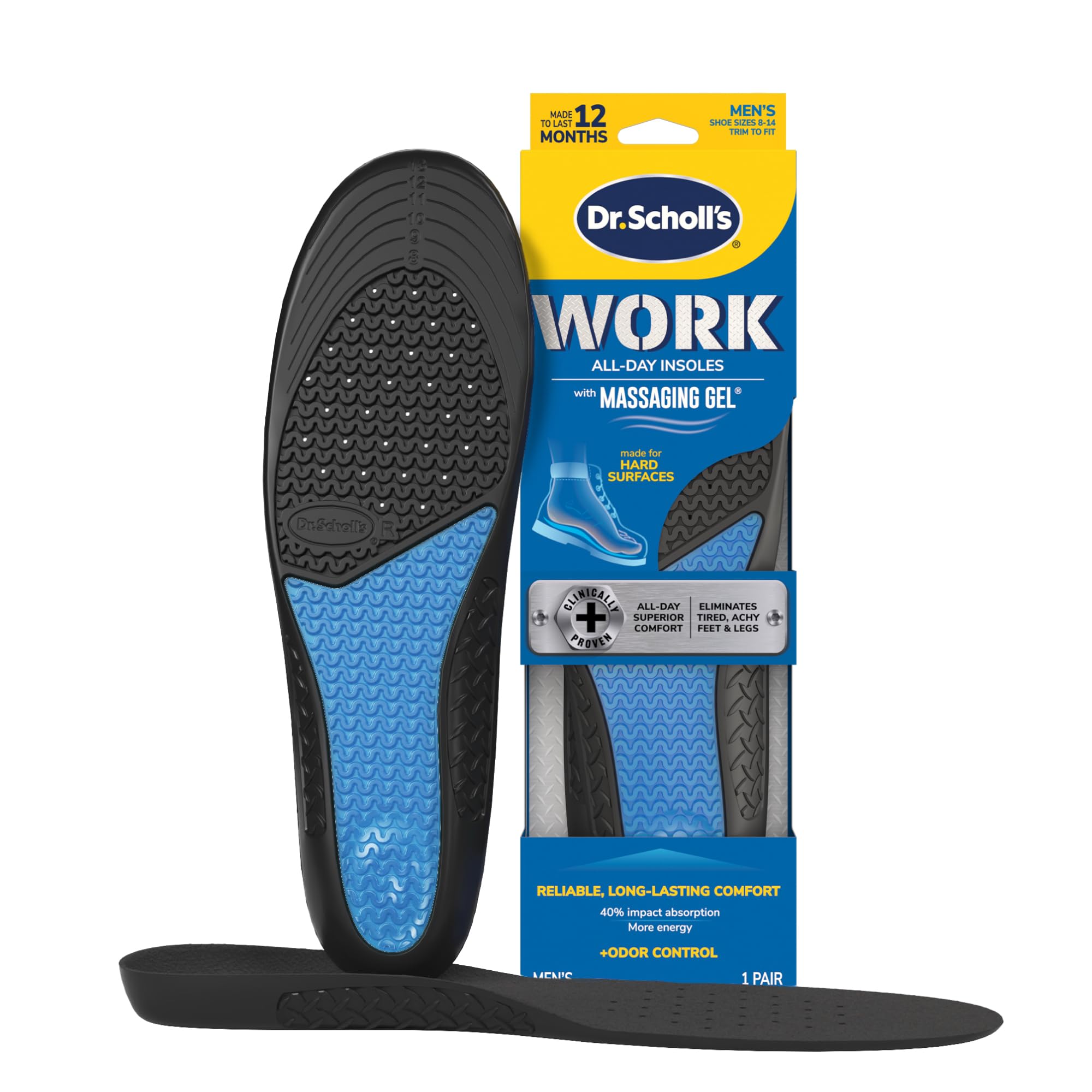
Dr. Scholl’s Work All-Day
Key Features
- Fit: Trim to fit
- Count: 1 pair
- Cushioning: Massaging gel
- Odor control: Polygiene StayFresh
- Price: Budget
The Dr. Scholl’s Work All-Day is the comfort-first pick: a massaging gel layer, a trim-to-fit shape, and Polygiene odor control for workers who spend the day in hot boots. We like it as a low-cost reset for tired feet, not as a fix for a fallen arch.
The gel is soft under the heel and forefoot, and that is exactly what makes it appealing after a long shift on concrete. It is not an orthotic. If your boots already have a decent arch and your complaint is ache rather than collapse, the cushioning is the point. If you need serious arch support, this one will feel flat.
Polygiene is a genuine plus in work boots, where moisture and smell build up fast. The trim-to-fit sheet is forgiving, but take the time to trace your old insole; a ragged cut can curl at the toe.
Against the Heavy Duty Support, this is the softer, lower-cost answer for someone whose feet ache but whose arches are basically fine. It is also the easier one to swap into a pair of boots that do not have much spare depth. The gel is the reason it stays in the rotation.
Pros
- Massaging gel cushioning
- Polygiene odor control
- Budget-friendly trim-to-fit pair
Cons
- Cushioning can flatten over time
We like the Dr. Scholl’s Work All-Day as a low-cost comfort reset for aching feet in hot boots, provided you do not need serious arch correction.
Best for Boot Replacement
Timberland PRO Anti-Fatigue
Key Features
- Type: Replacement insole
- Boot line: Timberland PRO
- Department: Men
- Technology: Anti-fatigue
- Price: Midrange
The Timberland PRO Anti-Fatigue insole makes the most sense when the original footbed in a pair of work boots has gone flat and you want the cushion back without buying new boots. It is a replacement insole first, an orthotic second.
The anti-fatigue foam has a soft, gel-like feel underfoot, and that is what makes it noticeable on hard floors. It is a replacement insole, so remove the old footbed before fitting it rather than stacking the two; the point is to restore the boot’s cushion, not to add a second layer.
We think it is a good buy for someone who likes a cushioned boot and does not need a firm arch. The arch support is modest, and the softness is the reason to choose it. For a Timberland PRO owner who just wants the comfort back, it is an easy match.
It is not the cheapest way to add cushion, and the value depends on how much life it adds to the boots. If the uppers are still solid, that trade can make sense; if the boots are done, put the money toward the boots.
Pros
- Soft anti-fatigue cushioning
- Replacement shape for work boots
- Restores cushion to worn boots
Cons
- Thick profile can crowd snug boots
- Narrow shape may pinch wide feet
Choose the Timberland PRO Anti-Fatigue when you want to bring a flattened work boot back to a soft, cushioned feel without buying new boots.
Best for High Arches
CRUVHEAL 220+ Orthotic
Key Features
- Warranty: 1-year support
- Arch height: 1.4 inches
- Weight support: 220+ lbs
- Heel cushioning: Shock-absorbing gel pads
- Price: Midrange
The CRUVHEAL 220+ is built around a 1.4-inch arch and a weight rating that starts where most comfort insoles stop. For a heavy worker with high arches or plantar fasciitis, that combination is more useful than another soft gel pad.
We think it is the best value in the heavy-duty corner of this group. The arch is strong and the heel gel takes the edge off hard floors, while the one-year support promise gives you a reason to try it in a work boot rather than a casual shoe.
Sizing is the part to get right. The insole uses a size chart and a 1.4-inch arch, so check length against your boot’s removable footbed before you trim. A high-volume insert in a tight work boot can push your foot up into the steel toe, which is the opposite of the comfort you are buying. Get the length right and the arch lands where it should.
Against the softer work-boot insoles here, it is less about cushion and more about structure. It is not the softest insole in this group, but it is the one we trust to keep its shape under a heavier worker.
Pros
- 1.4-inch arch support
- Rated for 220+ lbs
- Heel gel and one-year support
Cons
- Firm arch needs a break-in period
We recommend the CRUVHEAL 220+ for heavier workers with high arches or plantar fasciitis who want firm support and a defined heel cradle at a midrange price.
Best for Concrete Floors
Spenco PolySorb Heavy Duty
Key Features
- Heel: SpenCore heel pad
- Forefoot: SpenCore crash pad
- Heel cup: Deep heel cup
- Cushioning: PolySorb foam
- Price: Midrange
Spenco’s PolySorb Heavy Duty is the most deliberately engineered insole in this group for the two moments that beat up a worker’s foot: heel strike and toe-off.
The deep heel cup and thick SpenCore heel pad are the parts you feel first; they give the back of the foot a planted feeling. The forefoot crash pad and first-ray drop zone are less obvious, but they are there to smooth the roll from heel to toe rather than let the front of the foot slap down.
We think this is the pick for a worker who spends the day walking on concrete rather than standing in one spot. It has more structure than a gel cushion but less aggressive arch than the PowerStep, so it suits someone who wants shock absorption without a full orthotic feel. The shape is particular: the deep heel cup needs a boot with a compatible heel pocket, and the fit is not as forgiving as a flat gel sheet.
It is a midrange insole, and the engineering justifies the step up from a plain foam pad if you are on your feet all day.
Pros
- SpenCore heel and forefoot pads
- Deep heel cup for alignment
- PolySorb foam cushioning
Cons
- Foam can pack down with heavy daily use
The Spenco PolySorb Heavy Duty is our pick for workers who walk hard floors all day and want heel and forefoot shock absorption without a full orthotic.
Best for Low Arches
KEEN Utility K20
Key Features
- Use: Work shoes or boots
- Size: Men’s 11-12
- Cushioning: K20 Cushion
- Arch support: Low to medium arch
- Price: Midrange
The KEEN Utility K20 is not trying to be a corrective orthotic. It is a cushioned work-shoe insole for low-to-medium arches, and that narrower brief is exactly why it works for some people.
The K20 Cushion has a denser, mat-forming feel than a gel insole; it is the kind of cushion that makes a concrete floor feel less unforgiving without lifting your arch into a new position.
KEEN describes it for work shoes or boots with low to medium arch, and that is the right way to shop for it: this is a comfort layer, not a fit system. If your boot already has a firm orthotic, the K20 is the wrong shape to stack on top.
We think it is a smart pick for the worker who has tried soft gel insoles and found them too squishy. The K20 gives a more planted step and enough cushion to take the edge off, but it will not fix a high arch or replace a proper orthotic. For the right foot, that is a useful middle ground.
Pros
- K20 cushioning for hard floors
- Built for low-to-medium arches
- Work-shoe or boot use
Cons
- Thick profile can crowd tight boots
- Only offered in men’s 11-12
We like the KEEN Utility K20 for low-to-medium arches that want a planted, cushioned work-boot step rather than a corrective orthotic.
Best for Light Workdays
Copper Fit Work Gear

Key Features
- Foam: Dual layer
- Ventilation: Ventilated
- Construction: Triple layer
- Price: Budget
Copper Fit’s Work Gear insole is the budget option that does not feel like a cardboard cutout: a triple-layer build, dual-layer foam, and ventilation channels for hot work boots.
The foam is soft and immediately comfortable, and the ventilated top is a sensible touch for boots that turn into saunas by midday. It is the kind of insole that softens a hard floor without asking you to relearn how to walk.
The trim-to-fit shape is simple to work with, and the price tier makes it easy to try a pair in a second set of boots. That is the appeal: low risk, quick comfort, no orthotic learning curve.
We think it earns a place as a low-cost comfort refresh for lighter workdays, especially as a second pair for boots that already fit well. The ventilation and soft foam are the reasons it stays in the rotation.
Pros
- Triple-layer, dual-foam cushioning
- Ventilated top for hot boots
- Budget price tier
Cons
- Can make a snug boot feel tighter
- Foam may break down with daily wear
The Copper Fit Work Gear is the budget cushion pick for roomy boots, best for mild ache and hot feet rather than deep arch support.
How We Put 14 Pairs of Work Boot Insoles Through Their Paces
We started by gathering every insole marketed for work boots or commonly stuffed into them by people who stand for a living, then filtered by arch height, thickness, size range, and price so the group ran from flat trim-to-fit budget pairs to firm molded supports. That left us with 14 pairs and a roster of testers with different feet, different boots, and different jobs.
Each pair went into a real rotation: 10-hour shifts on concrete, standing at a workbench, warehouse aisles, Saturday yard work, and evening dog walks. We measured every insole with calipers before trimming and again at the three-month mark, then had testers trim to fit and report whether the insole slid forward, bunched at the toe, or lifted the heel enough to cause slip. Anyone who had to loosen their laces got written down, because thickness is the thing that quietly wrecks an otherwise good fit.
At the two-hour, six-hour, and ten-hour marks, testers noted where they felt pressure and whether anything ached that hadn’t before. We pressed a thumb into each arch to see how fast it flattened and watched whether it stayed put under a full day of weight. At three months and again at six, we pulled the liners out and looked for compressed foam, cracked gel, separated fabric, and heel cups worn thin. Value got judged by price divided by the months a pair stayed comfortable, not by the sticker — a couple of inexpensive insoles outlasted pairs costing several times more.
How to Choose Insoles for Work Boots
The right work-boot insole is the one that matches your arch, fits inside the boot without stealing toe room, and survives the hours you actually work.
Match the arch support to your foot
Arch support is the first fork in the road. A firm orthotic with a defined arch and a deep heel cup, like the PowerStep Pinnacle Maxx, gives a flat or collapsing arch something to push against. A softer cushion such as the Dr. Scholl’s Work All-Day is better for feet that ache from impact but do not need correction.
Be honest about the problem. If the pain sits under the arch or in the heel after a shift, start with structure. If the whole foot just feels tired and the boot itself fits well, cushioning is the better spend. A low-to-medium arch worker may prefer the planted feel of the KEEN K20 over a firm orthotic.
Fit the insole to the boot, not just the shoe size
Work boots are less forgiving than sneakers. A high-volume insole can lift your foot enough to crowd the toe box, especially in a steel-toe boot. Remove the factory footbed before adding a replacement, and check that your toes still have room to move without rubbing the front or the cap.
Trim-to-fit models are useful, but cut conservatively. Trace the original footbed, cut slightly outside the line, then test and trim in small steps. The Dr. Scholl’s Heavy Duty Support and Timberland PRO Anti-Fatigue are both substantial inserts, so they suit a roomier boot better than a close-fitting one.
Choose cushioning for the way you work
Standing in one spot and walking all day put different demands on an insole. For standing, a soft gel or foam under the heel and forefoot takes the edge off hard concrete. For walking, heel Strike and toe-off matter more, which is where a design like the Spenco PolySorb Heavy Duty earns its place.
More cushion is not automatically better. A very soft insole can feel great in the first hour and then pack down, while a firmer insert may feel odd at first but keep its shape. Think about the surface, the hours, and whether you are mostly standing or covering ground.
Weigh durability, body weight, and value
Heavier workers should pay more attention to the weight rating and the firmness of the support. A 220-plus-pound insole such as the CRUVHEAL is built to hold its shape under more load, while a basic gel pad may flatten sooner. That does not make the gel pad useless; it makes it a shorter-term comfort buy.
Value is about cost per comfortable shift, not just the shelf price. A premium orthotic can be the better deal if it keeps its arch for a year, while a cheap pair that flattens in a month is false economy. Replace any insole once the arch collapses or the heel cushion feels flat.
Frequently Asked Questions
Can I use work-boot insoles in hiking boots?
Usually, if the hiking boots have a removable footbed and enough volume. Work-boot insoles tend to be thicker and more supportive, so check the heel pocket and toe room before trimming. A boot-specific cushion like the Timberland PRO or KEEN K20 is the easier crossover; a firm orthotic needs more room.
How do I trim a trim-to-fit insole without ruining it?
Trace your boot’s original footbed, cut slightly outside the line, then test and trim in small increments from the toe. Never cut the arch side or the heel cup. A clean, slightly large fit is easier to live with than a short insole that slides forward.
How do I keep new insoles from sliding around in my work boots?
Start with a dry boot and a clean footbed, and make sure the old insole is out. A trim-to-fit insert should sit flat without curling at the edges. If it slides, give it a short test walk before a full shift and reset it; a strip of double-sided tape can hold a trial fit, but a proper fit should not need it long term.
Final Verdict
For most workers, we recommend the PowerStep Pinnacle Maxx: it gives the firm arch and heel support that soft gel insoles cannot, and it is the pair we trust when arch or heel pain is the reason for buying. If you are a heavier worker who wants a work-boot-specific fit at a lower price tier, choose the Dr. Scholl’s Heavy Duty Support; if cushion is the only goal, the Work All-Day is the easier spend. The deciding question is whether you need correction or comfort.