This post contains affiliate links. We may earn a small commission when you buy through our links — at no extra cost to you.
Around mile eight of a rocky descent, my feet started filing complaints. The boots were fine — they’d carried me through plenty of hikes — but the flimsy insole that came in the box had flattened into something closer to cardboard. Stock insoles are essentially spacers, there to fill the bottom of the boot until you decide you want real support. A proper pair changes where pressure lands under your foot, holds your arch up on the downhills, and can turn a boot that leaves you hobbling at the trailhead into one you can wear all day.
I’ve since pulled the factory insoles out of every pair of boots I own. Over the past six months, my team and I have hiked in 14 pairs of insoles, from thin foam inserts to rigid, structured ones with deep heel cups. One thing nobody tells a first-time buyer: thickness isn’t free. A quarter inch of extra cushion can make a snug boot tight across the toes, so think about the volume you actually have to work with before you go thicker. The picks below were chosen with that in mind.




Best for All-Round Hiking
PowerStep Pinnacle
Key Features
- Sizing: Men 12-13, sized to fit
- Cushioning: Dual-layer
- Item weight: 2.4 oz
- Arch support: Firm, structured
- Price: Premium
Firm is the whole argument for the Pinnacle. The arch is molded to hold a shape rather than flatten under it, which is what we want when a boot is carrying weight down a rocky descent: the insole takes the load instead of your midfoot. Underneath that shell sits a dual layer of cushioning, so the heel still gets some give on impact without the arch folding with it.
Numbered sizing is the other thing we appreciate. There is no trim-to-fit blank and no scissors work, so the arch lands where it was designed to sit. The requirement is a boot whose factory footbed lifts out — most hiking boots qualify, and anything with a glued-in liner does not, so check before you order.
The trade-off is the feel. This is not a soft insole, and the first few miles make that plain; the arch announces itself before it settles against your foot. On rough ground that is a fair exchange, and on pavement it is more support than most people want. If your heel and arch are what ache on the first mile of the morning, this is the shape in this group built most directly around that.
Small thing worth knowing: PowerStep backs the pair with a 30-day money-back guarantee, which takes most of the risk out of trying a firm insole for the first time.
Pros
- Firm molded arch that holds under load
- Numbered sizing, so no trimming mistakes
- Cushioned heel softens impact
- 30-day money-back guarantee
Cons
- Takes up room in a snug boot
- Needs a boot with a removable footbed
Our default pick for hiking: a firm, shaped arch and heel cup that hold up under a loaded pack, in any boot with a removable footbed.
Best for High Arches
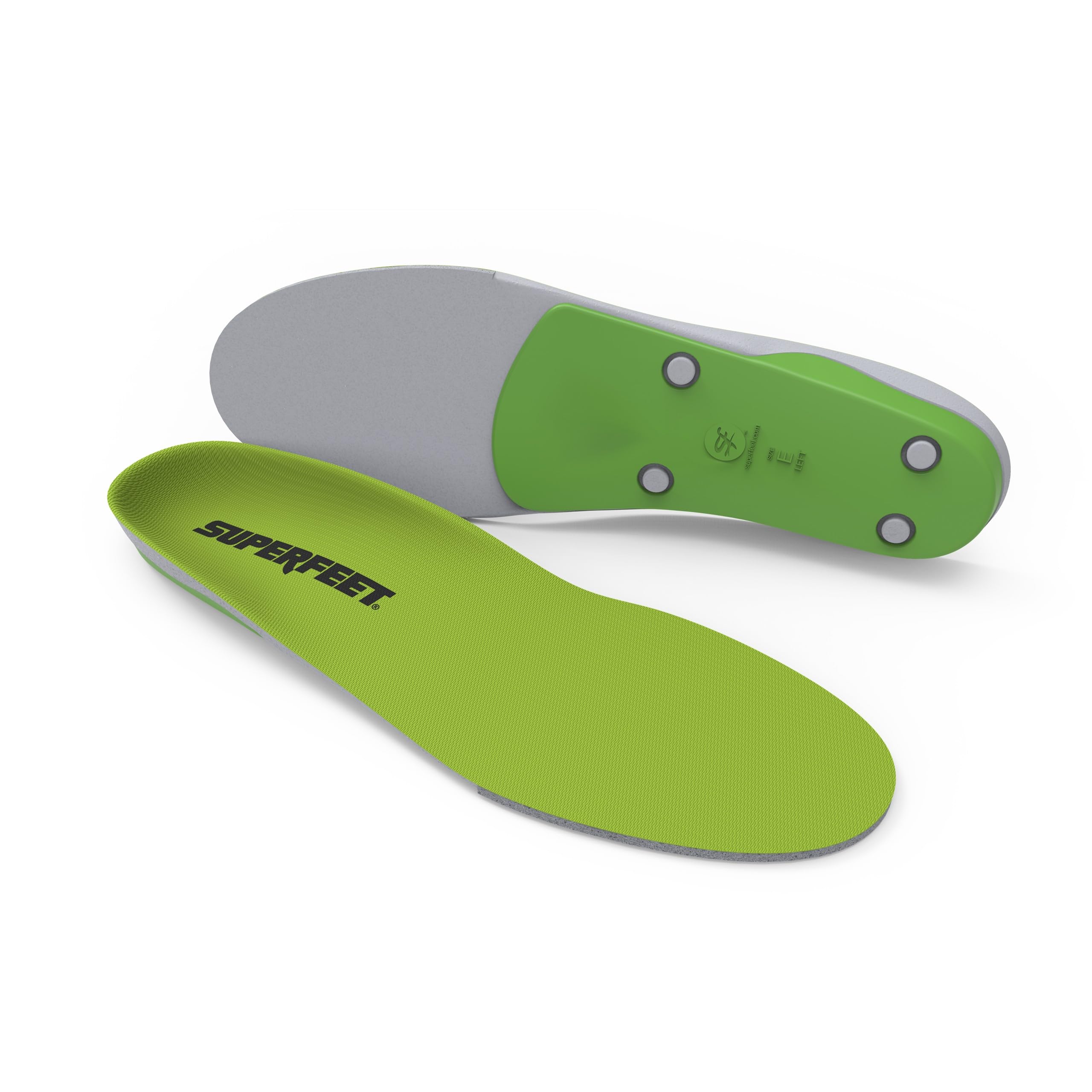
Superfeet Green
Key Features
- Top cover: Moisturewick
- Item weight: 3.03 oz
- Arch profile: High
- Designed for: Roomy footwear
- Price: Premium
High arch, roomy footwear — the two conditions Superfeet names for the Green are the two that decide it. This is the most aggressive shape in the group: a deep, sculpted heel cup and an arch that pushes up hard under the midfoot rather than easing off. In a big leather boot with space around the foot, that reads as structure. In a snug trail runner, it reads as a lump under the instep.
We like it best in exactly the boots that need the help — flat stock footbed, midsole gone soft. The closed-cell foam does not pack down the way a soft insole does, the Moisturewick cover keeps a sweaty foot from feeling slick against the boot, and the density that makes the first mile feel severe is the density that keeps the arch from collapsing after months of use. On durability, it is near the top of this set.
Trim-to-fit is the fussy part, and placement matters more than length: trace the old footbed and cut inside the line, because a short cut slides the arch back under your heel. Width is the other thing to weigh — it runs narrow, and a wide forefoot will feel the edges. Get the cut and the profile right and it is the longest-lived pair here.
Pros
- High, firm arch built for roomy boots
- Closed-cell foam keeps its shape
- Moisturewick top cover
- Sculpted heel cup cradles the heel
Cons
- Too much arch for medium or low feet
- Runs narrow for wide forefeet
We recommend these for a genuinely high arch in a roomy boot — the shape is uncompromising, and that is exactly why it works on rough ground.
Best for Medium Arches
Superfeet Blue
Key Features
- Fit: Full length, trim-to-fit
- Heel: Deep heel cup
- Item weight: 4.8 oz
- Arch profile: Medium
- Price: Premium
Same maker, milder shape. Where the Green drives hard under the midfoot, the Blue sits closer to a neutral arch and fills the full length of the shoe, which makes it the safer first purchase if you have never worn a molded insole. It is the pair we suggest to someone who says their boots are fine until about the fourth hour.
The stabilizer cap does the quiet work: a firm rail under the heel and arch that resists rolling inward as you land. On long, flat approaches, where a soft footbed lets the foot pronate step after step, that rail is the difference between arriving fresh and arriving sore.
Comfort is the pleasant surprise. Of the two Superfeet here, this is the one that feels broken in on day one, and the full-length fit means no trimmed edge under your toes. Fit is still the weak point: it is a template you cut yourself, and a wide forefoot ends up pressed against the sides. If you do not know your arch type, start here and change only if the arch feels like it is in the wrong place.
Pros
- Medium profile suits most feet
- Stabilizer cap resists inward roll
- Full length with a deep heel cup
- Holds up over a long season
Cons
- Runs narrow through the forefoot
We point most hikers here: a medium arch and full-length fit that suit ordinary feet and most hiking shoes without the Green’s demands.
Best for Cushioned Comfort
Sof Sole Athlete
Key Features
- Use: Running, walking, gym
- Cushioning: Heel to toe
- Construction: PU foam and gel
- Price: Midrange
Cushioning is the entire pitch, and it is a different pitch from everything above. Sof Sole builds the Athlete from PU foam with a gel layer running heel to toe, so the whole footbed gives underfoot rather than just the arch. Nothing here is trying to correct anything; the job is absorbing impact.
We used these where impact is the complaint rather than collapse — packed trail, gravel roads, the steady pounding that leaves your heels sore instead of your arches tired. Late in a long day is where they earn their keep: the foam is still doing something when a stock footbed has long since flattened.
Thickness is the catch, and it is not a small one. This is a bulky insole, and in a boot that was already close-fitting it lifts the foot and crowds the toes. A snug trail shoe is the wrong home for it; a roomy boot with a removable footbed is the right one.
Wear is the second caveat, and the reason it is not higher up this list. The forefoot cover tends to break down before the rest of the insole shows anything, so check the ball of the foot rather than the heel when you are deciding whether a pair has had it. For moderate ground and a foot that wants softness over correction, that is an acceptable trade.
Pros
- Cushioning runs the full length
- Softens hard, repetitive ground
- Drops into most roomy boots
Cons
- Bulky enough to crowd a close-fitting boot
If impact is the problem rather than collapse, we hand you this one — foam and gel under the whole foot, for boots roomy enough to take it.
Best for Budget Support
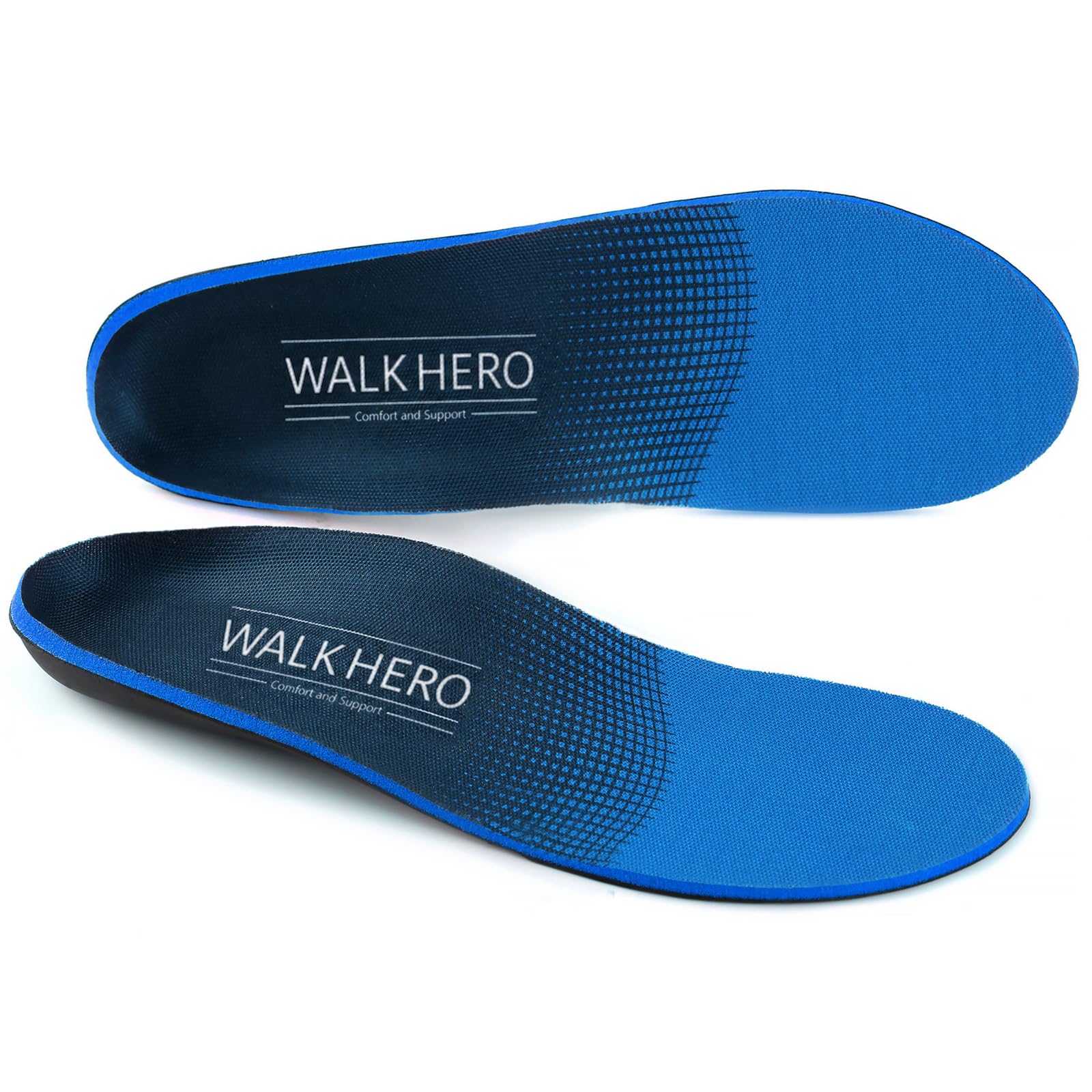
WalkHero Arch Support
Key Features
- Heel: Deep heel cup
- Material: EVA
- Item weight: 3.53 oz
- Designed for: Wide, high-volume shoes
- Price: Midrange
The support here is not a token gesture, which is what makes the price position interesting: a molded EVA shell, a contoured arch, a deep heel cup, and a firmness that holds its shape instead of squashing flat. It is the low-risk way to find out whether structured support helps your feet at all.
That firmness is the whole character of the insole. The arch is pronounced and the foam does not give much, which suits a boot carrying a pack and feels unforgiving in a light shoe on pavement. These are built for wide, high-volume footwear, so a snug boot turns the extra material into pressure across the top of the foot.
Two things to plan for. In a roomy boot the insole can migrate, especially with the laces loose, so seat it flat and check it after the first mile. And the top cover will go before the shell does — this is a pair you replace when the fabric under the ball of your foot wears through, not when the arch gives up. For occasional hikers and anyone trying a supportive insole for the first time, that is a fair deal.
Pros
- Molded arch and deep heel cup at a low price
- Arch support holds its shape
- Roomy enough for high-volume boots
Cons
- Firm ride suits boots better than light shoes
We see it as the low-risk experiment: real arch and heel structure near the bottom of the price range, if your boots have the volume for it.
Best for Gentle Trails
Dr. Scholl’s Walk Longer
Key Features
- Fit: Trim to fit
- Use: Walking, hiking, standing
- Cushioning: Plush foam
- Price: Budget
Hiking is in the product name, which is worth a raised eyebrow — most insoles sold for walking are cushioning first and support second. These are that, honestly: plush foam with a modest arch and a springy feel under the heel that takes the edge off hardpack and pavement alike.
We reach for them on days when the ground is gentle and the mileage is long — rail trails, fire roads, a whole day standing at a show. What they are not is structure. If your boots are fine except that everything aches by mid-afternoon, these help; if your arches collapse under a pack or you are carrying weight over rough ground, they will not hold you. That is the honest boundary, and near the bottom of this group’s price range it is a fair trade.
Fit is straightforward: the pair trims to the boot’s outline, the foam is soft enough that a slightly rough cut does not press, and they sit still in a laced boot. Expect to replace them sooner than a firm insole — soft foam is soft foam — and buy them knowing that going in.
Pros
- Plush foam softens hard, even ground
- Trims easily to the boot
- Comfortable for hours of standing
Cons
- Modest arch support under a loaded pack
We reach for these on long, gentle days: plush foam and a modest arch, but not the pick for a loaded pack or high arches.
Best for Sensitive Feet
Spenco Polysorb

Key Features
- Heel: SpenCore pad, deep cup
- Material: Polysorb foam
- Item weight: 3.84 oz
- Arch support: Soft
- Price: Midrange
Softness is the point of the Polysorb. The foam is springy rather than firm, the arch is gentle, and there is a SpenCore pad under the heel with a crash pad at the forefoot — cushioning built for feet that find structure uncomfortable rather than reassuring.
The heel is thick, and that is a fit change as much as a comfort one. It lifts the heel slightly and takes up volume, which is fine in a roomy boot and awkward in a low-volume shoe where the ankle rides up and the heel sits differently in the boot’s counter. Width is the other issue: it is a narrow build, and a wide foot will feel the edges.
Its place in this group is the sensitive-foot option — a heel cup and a little arch without the hard shelf under the midfoot that the firm insoles put there. For a walker whose feet bruise easily on gravel, that trade is worth making. Measure the volume first, and buy it for a boot with room to spare rather than your tightest pair.
Pros
- Soft cushioning for sensitive feet
- Heel pad plus forefoot crash pad
- Deep heel cup keeps the foot centered
Cons
- Thick heel changes how the boot fits
- Narrow build for wide feet
We suggest these for feet that find firm insoles punishing: soft, springy foam with a gentle arch, provided your boots have room for a thick heel.
Best for Camp and Casual
Amitataha Memory Foam

Key Features
- Sizes: L (US M: 9.5-12.5/W: 10.5-13.5)
- Material: Memory foam
- Item weight: 4.16 oz
- Arch support: High
- Price: Budget
Memory foam at the very bottom of the price range, and the shape follows: soft, thick and cuttable, with a high-arch claim that reads better on the packaging than underfoot.
The softness is real, and it is genuinely comfortable at first. Drop a pair into stiff boots that have no give left and the difference is immediate; the cut line on the back makes trimming straightforward, the three sizes cover a wide spread of feet, and the top fabric is pleasant against a thin sock.
What memory foam does not do is hold a shape. Under a pack on rough ground it compresses and stays compressed, so the arch you felt on the first day is a suggestion by the end of a long hike. Thickness is the other problem: in anything fitted it crowds the toes, and in a warm boot it runs hot.
So treat it as a comfort patch rather than a hiking insole. We keep a pair for camp shoes, muddy boots and the walk to the trailhead, where the arch barely matters. For the hike itself, put the money toward structure.
Pros
- The least expensive way to add cushioning
- Soft underfoot from the first step
- Cut lines make trimming easy
Cons
- Compresses and loses its arch under load
- Thick enough to crowd a fitted shoe
We treat this as a comfort patch rather than a hiking insole: soft memory foam for camp shoes and easy walks, where the arch barely matters.
How We Tested the Best Insoles for Hiking Shoes
We started with a list of more than 40 insoles sold for hiking and backpacking and narrowed it by looking at what each was actually built to do: arch height options, materials, stack thickness, whether the top sheet was fabric or bare foam, and price. That left us with 14 pairs, which went straight into boots and stayed there for six months.
Testers wore them on loaded day hikes with 25-pound packs, on a three-day backpacking trip, and through a week of errands and dog walks in hiking boots. We swapped pairs between boots of different sizes and widths to see how much trimming each one needed and whether heel slip or a cramped toe box appeared afterward. On descents we noted whether the arch held its shape under weight or flattened out; on climbs, whether the heel cup stopped the foot from sliding. Any hot spots got logged with the mile they showed up.
Three of our testers deal with plantar fasciitis and one has very high arches, so they kept notes on when pain arrived during a hike and when it didn’t. We measured every insole with calipers before testing and again at the end, checking for compressed heels, peeling top sheets, and foam that had gone flat. We also asked whether the price still felt fair after six months of regular use — an insole that lasts two seasons beats a cheaper one that packs out by August.
How to Choose Insoles for Hiking Shoes
The footbed a new boot ships with is a thin liner, not support, which makes replacing it the cheapest change you can make to how a boot feels on a long day.
Match the arch to your foot, not to the marketing
The expensive mistake in this category is buying the highest arch you can find. An insole shaped for a high arch under a medium foot puts a hard ridge under the midfoot, and no amount of breaking in moves it to where it should sit. Check yourself with the wet-footprint test: a broad, nearly complete print suggests a low arch, a narrow band down the outside a high one.
Then buy the profile that matches and judge comfort afterwards. If an insole feels like it is in the wrong place rather than merely firm, it is the wrong insole. The Superfeet range is the clearest illustration here — the Green and the Blue are the same idea in two different profiles, and only one of them will suit your foot.
Decide whether you need structure or cushioning
Firm and soft solve different problems. Structure — a molded arch and a deep heel cup — holds the foot steady when a pack is pushing you around, which is why it suits rough ground and long loaded days. Cushioning absorbs impact, and it is what helps on hard, repetitive surfaces and for feet that bruise easily. Most hikers want a firm arch with a softened heel, which is roughly the PowerStep recipe.
The trap is judging in the shop by squeeze. Plush foam feels wonderful in the hand and compresses under load; a firm insole feels severe and keeps its shape. The firmer the insole, the more it will feel like too much for the first few miles and the longer it will hold its arch.
Check the volume before anything else
Every insole takes up space inside the boot, and boots are built around the footbed they ship with. Take the stock footbed out and compare it with the replacement before you cut anything; if the boot has no removable footbed, an insole generally lifts your heel and crowds your toes instead of helping.
Room to spare means you can wear the bulky, cushioned options like the Sof Sole Athlete or the thick-heeled Spenco. A close-fitting, precise trail shoe points you toward a thin pair you trim yourself. If your toes already brush the front on descents, that is the sign to go thinner, not softer.
Sized or trim-to-fit, and getting the cut right
Sized insoles are the easier purchase: no scissors, and no chance of sliding the arch out of position. Trim-to-fit covers more shoes and stretches across several pairs of boots, but the cut is permanent. Trace the old footbed, then cut inside the printed line and test the fit with the boot laced before you shorten anything — slightly long is recoverable, slightly short is not.
Placement matters more than length. The arch has to sit under your arch, not under your heel, which is why a careful trace of the original footbed beats a quick freehand trim every time.
Frequently Asked Questions
Can I move one pair of insoles between boots?
Only if the boots fit the same way. A sized insole travels reasonably well between two pairs of the same size, but a trim-to-fit pair belongs to the boot it was cut for, and moving it into a wider or longer shoe slides the arch out of position.
If you hike in two pairs regularly, a second set is the better answer — most of these cost less than a single lift ticket.
How do I know when to replace them?
Look at the ball of the foot and the heel pad rather than the arch. A worn-through top cover, a heel pad that stays flattened after a day out of the boot, or an arch you can push flat with a thumb all mean the pair is done.
Firm closed-cell insoles hold their shape much longer than soft foam, which is most of what the premium price buys.
My boots already feel supportive — do I need new insoles?
Press a thumb hard into the arch of the boot’s own footbed. If it bottoms out against something hard, an insole adds real material between you and the midsole. If the stock footbed is already shaped and cushioned, a replacement mainly buys you a different arch profile or a fresh top cover.
In that case, spend the money only if something is actually bothering you on the trail.
Final Verdict
The PowerStep Pinnacle is where most hikers should start: firm enough to hold an arch under a pack, shaped well enough to matter on a rocky descent, and sized rather than trimmed so there is nothing to get wrong. It asks for a boot with a removable footbed, which most hiking boots have.
If your arches are genuinely high and your boots are roomy, the Superfeet Green is the better shape and the longer-lived one. If impact rather than support is the complaint, the Sof Sole Athlete’s foam and gel are the softer answer, in a boot with space to spare.