This post contains affiliate links. We may earn a small commission when you buy through our links — at no extra cost to you.
The insole that comes in a new pair of hiking boots is there to cover the stitching, not to carry you down a mountain. Swap it for something with real structure and the same boot suddenly holds your arch, stops your heel from sliding on descents, and eases the hot-spot burn under the ball of your foot. It’s the least glamorous upgrade in hiking and the one that pays off fastest. Over the past six months, my team and I have put 14 pairs of insoles through actual trails, long days on our feet, and more than a few sore Monday mornings.
Here’s what surprised me: the softest, squishiest pair in the box is rarely the one that saves your feet. Cushion feels lovely for the first hour and then flattens, which is why firmness and genuine arch support matter far more than plushness. Fit matters most of all, since a thick insole eats room in a snug boot and pushes your toes forward on every downhill. Below are the ones that earned a permanent place in our boots, sorted for different feet and different kinds of miles.



Best for All-Around Hiking
PowerStep Pinnacle
Key Features
- Fit: Full length
- Cushioning: Maximum, dual-layer
- Shoe types: Athletic, walking, work, casual
- Arch support: Contoured
- Price: Premium
The Pinnacle is the insole we recommend first for most hiking boots because it gets the balance right: a contoured arch under the midfoot, a full-length base that supports the whole foot, and dual-layer cushioning that takes the sting out of long descents. We prefer that combination to a soft gel pad that feels nice in the store and collapses under a pack. It also has the strongest case here for heel and plantar fasciitis relief, which matters if your hiking day starts with a tender first step.
Full length matters in a hiking boot. The Pinnacle replaces the whole stock footbed, so your forefoot is not left on a thinner, older layer while the heel gets all the attention. The arch is supportive without feeling like a hard ridge, and the top cloth is smooth enough to work with a hiking sock. In our testing, that full-foot coverage was the detail that made the Pinnacle feel more planted than a half-length insert.
The caveat is volume. The Pinnacle is a substantial insole, and in a boot that is already snug you may feel your instep press against the tongue. That is the point at which we point hikers to the PowerStep Original. In a roomy boot with a removable footbed, the Pinnacle is the one we keep coming back to.
Pros
- Balanced cushioning and contoured arch support
- Full-length coverage for the whole foot
- Strong case for heel and plantar relief
Cons
- Firmer than soft gel insoles
For most hikers, the Pinnacle is the insole we recommend first: it balances arch support and shock absorption better than anything else here.
Best for High Arches
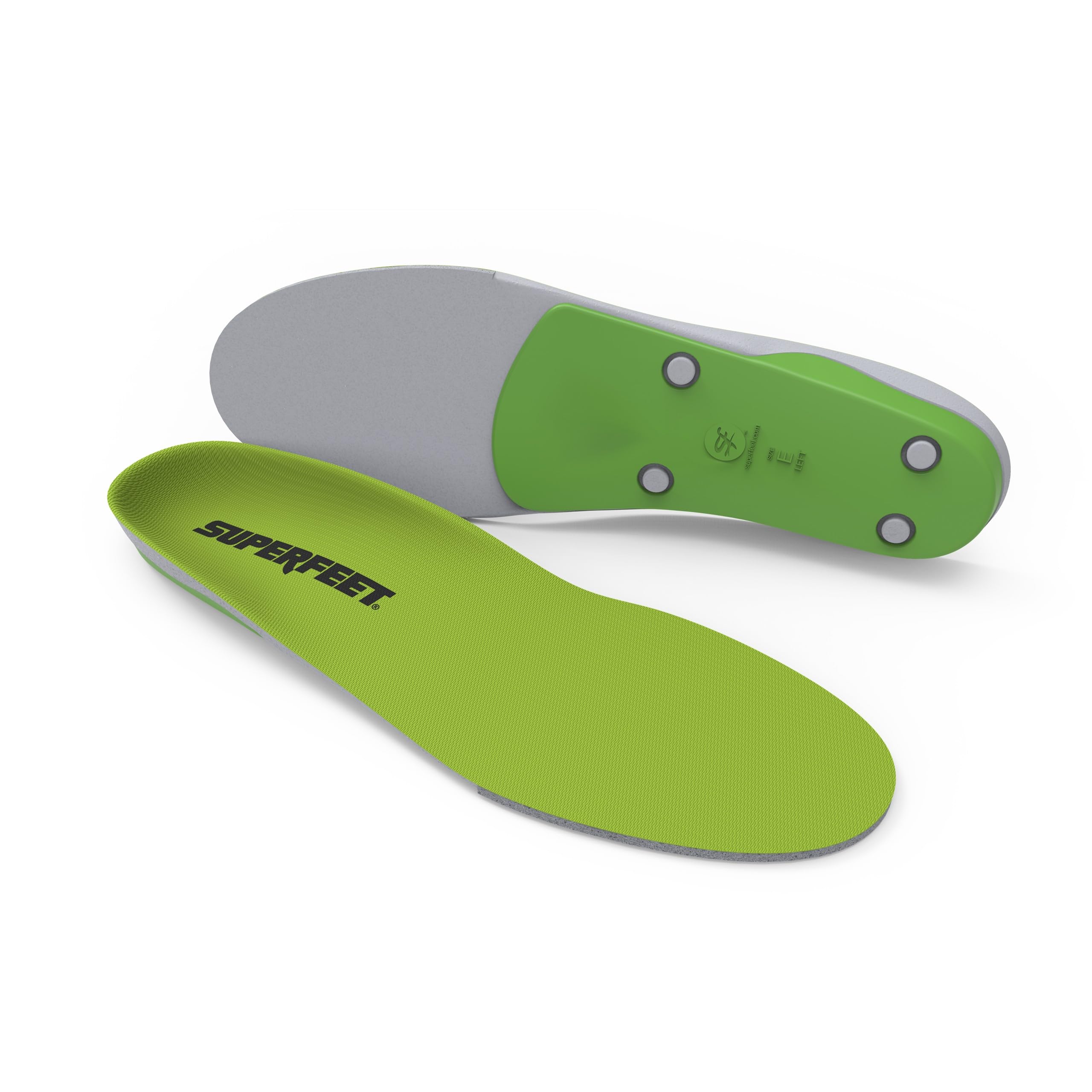
Superfeet Green
Key Features
- Heel: Sculpted heel cup
- Top cover: Moisture-wick
- Arch support: High
- Construction: Closed-cell foam
- Price: Premium
The Green is the high-arch specialist in this group. Its arch is pronounced, its heel cup is deeply sculpted, and the closed-cell foam is built to hold shape rather than squish away after a few miles. We recommend it for hikers who know they like firm, positive support under the midfoot and who have a boot with a removable footbed.
What we appreciate most is the heel cup. In a hiking boot, a deep cradle helps the heel settle instead of sliding, and that is the kind of stability that matters on uneven ground. The moisture-wick top cover is a sensible touch for sweaty feet. This is a support-first design, and the shape is the reason it earns a place.
For the right foot and the right boot, the Green is one of the most purposeful hiking insoles here. It pairs best with a boot that has room over the instep and a footbed you can pull out, because the Green needs space to sit flat. If you want a softer ride, the Pinnacle is the easier place to start. The Green asks you to commit to its arch, and that is exactly why some hikers keep coming back to it.
Pros
- Pronounced high arch for firm support
- Deep heel cup helps center the foot
- Moisture-wick top cover
- Closed-cell foam holds its shape
Cons
- High arch is too much for low arches
If your boots are roomy and your arches are high, the Green is the pair we point you to for firm, supportive control.
Best for Snug Boots
PowerStep Original
Key Features
- Heel: Deep heel cradle
- Profile: Low-profile full length
- Shoe fit: Tighter-fitting shoes
- Arch support: Neutral, contoured
- Price: Midrange
The Original is the low-profile member of the PowerStep pair, and that shape is the reason to choose it. It is a full-length insole made for tighter-fitting shoes, with a neutral contoured arch and a deep heel cradle. In a hiking boot that already hugs your foot, it adds support without turning the fit into a squeeze. The full-length shape also means you trim the toe, not the arch, so the support stays where it belongs.
We reach for the Original when the boot has a snug heel and a low instep. The neutral arch is less aggressive than the Green’s high arch, so it suits more feet, and the full-length base keeps the forefoot from sliding onto the stock footbed. The arch is designed to hold its shape under a pack, which is the job we want it to do. The top cloth is simple and low-bulk, which helps in a tight boot.
For hikers who need the lower profile and a more neutral arch, it earns its place. It is the pair we recommend when the boot, not the trail, sets the limit. If you have room to spare and want a softer, more cushioned ride, the Pinnacle is the better match.
Pros
- Low-profile shape fits snug boots
- Neutral arch suits more foot shapes
- Full-length base supports the forefoot
Cons
- Firm feel may need a break-in
Buy the Original if your hiking boots are already snug and you want support without extra bulk.
Best for Budget Cushioning
Dr. Scholl’s Sport
Key Features
- Fit: Men’s trim-to-fit
- Use: Athletic activities
- Support: Flexible side-to-side
- Cushioning: Shock absorption
- Price: Budget
The Sport is our budget pick, and it earns that role by being lighter and more flexible than the orthotic-style insoles here. You get shock absorption under the heel and a flexible side-to-side feel that suits athletic shoes and roomy hiking boots. We recommend it for hikers who want a little more comfort than the stock footbed without committing to a firm, high-arch insert.
What we found is that the Sport works best as a comfort upgrade rather than a corrective device. The arch is supportive without being a hard ridge, the top layer is soft, and the insole does not take over the boot. That makes it a good match for casual trails, dog walks, and boots that already fit well. It is also easy to trim into a men’s boot because the shape is not as deeply contoured as the PowerStep or Superfeet.
The Sport is not the pair we choose for a heavy pack or a long, rocky descent. The cushioning is there, but it is a comfort layer rather than a firm orthotic, and the arch support is more moderate. For the hiker who wants a budget-friendly upgrade for easier days, that is a reasonable trade. If you need maximum support, the Pinnacle is the better match.
Pros
- Flexible, lighter feel in the boot
- Heel shock absorption for easier trails
Cons
- Can wear out with heavy use
The Sport is our budget pick for hikers who want a lighter, more flexible insole for easier trails.
Best for Heavy Hikers
VALSOLE Heavy Duty
Key Features
- Use: Work boots
- Cushioning: Shock-absorbing
- Arch support: High
- Support level: Heavy-duty, 220+ lbs
- Price: Midrange
The VALSOLE is built around a 220-pound-plus brief, and that is the first thing to understand about it. The high arch and thick, shock-absorbing build are meant for heavier hikers and high-volume boots, not for someone looking for a barely-there insert. We recommend it when the stock footbed feels like it is bottoming out under a pack.
We were impressed by how much support the high arch provides for the price tier. It gives the midfoot a solid shelf and keeps the heel centered, which is the combination that makes a heavy load feel less punishing. The shape is also generous through the forefoot, so it suits work-style and roomy hiking boots better than a low-profile trail shoe.
The trade-off is bulk and sizing. This is a thick insole, and in a snug boot it can crowd the toes or lift the heel. The sizing can also run short, so check the length against your boot’s footbed before you trim. We wish the fit were more consistent, because the support is there. For a high-volume boot and a heavier hiker, it is still a strong budget-conscious choice.
Pros
- Heavy-duty support for 220+ lb hikers
- High arch with a centered heel
- Shock absorption for loaded packs
Cons
- Firm underfoot for some feet
Heavier hikers and high-volume boots are where the VALSOLE makes the most sense, with a high arch and heavy-duty support.
Best for Budget Arch Support
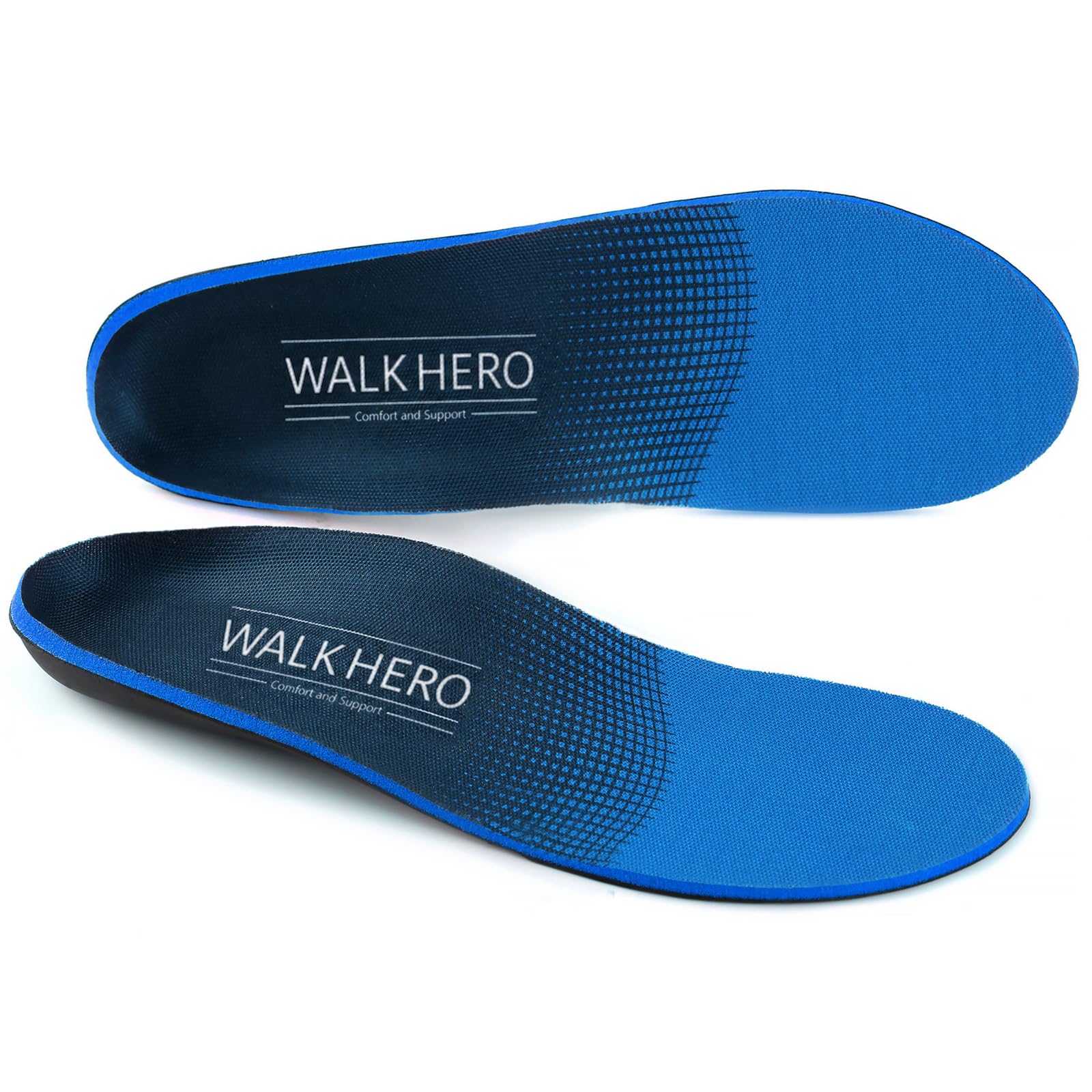
WalkHero Plantar Fasciitis
Key Features
- Heel: Deep heel cup
- Material: Premium EVA
- Shoe fit: Wider, high-volume shoes
- Arch support: High
- Price: Budget
The WalkHero is the budget arch-support pick. It puts a high arch and a deep heel cup into an EVA insole that costs far less than the premium orthotics here. We recommend it for hikers who want a pronounced arch and do not want to pay premium prices for it. It is designed for wider, high-volume shoes, so it makes the most sense in a roomy boot.
The high arch is the main event. It gives the midfoot a clear shelf, and the deep heel cup helps keep the foot centered when you are carrying a pack. The EVA material is firm enough to hold its shape, which is what you want from an arch-support insole. It is not a soft, squishy comfort layer, and that is the right call for this design.
The WalkHero works best in a roomy boot with a removable footbed, where the insole can sit down in the bottom of the boot. For the money, it is a capable arch-support option for hikers who prefer a firm ride. If you need a soft landing under the forefoot, this is not the pair; if you want clear arch support at a budget price, it is worth a look.
Pros
- Pronounced high arch at a budget price
- Deep heel cup helps center the foot
- Firm EVA holds its shape
Cons
- Can slide in smooth boot liners
The WalkHero gives budget-minded hikers a pronounced arch and deep heel cup without the premium price.
Best for Wide Heavy Feet
Dr. Scholl’s Heavy Duty

Key Features
- Fit: Men’s 8-14, trim-to-fit
- Use: Work boots and shoes
- Support level: Heavy-duty, 200+ lbs
- Heel cushioning: Extra supportive
- Price: Budget
The Heavy Duty Support is aimed at men over 200 pounds and wide feet, and its extra heel cushioning is the reason to look at it. It is a budget insole for roomy work-style boots, with a shock-absorbing base and a shape that is meant to spread pressure across the foot.
We recommend it for hikers who want a wide, cushioned platform under a heavy pack and do not need the highest arch in the group. The heel cushioning is the standout: it takes the edge off hard footfalls and makes a stiff boot feel less punishing. The full-length shape also keeps the forefoot covered, which is more than some budget insoles manage.
The Heavy Duty works best in a roomy boot with a removable footbed; in a tight boot, the extra volume can make the fit worse. It is also a work-style insole rather than a technical hiking insert, so we see it as a budget option for easier trails and fire-road walks.
For a heavy hiker on a budget, the Heavy Duty Support is still worth a look, especially if your boot is roomy and your main complaint is heel impact. It has a clear place for heavier hikers who want cushioning without a premium price, as long as the boot has room for it.
Pros
- Extra heel cushioning for heavy footfalls
- Budget heavy-duty support for 200+ lbs
Cons
- Runs narrow for wide feet
- Durability varies with heavy use
The Heavy Duty Support is a budget option for wide-footed, heavier hikers who want extra heel cushioning in a roomy boot.
How We Chose and Tested These Insoles
We started by gathering every insole we could find that was built for hiking boots rather than casual shoes, then cut anything that came in only one arch height or one fixed length. Fit is most of the battle here: a pair you can’t trim or size to your boot is a pair you’ll fight with all day. Customer reviews narrowed the field further, especially the complaints about foam that flattened within a month, edges that curled up, and heel cups that squeaked. That left us with 14 pairs, which we tested over six months.
Testing happened where insoles actually live. Every pair went into at least one tester’s hiking boots for day hikes with a loaded pack, long rocky descents, and one memorably wet weekend that we didn’t plan for. We also wore them for standing shifts on a hard floor and on a full travel day, since plenty of people shop for these because their feet ache by mid-afternoon, not just because they bag peaks.
At install, we trimmed each pair with kitchen scissors against the outline of the boot’s stock insole and noted how far off the sizing was, then checked whether our toes still had room and whether the heel cup sat deep enough to stop any lift on a downhill. Hardness got a manual check, a firm thumb press into the arch and heel, repeated after roughly 40 miles to see which foams had packed out. Testers with plantar fasciitis and high arches wrote down where they felt pressure during a hike and how their feet felt the next morning, which is how we judged foot relief and real comfort rather than first-minute softness. Durability was simply a matter of watching edges, top sheets, and smell, and weighing what each pair looked like after six months against what it cost.
How to Choose Insoles for Hiking Boots
The right insole is the one that matches your arch and leaves enough room in the boot; more cushioning is not automatically better.
Match the arch to your foot
A high-arch insole like Superfeet Green puts a noticeable shelf under the midfoot. A neutral contoured insole like PowerStep Original suits flatter feet or anyone who has never worn an arch support. Do not buy the highest arch just because it sounds supportive; a shape that presses in the wrong place will make a long descent miserable. Start with a moderate contour if you are unsure, and give your foot a few short hikes to adjust.
Check boot volume before you commit
A thick insole can turn a comfortable boot into a cramped one. If your boot has a removable footbed, take it out and compare the replacement; the insole should sit flat without lifting your heel or pressing your toes. The Pinnacle is substantial, while the PowerStep Original is deliberately low-profile. Adding a full-length insole on top of a thick stock footbed is the most common way to get a numb toe.
Choose cushioning for the hiking you do
Long descents and loaded packs reward more shock absorption; rocky, technical ground rewards a firmer, more controlled platform. The Pinnacle leans cushioned, Superfeet Green leans firm, and Dr. Scholl’s Sport is a lighter comfort layer. If you mostly walk easy trails, a moderate insole is enough. If you feel every rock through your boots, move up to a more substantial design.
Trim and secure the fit
Most insoles are trimmed at the toe, not the arch. Cut a little at a time, keep the heel and arch intact, and test the fit with the boot laced. An insole that bunches or slides will rub, especially on a long descent. The WalkHero can slide in a smooth liner, so set it flat and check it before you head out. If the insole lifts your heel, it is too thick for that boot.
Frequently Asked Questions
Can I use running-shoe insoles in hiking boots?
Sometimes, but running insoles are usually built for a softer, lower-volume shoe. In a hiking boot, they can feel too narrow or compress too quickly under a pack. Check that the insole sits flat, does not lift your heel, and leaves room for your toes. If you already have a hiking-specific insole, use that instead of borrowing from a running shoe.
How often should I replace hiking boot insoles?
Replace them when the arch feels flat, the foam stays compressed after you step off, or the top cover is cracked or worn through. Heavy pack loads, heat, and daily use shorten that interval; occasional hikers can often get more seasons from a pair. Check them at the start of each hiking season and compare the arch to a new insole.
Are expensive hiking boot insoles worth it?
Premium insoles buy firmer, more consistent arch support and better durability, not automatic comfort. If you hike often with a loaded pack or have heel pain, the extra spend is easier to justify. For occasional easy trails, a budget insole like Dr. Scholl’s Sport can be enough. Match the support to your foot first, then decide how much to spend.
Final Verdict
For most hikers, the PowerStep Pinnacle is the insole we recommend first. It has the best balance here of arch support and shock absorption, and it is the easiest premium pick to live with in a roomy hiking boot.
If you have high arches and a roomy boot, Superfeet Green gives firmer, more pronounced support; if your boot is snug, PowerStep Original is the lower-profile answer. Budget-minded hikers can start with Dr. Scholl’s Sport, but should accept a more moderate arch.