This post contains affiliate links. We may earn a small commission when you buy through our links — at no extra cost to you.
Adjustable ski poles seem practical until the lock slips mid-run or the aluminum bends during a hard plant. The convenience of changing length often comes with a heavier shaft and a weaker joint that fixed-length poles avoid.
Among the few truly telescoping models, two stand out for reliability: one punches above its price point, the other is tailored for women. For skiers who don’t need adjustability, fixed-length poles typically deliver better durability and a lighter swing weight.
Knowing when to trade adjustability for strength is the difference between a pole that lasts a season and one that lasts many. This guide focuses on the two adjustable options with proven track records and signals when a fixed-length pole is the smarter buy.

Best for Female Skiers
Atomic Cloud
Key Features
- Shaft Material: Aluminum
- Weight per Pole: 260g per pole
- Price: $$
The Cloud Poles are built around a women-specific grip and a push-button lock that makes length changes quick and tool-free. At 260g per pole, they’re noticeably lighter than the top pick’s flip-lock alternative — a real advantage for skiers who make frequent pole plants all day. The aluminum shaft handles groomed runs and moderate moguls well, though the push-button mechanism means less clamping force than a flip lock, and a small number of poles have bent during normal use. These are best suited for recreational resort skiing where lightweight feel matters more than extreme durability.
Pros
- Light enough to forget you’re carrying them — noticeable swing weight savings all day.
- Push-button lock adjusts in seconds without fiddling with screws or cams.
- Grip shape and diameter tailored for smaller hands improves control on hardpack.
Cons
- On hard landings or aggressive planting, the shaft can bend — best for moderate use rather than heavy mogul work.
A smart choice for women who spend their days carving groomers and want an adjustable pole that won’t weigh them down — just steer clear of extreme terrain or big air.
Best for Lightweight Seekers
Zipline Blurr 16.0

Key Features
- Shaft Material: Graphite composite
- Grip/Strap: Dual density rubber
- Price: $$
Featherlight graphite composite construction keeps swing weight low for quick pole plants, and the dual-density rubber grip provides a comfortable hold. The fixed 122 cm length means no adjustability – ideal only if you know your exact size. Some poles have shown tip breakage under stress, so careful with aggressive planting.
Pros
- Featherlight graphite composite shaft reduces arm fatigue during long days on the mountain.
- Comfortable dual-density rubber grip provides secure hold even with gloves.
Cons
- Tip may snap under lateral stress in hard snow – best on groomed terrain.
A good fit for skiers who know their exact pole length and prioritize low swing weight over adjustability – but tip durability is worth monitoring.
Best for Budget Skiers
Rossignol Tactic

Key Features
- Shaft Material: Aluminum
- Weight per Pole: 1.1 lbs
- Grip/Strap: Bi-injected
- Price: $
The Rossignol Tactic provides a lightweight aluminum shaft and comfortable bi-injected grip at a budget price – a strong value for resort skiers. Its fixed 120 cm length means it won’t suit those needing adjustability, and occasional manufacturing defects (like handles detaching) are worth checking on arrival.
Pros
- Solid construction at a budget price.
- Lightweight feel reduces arm fatigue during long runs.
Cons
- Fixed 120 cm length – no adjustability for different ski styles or users.
A budget-friendly fixed-length pole for resort skiers who prioritize weight and price over adjustability – inspect the handle for secure attachment.
Best for Women Skiers
Rossignol Electra

Key Features
- Shaft Material: Aluminum
- Weight per Pole: 0.39kg per pair
- Grip/Strap: Women-specific grip
- Price: $$
The Rossignol Electra offers a women-specific grip that dampens vibration and a lightweight aluminum shaft at just 0.39kg per pair – ideal for resort skiing where comfort matters. However, it is a fixed-length pole, so it won’t suit skiers needing on-the-fly length adjustments. Durability under heavy use may be a concern, but for casual groomer days it holds up well.
Pros
- Women-specific grip reduces vibration on hardpack
- Lightweight pair at 0.39kg eases pole plants
Cons
- Some poles may bend under aggressive use – best suited for light resort skiing
For women skiers who prioritize comfort and style over adjustability, and stick to groomed runs, the Electra delivers.
Best for Kids Learning
LEKI Kids Rider

Key Features
- Shaft Material: Aluminum 14mm
- Weight per Pole: 156g (90cm)
- Grip/Strap: Turbo Sport with buckle
- Price: $
LEKI’s Kids Rider offers a proper child-specific grip and lightweight aluminum shaft at a budget price, making it a safe choice for first-time skiers. The fixed-length design suits one season per size, though the thin shaft may bend if a child leans heavily into turns – better suited to light use than aggressive skiing.
Pros
- Child-sized grip and buckle strap designed for small hands
- Budget-friendly price for a dedicated kids’ pole
Cons
- Thin aluminum shafts can bend under pressure from heavier or more aggressive use
Best for young children learning to ski on easy terrain; look for telescoping poles if you need adjustability as your child grows.
Best for Detachable Straps
LEKI Bold Lite S

Key Features
- Shaft Material: Aluminum 16mm
- Weight per Pole: 241g (120cm)
- Grip/Strap: Trigger S SL
- Price: $$$
The LEKI Bold Lite S pairs a quick-release Trigger S strap with a stiff 16mm HTS aluminum shaft at just 241g (120cm) – ideal for skiers who want that detachable safety feature. However, it comes in fixed lengths from 110 to 135cm, so it won’t suit anyone needing on-mountain adjustability for different skiers or terrain changes.
Pros
- Trigger S strap lets you detach quickly from the pole for safety or when using a phone
- Lightweight 16mm HTS aluminum shaft at 241g (120cm) for easy swing weight
Cons
- Fixed length per size – no telescoping or height adjustment
Best for skiers who already know their preferred pole length and want LEKI’s detachable strap system, not for anyone needing adjustable poles.
Best for Travel Storage
K2 Power

The K2 Power poles fold to 50 cm, making them easy to pack for trips. The aluminum shaft and steel tip provide a solid feel for occasional use. However, this is a collapsible design for storage only—not for adjusting pole length. Skiers who need on-mountain adjustability should look elsewhere.
Pros
- Folds to 50 cm for compact storage during travel.
- Aluminum shaft with steel tip offers decent durability for occasional skiing.
Cons
- Folded length of 50 cm may still be too long for some small backpacks.
A good fit for skiers who value travel-friendly storage and occasional use.
Best for Occasional Use
HEAD Multi

Key Features
- Shaft Material: Aluminum
- Grip/Strap: Transparent race grip
- Price: $$
This HEAD pole comes as a pair with a transparent race grip, star tip, and 50mm race basket — solid basics for recreational skiing. The mid-range price is reasonable for a no-frills fixed-length option. However, it lacks adjustability, so skiers needing telescoping poles should look elsewhere. Spec details are sparse, but for casual use this is sufficient.
Pros
- Sold as a pair at a mid-range price.
- Transparent race grip and star tip offer decent control for recreational skiing.
Cons
- Length is fixed — cannot be adjusted for varying terrain or preferences.
For occasional resort skiers who don’t need adjustable pole lengths, this fixed pair works well without overspending.
Best for Emergency Backup
Swix Techlite

The Swix Techlite is the cheapest pole in this set, pairing a 1 lb aluminum shaft with a hardened steel tip. That low price, however, buys a fixed 110 cm length — not the adjustable option you’re after. With limited user feedback and no way to tweak fit, this pole suits only short-notice replacements or skiers who can accept a one-size-fits-most gamble.
Pros
- Hardened steel tip holds up on packed resort snow.
- Lightest price in the set; easy to stash as a backup.
Cons
- Fixed 110 cm length — no way to adjust for height or terrain changes.
Skip if you need telescoping length. Grab only as a cheap last-minute spare if you already know your preferred size.
Best for Premium Feel
Zipline Lollipop

Key Features
- Shaft Material: Graphite composite
- Weight per Pole: ~0.59kg per pair
- Grip/Strap: Dual density rubber
- Price: $$$
The dual-density rubber grip reduces hand fatigue, and the carbide tip provides solid traction on firm snow and ice. The graphite composite shaft keeps the swing weight light, but this pole comes in a fixed length — it cannot be adjusted for different terrain or skier height. Durability is a secondary concern: the finish may chip, and the shaft can bend under repeated hard use. For skiers who know their exact pole length and prioritize grip comfort and precise planting over adjustability, it performs well — but those needing telescoping poles should look at adjustable options.
Pros
- Ergonomic dual-density grip reduces hand fatigue on longer runs.
- Carbide tip provides secure planting on firm snow and ice.
Cons
- Paint chipping and possible bending of the fixed-length shaft under heavy use — worth checking the return policy.
A good pick if you know your exact pole length and value grip comfort and precise planting over adjustability or heavy-duty durability.
Best for Budget Skiers
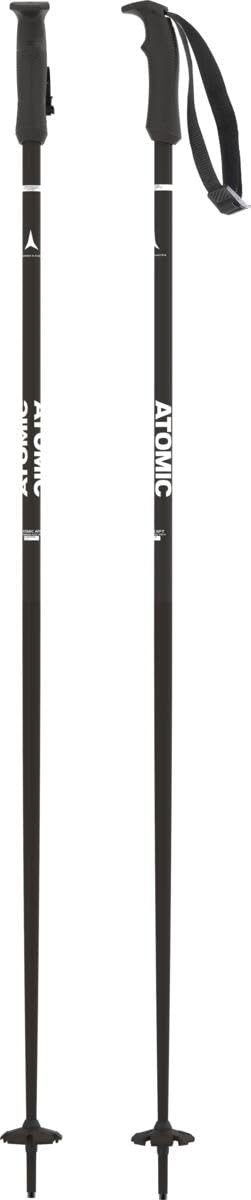
Atomic AMT
The flip-lock mechanism lets you dial in pole length in seconds, and at this price point, it’s a rare find. The aluminum shaft keeps weight manageable for a day on groomed slopes, and the grip offers adequate comfort for casual skiing. For resort use, the build feels appropriate — it’s not meant to survive hard impacts or heavy leverage but handles standard pole plants without issue.
This pole suits skiers who want adjustability for sharing poles or fine-tuning length without spending much. It’s a good match for beginners, occasional resort skiers, or anyone on a tight budget. Durability has shown variance — some poles have bent under normal use, so it’s best kept away from aggressive skiing or backcountry trips where poles take more abuse.
Pros
- Flip-lock allows quick length adjustments on the fly.
- Solid build quality for the price with consistent positive feedback on materials.
- Light enough to carry all day without arm fatigue.
Cons
- Some poles can bend under normal resort use — worth checking the return policy.
For budget-conscious resort skiers who need adjustable poles, the Atomic AMT is a straightforward fit that gets the job done without overcomplicating things.
How to Choose
The most important factor when buying adjustable ski poles is the locking mechanism—it must hold securely, or the adjustability becomes useless.
Adjustability: Telescoping vs. Collapsible
Telescoping poles let you change length mid-run for different terrain, but the locking joint adds weight and a failure point. Collapsible poles (like the K2 Power) fold for storage but do not adjust height—they are fixed-length when assembled.
If you rarely change length, a fixed pole saves weight and avoids the risk of slipping locks. For skiers who shuttle between groomers and powder, telescoping is worth the trade-off.
Shaft Material: Aluminum vs. Composite
Aluminum shafts are heavier but can bend and be straightened; composite shafts (graphite or carbon) are lighter and damp vibration but can shatter on a hard impact. Aluminum is the reliable choice for most resort skiers.
Composite poles excel for all-mountain skiers who prioritize swing weight, but they require careful handling. If you regularly plant poles hard, stick with aluminum.
Lock Mechanism Type
Flip locks are simple and affordable but can loosen over time and need periodic tightening. Push-button locks are more secure and precise but add complexity and a few grams of weight.
For casual use, flip locks are fine; for frequent adjustments or backcountry trust, push-button is the better bet. Check user reviews for lock reliability on any model.
Weight per Pole
Lighter poles reduce arm fatigue but often use thinner aluminum or composite, which can sacrifice durability. The sweet spot for resort use is around 250–300g per pole; anything under 200g is likely fragile.
Ultra-light poles (under 200g) are best for racers or skiers who never hit tree roots. For everyday skiing, a 300g aluminum pole is a safe balance.
Grip Comfort and Strap System
Grip shape and strap length are often overlooked. Bulky gloves need longer straps; many stock straps are too short for mittens. Dual-density rubber grips provide a tacky, comfy hold without hard plastic.
Detachable straps (like LEKI’s Trigger S) are useful for safety and easy removal, but they add cost. If you ski with thin gloves, standard straps work fine.
FAQ
Are adjustable ski poles less durable than fixed-length ones?
Yes, generally. The locking mechanism introduces a weak point, and many adjustable poles use thinner aluminum to keep weight down. If you ski aggressively or plant poles hard, a fixed-length aluminum pole will likely last longer. For casual resort use, modern adjustable poles like the Atomic AMT are durable enough.
How do I know what length of ski pole I need?
Stand upright in ski boots and hold the pole upside down under the basket—your elbow should form a 90-degree angle. For general resort skiing, that length works. Add 5 cm for powder, subtract 5 cm for moguls. Adjustable poles let you experiment, but start with the 90-degree rule.
What is the best lock mechanism for telescoping ski poles?
Push-button locks are more secure and less prone to slipping than flip locks, but they add weight and complexity. Flip locks are simpler and cheaper, but require occasional tightening. For most skiers, a well-maintained flip lock (like on the Atomic AMT) is reliable enough for resort use.
Do lightweight carbon ski poles break easily?
Carbon and graphite composite poles are more brittle than aluminum. A hard sideways impact or a twisted plant can cause a crack that renders the pole unusable. Aluminum will bend but often stays functional. If you ski in rocky terrain or hit trees, avoid lightweight composite poles.