This post contains affiliate links. We may earn a small commission when you buy through our links — at no extra cost to you.
An action camera can let you down in two ways: the battery quits before the summit, or it keeps rolling and hands you five minutes of footage too shaky to watch. Everything else — mounts, apps, menus — only matters once those two are settled. Get them right and a hike, a paddle, or a powder day turns into footage you’ll actually rewatch instead of a card full of clips you’ll never open.
I’ve lost more good light to a dead battery than to bad framing, which is why I read the fine print now: battery ratings get recorded at the lowest resolution with the screen off, and that is nobody’s real shooting day. Picture quality, ease of use, and the accessory ecosystem still decide whether you’ll bother bringing the thing; reliability and connectivity decide whether the footage survives the trip to your phone. Over the past six months my team and I have carried seven cameras up trails, across lakes, and through a lot of rain, and the ones below are the ones that kept recording when the day got good.

Best for All-Round Outdoor Use
DJI Osmo Action 4
Key Features
- Video: 4K 120fps
- Sensor: 1/1.3-inch CMOS
- Weight: 5.11 oz
- Battery: 1770mAh, up to 160 min
- Price: Midrange
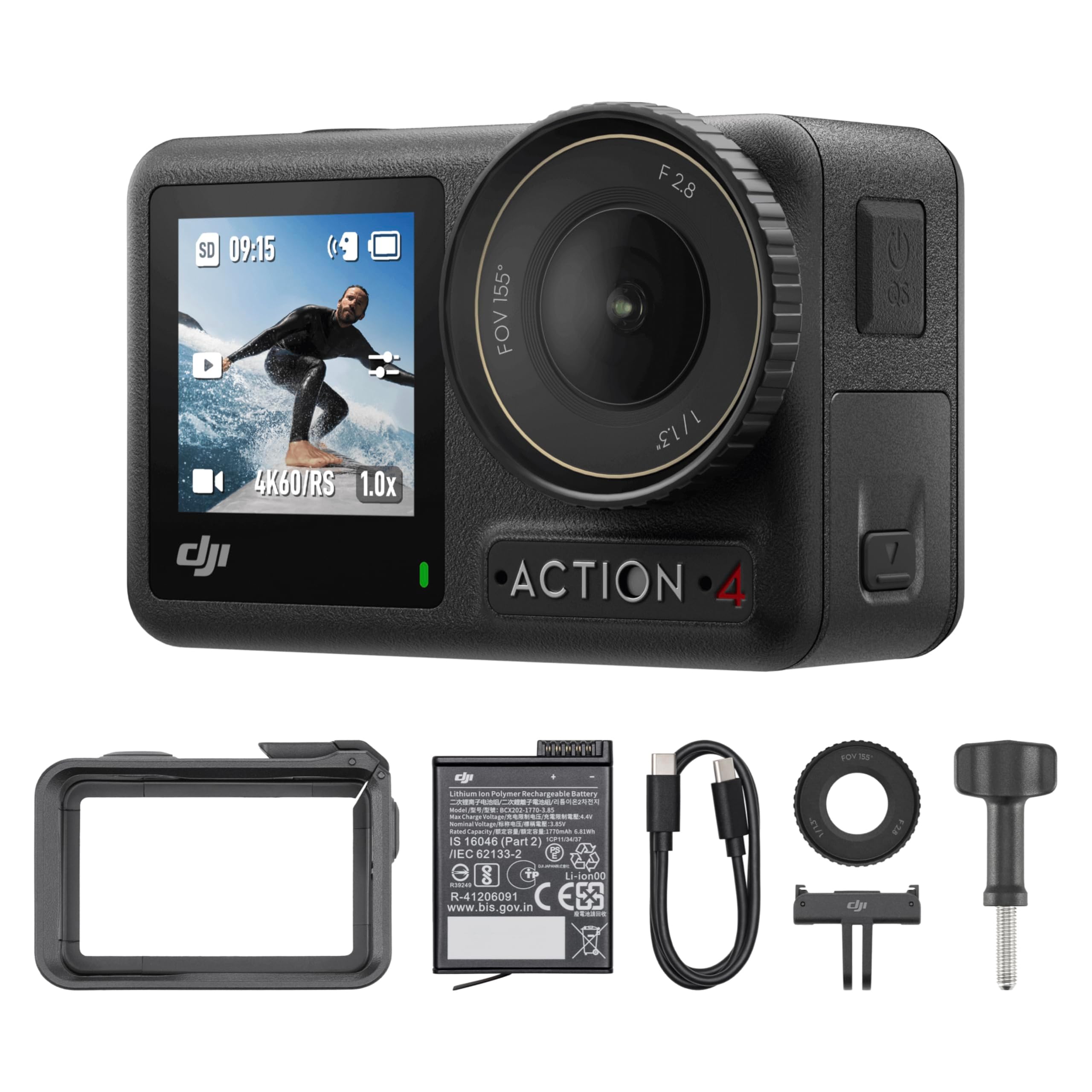
The Osmo Action 6 is the more capable camera on this page, and the Action 4 is the one we recommend to almost everyone. What it keeps is the part that matters outdoors: a 1/1.3-inch sensor that still looks clean at dusk, 4K at up to 120fps, a 155-degree field of view, and stabilization that holds a horizon on a rocky descent. What it gives up is 8K and the variable aperture, which most hikers will never miss.
Two details decided it for us. The first is that it is waterproof without a housing, so there is no case to seal, nothing muffling the microphone, and no latch to fumble at a stream crossing. The second is the magnetic quick-release mount: moving from a chest harness to a helmet takes seconds, which is exactly what you want when the light is going. The battery is rated to keep working at -4°F and listed for up to 160 minutes, so a cold morning does not end the day early.
The friction is setup. Activation and pairing run through DJI’s phone app, so do that at home on Wi-Fi before you leave rather than at a trailhead with one bar of signal. Once it is paired, the touchscreens are quick to live with, the front screen makes framing yourself easy, and 145 grams on a helmet is light enough to forget about.
Pros
- 1/1.3-inch sensor holds color at dusk
- Waterproof without a housing
- Magnetic mount swaps helmet to chest fast
- Cold-rated battery, up to 160 minutes
Cons
- One battery in the Essential Combo
We recommend the Action 4 to almost anyone shopping for an outdoor camera: it is sealed, cold-rated and quick to remount, and the premium model’s extras are ones most hikers never use.
Best for Low-Light Filming
DJI Osmo Action 6
Key Features
- Video: 8K
- Sensor: 1/1.1-inch square
- Battery: 2 × 1950mAh
- Aperture: f/2.0–f/4.0
- Price: Premium
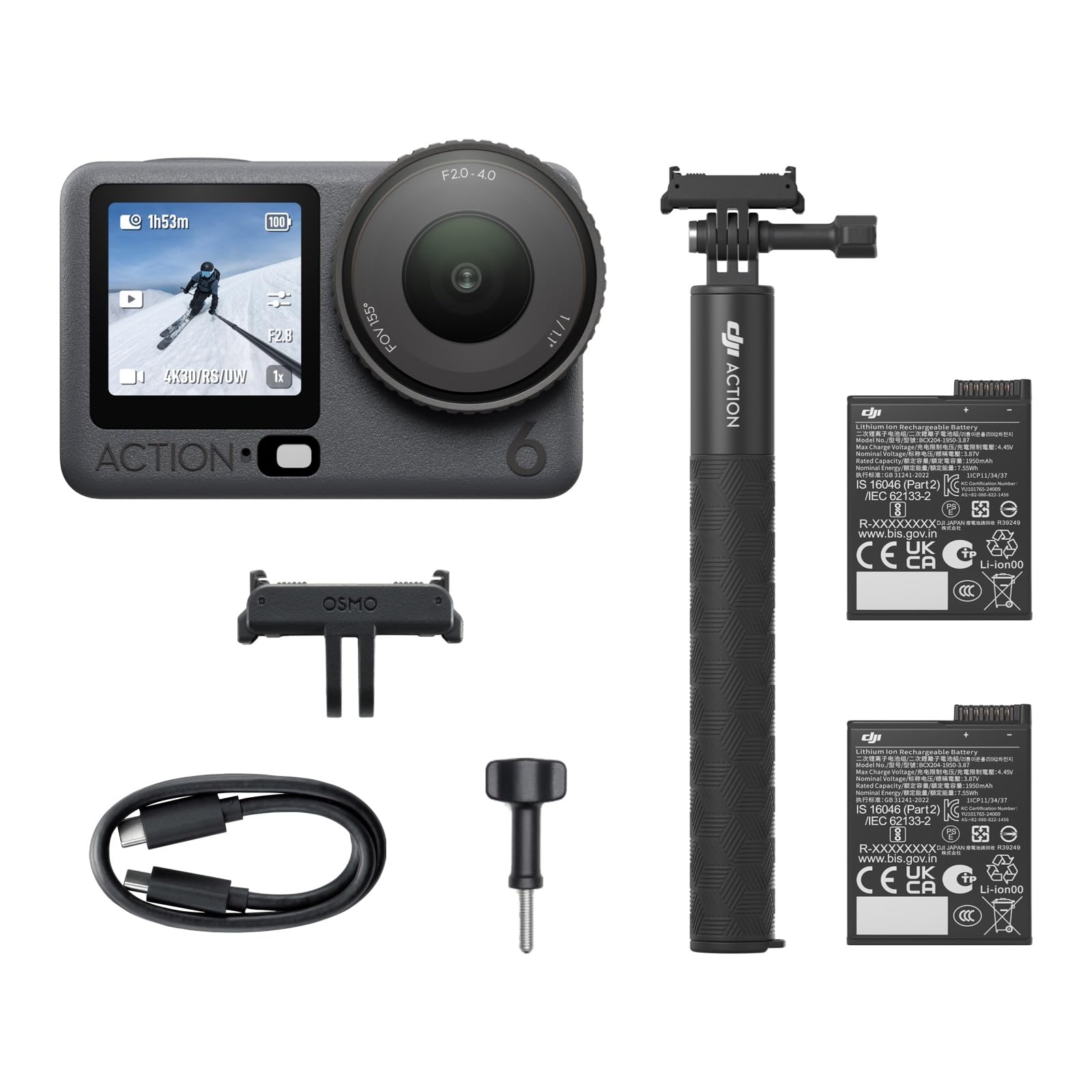
A variable aperture of f/2.0 to f/4.0 sounds like a spec-sheet flourish until you are filming a shaded gully at dusk and the detail stops smearing. That, the 1/1.1-inch square sensor and 8K capture are what this camera is for: the outdoor shooter whose good footage happens in bad light. It is also the most expensive camera here, and we think it earns that only if low light is genuinely your problem.
The rest of the kit is built for a long day. Two 1950mAh batteries and a 1.5m extension rod come in the box, gesture and voice control let you start recording with your hands full, and RockSteady 3.0 with 360-degree HorizonSteady keeps bike and paddle footage level. DJI lists up to four hours of recording across both packs, with cold-weather operation and quick charging.
Two things we noted. The reliability picture is less settled than the Action 4’s — freezes and firmware complaints are mixed in with the praise, and the first session usually includes an update. And the premium is real: this is the most expensive camera in the roundup by a wide margin. If you shoot mostly in daylight, you are paying for capability you will rarely switch on.
Pros
- Variable aperture for low-light shooting
- Two batteries and an extension rod included
- Up to four hours across both packs
Cons
- Most expensive camera in this group
- Firmware and freeze issues can appear early
Buy the Action 6 if your best footage happens at dawn, dusk or in shade and you want the most capable camera here; for daylight trail clips, its premium buys little you will notice.
Best for Vlogging on Trail
AKASO Brave 4 Pro
Key Features
- Video: 4K 30fps
- Batteries: 2 × 1350mAh
- Waterproof: 131 ft with case
- Included card: 64GB
- Price: Midrange
A second screen on the front is a small thing that changes how you shoot. On a run or a climb you can frame yourself without guessing, which is why this is the AKASO we point vloggers and trip-report types toward. The rest is a sensible step up from the bargain end: 4K30, 20MP stills, 6-axis electronic stabilization and a case rated to 131 feet.
What we liked most is how complete the box is. A 64GB U3 card, a dual-slot charger, two 1350mAh batteries and a wrist remote come with it, so there is no second order before your first trip. The 180-minute battery rating is the most generous in the AKASO lineup, though we treat it as a best case and carry both packs for a full day.
One practical note: the housing covers the controls, so choose your mode before you close the latch — you will not be switching it underwater or mid-paddle. Beyond that it behaves like a well-sorted budget camera: quick to set up, easy to hand to someone who has never used one, and small enough to live in a jacket pocket. The step up from the EK7000 buys the front screen, a memory card in the box and stronger stabilization.
Pros
- Front screen makes self-framing easy
- Card, charger and two batteries included
- 6-axis EIS 2.0 steadies helmet and bar footage
Cons
- 4K capped at 30fps
The Brave 4 Pro is the budget camera to buy if you film yourself: a front screen plus a card, charger and two batteries in the box make it a complete first kit.
Best for First Action Camera
AKASO EK7000
Key Features
- Video: 4K 30fps
- Photos: 20MP
- Weight: 2 oz
- Waterproof: 131 ft with case
- Price: Budget
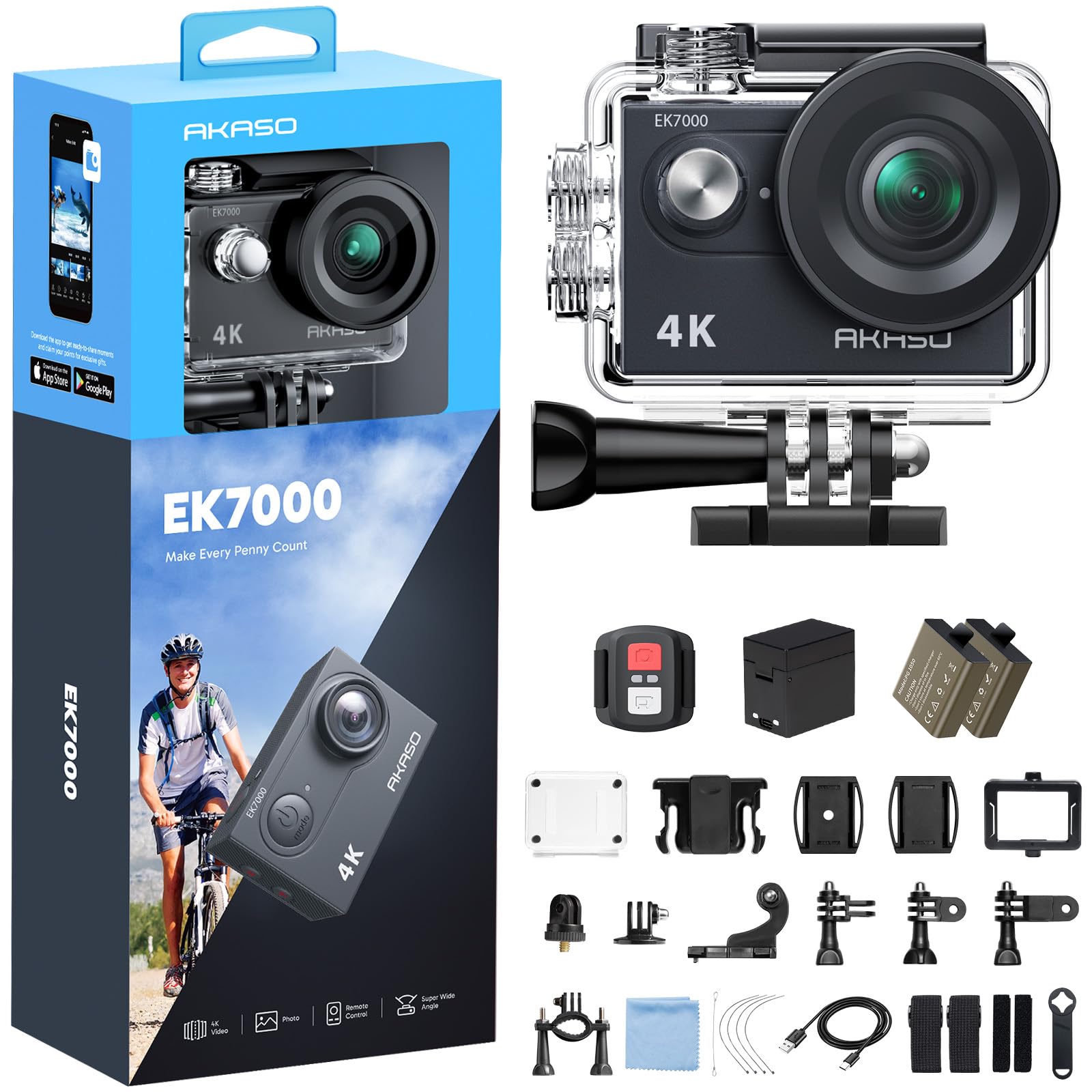
The EK7000 makes the case for spending very little. In the box: a 4K30 camera, a case rated to 131 feet, two batteries, a wrist remote and a spread of mounts for helmets, bars and chest rigs. It weighs 2 ounces, which is the figure that matters when it is clipped to a helmet for a whole climb.
The wrist remote is the detail we appreciate most. When the camera is out of reach on a helmet or handlebar, a button on your wrist beats reaching up to check whether it is recording. The case seals properly as long as the gasket stays clean and sand-free, and the included mounts mean you can attach it three different ways without buying anything else.
What it does not do is make you feel under-equipped. The menus are simple enough to learn on the drive to a trailhead, the accessories cover most of what a first season asks for, and if it ends up living at the bottom of a pack for a month, nothing much is lost. That is why this is the one we hand to anyone who is not yet sure an action camera will earn its place.
Pros
- Case rated to 131 ft
- Two batteries, charger and mounts included
- Wrist remote works out of reach
Cons
- About 90 minutes per battery
- Wide lens makes subjects look distant
We point first-time buyers at the EK7000: it is the least expensive camera here that we trust outdoors, and the box already covers helmet, bar and chest mounting.
Best for Long Days Out
icefox i7
Key Features
- Video: 4K 60fps
- Weight: 2.86 oz
- Batteries: 2 × 2150mAh
- Waterproof: 98 ft with case
- Price: Budget
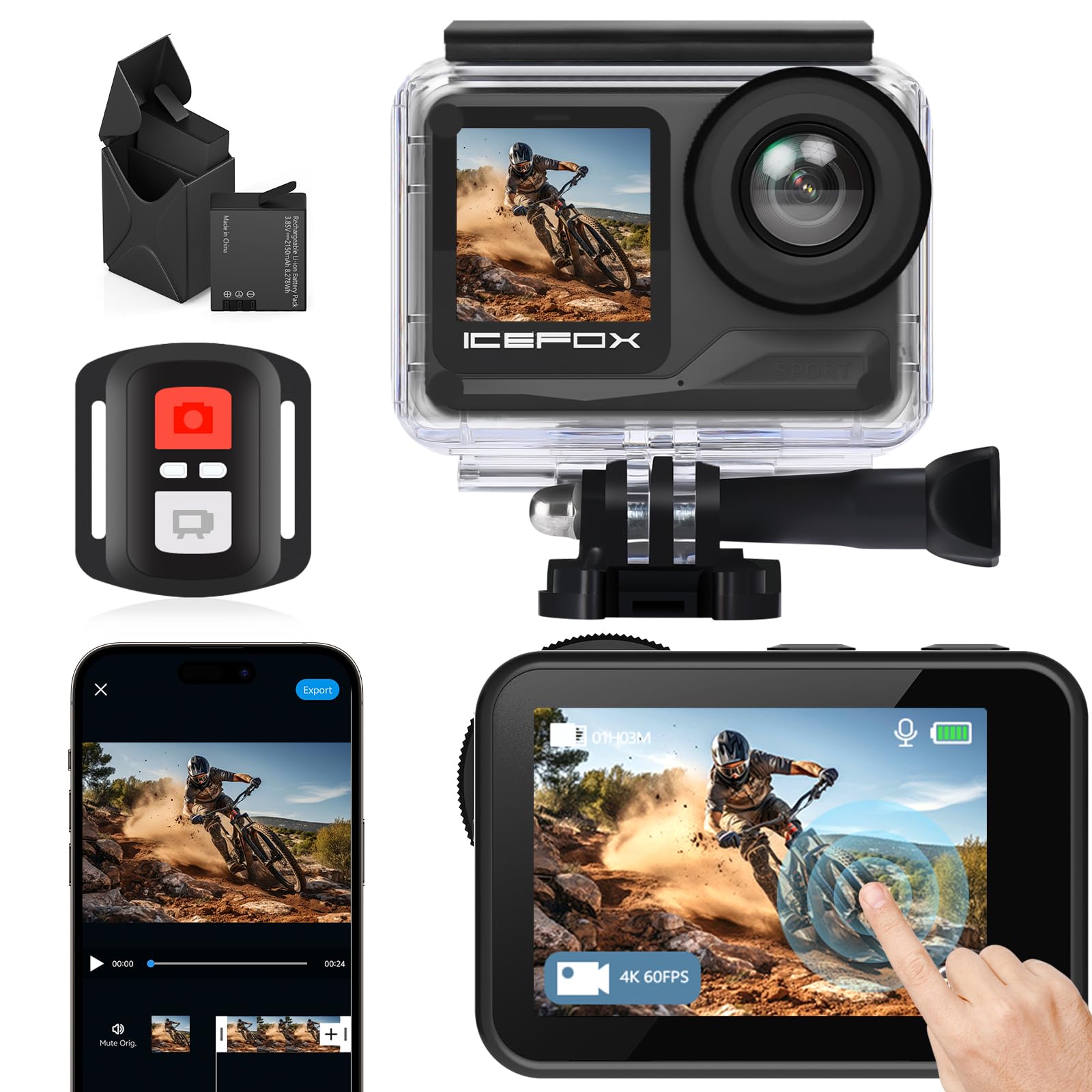
Two 2150mAh batteries are the headline. That is the biggest pair on any budget camera here, and it is why this is the one we reach for on a long day away from a socket. The listing claims five hours of 4K across both packs and puts average life at about two and a half hours per charge, which is the sort of number to verify on your own card before a big trip.
There is more here than power. It shoots 4K at up to 60fps, takes 30MP stills through a 147-degree lens, and comes with a case rated to 98 feet, a remote and a full set of mounts. At 81 grams it is the lightest camera in this roundup, and on a helmet that translates into something you stop noticing.
The compromises live in the interface. The screen is 1.4 inches, small enough that framing and changing settings take more squinting than they should, and app pairing is the weak link — it can take a few attempts before the Wi-Fi holds. Neither puts us off at the price. If you want the most predictable budget camera, the AKASO EK7000 is steadier; if you want a card and a front screen in the box, the Brave 4 Pro is the step up.
Pros
- Two 2150mAh batteries in the box
- 4K60 and 30MP stills at budget money
- Lightest camera here at 81 g
Cons
- Small 1.4-inch screen
- App pairing can be stubborn
This is the budget pick for long days away from a socket: two 2150mAh packs and 4K60 at the lowest price tier, provided you can live with a small screen and fussy app pairing.
Best for One-Box Gopro Kit
GoPro Hero

Key Features
- Video: 4K 30fps
- Battery: About 1 hour
- Included: 64GB card and 50-in-1 kit
- Waterproof: 33 ft without housing
- Price: Premium
Start with the battery, because it decides whether this GoPro suits you. The listing gives about an hour of recording, and the pack is built into the camera, so there is no swapping in a fresh one at lunch. For a short ride or a morning on the water that is fine. For a full day of hiking, it is why we do not put it above the Action 4.
What it does well is what GoPro has always done well. It is waterproof to 33 feet without a housing, HyperSmooth keeps handheld and bike footage steady, and voice control means you can start recording with your hands full. The bundle arrives ready to shoot, too: a 64GB card and a 50-in-1 accessory kit cover helmet, bar and chest mounting without a second order.
The rest is a step behind this field. Stills are 12MP and video tops out at 4K30, both short of cameras here that cost less, and it can run warm during long takes. As a first GoPro, or a single box for someone who wants the ecosystem and the voice commands, it is easy to live with. As an outdoor camera for long days, it loses to anything that lets you carry spare power.
Pros
- 33 ft waterproof with no housing
- HyperSmooth and hands-free voice control
- 64GB card and 50-in-1 mount kit included
Cons
- 12MP stills and 4K30 video only
A tidy one-box GoPro for short outings and anyone who wants voice control and a housing-free body, but its built-in battery rules it out of full days.
How We Tested Seven Action Cameras in the Field
We started by pulling every current model we could find from the major brands, then cut the list down by what actually survives a day outside: a battery you can swap, mounts that work with the gear people already own, and an app that doesn’t demand an account before it will talk to your phone. From that group we tested seven cameras, all bought at retail, over six months that ran from wet spring hikes into hot, dusty summer afternoons.
Each camera got strapped to the same bike helmet and handlebar for laps on a rooty local trail, sealed into its case for a snorkel and a pool session, and clipped to a pack strap on rainy hikes where we deliberately didn’t dry it off between takes. We timed how long it took to go from pocket to recording with cold, wet hands and gloves on, and counted the taps it took to change frame rate or turn off a beep. On the trail we recorded continuously at the highest setting with stabilization on until the battery died, then noted whether it came out with numb fingers and how many spares a four-hour morning required.
Back home we watched everything on a 27-inch monitor, checking whether snow highlights held detail, whether shadowed tree cover turned to mush, and how much of the frame stabilization cropped away. We paired each camera to a phone in a parking lot with weak signal and timed the transfer of a two-minute clip, logging drops and re-pairs. Over the six months we also recorded every overheat shutdown, corrupted card, and fogged lens, and kept a running list of what came in the box versus what we had to buy separately — spare batteries, mount adapters, a housing that doesn’t ship with the camera.
How to Choose an Action Camera for the Outdoors
The most useful question is not resolution — it is how wet the camera gets and how much power you can carry, because those two decide whether it comes along.
Sealed body or dive housing
The word waterproof on a box can mean two very different things. A sealed camera such as the DJI Osmo Action 4 shrugs off rain, spray and a dunking with nothing added, so the microphone stays clear and there is no latch to get wrong at a stream crossing. A housing, which the AKASO and icefox cameras use, goes deeper — 98 or 131 feet here — but it adds a step every time you want to change a setting. Match the camera to your wettest realistic use rather than the deepest number printed on the page.
Stabilization before resolution
Footage from a helmet or a handlebar lives or dies on shake, and no amount of resolution rescues a jittery clip. Every camera here claims electronic stabilization, but the implementations differ: DJI’s RockSteady and GoPro’s HyperSmooth are the ones that hold a horizon through a rock garden, while the AKASO EIS 2.0 is a step up on plain EIS. Our rule is simple — a stabilized 4K30 clip beats a shaky 4K60 one every time, so read the stabilization claim before the frame rate.
Batteries, cold, and the word up to
Runtime figures are quoted in the best conditions, at a frame rate you may not use, at room temperature. Cold cuts capacity, which is why DJI’s cold-weather rating on the Action 4 is worth more than a bigger number from a camera that only behaves in the warm. What you can control is how many packs you carry: two 1350mAh batteries in the box, as on the AKASO Brave 4 Pro, beat one larger cell, and a spare is the cheapest insurance on any trip. Count batteries, not minutes.
Mounts decide whether it comes along
A camera that takes thirty seconds to attach stays in the bag. Magnetic quick-release systems, like the ones on both DJI cameras, are the fastest way to move between a chest harness and a helmet; the GoPro-style finger mounts the budget cameras use are slower but universally supported, which matters if you already own a box of them. Check the box for the mount your activity needs — helmet adhesive, handlebar clamp, chest rig — before you buy the camera.
Sensor size and low light
If your best moments happen at dawn, dusk or under a canopy, sensor size decides the footage. The 1/1.3-inch sensor in the Action 4 and the 1/1.1-inch square sensor in the Action 6 gather far more light than the small sensors in the budget cameras, and the Action 6’s variable aperture adds another stop of control on top. That is what the premium buys — not sharpness in sunshine, where even the cheap cameras look fine.
Frequently Asked Questions
What kind of memory card does an action camera need?
Look for a microSD card rated U3 or V30. A slow card is the usual reason recording stops on its own halfway through a clip, and the 4K modes here are the ones that suffer first. Buy from a known brand, format the card in the camera before your first trip rather than on a computer, and keep a spare in the bag.
How do I stop the waterproof housing from fogging up?
Seal the case in dry air — indoors or in a car — rather than on a humid trail, and drop in a silica or anti-fog insert before you close the latch. Keep the gasket clean and sand-free, and do not open the case between dunks, because every opening lets moist air back in. Cameras that seal without a housing skip the problem entirely.
Will my action camera float if I drop it?
Assume it sinks. These cameras are dense, and adding a housing makes them denser still. Tether the mount to your pack or wrist, or clip on a float handle before you take it into deep water. That is the difference between a soaked camera and a lost one.
Can I use one for photos as well as video?
Yes, and the numbers are better than you might expect: most of the cameras here shoot 20MP stills, and the icefox claims 30MP, while the GoPro Hero sits at 12MP. They are fine for sharing and small prints, but the wide lenses suit action better than landscapes, so carry a phone or a compact for the view from the summit.
Final Verdict
For most people heading outdoors, the DJI Osmo Action 4 is the camera to buy. It has the sensor for dusk, waterproofing that needs no case, a mount you can move from chest to helmet in seconds and a battery rated for the cold. The Osmo Action 6 is the upgrade if low light is where your footage actually lives.
If budget is the constraint, the AKASO EK7000 is the cheapest camera here we are comfortable recommending, and the Brave 4 Pro is worth the step up when you want a memory card, a second battery and a front screen in the box on day one.