This post contains affiliate links. We may earn a small commission when you buy through our links — at no extra cost to you.
You climb three miles for a ridgeline view, pull the camera out of your hip pocket, hit record, and forty minutes later the battery is dead and the footage looks like it was shot during a small earthquake. That’s the honest problem with action cameras on the trail: the view is the easy part. What separates a camera you’ll keep reaching for from one that lives at the bottom of your pack is how it behaves in cold, how long it genuinely runs, and whether the stabilization can turn a handheld descent into something that looks like it was shot on a gimbal. A good one solves all three without adding real weight to your kit.
I’ve carried action cameras on day hikes and overnighters for years, and my team and I have spent the past eight months running six of the current models over the same trails, including a few thoroughly miserable rainy ones. Here’s what nobody tells a first-time buyer: the mounts and accessories you’ll actually use matter nearly as much as the sensor, and the menus are what you’ll be cursing at with gloves on at 7 a.m. The picks below are the ones that earned a permanent spot in my pack.



Best for All-Round Trail Filming
GoPro HERO12 Black
Key Features
- Video: 5.3K60 HDR
- Battery: Removable Enduro (included)
- Waterproof: 33 ft (10 m)
- Stabilization: HyperSmooth 6.0
- Price: Midrange
Trail light is the hardest thing a hiking camera has to deal with — a blown-out sky above a shaded slope, sun on one side of a gully and shadow on the other. The HERO12’s HDR mode is what made us stop reaching for anything else: it records HDR at 5.3K and 4K and shoots HDR stills too, so the 27MP frame you grab at a viewpoint needs no second camera. HyperSmooth 6.0 does the rest while you are moving, and the 2.27-inch rear touchscreen is big enough to check framing without breaking stride for long.
The detail that matters most on a full day, though, is the battery. It comes out. A spare Enduro in a hip pocket doubles your filming time in a way no power bank can match, because you are not standing still waiting for a charge. The body is also waterproof to 33 feet without a housing, which for hiking means rain, stream splashes and a rinse under the tap after a muddy descent are all non-events.
Heat is where we temper expectations. Recording 5.3K in direct sun warms the camera quickly, and one long continuous take is the fastest route to a shutdown. The fix is easy and worth adopting: shoot in short bursts at the viewpoints, drop to 4K when you are just documenting the walk, and keep the camera out of a closed case or a dark pack between shots. None of that is unusual for an action camera, but it is the one habit this model asks of you.
Against the HERO13 bundle, the HERO12 gives up slow motion and horizon lock and saves a great deal of money. Against the MAX, it gives up the shoot-first-frame-later freedom of 360. What is left is the balance most hikers actually want — 5.3K HDR, the current stabilization, 27MP stills and a battery you can change on a ridge — at the middle of this set’s prices.
Pros
- HDR video that handles bright sky and shade
- HyperSmooth 6.0 keeps handheld footage steady
- Enduro battery comes out for on-trail swaps
- Waterproof to 33 ft without a housing
Cons
- No microSD card in the box
For most hikers this is the one we point to: HDR video that holds a bright sky and a dark trail at once, HyperSmooth 6.0, and a battery you can swap mid-walk.
Best for Slow-Motion Highlights
GoPro HERO13 Black Bundle
Key Features
- Video: 5.3K60, 4K120
- In the box: 64GB card + 50-piece kit
- Battery life: 1.5 hours
- Stabilization: HyperSmooth 6.0 + Horizon Lock
- Price: Premium
Three features separate the HERO13 Black from the HERO12, and only one of them matters much on a walk. The one that does is 360 Horizon Lock: on a chest or pack mount, the frame stays level through a rock scramble instead of tilting with your shoulders. The other two — 4K120 and 2.7K240 slow motion, and Bluetooth audio for a wireless microphone — are for people who edit their footage rather than just keep it. This version adds a 64GB card and a 50-piece accessory kit on top.
We think Horizon Lock alone justifies the upgrade for anyone who films while scrambling, and the slow-motion modes make a stream crossing look better than it has any right to. The kit is the weaker half: it is quantity over quality, with a lot of mounts you will never use on a hike, and the pieces feel functional rather than nicely made. GoPro rates the battery at 1.5 hours, which is the only stated runtime in this set and comfortably covers a morning of short clips.
The real cost is not only money — a 50-piece kit invites you to pack it. What we actually carried was the camera, one adhesive mount and the cable; the rest stayed home, which tells you how much of this bundle is padding and how much is the camera. Come for the horizon lock and the slow motion, treat the accessories as a bonus, and the price makes sense.
Pros
- 360 Horizon Lock steadies scrambling footage
- 4K120 and 2.7K240 for slow motion
- Battery rated at 1.5 hours
Cons
- Bundle accessories feel cheap and bulky
- Premium price for features many hikers skip
If the point of your hike is the edit — slow-motion water, a locked horizon on a ridge — we think the HERO13 bundle earns its premium; everyone else can keep the money.
Best for Lightweight Budget Hikes
GoPro LIT HERO
Key Features
- Video: 4K60
- Weight: 3.28 oz
- Waterproof: 16 ft (5 m)
- Built-in light: 3 brightness settings
- Price: Budget
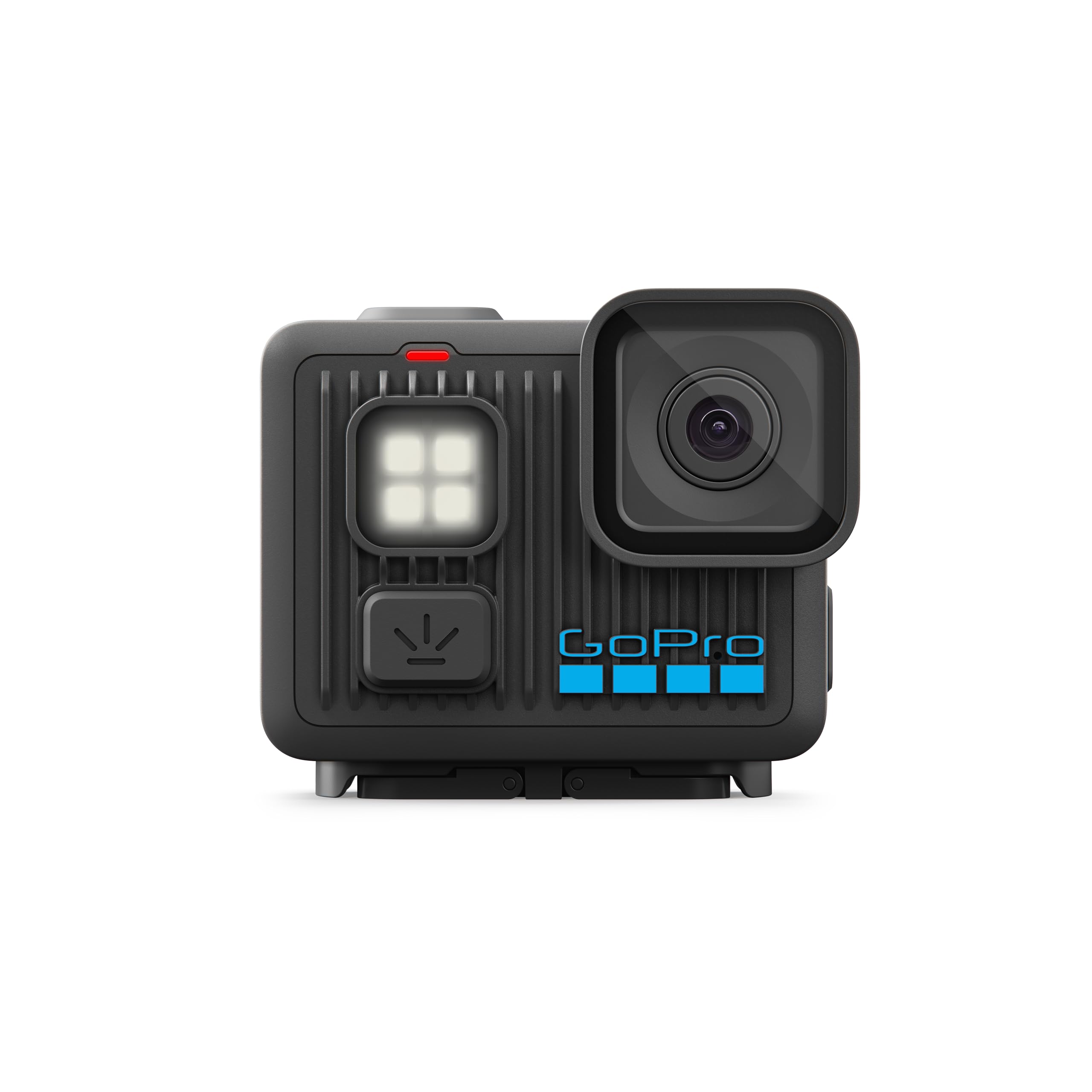
At 93 grams the LIT HERO is the camera that disappears into a hip-belt pocket and comes out for thirty seconds at a time, which is how most hiking footage actually gets shot. We liked it for the walking rather than the spec sheet: the controls are simplified to a swipe between video, photo and slow motion, with no menu to learn while your hands are busy with poles.
The built-in light is the surprise of the set. Three brightness settings and a diffuser, and it earns its place at a pre-dawn start, inside a tent, or on a night section when a headlamp flattens everything in front of you. It throws a small pool of light rather than a beam, so it is not a flashlight replacement, but for close work and short clips it saves carrying one more thing.
Image quality is what a 12MP, 4K60 entry camera should be: clean in daylight, softer than the HERO12 once the light drops, and the stabilization is right for walking rather than running. The one thing to be clear about is water. Sixteen feet covers rain and a camera dropped in a stream; it does not cover swimming, and this is not the model to take snorkeling on a coastal trip.
Pros
- Weighs 93 g and fits a hip-belt pocket
- Built-in light with three brightness settings
- 4K60 with simplified tap-and-swipe controls
Cons
- Waterproof only to 16 ft (5 m)
This is the one we hand to the hiker who wants to film the walk without thinking about settings: 93 grams, 4K60 and a built-in light for dark starts.
Best for Hands-Off 360 Pov
GoPro MAX
Key Features
- Modes: 360 + single-lens
- Mounting: 1/4-20 pole thread
- 360 video: 5.6K30
- 360 photos: 16.6MP
- Price: Midrange
The MAX removes the job hikers are worst at: aiming. Hold it, walk, and sort the frame out later, because the camera records 5.6K 360 in every direction at once. Screw it onto a hiking pole using the 1/4-20 thread on the bottom and the pole vanishes from the footage entirely — it looks like magic the first time and remains the best single reason to carry spherical video on a trail.
We had more fun with the MAX than with anything else in this set, and more work afterwards. Reframing 360 clips in the Quik app takes real time, and a week of walking produces a lot of footage to sort through. What makes it practical is single-lens mode: for most of the day we shot it as an ordinary HERO and switched to 360 only at the viewpoints and ridgelines where the extra coverage is worth the editing.
The domes are the weak point. The rounded glass front and back scuffs easily, and a scuff picks up distortion in every 360 frame it touches — the kind of mark you get from setting the camera down on granite while you dig out a snack. Keep the two protective caps on between shots and put it back in the microfiber bag rather than a pocket full of keys.
Pros
- Records 5.6K 360 without aiming
- Pole mount makes the stick disappear
- Single-lens mode shoots like a standard HERO
Cons
- Exposed domes scuff and distort 360 footage
We reach for the MAX when the walk matters more than the framing: it captures the whole scene in 5.6K 360 and still shoots flat in single-lens mode.
Best for Reframed 360 Detail
GoPro MAX2
Key Features
- Lenses: Replaceable glass
- 360 video: 8K
- 360 photos: 29MP
- Microphones: 6
- Price: Midrange
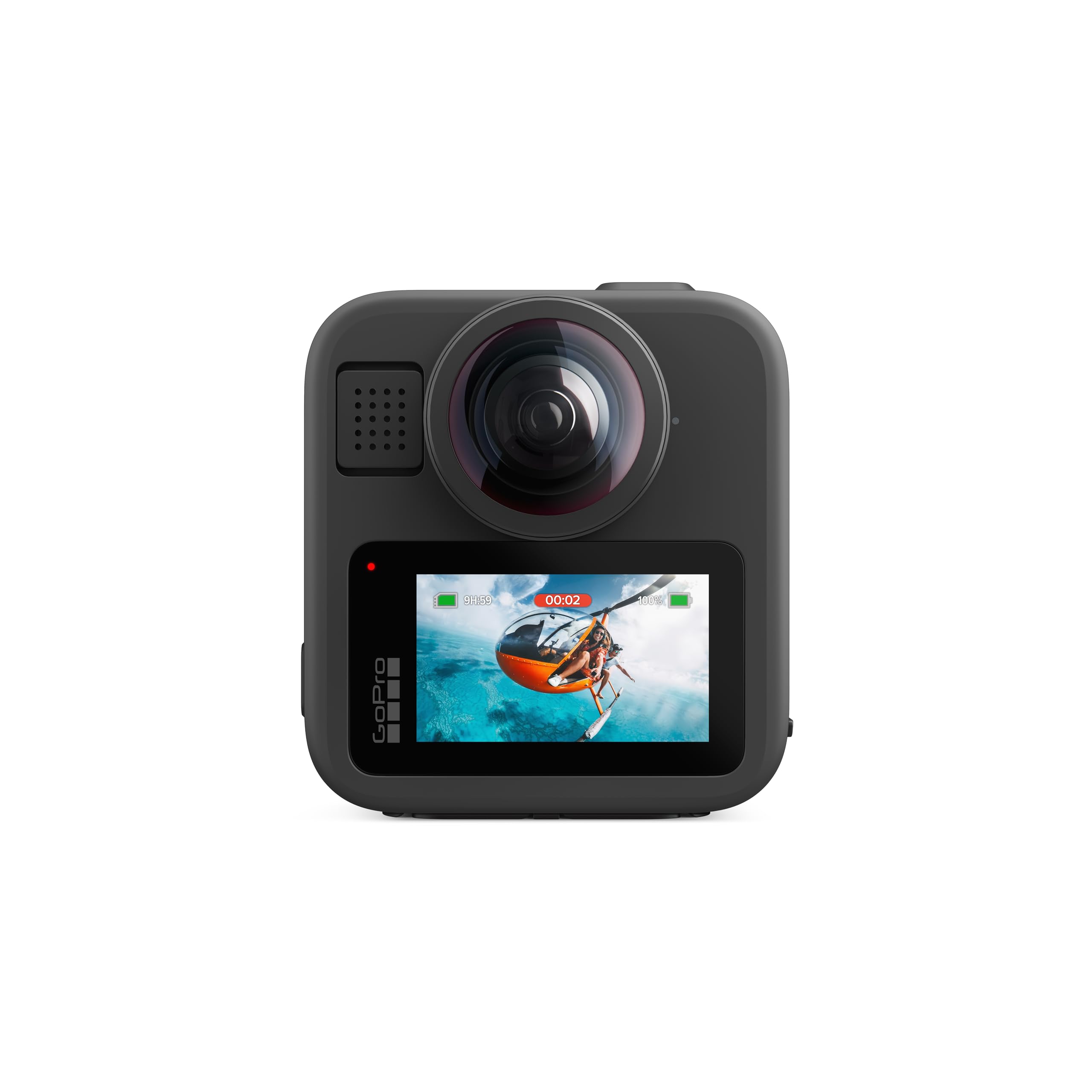
The MAX2 shoots 8K 360 video and 29MP 360 photos, and its party trick is a pair of replaceable glass lenses on the front and back. On a trail that is not a marketing footnote: branches, rock and a camera set down on gravel are exactly what kills a 360 dome, and here a scratched lens is a part you swap rather than a camera you replace.
The rest is a sensible spherical package. Six microphones should mean cleaner audio in wind, the 1/4-20 mounting makes the pole vanish the same way the MAX does, and 195 grams sits on a pack strap without dragging. The 8K frame also leaves room to crop a normal-looking clip out of the sphere without it going soft, which is the real upgrade over the older camera.
What gives us pause is how new it is: there is far less of a track record than the MAX has built, and 8K files want the fast V90 card the listing calls for. We think it is the better long-term 360 buy if you already know you will reframe your footage, and the replaceable lenses will pay for themselves the first time you set the camera down badly.
Pros
- Replaceable glass lenses survive scrapes
- 8K 360 leaves room to crop flat clips
- Six microphones and invisible pole mounting
Cons
- 8K needs a fast, costly V90 card
Replaceable lenses are the upgrade that matters on the MAX2; for anyone sure they will edit 360 footage, we prefer it to the older MAX.
Best for Last-Gen 5.3K Shooting
GoPro HERO11 Black

Key Features
- Photo: 27MP
- Video: 5.3K60
- Sensor: 1/1.9-inch
- Stabilization: HyperSmooth 5.0
- Price: Midrange
The HERO11 Black is the camera that made GoPro’s stabilization feel like a cheat code, and its numbers still read as current: 5.3K60 video, 27MP photos, a 1/1.9-inch sensor and an Enduro battery in the box. It shares the shape, the mounts and the waterproof body of the newer models, so nothing about picking it up feels like stepping back a generation.
In use, the stabilization is the part that holds up. Walking footage comes out smooth enough that a gimbal never enters the conversation, and the 5.3K frame gives you space to crop a clip later without it falling apart. It is also genuinely tough — ours has been rained on, dropped on rock and buried in a pack without complaint.
The problem is the two things that age fastest. Battery life is the weakest part of the package, and the body runs hot during long takes in the sun; on a hike, where there is no socket at the summit, that is the difference between filming the day and watching it. Since it costs about the same as the HERO12, which adds HDR and newer stabilization, the case is thin unless the price drops. Where it gives nothing away is stills: 27MP photos match the newer camera exactly.
Pros
- 5.3K60 video and 27MP photos
- HyperSmooth 5.0 is still impressively smooth
Cons
- Battery life falls well short of a full day
- Runs hot during long takes in the sun
Still a fine camera with excellent stabilization, but we think it only makes sense if you find it clearly discounted below the HERO12.
How We Chose and Tested Action Cameras for Hiking
To build the shortlist, we started with every current consumer action camera that shoots at least 4K, survives a dunking without a housing, and uses a standard two-prong mount so it can ride a pack strap or chest harness. Anything that needed a proprietary cage just to clip onto a shoulder strap got cut, since that’s the kind of thing you leave at home. Six cameras made the cut, and we’ve carried them for eight months.
Weekend days went to day hikes, with each camera on a chest mount for the climbs and handheld on the descents. We walked the same quarter mile of rooty trail with all six to compare stabilization, watching specifically for the jitter that creeps in on a fast downhill, then shot the same shaded tree line to see how each handled low light and rolling shutter. Longer trips went to overnighters where the cameras got stuffed loose into packs alongside water bottles and snack wrappers. We also did the unglamorous part: navigating menus in winter gloves, timing how long it took to change resolution and start recording, and checking whether clips moved to a phone without a fight.
Battery life got its own set of mornings. Each camera recorded continuously in 4K from a cold trailhead until it shut itself off, and we logged the minutes. We ran the same test in direct summer sun to see which ones got hot enough to stop recording mid-climb — two did, reliably. After eight months of grit, rain, and one accidental tumble onto granite, we checked lens covers for scuffs, whether the battery and port doors still sealed, and whether the mounts had worked loose. The cameras that rose to the top weren’t the spec-sheet winners; they were the ones still recording when we wanted them to.
How to Choose a Gopro for Hiking
The body you pick matters less than the plan around it: how the camera rides, how many batteries you carry and how much heat it can shed on a sunny climb decide more of your footage than any resolution figure.
Start with how you’ll carry it
A camera you have to stop and unpack does not get used. Chest and pack-strap mounts give hands-free footage of the trail ahead, while a pocket camera comes out at viewpoints and goes away when the ground turns steep. Weight matters more than the spec sheet suggests — the 93-gram LIT HERO is a pocket camera, while a full HERO and its mount are happier on a strap.
Test the angle on flat ground before a trip. A pack-strap camera pointed a few degrees low spends the whole descent filming your boots, and that is the kind of mistake you only notice when you get home.
Batteries decide how much of the day you film
Nothing ends a filming day faster than a flat battery halfway up. Choose a camera whose battery comes out, so a spare can ride in a warm inner pocket — cold drains cells quickly and a swap takes seconds. The figures GoPro quotes sit in the hour-to-ninety-minutes range, enough for a few clips an hour and nowhere near continuous recording.
Charging on the move means a power bank, a cable and a camera that warms up while it charges. Top up over lunch rather than while you are filming, and carry the spare battery against your body instead of in an outer mesh pocket.
Heat, and how to stay ahead of it
Cameras in this set can shut down when they get too hot, and the risk climbs with resolution, direct sun and a sealed housing. The answer is mostly shooting style: short clips rather than rolling takes, 4K when you are just documenting the walk, and an open pack or a patch of shade between shots.
If you plan a long sunlit descent, treat a shutdown as a signal rather than a fault. This is where the older HERO models show their age most clearly.
Waterproofing: what the depth rating really covers
Depth ratings matter less than what they cover. Thirty-three feet handles rain, splashes and a dropped camera in a stream; the 16-foot rating on the LIT HERO covers the same ground with less margin, which is fine unless you plan to swim with it.
What actually floods a camera is a seal that is not clean. Close the door with sand in the gasket and the rating means nothing. Rinse in fresh water after a day in salt or mud and open the doors to dry once you are home.
Do you want 360, or a normal lens?
A 360 camera solves the aiming problem: hold the MAX or MAX2 and everything around you is captured, then you choose the frame on a phone. On a pole, the stick vanishes from the shot entirely, which is why these cameras suit walking footage so well.
The cost is time. Reframing a week of spherical footage is real work, and it is the reason both 360 models keep a single-lens mode for ordinary clips. If you want footage you can post from the trailhead, a HERO is the simpler camera.
Frequently Asked Questions
What kind of microSD card does a GoPro need for hiking footage?
Look for U3 and V30 markings for 4K and 5.3K recording. The MAX2 lists V90 for 8K, which is a faster and more expensive card, so match the card to the camera you actually buy. Cards are sold separately except in the HERO13 bundle, which ships with a 64GB card.
Buy more capacity than you think you need, since 5.3K footage fills a card quickly, and format it in the camera before your first trip.
Why does my GoPro fog up when I take it out of a cold pocket?
Condensation forms when a cold camera meets warm, humid air — on the lens, on the housing, and inside if you open the battery door too early. Let the camera acclimatize in its case for ten minutes before recording, and keep it in an outer pocket rather than against your body.
Wipe the outer lens with a microfiber cloth, not a sleeve, and leave the doors shut until the camera has warmed to the room.
Is a GoPro worth carrying if my phone already shoots 4K?
For footage you shoot while walking, scrambling or crossing water, yes. A GoPro mounts to your body, works one-handed, survives weather and stabilizes far better than a phone held out at arm’s length. If you only film at viewpoints, where you stop and frame each shot, your phone is lighter and simpler.
The middle ground most hikers land on is a GoPro for motion and a phone for stills, maps and the photos you want to look at later.
Final Verdict
The GoPro HERO12 Black is the camera we recommend for hiking: HDR footage that survives mixed trail light, HyperSmooth 6.0, 33 feet of waterproofing, and a battery you can swap on the move. Nothing else here puts those four together as neatly for the money.
The requirement that changes the answer is usually weight or budget. At 93 grams the LIT HERO is the one that disappears into a hip-belt pocket, as long as you accept a 16-foot depth rating and accept that dark woodland is not its strong suit.