This post contains affiliate links. We may earn a small commission when you buy through our links — at no extra cost to you.
A six-person tent rarely sleeps six full-size adults, and that’s the first thing to get straight. What the number on the box really buys is room for four people plus duffels, a cooler, and the dog. The tents worth owning set up before the sky opens, keep the floor dry through a night of rain, and don’t make you wrestle a zipper at 2 a.m. — that’s the difference between a weekend everyone remembers fondly and one nobody wants to repeat.
I’ve pitched tents in the rain with two kids asking whether we were done yet, so I care about setup time and very little about marketing copy. My team and I put 10 six-person tents through nine months of real camping — state park sites, a windy lakeside pitch, one memorably wet weekend — tracking durability, water resistance, zipper quality, stability, and value. One thing a first-timer should know: capacity claims are optimistic, so lay your sleeping pads out against the floor plan before committing. The picks below are the ones we’d pitch again.



Best for Tall Campers
UNP 6 Person Cabin Tent
Key Features
- Doors: 1 door
- Weight: 17.8 lb
- Floor area: 90 sq ft
- Peak height: 78 in
- Price: Midrange
Clostnature lists this six-person tent at 9 feet 10 inches square, and that works out to 108 square feet — the largest floor in this roundup by a clear margin. Two queen air mattresses leave a walkable strip down the middle, and with doors on opposite sides, the adults’ side and the kids-and-gear side stop being the same traffic jam at bedtime.
That floor, plus two vestibules and the strongest waterproofing quoted anywhere in this group, is why it takes the top spot. The fly, the groundsheet and the bathtub floor all carry a PU 5000 coating, several times the rating on the budget tents here, and the tub turns up at the edges so a puddle outside stays outside. The vestibules add up to more than 21 square feet, which is where wet boots and packs live instead of on your sleeping bag.
Pitching is a two-pole clip-on frame that goes up quickly with one person, and at 11 pounds minimum trail weight this is the lightest bag in the roundup — one adult carries it from the trunk with the cooler in the other hand. The mesh runs high on every side, which matters more than the spec sheet suggests: a still August night stays breathable instead of turning into a sauna by midnight.
What to plan for: two doors and two vestibules double the zipper real estate you have to look after, and the two-door layout only pays off if everyone actually uses their own side. We stake the guylines even on a calm forecast, because a light frame relies on tension rather than on weight to stay upright.
Pros
- Largest floor here at 108 square feet
- Two doors and two vestibules for family traffic
- PU 5000 coating on fly, floor and bathtub
- 11 pounds minimum trail weight, lightest in this set
Cons
- Pole failures appear after a season of use
- 71-inch peak means tall campers stoop
We pick it for space and weather protection together: the biggest floor here, two doors, a PU 5000 coating and the lightest bag of the group.
Best for Late-Night Setup
FanttikOutdoor Zeta C6 Pro
Key Features
- Weight: 19 lb
- Floor area: 90 sq ft
- Setup time: 60 seconds
- Peak height: 66 in
- Price: Midrange
The pitch is the whole idea here, and it’s why we hand this tent to anyone who rolls in after dark. The poles are pre-attached to the shell, so setup is unfold, extend, stake the corners, throw the fly; the 60-second figure is the best case, but the routine is a couple of minutes once you’ve done it once, with no sleeves to thread and nothing to assemble.
The convenience doesn’t cost you floor. At 10 by 9 feet and 90 square feet, it matches the UNP and beats the Coleman Skydome, with room for two queen mattresses and a strip to walk in. Four mesh windows and a mesh ceiling keep air moving. The trade is height: 66 inches at the peak is the lowest here, so adults stoop and only kids stand upright, which is why it sits behind the Clostnature for a family that camps often.
Rain is handled better than the position in this list suggests — a 1500mm coating, a drainage channel under the door zip, and a fly that covers the roof instead of perching on it. The zip itself needs babysitting, because the storm flap catches unless you hold it clear, and the vestibule is 2.25 square feet, which is a pair of boots rather than a gear store. Frame sections are the long-term question: bent and snapped poles turn up after a season of use.
Pros
- Pre-attached pole frame pitches in about a minute
- 90 square feet, enough for two queen mattresses
- 1500mm coating with a door drainage channel
- Four mesh windows plus a mesh ceiling
Cons
- Door zip catches on the storm flap
- Frame sections can bend or snap in use
For anyone who reaches the campsite after dark, this is the tent we hand over: pre-attached poles, a one-minute frame, and 90 square feet behind it.
Best for Tall Campers
UNP 6 Person Cabin Tent
Key Features
- Doors: 1 door
- Weight: 17.8 lb
- Floor area: 90 sq ft
- Peak height: 78 in
- Price: Midrange
Seventy-eight inches at the peak is the tallest interior in this roundup — seven inches over the Clostnature and a foot over the FanttikOutdoor — and it’s the reason to start here if you’re tall or tired of dressing lying down. The walls run close to vertical, so the height is still usable where you sit rather than only at one point in the middle.
The rest is a conventional cabin done competently: 10 by 9 feet and 90 square feet, five mesh windows and a mesh roof panel, alloy steel poles and a full fly. At 17.8 pounds it’s a two-person carry from the car, and the long, slim bag slides behind a seat without a fight. Setup runs about ten minutes solo and less with a second pair of hands.
Weather is where we hesitate. Water resistance is the uneven part: fine through a shower, but damp walls and wet seams turn up in a long soak, and the door zip is the weak component — one slider, a full-length run, and a flap that grabs. As a fair-weather family tent at a price under the top pick, it’s genuinely good. As the tent you take when the forecast turns, we take the Clostnature instead.
Pros
- Tallest peak in this set at 78 inches
- 90 square feet with near-vertical walls
- 17.8-pound pack with a slim carry bag
- Five mesh windows and a mesh roof
Cons
- Water resistance is uneven in sustained rain
- Single-slider door zip that sticks
We keep it on the list for the headroom: 78 inches at the peak, standing room for most adults, at a price below the top pick.
Best for Standing Room
Coleman Skydome 6 Person
Key Features
- Doors: 1 door
- Floor area: 86 sq ft
- Setup time: Under 5 minutes
- Peak height: 6 ft
- Price: Midrange
The Skydome’s trick is the wall angle. Instead of a dome that curves inward and steals height at the edges, the sides run nearly vertical, which Coleman puts at 20 percent more headroom than its traditional domes. That means the 6-foot peak is usable where you actually sit, and we think it, plus the wider door, is what makes this the easiest tent here to move an air bed and a cooler into.
Setup is the other half of the pitch: two pre-attached poles, clips rather than sleeves, and a frame that snaps into shape, with Coleman claiming under five minutes. The current version is also listed as PFAS-free, a fabric-treatment detail that rarely appears on a family tent at this price, and one we appreciate.
Two things keep it behind the top pick. The floor is 86 square feet for more money than the roomier Clostnature, and durability is where it slips — pole joints and splintered sections show up after windy nights, more so than on the cheaper tents here. Buy it for the standing room and the easy door, then guy it out and don’t ask the frame to take a gust on its own.
Pros
- Near-vertical walls make the 6-foot peak usable
- Pre-attached poles, under five minutes
- Wider door for air beds and coolers
- Listed as PFAS-free fabric
Cons
- Pole joints can splinter in wind
- 86 square feet for more money than roomier picks
Our pick when you want to stand up and walk gear in through a wide door, as long as you accept a smaller floor and a frame that needs guying out.
Best for Long Trips
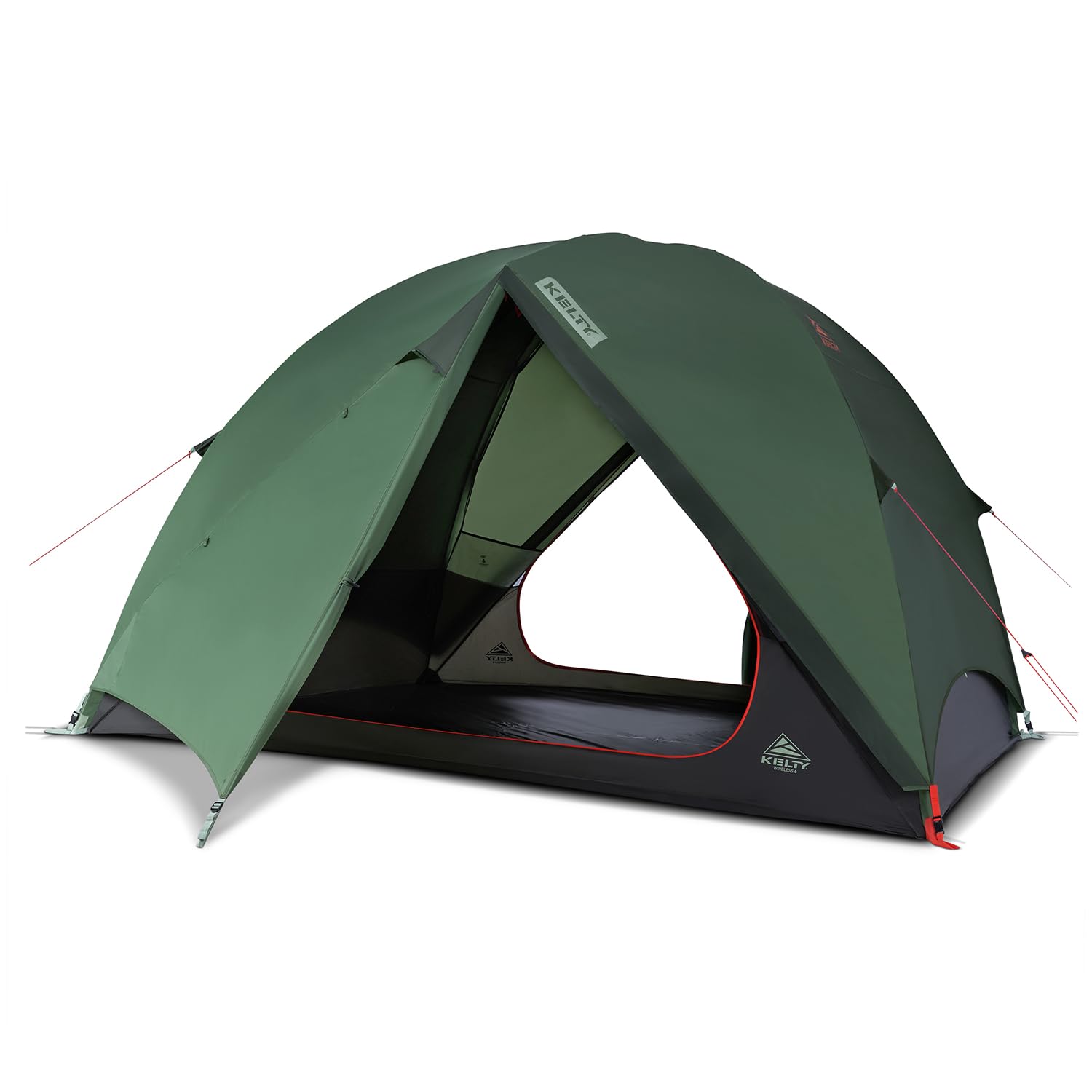
Kelty Wireless 6
Key Features
- Weight: 19.8 lb
- Floor size: 117 x 106 in
- Peak height: 74 in
- Doors and vestibules: 2 doors, 2 vestibules
- Price: Premium
At the top of this group’s price range, the Wireless is for the family that camps a dozen nights a year and wants the routine to be pleasant rather than merely survivable. What the money buys is architecture: two doors, each with its own vestibule, so six people aren’t sharing one exit and one wet pile of boots at the end of a rainy hike.
The numbers back it up — 117 by 106 inches on the floor, 74 inches at the peak, 68D polyester with a 1200mm hydrostatic head, and a 19.8-pound bag. The high tub floor means you can run it with the fly off and still keep some privacy, and the 40-denier no-see-um mesh is fine enough that a June evening in a river valley doesn’t fill the tent with bugs.
Pitching is quick and genuinely one-person: color-coded corners, a clip frame, and pre-attached guylines that don’t become a bird’s nest in the duffel. Fiberglass poles at this price are the compromise we noticed — they’re the heaviest part of the bag and the part most likely to give out.
So the honest comparison is that the Clostnature gives you more floor, a stronger waterproof rating and less weight for less money. What the Kelty adds is the second vestibule, the extra height, and a level of finish that makes everyday camping nicer. If you’ll use both doors and a covered porch on every trip, the premium is defensible; if you won’t, you’re paying for space you already had.
Pros
- Two doors, two vestibules, no queues
- 74-inch peak over a 117 x 106 floor
- 1200mm fly with a high tub floor
- Color-coded, one-person pitch
Cons
- Highest price in this roundup
- Pole failures appear in its durability record
Where the budget is real and the routine matters, we recommend the Wireless: two doors, two vestibules, 74 inches of headroom and the most polished pitch here.
Best for First Tents
CAMPROS CP 6 Person Dome
Key Features
- Weight: 13.7 lb
- Floor area: 77 sq ft
- Floor size: 11 x 7 ft
- Peak height: 72 in
- Price: Budget
Eleven by seven feet is a long, narrow footprint, and it changes how the tent works. A king air mattress fills the width with a strip left at the foot for bags; two twins sit side by side with a gap between them; and the 72-inch center means most adults stand with an inch or two to spare. At 77 square feet it’s the smallest floor among the six-person tents here, but it’s laid out for sleeping rather than for hanging out.
For a first tent, a festival, or a summer of backyard sleepovers, we think it’s the sensible buy. The mesh roof panel comes into its own once the fly comes off on a clear night, the interior e-port lets a power cable reach a light or a phone without propping the door open, and the bag is listed at 6.2 kilograms — a couple of trips from the car for one adult.
What holds it back is hardware. The door runs a single slider on a long diagonal, so every entry is a full sweep from the ground up, and the zip catches the flap unless you hold it clear with your other hand. The shell is light, which is why it packs small and why we treat it as a fair-weather tent with a groundsheet underneath. Neither flaw is fatal at the price; both are why it’s a budget pick rather than the pick.
Pros
- 72-inch center height at a budget price
- Mesh roof panel for clear nights
- Interior e-port for a power cable
- 11 x 7 floor takes a king air mattress
Cons
- Single-slider door zip on a long run
- Light shell, best in fair weather
For a first tent, a festival or a summer of backyards, we think it’s the sensible buy: 72 inches of standing height at a budget price.
Best for Budget Group Trips
CAMEL CROWN 6 Person Tent

Key Features
- Weight: 18 lb
- Floor size: 142.5 x 94.5 in
- Peak height: 74.8 in
- Waterproof coating: PU 2000
- Price: Budget
On paper this is the biggest tent in the roundup for the least money: 142.5 by 94.5 inches, nearly twelve feet long, and 74.8 inches at the peak, in a 150D Oxford shell with a PU 2000 coating. That’s a heavier weave than the thin polyester on most budget tents, and it’s the part of the spec sheet we find most convincing.
Setup is a conventional sleeve-and-fiberglass job that runs about ten minutes with two people, and the bag is small enough to live in a trunk. The floor mat and the iron stakes in the box save you a purchase, though those stakes bend in anything softer than a lawn.
Two things keep it out of the top tier. The zips are the recurring problem — sticky, single-closure, and needing two hands at the door — and the six-person claim is optimistic: with adults and gear this is a comfortable four, or two queen mattresses and very little else. At the lowest price here it’s still a fair buy, as long as you buy it as a four-person tent that happens to have a big floor.
Pros
- Biggest claimed floor and 74.8-inch peak
- 150D Oxford with a PU 2000 coating
- Lowest price in this roundup
- Floor mat and stakes included
Cons
- Door zips stick and need two hands
- Six-person rating is optimistic with gear
We treat it as a four-person tent with a six-person label: a big floor and heavier fabric, the weakest zips here, and the lowest price of the group.
Best for Two-Door Value
Purebox 6 Person Tent

Key Features
- Doors: 2 doors
- Weight: 13 lb
- Floor size: 10 x 8 ft
- Peak height: 6 ft
- Price: Budget
Thirteen pounds with a door on each side is the whole pitch, and it’s a good one. At 10 by 8 feet this is a standard six-person footprint that one adult carries from the car, and the second door means nobody climbs over the air mattress at two in the morning.
The shell is where the weight came from. The fabric is thin enough that the seams are the part to watch in rain — taped or not, water at the seams is where it gives in a long soak — and the stakes in the bag are small enough that soft ground wants something with more bite. Setup is the easy part: sleeve poles, one person, about ten minutes.
Ventilation is better than the price suggests, with two mesh windows and a fly that lifts off for airflow, and the extended floor adds a little length at the foot for packs. It behaves like a good three-season shelter in fair weather and like a budget tent in a storm, which is exactly what it is.
As a second tent, a scout-camp tent, or a first tent for a teenager, it earns its place. As the family’s only shelter for a wet week, it doesn’t. We keep it in the roundup because two doors and a 13-pound bag at a budget price is a specific, useful combination — and because most people’s camping is a dry weekend in July.
Pros
- Two doors at 13 pounds
- 10 x 8 floor with extended length
- Taped seams and two mesh windows
- Budget price for the feature set
Cons
- Thin fabric, with seams the rain weak point
- Small stakes need replacing for soft ground
Two doors, 13 pounds and a budget price make it the second-tent pick for us; the seams are the question if the forecast turns wet.
How We Tested 10 Six-Person Tents
We started by pulling every six-person tent we could find from brands we’ve camped in before, then cut the list using specs that actually change a trip: peak height, floor dimensions, packed weight, pole material, and the waterproof ratings published for the fly and floor. We also combed customer reviews for complaints about leaks, snapped poles, and zippers that failed in the first season, and dropped any tent that kept showing up. That left 10 tents, camped in over nine months.
Each tent got a solo first pitch with a stopwatch running and no help, then a second pitch in whatever wind the site offered. We noted where the instructions lost us, whether pole sections snapped together without snagging, and how much of the job one person could finish alone. At a windy lakeside pitch we guyed every tent out fully and watched for poles bowing or walls flattening; in rain we ran a hose over each fly for ten minutes, then checked corners, seams, and floor for water coming through.
Capacity got measured rather than trusted: we laid out six sleeping pads, then four pads plus a cooler, two duffels, and a dog bed, and noted where the walls pushed in. Every door and window zipper was opened and closed 50 times while we watched for fabric catching in the coil. After each trip we went over pole joints, seam tape, and floor abrasion, and timed how long each tent took to pack back into its bag — several never fit again. Value came down to what was included and what survived.
How to Choose a Six-Person Tent
The six-person label counts sleeping bags, not rooms, so the first thing to compare is floor area and how your family actually sleeps.
Floor Area and How You Sleep
Six people means six sleeping bags laid shoulder to shoulder; add gear, a dog or an air mattress and the arithmetic changes fast. The tents here run from 77 square feet in the CAMPROS to 108 in the Clostnature, and that difference is a walkable strip versus a shuffle.
Two queen mattresses want a footprint close to 10 feet square, which is the Clostnature’s shape rather than the long, narrow 11-by-7 of the budget picks. Decide that before anything else: if you sleep on mattresses, buy square footage rather than the capacity number.
Peak Height and Wall Angle
Center height runs from 66 inches on the FanttikOutdoor to 78 on the UNP, and the figure only means something next to the wall angle. A dome tapers, so a 72-inch peak can leave 50 inches where you sit; a nearly vertical wall, as on the Coleman Skydome, keeps the height out at the edges where people actually are.
Measure the tallest person in the family and subtract a couple of inches for the floor mat. Under about 6 feet 2, anything at 72 inches or above is comfortable to dress in.
Water Protection: Coating, Fly and Tub
Waterproofing is three separate things: the coating on the fabric, which runs from 1000mm on the budget tents to 1500mm on the FanttikOutdoor and 5000mm on the Clostnature; the coverage of the fly; and whether the floor turns up into a bathtub.
The trap is trusting the coating number alone. A partial fly leaves the roof seams exposed, and the door zip is where most water gets in. For anything beyond a summer shower, look for a full-coverage fly and a tub floor, and reseal the seams once a season.
Zippers and Poles Decide How Long It Lasts
Door zips and pole joints are what fail first across this group — zips that catch the storm flap, frame sections that splinter on a windy night. A two-slider door is worth having, because it lets you open from the top while the bottom stays closed against rain and toddlers.
Poles last longer when the tent is guyed out and the frame isn’t forced. If a section bends, stop and straighten it rather than pushing through; cheap tents rarely die of old age, they die of one rushed setup.
Weight, Bag Size and Who Pitches It
Packed weight here runs from 11 pounds on the Clostnature to 24 on the heaviest instant tent, and the practical threshold is simple: under 15 pounds one adult handles it in a single trip, over 20 you want two people.
Setup style matters as much. Pre-attached instant frames go up fastest on arrival; sleeve-and-clip poles pack smaller and cost less. If you always camp with a second adult, buy the roomier, heavier tent. If you often pitch alone, buy the frame you can manage by yourself.
Frequently Asked Questions
Do I need to buy a footprint or groundsheet separately?
It helps. Most tents here rely on a coated floor alone, and the Clostnature is the one that builds a groundsheet and bathtub into the body. A cheap tarp does the same job if you cut it a couple of inches smaller than the floor — never larger, or it channels rainwater under the tent instead of away from it.
How do I keep condensation out of a six-person tent?
Ventilation is the fix, not more waterproofing. Keep the mesh panels zipped instead of the fabric door, leave the fly’s vents open even on a cool night, and pitch so the low vent faces away from the wind. A mesh roof panel, like the one on the CAMPROS, is the fastest escape route on a clear night. Cooking inside or dragging in wet gear adds moisture that has nowhere to go.
Can you backpack with a six-person tent?
Rarely. The Clostnature is the only one here with a realistic carrying figure, at 11 pounds minimum trail weight, and even that is a two-person split once you add stakes, fly and a share of the food. Treat every tent on this page as car camping first, and pack one only when the walk in is short.
Final Verdict
The Clostnature is the tent we point most families to: 108 square feet, two doors and two vestibules, the strongest waterproof coating in this group, and the lightest bag here. Nothing else in this roundup combines all four, and for a family that camps more than once a summer, that combination is the whole decision.
If the pitch has to happen in the dark, the FanttikOutdoor’s pre-attached frame is worth the lost headroom. If standing up and dragging an air bed through a wide door matter more than floor area, the Coleman Skydome does that job. Settle the floor plan first, then the weather protection; everything else is preference.