This post contains affiliate links. We may earn a small commission when you buy through our links — at no extra cost to you.
Camping with kids is mostly a logistics problem dressed up as a vacation, and the tent is where those logistics either hold or fall apart. I’ve pitched one in the rain with two children arguing over a flashlight, so I know how fast a bad tent turns a trip into a story you tell later. What you actually want is a shelter that goes up without a second adult, stays dry through a real downpour, and still has floor space left once everyone’s duffel is inside.
We’ve spent the past eight months living with 10 family tents — backyard sleepovers, a soggy weekend at a state park, a breezy lakeside site — and the gap between the best and the rest is wider than the prices suggest. One thing first-time buyers rarely hear: capacity ratings are optimistic. A six-person tent sleeps four people and a dog comfortably, so size up if your kids are big or you camp with gear. The picks below earned their spots one storm and one stubborn zipper at a time.



Best for Most Families
CORE 9P Instant Cabin
Key Features
- Sleeps: 9
- Floor area: 126 sq ft
- Setup time: 2 minutes
- Peak height: 78 in
- Price: Premium
Arrival is the moment a family tent earns or loses its keep: cold, hungry, everyone standing around while one adult feeds poles through sleeves. This CORE ends that scene fastest of anything here. The frame is pre-attached, so you unfold it, extend four telescopic legs, and the cabin is standing. CORE’s two-minute claim doesn’t count stakes, guylines, or the fly, but the part that usually goes wrong is over before the cooler comes out.
What goes up is genuinely roomy. The floor is 14 by 9 feet — 126 square feet — which is two queen airbeds with walking space between them rather than the mattress jigsaw most six-person domes give you. Two doors keep a family from queuing to get out, and the 78-inch center height means most adults change clothes without folding themselves in half. CORE quotes four people with gear or nine without, and the first number is the honest one.
That combination of instant frame, full standing height, and a divider that splits one big room into two is why this is our top pick; instant tents usually make you give up height, and this one doesn’t. Rain is the part to plan around. The 1200mm coating and taped seams handle a normal night, but stake every guyline and put a tarp under the floor if the forecast is serious, and know that clipping the fly over a 78-inch frame puts the far corners out of reach for shorter campers.
Pros
- Pre-attached frame stands up in minutes
- 78-inch ceiling and two doors
- Divider splits 126 square feet into two rooms
- Taped rainfly with a 1200mm coating
Cons
- Poles can bend in hard wind
- 27.6 pounds to move and store
The tent we recommend to most families: it stands in about two minutes, adults can dress without crouching, and the divider gives parents a room of their own.
Best for Tight Budgets
Coleman Sundome 6P
Key Features
- Sleeps: 6
- Floor area: 100 sq ft
- Peak height: 6 ft
- Water resistance: WeatherTec system
- Price: Midrange
Ten by ten feet, six feet at the peak, one room, one door. The Sundome makes a modest first impression until you look at the floor: welded corners and inverted seams, the construction that stops water pooling under an air mattress and wicking up through the fabric. That’s Coleman’s WeatherTec, and it’s the part of this tent we trust most. A full rainfly, big side windows, and a low ground vent finish the job.
At this money it’s the value pick of the group, and the math is easy to live with: 100 square feet holds two queen airbeds, which is four people with nowhere left to put a bag, or a family of four who sleep on bags and keep duffels by the door. Treat the six-person figure as four plus gear. Buy it and you have spent sensibly and kept budget for sleeping bags, a stove, and a tarp.
Pitching is quick and doesn’t need a second adult: continuous pole sleeves and Insta-Clip attachments mean no threading a rod through a tunnel. Ventilation is what we came back to — the ground vent pushes warm air up and out through the windows, which is the difference between sleeping and lying awake in July. It’s a fair-weather family tent that handles a wet night, not a base camp for a rainy week.
Pros
- Welded floor and inverted seams shed water
- Ground vent and big windows move air
- Fast pitch with Insta-Clip attachments
Cons
- Six-foot ceiling means most adults crouch
- Door zipper snags on the flap
If you want the least risky way to spend modest money on a family tent, this is it: easy to pitch, genuinely weather-ready, and roomy for four.
Best for Big Groups
CORE 12P Cabin
Key Features
- Doors: 2
- Sleeps: 12
- Floor area: 176 sq ft
- Peak height: 86 in
- Price: Premium
Sloped cabin walls look big in the photo and live small once the beds are in; this CORE’s walls run nearly straight up, so the 176 square feet is mostly floor you can stand on rather than a wedge you crawl into. The 86-inch ceiling is the luxury: adults walk in upright, put on a jacket, and never do the dome-tent crouch that gets tiring by the third day.
Sixteen by eleven feet, quoted as four queen airbeds or twelve sleepers without gear. Twelve adults is a stretch; six with cots and a cooler is realistic, and the room divider gives the children a side of their own. Nine windows and a mesh roof keep that much volume from turning into a greenhouse, and two doors mean the traffic doesn’t all funnel through one zip.
It is unapologetically a car-camping tent. The box includes 22 stakes and 22 guylines, and the poles are fiberglass and sleeve-fed, so plan a genuine half hour for the first pitch with two adults working. That stake count is what keeps a tent this tall from sailing in wind, and wind is the reason to use all of them every time rather than only when the forecast turns.
Pros
- Near-vertical walls make the floor usable
- 86-inch center height for standing up
- Two doors, nine windows, and a divider
Cons
- Long first pitch with 22 stakes
- Front door zipper can stick
When the whole extended family shows up, this is the tent we point to: 176 square feet, straight walls, and an 86-inch ceiling you walk under.
Best for Long Stays
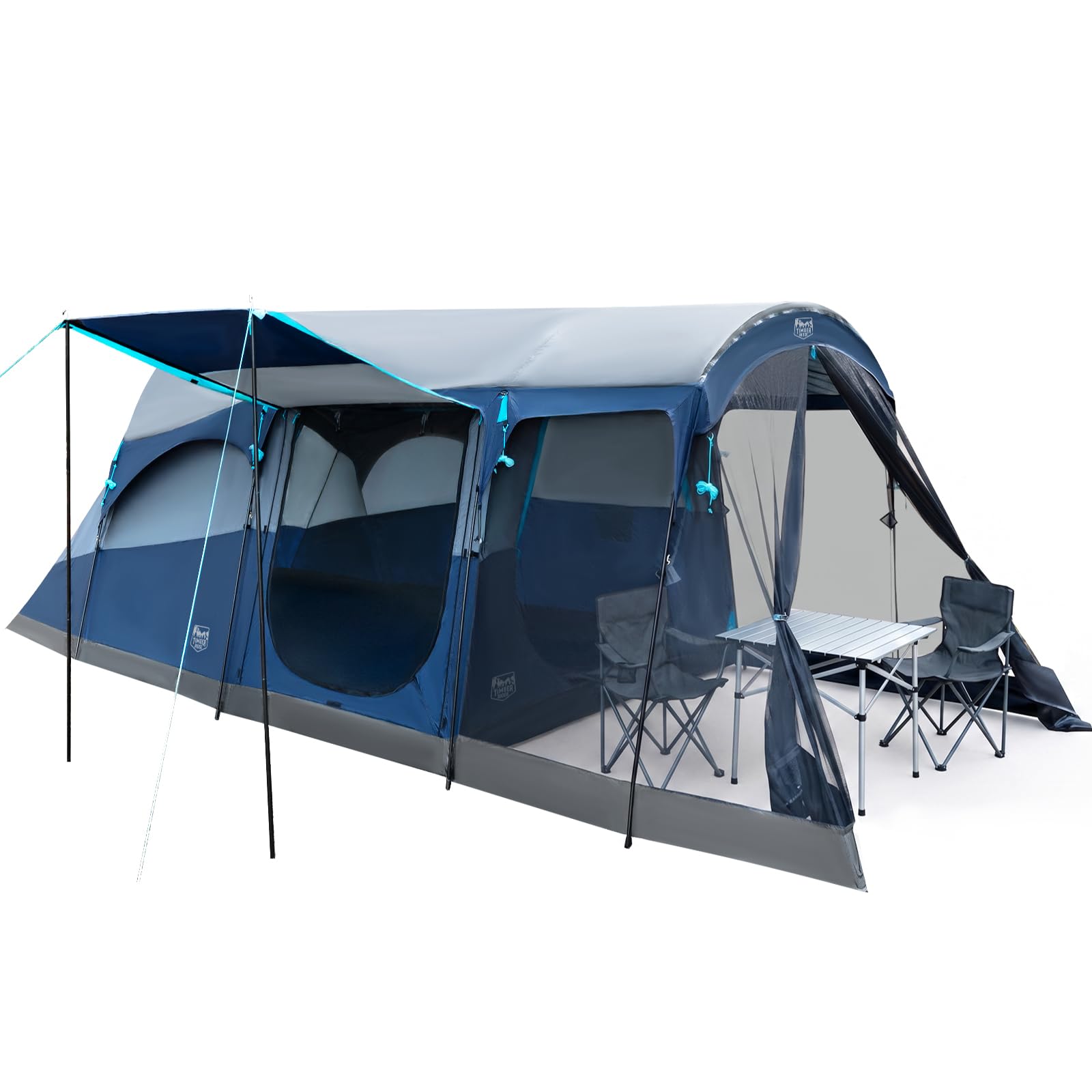
Timber Ridge 8P Porch
Key Features
- Sleeps: 8
- Floor area: 160 sq ft
- Peak height: 76 in
- Packed weight: 32 lb
- Price: Midrange
Twenty feet is the number that decides whether this TIMBER RIDGE suits you. The rear 14 feet is the sleeping cabin; the front six is a screened porch with its own floor, a full mesh wall, and enough room for two camp chairs when the mosquitoes win.
A porch changes a family trip more than any other single feature. Boots stay outside the sleeping area. Wet jackets hang where they can drip. On a buggy evening the children have somewhere to be that isn’t a wall away from you, and you have somewhere to sit that isn’t a camp chair in the rain. The mesh ceiling and the wide front door keep the whole thing airy instead of sealed.
Set against that, the color-coded fiberglass frame is a two-adult, fifteen-minute job, and at 32 pounds this is a tent that lives in the car rather than on your back. A rain-drip guard over the door is the detail that matters most in practice, and you only notice it when a tent doesn’t have one and water is running down your neck.
Where this earns its place is the long stay: a week at one site, a family that cooks and sits out rather than moving every day, weather that might turn. At 76 inches the ceiling is tall enough that nobody is changing clothes on their knees, and the porch is the reason to choose this over a cheaper dome of the same capacity.
Pros
- Six-foot screened porch with its own floor
- 76-inch ceiling and huge front door
- Color-coded poles simplify a two-person pitch
Cons
- Twenty-foot footprint rules out small sites
- Door zipper catches on the flap
For a family that stays a week at one site, the screened porch earns its cost — provided your pitch is long enough to take a 20-foot tent.
Best for Sleeping In
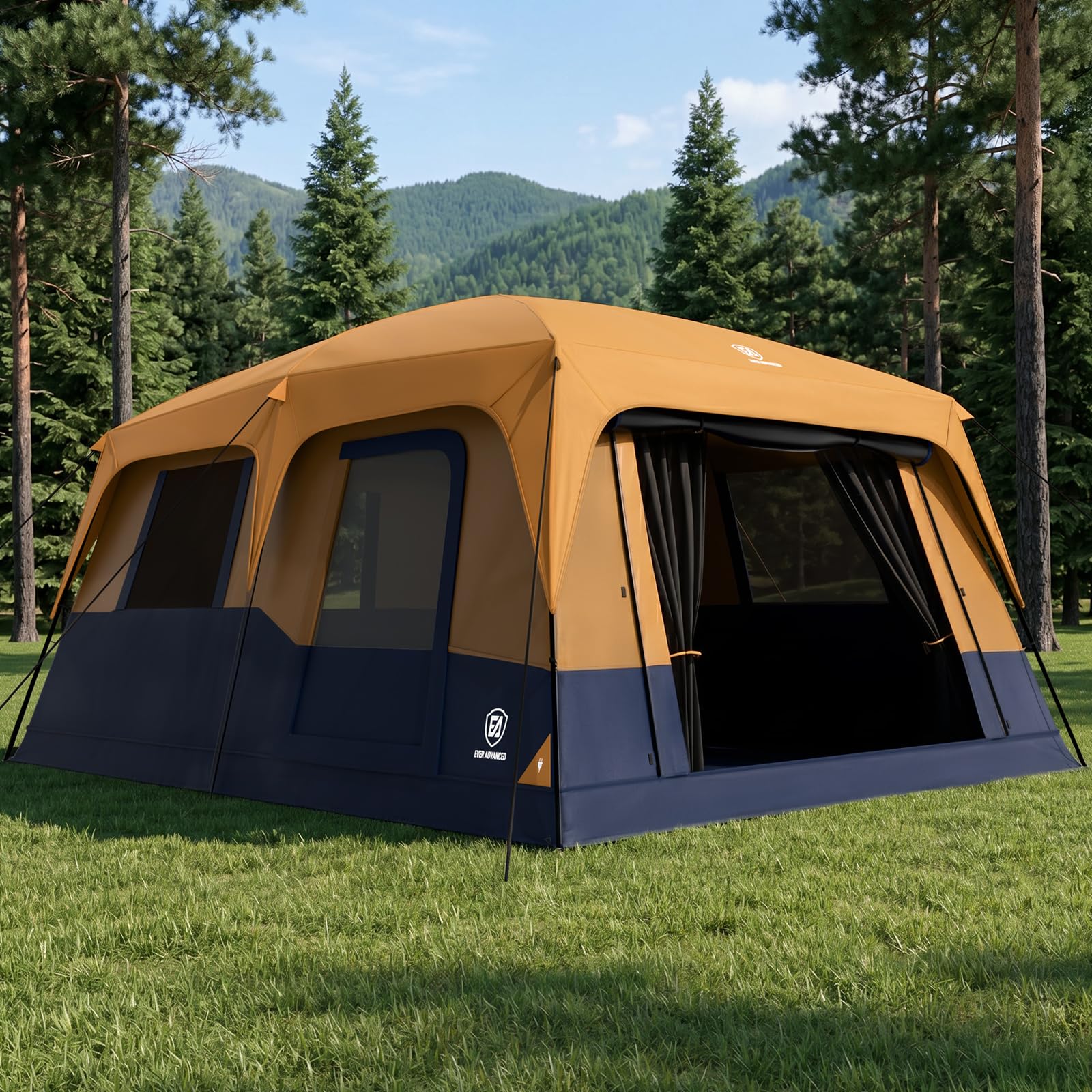
Ever Advanced 8P Blackout
Key Features
- Sleeps: 8
- Floor area: 112 sq ft
- Peak height: 80 in
- Packed weight: 43.1 lb
- Price: Premium
Blackout fabric is the whole pitch. The walls read pale gray from outside and go genuinely dark inside, which is why parents of small children end up paying for it. Add an 80-inch ceiling and an 8-by-14 floor and you have a cabin tent a six-foot adult can stand up in and a toddler can nap in at noon.
The rest of the design follows: four zippered mesh windows, overhead mesh, two doors, and a 4000mm coating that is the highest water rating in this group. The trade sits on the other side of the ledger — dark fabric holds heat, and on a hot afternoon this tent is warmer inside than a pale one, so pack a battery fan for July trips.
This is the tent we point to when sleep is the scarce resource: a festival where the sun is up before the children are, a site under a floodlight, a toddler who won’t nap in daylight. What you buy is the dark interior and the tallest side walls of any eight-person tent here; what you give up, besides money, is daylight, so bring a lantern and expect to check the time more often than seems reasonable.
Pros
- Blackout interior blocks morning light
- 80-inch ceiling and 4000mm coating
- Two doors and four zippered mesh windows
Cons
- Heaviest tent here at 43.1 pounds
Buy this one when daylight is the enemy: a genuinely dark interior and an 80-inch ceiling for families whose children wake with the sun.
Best for Large Families
UNP 10P Family Tent
Key Features
- Sleeps: 10
- Floor area: 162 sq ft
- Peak height: 78 in
- Packed weight: 21 lb
- Price: Midrange
Eighteen feet by nine, 78 inches tall, a divider down the middle, and 162 square feet: the UNP is the cheapest way here to sleep ten, and the floor plan is the reason. Ten sleeping bags or three queen airbeds is the claim; what it really buys is a family of six or seven with a duffel wall along the front and room to walk.
Setup is conventional pole-and-sleeve work with a lot of stakes, and it wants two adults to stand it up without an argument. The mesh roof is the detail we liked most — in August it’s the difference between a tent that feels like a sealed bag and one you can lie in and watch stars through — and the divider means the children’s side and the adults’ side are genuinely separate rooms.
What it asks in return is care. Feed each pole without forcing a bind, stake it out so the frame isn’t fighting the wind, and keep a repair sleeve in the bag; a ten-person tent at this price is a fair bargain as long as you don’t treat the frame like a hammer. Do that and you have big-family space at a price the big cabins can’t approach.
Pros
- 162 square feet with a room divider
- Mesh roof for stargazing and airflow
- 78-inch ceiling and two doors
Cons
- Poles and corner grommets are the wear points
- Vague instructions on the first pitch
The cheapest ten-person tent in this roundup, and the roomiest per dollar for a big family that wants a divider and a stargazing roof.
Best for First Tents
Amazon Basics 8P Dome

Key Features
- Sleeps: 8
- Floor area: 135 sq ft
- Peak height: 70 in
- Pole material: Aluminum
- Price: Budget
Fifteen feet by nine, 135 square feet, and the lowest outlay here: the Amazon Basics dome is the cheapest route to a floor this big. It’s a plain single-room tent with a back window, a cool-air port, and a 70-inch ceiling that is the lowest of the big tents in this group — adults duck, children don’t.
For a first tent, a scout weekend, or a family that camps twice a summer, that trade is a sensible one. The money goes into the parts that matter: aluminum poles instead of the fiberglass most tents at this level use, a floor that turns up at the edges to hold back ground water, and a small shelf at the top with a lamp holder that you will be grateful for at nine at night.
What to watch is the pitch rather than the product. The poles want a firm push to seat in their sleeves, and the first assembly on a windy afternoon is when you’ll notice. Set it up once in the yard before you leave, learn where each pole belongs, and the second pitch takes a fraction of the time.
Pros
- 135 square feet at the lowest outlay here
- Aluminum poles rather than fiberglass
- Top shelf with a lamp holder
Cons
- Single door at the far end
- Door zipper catches on the fabric
The least expensive way into a 135-square-foot family tent, with aluminum poles to show for it — just don’t expect to stand up inside.
Best for Small Families
Fanttik 6P Instant

Key Features
- Sleeps: 6
- Floor area: 90 sq ft
- Setup time: 60 seconds
- Peak height: 66 in
- Price: Budget
Sixty seconds is the claim, and the pre-installed frame gets close: unfold it, extend the legs, and a 10-by-9 cabin stands up without a single pole to feed. Of the instant tents here, this is the cheapest and the lightest at 19 pounds, which makes it the one you can leave in the car for the weekend you decide to go.
Then you step inside and meet the catch. Peak height is 66 inches: fine for children, fine for sitting out a rainy hour, awkward for an adult putting on trousers. The floor is 90 square feet, which holds a queen airbed plus gear or four sleeping bags, and four mesh windows and a ceiling panel stop it feeling like a box.
Weather details show more thought than the price suggests: a 1500mm coating, a drainage channel at the bottom of the door zip so water doesn’t pour in when you open up, and enough stakes to guy it out properly in a breeze.
Think of it as a starter family tent rather than a base camp. With small children the low ceiling costs you nothing and the fast pitch is worth a great deal; with teenagers or a week of rain, you’ll want more tent. It’s the pick for the family that camps in short bursts and would rather be eating than pitching.
Pros
- Pre-installed frame pitches in about a minute
- 19 pounds, the lightest instant tent here
Cons
- Single door for a whole family
- Light-duty frame needs careful handling
The cheapest, lightest instant tent here — a smart buy for small children, a poor one for anyone who wants to stand up.
How We Tested the Best Family Camping Tents
I started with the tents that come up again and again in owner reviews and camping forums, then cut anything that needed two adults to pitch, topped out above what a family would reasonably spend on a tent used a handful of weekends a year, or packed down too long for a mid-size SUV. That left 10 tents, spanning dome, cabin, and blackout styles.
Each one has now been used for eight months, starting with a timed solo setup in my driveway and then a second timed pitch at a campsite after dark with two kids waiting in the car. I ran every door zipper open and shut 50 times, watching for snags, skipped teeth, and fabric catching in the coil, then did it again after a weekend of sandy feet. Inside, I measured usable floor space with four sleeping pads laid out, checked headroom at the center and at the corners, and counted whether everyone’s bag fit without blocking the door.
Rather than wait for weather, I made my own at home: ten minutes of hose spray on the fly, then a check of the seams, corners, and floor for dampness. The lakeside trip handled wind, where I watched how the poles flexed, whether the guy lines held their tension overnight, and how much the walls flapped. After every trip I stuffed each tent back into its bag and noted bent pole sections, frayed loops, stretched seams, and whether the fabric still looked taut on the frame — that last one is how we judged appearance, since a tent that sags looks old fast. Value came down to nights of use against the price, and the winners are the ones we’d happily pitch again.
How to Choose a Family Camping Tent
The number printed on a family tent is a sleeping-bag count, not a family count, so buy floor area first and the rest of the decision gets much easier.
Start with floor area, not the person count
A queen airbed eats roughly 30 square feet, so two of them plus floor to walk on is about 100 square feet — which is why a six-person tent and a nine-person tent feel identical once the mattresses go down. Our rule of thumb for airbed camping is 25 to 30 square feet of floor per sleeper, and half that for children in bags on the floor.
The gap between a 100-square-foot dome and a 176-square-foot cabin is the difference between a family that sleeps and a family that climbs over each other. Read the floor dimensions on the box, not the capacity figure.
Decide who pitches it, and how often
An instant frame and a pole-and-sleeve tent are two different evenings. Instant tents stand up in a minute or two; sleeve tents ask ten to fifteen minutes and, realistically, two adults. If one adult does most of the work while the other handles children and dinner, pay for the instant frame.
Two traps here. Quoted setup times never include stakes, guylines, and the rainfly, so add ten minutes to whatever the box claims. And a tall tent puts the fly’s far clips above a shorter camper’s reach, which is the step where a family pitch usually stalls.
Rain protection lives in the fly and the floor
Hydrostatic head measures how much water pressure a fabric resists before it leaks. Between 1000mm and 1500mm is a normal family tent; 4000mm is more than most families will ever test. The number matters less than coverage: a fly that reaches down the walls, taped seams, and a floor that turns up at the edges.
The trap is the word waterproof. On a tent it describes the fabric, not the stitching, and not the zip. If you camp in shoulder seasons, budget for a footprint tarp under the floor; it is the cheapest insurance a family tent has.
Height, doors, and dividers: four people in one room
Below about 72 inches at the peak, adults crouch, and by day two that gets old. Between 78 and 86 inches most people stand upright, which matters most for changing clothes and for the wet afternoon everyone spends inside.
Doors come next. One door means a family queues; two doors let the early riser out without waking the rest. A divider does not buy real privacy, but it separates a children’s side from a parents’ side, and at ten at night that is the same thing.
Match the footprint to the site you book
Measure before you buy. Many drive-in pads are 10 by 10 or 12 by 12 feet, which suits a dome or a 14-by-9 cabin but not a 20-foot tunnel; those want a long site or two adjacent pads. A tent that does not fit the pad gets pitched on a slope, and a sloping pitch ruins sleep faster than any missing feature.
Weight follows the same logic. Anything from about 20 to 43 pounds is car camping, so choose the space you want and accept the bag rather than downsizing to something you can carry and then sleeping badly.
Frequently Asked Questions
Do family tents get cold at night?
Warmth comes from what you sleep on and in, not from the tent walls. The mesh ceiling that makes a summer tent bearable is also where heat escapes, so put the rainfly on before bed when the night looks cool and leave the low vents open — that clears condensation without letting warmth out of the top.
In a big cabin tent the air volume works against you. A better pad and a hat do more than a heavier tent.
How do I keep a tent from leaking in its second season?
If water comes through the seams rather than the fabric, the proofing has worn off. Wash the fly with mild soap and water — never detergent — dry it completely, then work seam sealer into the stitched seams and the floor corners.
Store the tent loose and bone dry, never damp and compressed, and re-seal once a season if you camp often. A tent packed away wet is the one that comes out smelling.
Can I pitch a family tent in a backyard or at a festival?
Yes, with one rule: do not count on stakes. Many festivals and rented yards ban them, and a tent this size turns into a kite without anchors. Use sandbags or water weights at every corner and guyline point instead.
Leave the rainfly off in dry weather for airflow, and check the site’s rules on fires and generators before you load the car.
Final Verdict
For most families the CORE 9 Person Instant Cabin is the tent to buy. It removes the worst part of arriving, stands tall enough that nobody dresses on their knees, and gives parents a divider without shrinking the sleeping area. Nothing else here balances those three so evenly.
If money matters more than minutes, the Coleman Sundome is the safer cheap tent, with better-proven rain protection in a smaller room. If your group runs eight or more, the CORE 12 Person Cabin’s straight walls and 86-inch ceiling are worth the longer pitch.