This post contains affiliate links. We may earn a small commission when you buy through our links — at no extra cost to you.
A tent rated for four people and a tent that four people can actually ride out a rainy Saturday in are rarely the same shelter. Manufacturers count bodies lying shoulder to shoulder on the floor, which leaves no seat, no floor space, and nowhere to put the duffels, the dog, or the cooler that always ends up inside. What a genuinely good four-person tent fixes is the friction: the twenty-minute setup in fading light, the drip on a sleeping bag at 2 a.m., the door zipper that jams halfway around with a kid waiting to get out.
I’ve spent enough nights in tents that claim to sleep six and comfortably hold three to be suspicious of capacity numbers. We pitched 10 four-person tents over eight months — weekend car-camping trips, a friend’s backyard, and one long night of steady rain — and the best of them go up without a fight, stay dry, and give everyone somewhere to sit when the weather turns. One thing first-time buyers don’t realize: price tracks weight and packed size far more than it tracks roominess, so a heavier, cheaper tent is often the smarter buy for car camping. Every pick below is one we’d happily unroll again, and none of them are ultralight — that’s the point.


Best for Family Car Camping
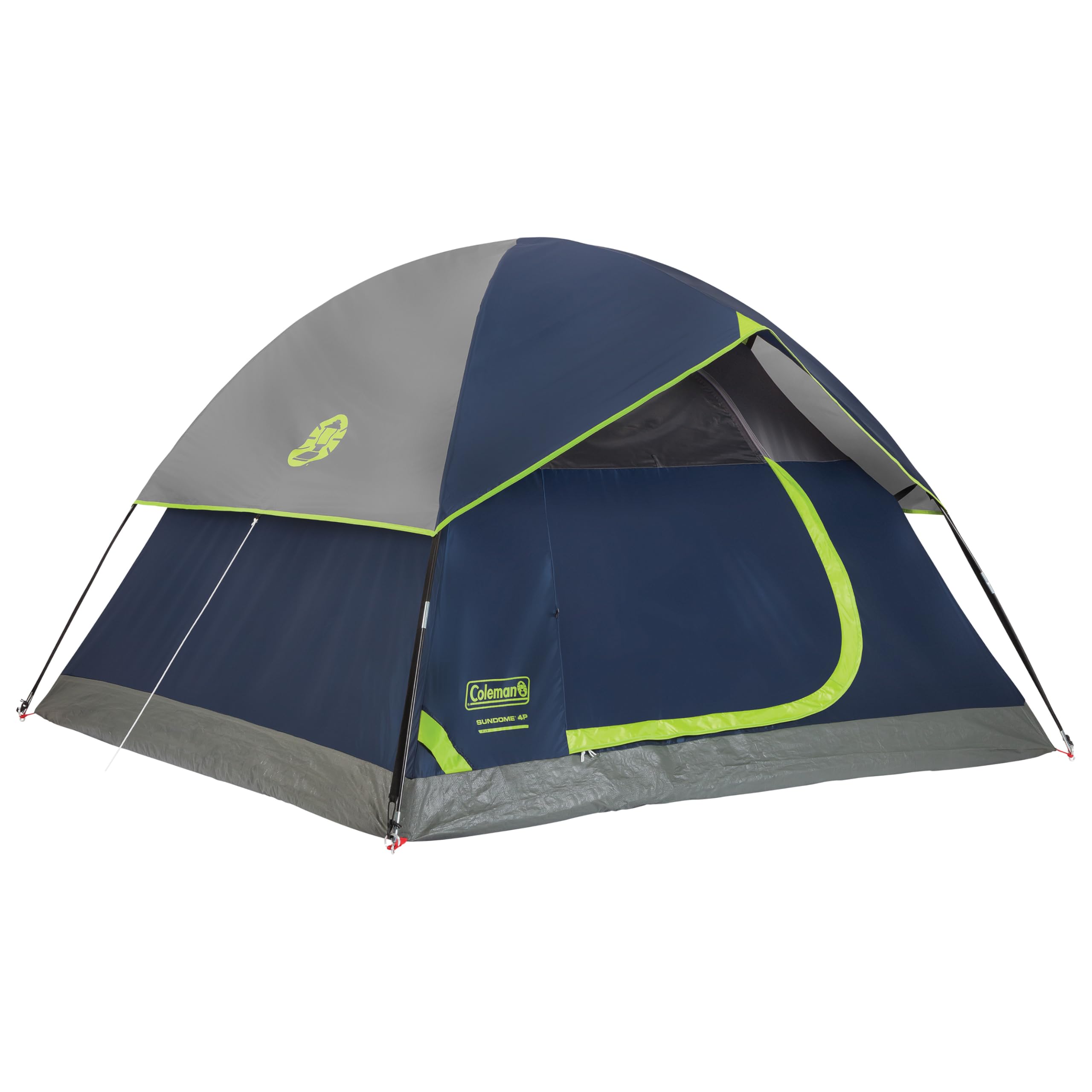
Coleman Sundome 4P
Key Features
- Weight: 9.1 lb
- Floor size: 9 x 7 ft
- Peak height: 59 in
- Sleeping capacity: 4 person
- Price: Midrange
Nine by seven feet is the number that decides whether a four-person tent works, and the Sundome uses its footprint well: 63 square feet, a rectangular floor, and corners wide enough to drop a sleeping bag into without a fight. That, plus the price, is why we send most families here first. Two adults and two children fit with duffels down the middle. Four grown adults fit the way they fit in any tent this size, shoulder to shoulder with nowhere to put a boot.
Pitching is the other half of the case. The body clips to the frame instead of threading through sleeves, so one person can walk the poles up and clip the shell out, then throw the fly over the top. Our first pitch was clumsy and our second was not, which is the honest version of a ten-minute setup claim. Stake the fly out at the door; leave it loose and it sags into the opening every time you unzip.
In rain it behaves the way a coated polyester dome with a fitted fly should: the water stays outside, and the low vent and mesh panels keep enough air moving that we were not wiping the walls at dawn. The frame is what to look after. A splintered pole is how this tent, like most at its price, ends its life early, so guy it out in wind instead of letting it rock, and never force a bent section back through a sleeve that does not want it.
It also goes back into its bag without a wrestling match, which among tents this size is rarer than the marketing implies.
Pros
- 63 sq ft rectangular floor fits bags and duffels
- Clips, not sleeves, for a fast one-person pitch
- Stays dry under the fitted rainfly
Cons
- 59-inch peak rules out standing
- One door for four people
We recommend the Sundome to anyone who wants four-person shelter, a quick pitch, and dry nights without spending much — it is the best all-round value here.
Best for Wet-Weather Trips
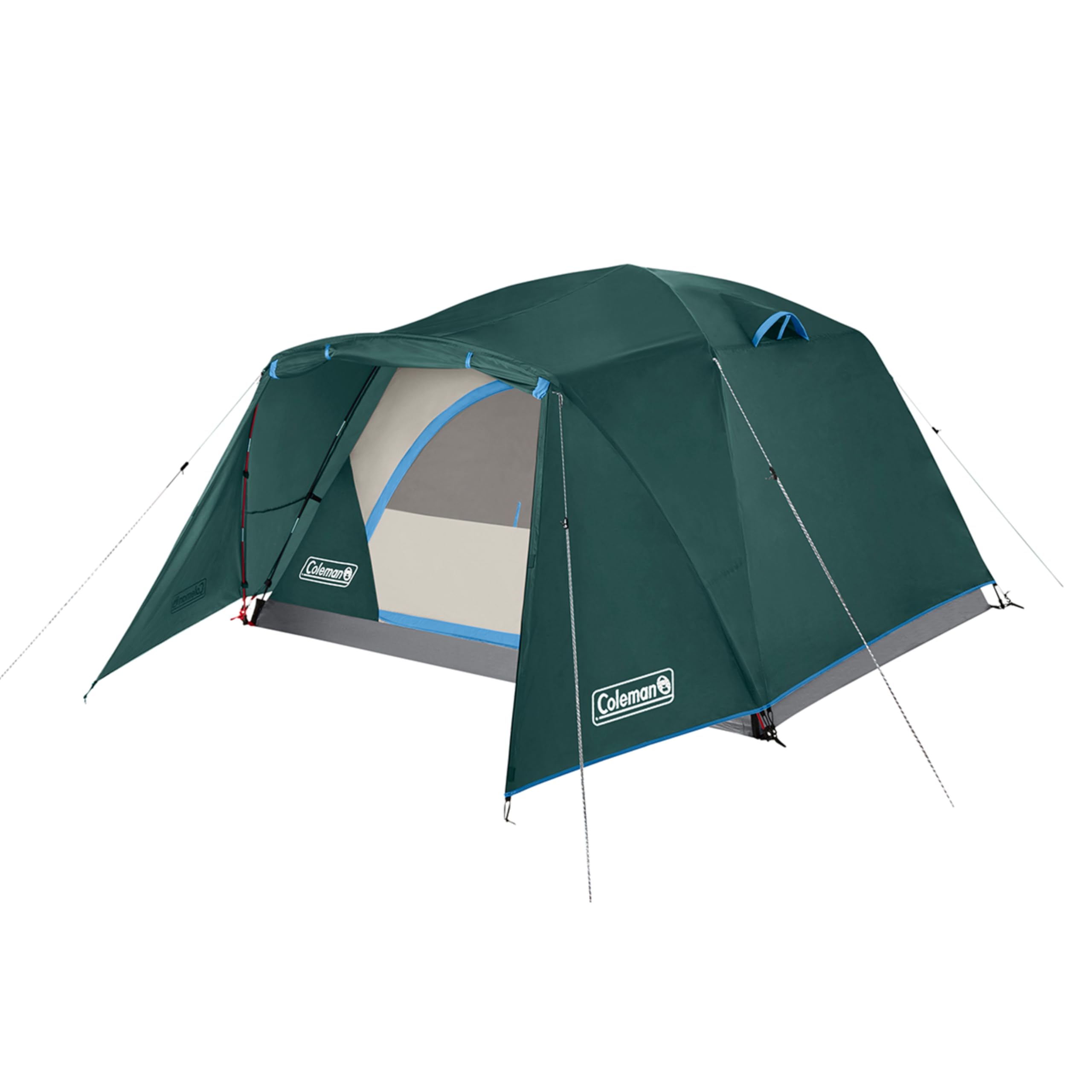
Coleman Skydome Full-Fly 4P
Key Features
- Weight: 13.7 lb
- Floor size: 10 x 8 ft
- Peak height: 72 in
- Vestibule area: 28 sq ft
- Price: Premium
A 13 by 3.5 foot vestibule is the reason to spend Skydome money rather than Sundome money. It is 28 square feet of covered floor at the front of the tent: somewhere to stand out of the rain and pull your boots off, somewhere for the cooler and the wet towel, and a windbreak over the doorway. We take that over a second door every time, because the porch is the part of a wet camping weekend that decides whether the trip is fun.
Inside, it does the Skydome trick: near-vertical walls and 72 inches at the peak, so an adult stands hunched rather than crawling, over a full 10 by 8 floor. The wide door swallows an inflated air bed without deflating it first. Air is the trade. The fly covers nearly the whole body, so the small vents and the door mesh do all the work; in still, humid weather, open every vent you have and accept that the inner walls will be damp by morning.
At 13.7 pounds it is still a car-camping tent, and the pre-attached poles go up the way the standard Skydome’s do: about five minutes, faster with two people when the wind is up. Pitch the vestibule first and stake it out, and the inner body stays out of the weather while you clip it in, which is the whole point of buying this version.
Pros
- 28 sq ft vestibule keeps boots and gear dry
- 72-inch peak and near-vertical walls
- Pre-attached poles pitch in about five minutes
Cons
- 13.7 lb to haul and store
- Costs well over the standard dome
Our pick for wet trips: the full-fly vestibule gives you a dry porch for boots and gear, and the Skydome frame still pitches in minutes.
Best for Standing Room
FanttikOutdoor Alpha C4 Ultra
Key Features
- Weight: 27.5 lb
- Floor size: 94 x 94 in
- Setup time: 60 seconds
- Peak height: 80 in
- Price: Premium
Standing up inside a tent to change clothes is a small luxury that sells itself on the first cold morning, and the Alpha C4 Ultra is built around it: 80 inches at the peak across a 94 by 94 inch hex, with four near-vertical walls instead of a sloping dome.
We were ready for the 60-second claim to be marketing, and for the frame it mostly is not. The hub unfolds and locks without a single pole to thread, though the rainfly adds a few minutes on top. What that buys is real: a queen air bed goes in with floor left over, and the 12 mesh windows keep a cabin this size from turning into a greenhouse by mid-morning.
The cost is literal and physical. At 27.5 pounds it is the heaviest tent here and a two-hands carry from the trunk. Seams are the place to watch, since the floor-to-wall joins take the abrasion of cots and boots. And pull the door panel taut before you move the slider, because a zipper that catches this much fabric is how a good tent gets a tear.
Pros
- 80-inch peak lets adults stand
- Hub frame locks out in about a minute
- 12 mesh windows keep a big cabin airy
Cons
- 27.5 lb before you add gear
- One door for a cabin this size
Buy this one if you want to stand up inside and pitch in about a minute; we think the 80-inch ceiling and the hub frame are worth carrying 27.5 pounds for.
Best for Quick Weekend Trips
FanttikOutdoor Zeta C4 Pro
Key Features
- Weight: 14.5 lb
- Floor size: 8 x 8 ft
- Peak height: 59 in
- Waterproof coating: 1500 mm
- Price: Midrange
Two feet less ceiling, half the weight, and about half the money is the trade the Zeta C4 Pro makes against the Alpha C4 Ultra, and for plenty of families it is the right trade. It is an 8 by 8 instant cabin with a 59-inch peak: you duck through the door and then stand hunched, not upright.
Setup is quick and honest about it. The pre-attached frame unfolds and clicks into shape in about a minute, and the fly hooks over the top. Ventilation is the strongest thing here, with mesh on all four sides, low floor vents, and a mesh ceiling panel, which matters in a cabin carrying this much fabric. Packing away is the slow half: the frame folds in a set order and the bag is sized for a tidy factory fold, so learn the fold at home rather than in the rain.
Water is where to set expectations. The listing describes the fabric as water-resistant and, in its own specifications, not waterproof, and we take that at face value. A 1500 mm coating and a drainage channel at the door handle a wet night; this is not the tent to bring to a weekend of sideways rain, which is the full-fly Coleman’s job. What you get instead is a light, airy, quick cabin that two people can put up without a conversation.
Pros
- Mesh on four sides plus a vented ceiling
- Frame clicks out in about a minute
- Half the weight of the standing cabin
Cons
- Water-resistant rather than waterproof
- Getting it back in the bag takes practice
For fair-weather weekends we pick this over the pricier cabin: instant setup, four-sided mesh, and a weight two people can throw in the trunk.
Best for Tight Budgets
Amazon Basics 4-Person Dome
Key Features
- Weight: 9.26 lb
- Floor size: 9 x 7 ft
- Setup time: Under 6 minutes
- Peak height: 48 in
- Price: Budget
Forty-eight inches at the peak is the catch here, and it is worth being blunt about it: adults crawl in, kneel to change, and sleep with the roof a forearm above their faces. What you accept that for is a genuinely cheap 9 by 7 dome with welded seams, a removable fly, and a small shelf at the top that holds a fan or a lantern.
The bones surprised us, given the price. Shock-corded poles thread through sleeves rather than clipping to the body, which is slower than the Coleman system but kinder to a bent section, and the fly covers the roof and the door side properly. The zipper is the weak point, and it is the fabric rather than the slider: the storm flap catches in the teeth unless you hold it clear, so teach whoever sleeps nearest the door to do that before the first midnight trip.
Two things worth knowing before you order. Fiberglass poles are what let a tent at this price down over time, so do not force one through a tight sleeve on a cold morning. And it is light enough that one person carries the tent plus the rest of the site kit in a single trip from the car.
Pros
- Welded seams and a removable rainfly
- Top shelf holds a fan or lantern
- One of the least expensive tents here
Cons
- 48-inch peak means crawling in
- Storm flap catches in the zipper
If the budget decides, this is the tent we point you to: a sealed 9 by 7 dome for very little money, provided everyone can duck through a 48-inch door.
Best for Kayak and Bike Trips
Clostnature 4-Person Tent

Key Features
- Floor size: 7 ft 3 in x 7 ft 8 in
- Peak height: 4 ft 7 in
- Trail weight: 8 lb
- Waterproof coating: PU2000 mm
- Price: Budget
Eight pounds of trail weight and a stuff sack small enough to disappear into a duffel is what this tent is for. Clostnature labels it a four-person tent at 7 foot 3 by 7 foot 8, and that rating is the ceiling of what it does: two adults sleep comfortably with packs at their feet, three is a negotiation, and four is a number on the box.
For very little money you get a proper double-wall dome: a PU2000 mm coating, factory-sealed seams, two windows, and eight stakes with four guylines, which is more hardware than most tents at this end of the range include. The 4 foot 7 ceiling means you are lying down or crawling, and the poles are fiberglass, so treat a cold-morning pitch gently.
The honest limit is weather. A 2000 mm coating and sealed seams handle a night of steady rain; we do not trust them through a storm with wind behind it, and if that is the forecast, pay for the full-fly Coleman instead. The zips are the other soft spot, and the door zip is the first thing to complain when the tent is pitched tight, so leave a little slack in the door panel. None of that changes what this one is good at: light, inexpensive, and small enough to vanish into a full car.
Pros
- Light and compact for kayak or bike trips
- Factory-sealed seams and PU2000 mm coating
- Eight stakes and four guylines included
Cons
- Sleeps two adults, not four
- Coating suits steady rain, not storms
A light, inexpensive tent for two adults and their gear; we choose it when the car is already full and the forecast is kind.
What We Put These Tents Through
We started with a shortlist of about 40 four-person tents pulled from manufacturer specs, retailer best-seller lists, and reader questions, then narrowed it by floor dimensions, peak height, door count, and price — cutting anything that turned out to be a three-person tent with a marketing bump. That left 10 tents, which we pitched and slept in over eight months, and we compared what each price tier actually bought in fabric, poles, and included extras.
Setup was timed solo with a stopwatch, starting from a fully stuffed bag, usually at dusk. We noted color-coded poles, whether the footprint clipped on without instructions, and how many times we had to stop and re-read the sheet. Inside, we laid out four full-size sleeping pads, four duffels, and a cooler to see what genuinely fit, then had two adults and two kids sit up, change clothes, and get out the door without climbing over each other.
Water resistance got a 10-minute hose soak at the seams and door, plus one long night of real rain; in the morning we checked for pooling in the corners and damp patches under the pads. Zippers were opened one-handed from inside, in the dark, and again after we deliberately tracked sand into the track. We re-staked each tent on an exposed ridge to watch how the poles handled gusts, and counted vents and checked the walls for condensation after a cold night. Eight months in, we looked for floor abrasion, lifting seam tape, and fly fabric that had faded or gone brittle.
How to Choose a Four-Person Camping Tent
The number on the box counts sleeping bags laid side by side, not people who want elbow room, so the useful question is how much floor and ceiling your version of four people needs.
What Four-Person Really Means
Four-person tents in this group run from about 56 to 80 square feet, and that spread matters more than the label. Divide the floor by four and you get roughly 14 to 20 square feet per sleeper: enough for a bag and a pad, not for a bag, a pad, and a duffel. Budget about 20 square feet per adult, and count an air bed as two people.
A queen mattress covers close to half of a 9 by 7 floor, which is why families who sleep on one usually end up in a six-person tent. Four adults plus gear under cover is what the 10 by 8 Skydome floor and its vestibule are for.
Height, Doors, and Getting Gear Inside
Peak height splits the category cleanly. Between 48 and 59 inches you crawl in and kneel to dress; at 72 to 80 inches you stand, and you pay for it in weight — the standing cabins here run 14 to 27 pounds against 9 for a plain dome. Door width matters nearly as much, because an inflated air bed has to go through it without being deflated first.
Every tent in this group has a single door, so site it away from the prevailing wind and the morning sun. If anyone in the party is tall or gets up in the night, put the money into ceiling height.
Rain: Coating, Seams, and the Fly
Two things do most of the work: the coating, which runs from around 1500 mm to 3000 mm on these tents, and whether the seams are sealed or welded. A partial fly covers the roof; a full fly reaches down the sides, and a vestibule adds a covered entry.
For three-season family camping we prioritise fly coverage over a bigger coating number, because rain usually arrives sideways and a soaked door panel is what wets the floor. Check that the fly reaches past the door before you commit.
Condensation and the Care That Adds Seasons
A sealed tent full of breathing people gets wet from the inside whatever the coating says, and these tents handle it with mesh: low vents, door mesh, roof panels. Leave every vent open unless it is actually raining, and pitch the low vent into the breeze.
Dry the tent completely, an afternoon in the sun or a line in the garage, before it goes into storage; a tent packed damp comes back with a smell and a coating that has given up. Pack-down is the other half of setup, and instant frames fold in a set order.
Frequently Asked Questions
Do I need a footprint or tarp under a camping tent?
Yes, and a cheap tarp is enough. Cut it an inch or two smaller than the tent floor on every side so no edge sticks out to catch rain. It protects the floor from gravel and roots, keeps ground moisture from wicking up through the fabric, and takes the abrasion that would otherwise wear the coating.
An oversized tarp is worse than none: it channels water under the tent instead of away from it.
Are instant tents harder to pack away than pole tents?
The frame folds back in the order it unfolded, and after two or three goes it takes about as long as a pole tent. The friction is the bag, which is sized for a tidy factory fold. Learn the fold once at home, wrap the fabric around the frame rather than stuffing it, and accept the weight: the instant cabins here run 14.5 to 27.5 pounds.
What do I do if a tent pole splinters?
Don’t tape it and keep loading it. Slide a pole repair sleeve over the break, pitch with reduced tension, and order a replacement section by model number. Coleman covers its frames for a year and Clostnature advertises a one-year guarantee, so a pole that splinters on the first pitch is a warranty conversation rather than a repair.
Final Verdict
Most people should buy the Coleman Sundome. It has the most usable floor of the value tents here, it pitches in minutes, it keeps rain out, and it leaves budget for a tarp and a decent cooler.
Spend up only for a reason: the Skydome with the full-fly vestibule if your trips are wet, or the Alpha C4 Ultra if standing up and a one-minute pitch are worth 27.5 pounds and a lot more money. The Fanttik Zeta C4 Pro sits between them and is the one we take for fair-weather weekends.