This post contains affiliate links. We may earn a small commission when you buy through our links — at no extra cost to you.
Camping is supposed to be the easy part of the weekend — until you’re standing in a field at dusk with a pile of poles, a rainfly that doesn’t obviously belong to anything, and a forecast that just changed. I’ve had that night. The tent is the one piece of gear that decides whether a trip feels like a vacation or an endurance test, and a good four-person tent fixes three things at once: it goes up without a fight, it keeps the water out when the sky opens, and it holds four sleeping pads plus duffels without everyone crawling over each other.
Here’s something I wish someone had told me before my first tent: a four-person rating is a sleeping-pad count, not a comfort count. Most of these will sleep four adults if nobody rolls over; three adults plus gear is what four-person actually feels like. We pitched and slept in 12 of them over eight months, and the gaps showed up in the rain and in morning condensation, not on the spec sheet. The ones below are the ones we’d take out again.



Best for Family Car Camping
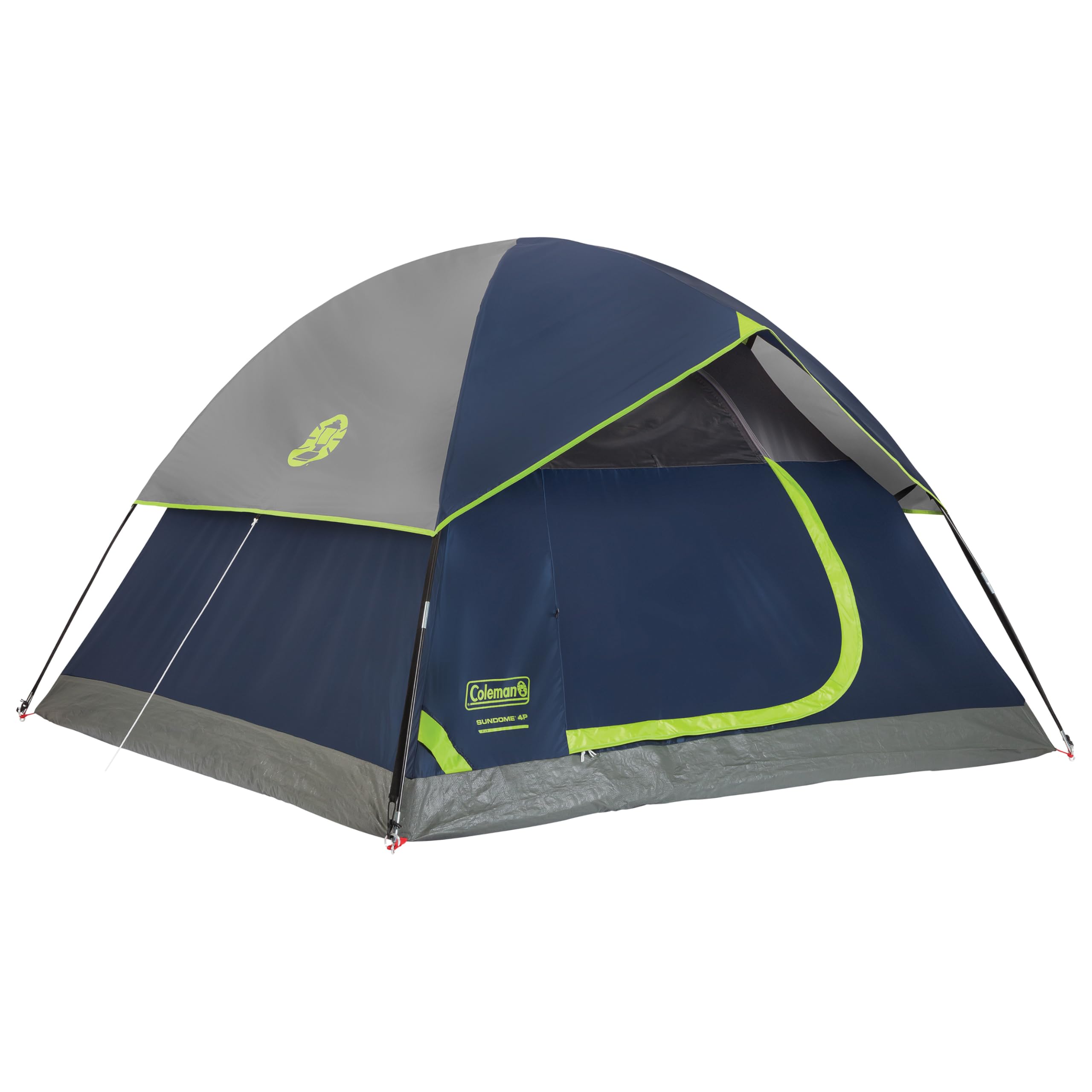
Coleman Sundome 4P
Key Features
- Floor: 108 x 84 in
- Weight: 9.1 lb
- Setup Time: 5 min
- Peak Height: 59 in
- Price: Midrange
Nine by seven feet sounds generous until four sleeping pads are on it. At 63 square feet, the Sundome is a genuinely comfortable tent for two or three and a four-person tent only when two of those people are small. We put it first anyway, because the things that decide most camping weekends are the things it gets right: a five-minute pitch, a rainfly that keeps a wet night outside, and a price in the middle of this group.
We have put this one up at dusk with a single headlamp and no argument, which is the highest compliment a tent can get. The frame is clipped rather than threaded, so the poles snap onto the body instead of disappearing into long sleeves, and the listed five minutes is realistic once you’ve done it once. One person can manage the whole job. The wide windows and the ground vent matter more than they sound on a still, warm night, when they’re the difference between a tent that’s misty by midnight and one that’s still comfortable.
Where it gives ground is height. Fifty-nine inches at the peak is a sit-up-and-change tent, not a stand-up one, and the single door means everyone files through the same opening. Be honest about bodies, too: two adults with a queen mattress and a duffel each are comfortable in here, and four adults with the same kit are not. Gear decides it, not the number on the box.
For a car, a cooler and a weekend at a state park, this is the tent we point people to first. If standing up is the priority, the UNP buys you a foot of headroom; if the tent has to be carried, the Clostnature is a different animal at five pounds. Those are different trips, not better versions of this tent.
Pros
- Five-minute clip pitch one person can handle
- Rainfly and coated floor handle a wet night
- 63 square feet takes a queen mattress plus gear
- Wide windows and ground vent keep air moving
Cons
- Tight for four adults with duffels
- 59-inch peak means no standing up
- Fiberglass poles can break in strong wind
For car camping with two adults and a couple of kids, this is the tent we recommend first: quick to pitch, properly rainproof, and priced in the middle rather than at the top.
Best for Backpacking and Biking
Clostnature 4P Backpacking
Key Features
- Doors: 2
- Floor: 7.3 x 7.7 ft
- Weight: 5 lb
- Peak Height: 55 in
- Price: Budget
Five pounds is the number that makes this tent interesting. Everything else here runs from nine pounds up to nearly thirty, which is fine when the car is twenty feet away and hopeless when it isn’t. Clostnature gets there with two aluminum poles and a low profile — 55 inches at the peak, so you crawl in and sit up rather than walk around.
We rate the layout as highly as the weight. Two doors and two vestibules on a four-person floor isn’t a luxury; it’s what stops four people climbing over each other at two in the morning, and the vestibules give wet boots and packs somewhere to live that isn’t the sleeping area. The fly and floor carry a PU 5000 mm coating, which is a serious number at this end of the market.
The compromises are the usual ones for a light tent. Fabric this thin wants a footprint or a clean, cleared pitch site, and the low ceiling makes the interior feel close when it’s full, so two people plus gear is the honest comfortable load. For hiking, biking and motorcycle trips, though, nothing else in this group is close: the Fanttik is over five times the packed weight.
Pros
- About five pounds packed, lightest here
- Two doors and two vestibules
- PU 5000 mm coating on fly and floor
- Aluminum poles instead of fiberglass
Cons
- 55-inch peak height rules out standing
- Thin fabric wants a footprint underneath
If the tent has to travel on your back or a bike, this is the one: about five pounds, two doors, two vestibules, and a floor that still sleeps four pads.
Best for Budget Headroom
UNP 4P Cabin
Seventy-two inches of center height is the whole argument. That’s six feet of clearance in the middle of a cabin-shaped body, so you can pull on trousers, hang a lantern and move around without the crouch that defines most four-person domes. We walked in and out of this one without ducking once, which is not something we can say about the Sundome. The floor is 8 by 7 feet, a little smaller than the Sundome’s, but the near-vertical walls make far more of it usable at shoulder height.
The details are better than the price suggests: two mesh windows, a mesh roof panel, a port for a power cord, and side pockets that hold a phone and a headlamp. Setup is a conventional sleeve-and-pole job in the five-minute range, and one person can do it. It has also kept rain out on ordinary nights rather than only in the catalogue photographs.
The caveats are specific rather than fatal. The door zipper catches on its flap the way budget zippers do; hold the fabric taut ahead of the slider and it behaves. In a blow, get the guy lines out rather than trusting the frame on its own. Neither stops it being a lot of tent for the money.
Pros
- 72-inch center height you can stand up in
- Near-vertical walls make the floor usable
- Mesh roof, two windows, and a cord port
- Full family space at a low price
Cons
- Base fabric and stake loops wear first
Standing room is the reason to buy this one: 72 inches of clearance and space for a family of four, at a price near the bottom of this group.
Best for Wet-Weather Trips
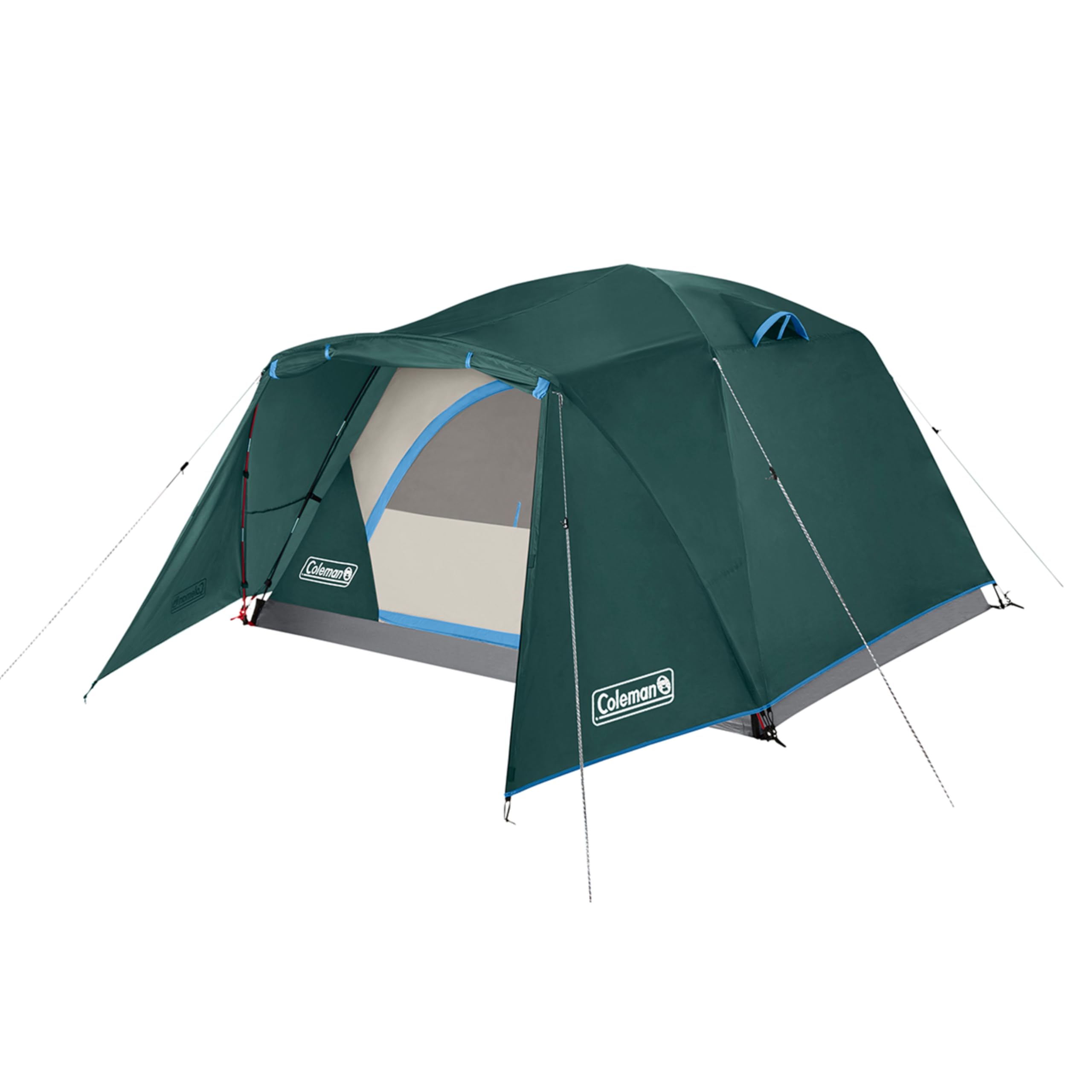
Coleman Skydome 4P Vestibule
Key Features
- Floor: 10 x 8 ft
- Weight: 13.7 lb
- Peak Height: 72 in
- Vestibule Area: 28 sq ft
- Price: Premium
Most tents here call a rainfly a feature and stop there. This Skydome’s fly runs all the way out over a front porch — 28 square feet, roughly 13 by 3.5 feet — where wet jackets, two packs and a cooler can live without anyone stepping over them at night. On a wet trip, the messy half of camping stays outside the sleeping half.
That vestibule is the reason to pay for this one, and the seams back it up: taped and welded rather than simply coated. The other half of the value is the shape. Eight by ten feet of floor and 72 inches at the peak, with the near-vertical walls Coleman builds into this line, means four adults can dress standing up instead of taking turns on their knees.
Two things to know before you commit. A full fly that covers nearly all the mesh cuts airflow, so in warm, still weather you’ll have the door and the rear vent open — condensation is the price of weather protection, and this tent is built for the wet trip, not the hot one. The second is weight: at nearly 14 pounds it lives in the car. Backpackers should stop reading here.
Pros
- 28-square-foot vestibule keeps wet kit outside
- 72-inch peak and near-vertical walls
- Taped and welded seams on the fly
- 10 by 8 foot floor for four adults
Cons
- Nearly 14 pounds, so car camping only
Camping through real rain with four people and a lot of gear is what this one is for: a 28-square-foot covered vestibule, taped seams and standing height inside.
Best for Base Camps
Fanttik Alpha C4 Ultra
Key Features
- Floor: 94 x 94 in
- Weight: 27.5 lb
- Setup Time: 1 min
- Peak Height: 80 in
- Price: Premium
A minute is the claim, and the frame does the work: the Alpha C4 is a hub tent, so the poles are pre-attached and the whole thing unfolds and locks rather than being threaded together. We stood it up in about the time it takes to describe it, then spent longer staking it and hooking on the rainfly, which is where the real minutes go.
What the weight and the money buy is space and standing room. Ninety-four inches square is 61 square feet, and 80 inches at the peak is the tallest here by eight inches — a six-foot-three camper can stand with room to spare. Twelve mesh windows and a gear loft keep it livable on a hot afternoon, and the door is wide enough to walk a cot through.
We were most impressed by how much of this tent is designed for the second season rather than the first weekend. The floor is 300D, heavier than anything else in this group, the seams at the doors and windows are sealed, and the rainfly hooks down tightly enough that it isn’t going anywhere in a gust. That’s the difference between a clever pop-up and a tent you keep.
It’s also a specialist. At 27.5 pounds it is never going on your back, and it is the most expensive tent here by a distance. For a truck, a base camp or a long stay on one pitch, though, the trade makes sense.
Pros
- Pitches in about a minute with no pole assembly
- 80-inch peak height, tallest here
- 300D floor and sealed seams
- Twelve mesh windows and a gear loft
Cons
- 27.5 pounds, so it stays with the vehicle
- Zippers can catch in the door fabric
For overlanding and base camps where setup speed and standing room beat low weight, this hub tent stands up in about a minute and gives you 80 inches of headroom.
Best for First Tent
Amazon Basics 4P Dome

Key Features
- Floor: 108 x 84 in
- Weight: 9.26 lb
- Setup Time: 6 min
- Peak Height: 48 in
- Price: Budget
This is the least expensive tent in the group, and it doesn’t look it: a simple orange dome, two shock-corded poles, a removable rainfly and a six-minute setup. The floor is 108 by 84 inches — the same 63 square feet as the Sundome — which is the first surprise.
The second is how low it sits. Forty-eight inches at the peak is the shortest here by nearly a foot, so this is a tent you sleep in and change in on your knees, not one you sit around in. One door and one window keep the price down and make a warm afternoon warmer than it needs to be.
We rate it as a first tent, a kids’ overflow tent, or the one that stays in the car for the night nobody planned: the shell does its job, and the rainfly and welded seams have kept ordinary weather out. The savings went into the fittings rather than the fabric, and that is where the compromises show.
Pros
- Lowest price in this group
- 63 square feet of floor for the money
- Removable rainfly and welded seams
- Six-minute setup with two shock-corded poles
Cons
- Door zipper catches on the flap
- Fiberglass poles are the weak point
A cheap first tent or a spare that lives in the trunk: this dome covers a family weekend and keeps the rain out, as long as you can live with a 48-inch ceiling.
How We Tested 12 Four-Person Tents
We started with a long list of four-person tents from the brands that turn up on campground loops everywhere, then trimmed it by the specs that actually change a trip: a full-coverage rainfly rather than a partial one, two doors, aluminum poles instead of fiberglass, at least 55 square feet of floor, and a peak height tall enough for our six-foot tester to sit up straight. That narrowed the field to 12 tents spread across the price range, from basic weekend models to shelters built for real weather.
Over eight months, every tent got pitched solo with a stopwatch running — the first time out of the box and again on its fifth setup. A good one went up in under five minutes without a second read of the instructions, and a couple never got there. We packed each one back into its stuff sack and weighed it, carried it from the car to the site, laid out four sleeping pads and two duffels to see what actually fit, and walked in and out in hiking boots to check the floor.
Then we got them wet. Each tent sat under a hose for ten minutes per side with paper towels pressed into the corners, and we compared notes after an overnight storm that flattened a neighboring canopy. On a warm, still night we zipped everything shut and checked the walls for condensation by morning, then repeated it with the vents open. Zippers were opened and closed a hundred times, including one-handed from inside in the dark, and we pushed the frames sideways to see how much they flexed before a pole bowed.
How to Choose a 4 Person Tent
The number on the box is a starting point, not a promise; what actually decides the right tent is whether it has to be carried, stood up in, or sat out in.
What four people actually means
Tent capacities are measured with sleeping pads touching and nothing else inside. A 56-to-63-square-foot floor — the UNP, the Sundome, the Alpha C4 — is a comfortable two-person tent, a reasonable two-adults-and-two-kids tent, and a cramped four-adult tent the moment duffels come through the door.
If four grown-ups are the plan, buy on floor area rather than the label. The Skydome’s 10-by-8-foot floor is the shape that actually delivers it, and that extra floor is most of what you pay for.
Height decides how the tent feels
Peak height is the specification people skip and then resent. Under 55 inches you crawl in and sit hunched; 59 to 60 inches is a sit-up-and-dress tent; 72 inches and above you stand. It is also where the price jumps: the Amazon Basics tops out at 48 inches, the Sundome at 59, while the UNP, the Skydome and the Alpha C4 run 72 to 80.
Standing room matters more than it sounds if you camp in cold or wet weather, because you’ll be dressing inside a lot. If you only ever pitch in summer and sleep in shorts, spend the money on floor area instead.
Weather protection is coverage, not a coating
Every tent here includes a rainfly; what separates them is how much of the tent it covers and how the seams are finished. A short fly stops above the door, so blowing rain reaches the zip and the lower wall. A full fly with a vestibule covers the entry and gives wet gear somewhere to go that isn’t the sleeping floor.
Taped or welded seams, and a floor that turns up several inches at the edges, are the other two details worth checking. If you camp to a schedule rather than a forecast, this is where the extra money belongs.
Weight and poles: car, bike or back
Poles set both the packed weight and the way a tent fails. Aluminum bends before it breaks and is lighter; fiberglass is cheaper and splinters. If the tent travels from car to pitch and back, weight is close to irrelevant and a heavier floor is a gift — that’s the Alpha C4’s argument at 27.5 pounds.
If it goes on your back, only one tent here qualifies: about five pounds, aluminum poles, two doors. There is no middle ground worth pretending exists.
Frequently Asked Questions
Do I need a footprint or a tarp under a 4 person tent?
Yes on gravel, rock or pine needles; it’s optional on grass. A footprint takes the abrasion that would otherwise wear the floor coating, which is the first thing to go on a budget tent.
Match it to the floor rather than buying a bigger tarp — 108 by 84 inches for the Sundome — and fold any overhang underneath. An edge sticking out past the tent collects rain and channels it under the floor.
Can one person set up a 4 person tent alone?
Usually, yes. Clip and hub frames, like the Sundome’s and the Alpha C4’s, go up solo without much drama, and instant designs are easier still. Long pole sleeves are the awkward ones, because the pole wants a second pair of hands at the far end.
Stake the corners before you raise the frame and the job gets simpler, especially in wind. Pitch with the door downwind so the fabric isn’t fighting you.
How many seasons should a 4 person tent last?
Several, for weekend use, and the poles usually fail before the fabric does. Fiberglass splinters at the joints; aluminum bends and can often be bent back.
Carry a pole repair sleeve, dry the tent fully before storage, and don’t leave it packed wet for weeks — mildew is what actually ends a tent’s life, not rain.
Final Verdict
Our pick for most people is the Coleman Sundome. It gets the boring things right: five minutes to pitch, a fly that keeps a wet night out, and enough floor for two adults and two kids, all at a mid-range price rather than a premium one.
The exception is a trip where the tent has to be carried, and there the Clostnature’s five pounds changes what’s possible. If you camp in the rain rather than around it, the Skydome’s covered vestibule is the upgrade that earns its keep.