This post contains affiliate links. We may earn a small commission when you buy through our links — at no extra cost to you.
A tent has one honest test, and it happens around 2 a.m., when the wind shifts and the seam above your head starts ticking. That’s when you find out whether the zipper closes on the first pull, whether the floor holds back the puddle at the door, and whether you’re sleeping or driving home early. I’ve done both, and the tents that hold up rarely carry the highest price tags — they’re the ones with honest poles, taped seams, and a floor thick enough to trust. The right tent fixes the parts of camping that wear people down: the wrestling match at setup, the elbow in your ribs all night, the morning you wake up damp.
Here’s what the spec sheet won’t tell you: a tent that needs two people to pitch is one you’ll resent every time you roll in after dark, and a four-person rating means four sleeping bags, not four people plus their gear. We put 12 tents through eight months of actual camping, and the gaps showed up fast. Below are the ones I’d pitch again — including a couple that don’t look like a sack of laundry.


Best for Everyday Family Camping
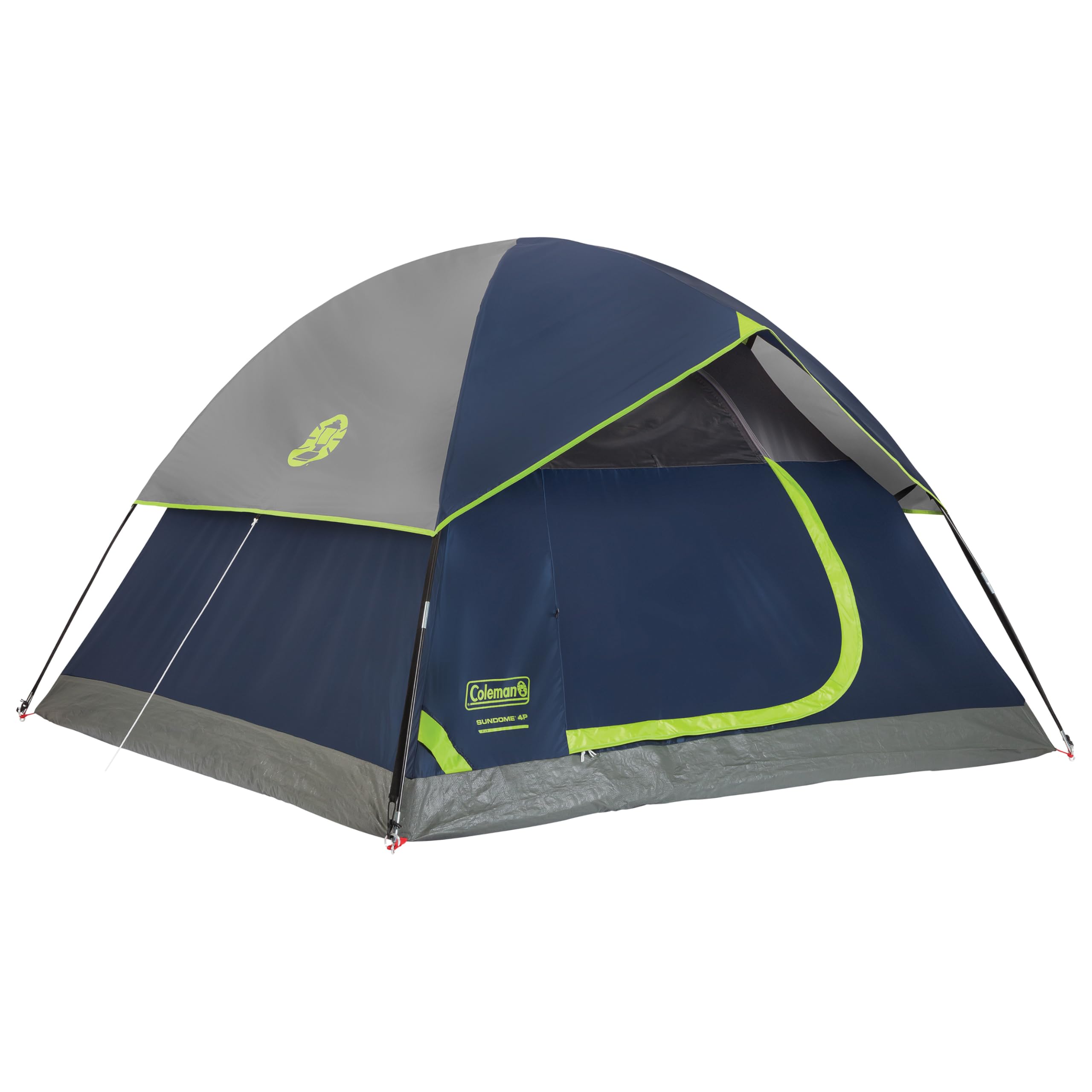
Coleman Sundome 4P
Key Features
- Sleeps: 4
- Footprint: 9 x 7 ft
- Floor area: 63 sq ft
- Packed weight: 9.1 lb
- Price: Midrange
Weather protection is where an inexpensive tent earns its keep, and the Sundome is the tent in this group we trust to keep two people dry through a wet night. A full rainfly, welded floor corners and a frame rated for 35 mph winds are more weatherproofing than the price suggests. The 9-by-7-foot floor is honest about itself, too: a queen air mattress and two bags, or two adults and small children who don’t mind being close.
Pitching is the other half of the appeal. The poles clip to the body rather than threading through sleeves, so one person can have it standing in about ten minutes and less once you’ve done it twice. That matters more than any line on a spec sheet, because the tents that ruin weekends are the ones nobody wants to put up in the rain.
Two things to plan around. The floor and base seams are where water gets in on wet ground, so cut a tarp to size and put it underneath, which does more than any spray-on treatment. And the poles are the part that gives first, which is why we stake the guylines even when the forecast is clear.
Four people in here is a stretch; three is comfortable and two is luxurious. If you need to stand up to dress, the UNP 6 Person cabin gives you a 78-inch ceiling for about the same money, and the CORE adds another 36 square feet and an instant frame at a much higher price and about three times the weight. For the couple, the small family and the once-a-month camper, this is the tent that asks the least of you.
Pros
- Keeps out steady rain at a mid-range price
- Clips instead of sleeves, so pitching is quick
- Two adults and gear fit without a squeeze
- Windows and a ground vent limit condensation
Cons
- Stated four-person capacity is really two or three
- Poles, not fabric, are the first thing to give
We recommend the Sundome to most campers: it keeps out real rain, one person can pitch it, and it leaves money in the budget for a tarp and a stove.
Best for Big Families
CORE 9 Person Instant Cabin
Key Features
- Sleeps: 9
- Floor area: 126 sq ft
- Center height: 78 in
- Packed weight: 27.6 lb
- Price: Premium
Pre-attached poles change the mood of a tent pitch. There’s no sleeve to feed and no pole order to get wrong: you unfold the cabin, extend the legs and the frame locks itself into a box, after which the rainfly clips on. The two-minute figure is about the frame rather than the whole job, so give it five minutes including stakes and nothing about the evening feels like work.
That speed is why this one stays in the recommendation for families: the tent stops being the chore that starts a trip. Inside, 14 by 9 feet and a 78-inch ceiling take two queen air mattresses with room to walk between them, and the two doors mean nobody climbs over anybody at two in the morning.
The cost is bulk. At 27.6 pounds with a long packed bag, this is a tent that rides in a car and nowhere else. Water is the other thing to watch: the fly is taped and the seams are sealed, but a long driving rain can push moisture through the walls, so seam sealer on the corners and a tarp underneath are cheap insurance. Four people with gear is the realistic load, and nine is a floor count rather than a sleeping plan.
Pros
- Frame locks into place in about two minutes
- Two queen mattresses with walking room to spare
- Two doors cut the midnight climb-over
- Taped fly and sealed seams handle ordinary weather
Cons
- 27.6 lb and a long bag mean car camping only
- Driving rain can push through the walls
We point big families here: two rooms’ worth of floor, a two-minute frame and two doors, as long as the tent only ever travels by car.
Best for Fast Weekend Trips
FanttikOutdoor Zeta C6 Pro
Key Features
- Sleeps: 6
- Floor area: 90 sq ft
- Center height: 66 in
- Packed weight: 19 lb
- Price: Midrange
Sixty seconds is the frame, not the tent. The poles are pre-installed, so you unfold, extend and the shell stands up almost immediately, but you still have four corners to stake and a fly to fasten, and on grass that is another few minutes. Go in expecting that and the speed is genuinely impressive; go in expecting to be finished in a minute and you’ll feel cheated.
What we like is where that leaves the tent overall: a 10-by-9-foot cabin one person can put up wet, tired and in the dark, at 19 pounds that doesn’t need a second pair of hands. Four mesh windows, floor vents and a mesh ceiling keep air moving through the whole shell, which is what a summer tent needs most and what keeps condensation off the walls at dawn.
Two limitations are worth knowing. The 66-inch ceiling is fine to sleep in and awkward to dress in, so anyone much over five and a half feet is crouching. And the single door’s zip catches on the storm flap, which is a two-second fix when you’re calm and a foul-mouthed one at two in the morning; keep the flap pulled clear as you close it and it behaves.
Pros
- Frame is standing in about a minute
- 19 lb, light enough to handle alone
- Mesh ceiling and floor vents keep air moving
- Two queen mattresses fit the 10-by-9 floor
Cons
- 66-inch ceiling means crouching to change
- Door zip catches on the storm flap
For people who hate pitching tents, this is the one: the frame stands in about a minute and one person can finish the job in five.
Best for Two-Room Family Stays
CAMPROS CP 8 Person
Key Features
- Rooms: 2
- Sleeps: 8
- Floor area: 126 sq ft
- Center height: 72 in
- Price: Midrange
A curtain down the middle of a tent sounds like a gimmick until you’re putting two children to bed on one side and staying up on the other. The CAMPROS hangs a full divider across its 14-by-9-foot interior, turning one large room into a sleeping side and a living side, which is the arrangement most families end up improvising with bags and coolers.
The rest of the shell is built for standing and moving: straight walls, a 72-inch ceiling and five mesh windows over 126 square feet of floor that takes two queen mattresses with a walkway left over. Two people can pitch it in about five minutes.
The door is the weak point. One zip serves both rooms, it runs a long way, and it drags when the flap folds under the slider, so keep the fabric pulled clear and it behaves. Water is the other variable: the fly covers the top well but leaves a run of seam exposed along the long side, and that’s where a sideways rain shows up first.
We rate the layout the best here for a family that wants separate sleeping sides without buying two tents. Eight people is a floor count rather than a plan, with six comfortable, but the divider and the headroom are what make a week under canvas liveable rather than merely large.
Pros
- Divider splits the tent into two real rooms
- 72-inch ceiling and straight walls
- 126 sq ft takes two queen mattresses
- Pitches in about five minutes with two people
Cons
- One door serves both rooms
- Fiberglass poles are the first to fail
Buy this one for the two-room layout: a real divider, standing height and 126 square feet, with a door zip that asks for a little patience.
Best for Stand-Up Budget Camping
UNP 6 Person Cabin
Key Features
- Sleeps: 6
- Floor area: 90 sq ft
- Center height: 78 in
- Packed weight: 17.8 lb
- Price: Midrange
Seventy-eight inches of center height is the number that matters here. Most adults can stand up straight to pull on trousers, and on a wet morning that single fact is worth more than any pocket or lantern loop. Around it sits a 10-by-9-foot cabin with five mesh windows and a mesh top, 90 square feet of floor that takes two queen mattresses, and a build that goes up in five minutes with two people.
It is the least you can spend here for a cabin you can stand in, and the compromises sit where you expect them. Water is the one to manage: seams and window zips can seep in a long, heavy rain, so seal the seams before the first trip and pitch with the fly tensioned rather than trusting the coating. Do that and it handles ordinary weather well, and the steel frame feels more solid than the price suggests.
Pros
- 78-inch ceiling most adults can stand under
- Two queen mattresses fit the 90 sq ft floor
- Five windows and a mesh top vent well
- Steel frame feels solid for the money
Cons
- One door for six people and their gear
- 17.8 lb of steel poles keeps it near the car
We think this is the value pick: 78 inches of ceiling, two air mattresses’ worth of floor, and the lowest price of any stand-up cabin here.
Best for Week-Long Stays
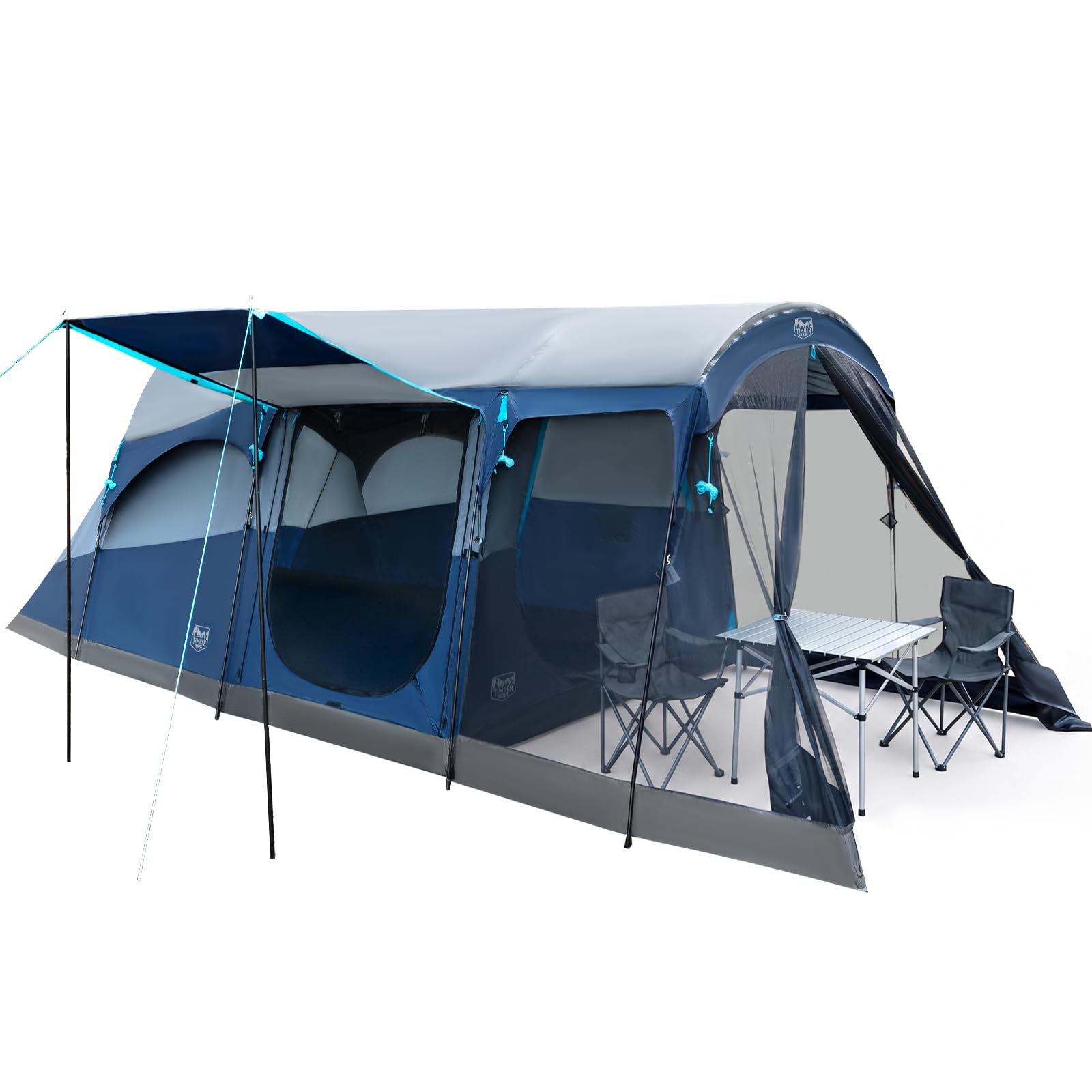
Timber Ridge 8 Person
Key Features
- Sleeps: 8
- Floor area: 160 sq ft
- Center height: 76 in
- Packed weight: 32 lb
- Price: Midrange
Twenty feet is what separates this from the CORE. Where the instant cabin runs 14 feet long, the Timber Ridge measures 20 by 8, and that extra length is the difference between gear piled on the sleeping area and gear with a corner of its own. Two rooms and a 76-inch ceiling make it feel less like a tent and more like a small, flappy cabin.
Pitching takes two people about 15 minutes, with color-coded poles and clips rather than sleeves, and the rainfly comes off entirely for clear nights, leaving a full mesh ceiling to sleep under and stargaze through.
For a week in one place, we rate that length above any feature on the spec sheet. It’s the tent that stops a family rearranging itself every evening, and the built-in E-port means a power lead reaches the air bed without a cable threaded through the door.
The trade is weight: 32 pounds, so it is a car-camping tent in the strict sense. The door zip catches where the pole sections meet, the sort of thing you learn to do one-handed with the other hand holding the fabric clear. And while it shrugs off thunderstorms, water can still find its way in along the zips in a long, wind-driven rain.
Pros
- 20-foot floor gives everyone a corner
- Two rooms plus a full mesh ceiling
- E-port routes a power lead inside
- Pitches in about 15 minutes with two
Cons
- 32 lb packed, so car camping only
- Door zip catches at the pole joins
Choose this for a long stay: 20 feet of floor, two rooms and a removable fly, provided the car is doing the carrying.
Best for Group Base Camps
UNP 8 Person Tunnel

Key Features
- Sleeps: 8
- Floor area: 180 sq ft
- Center height: 80 in
- Packed weight: 32 lb
- Price: Premium
The porch is the point. Six of this tent’s 20 feet are a screened room with its own door, which is where the boots come off, the dog sleeps and a chair earns its keep in the evening. Behind it, 14 feet of inner tent and 180 square feet of floor take two full air mattresses with space left over.
A tunnel this size stands on tension rather than on a frame: eight steel poles and 19 stakes, and until those are in, the shell is a puddle of fabric you can’t move. Pitch it in daylight if you can, and read the instructions first, because they are the vaguest part of the package and the color coding is what actually gets you through the first assembly.
We like it best as a base camp for a group that lives outside but wants a dry place to sit, since the porch does the job of a tarp with less string. It is a big footprint, though, so check the site before you book: a 20-foot tent needs more pad than most single sites offer, and the guylines have to reach something.
Pros
- Six-foot screened porch with its own door
- 180 sq ft takes two air mattresses easily
- 80-inch ceiling for standing
- Stayed dry in rain without extra treatment
Cons
- Nothing holds its shape until every stake is in
- Instructions are thin for a first pitch
Worth it for the porch: a screened room for boots and chairs, with 180 square feet of sleeping space behind it.
Best for First Trips
Amazon Basics 2 Person Dome

Key Features
- Sleeps: 2
- Seasons: 3
- Footprint: 84 x 60 in
- Setup time: 4 min
- Price: Budget
This is the least expensive tent here, and it doesn’t behave like a compromise: welded seams, a removable rainfly with a rear window and a cool-air port, and a dome that goes up in about four minutes with three poles. The 7-by-5-foot floor takes a full air mattress, two sleeping bags, or one adult and a lot of gear; two adults fit if they’re fond of each other.
What surprised us is the floor. The waterproof tub turns up the walls by several inches, so ground water has to climb before it reaches a seam, which is exactly the detail that usually goes missing at this end of the range. The zip is the weak point, one slider on a door that catches the flap, and the fiberglass poles want respectful handling. For a first trip or a spare for the backyard, that’s an easy trade.
Pros
- Welded seams and a removable rainfly
- Floor tub turns up the walls against ground water
- Up in about four minutes
- Lowest price of the tents here
Cons
- Door zip catches the fabric flap
- Fiberglass poles need careful handling
The one we suggest for a first trip or a backyard spare: a dry, simple dome with the lowest price in this guide.
How We Pitched, Soaked, and Slept in 12 Tents
We started with research rather than camping: three-season dome, cabin, and tunnel tents from brands that turn up on real campground loops, filtered by sleeping capacity, packed size, weight, and price. Anything that couldn’t fit two adults on pads or packed down bigger than a weekend duffel was cut. That left 12 tents, and my team and I have been using them for eight months — weekend trips, a soaked backyard, and one night on an exposed ridge with gusts that flattened the neighbor’s awning.
Every tent got pitched solo with a stopwatch running, once in calm air and once with wind pushing the panels flat. We noted whether the color-coded poles actually helped, how long it took to stake out the last corner, how much trunk space the packed bag ate, and how hard it was to stuff everything back in at 7 a.m. Inside, we laid out two pads and two duffels, knelt to check headroom, and looked at what was left over for boots and a cooler.
Then the hose. Ten minutes of spray from every angle, followed by a check of the floor, the seams, and the inside of the door for weeping — including that puddle that forms right where you step in. Zippers were opened and closed one-handed in the dark, dozens of times, and we logged every snag and every slider that jumped track. Poles, stake loops, and floor fabric got inspected after each trip for fraying and grit in the joints.
Durability only shows up late, so we kept notes across all eight months; the tent that looked sharpest in month one wasn’t the one that still felt crisp in month seven. Value came down to cost per season of real use, and appearance counted more than I expected — fabric that photographs like a trash bag is a tent you won’t want to pitch.
How to Choose a Camping Tent
The right tent is decided by three things: where you sleep, how much you’re willing to carry, and whether you’ll still want to pitch it after a long drive.
Size the tent to the people, not the label
Occupancy figures assume bodies on bare floor, with no mattress, no bags and no dog. A four-person dome holds two adults comfortably; a six-person cabin holds four with gear; a nine-person cabin that sleeps four with air beds is doing exactly what it promises. Our rule is to buy one size up from the number of people and then check floor area, because that is the figure that decides whether you walk between the mattresses or climb over them.
Two queen air mattresses need roughly 100 square feet once you allow for the gap between them. Measure your sleeping setup at home and compare it with the floor area on the listing rather than the person count.
Weather protection starts at the seams
A rainfly that stops at the top of the walls sheds water like an umbrella with a hole in it. What you want is a fly that comes down over the sides, seams that are taped or welded rather than stitched bare, and a floor whose waterproofing turns up the walls a few inches.
Then defend the ground. On wet grass, water arrives from below as often as above, so a tarp cut to the tent’s footprint is worth more than any spray-on coating. Our top pick earns its dry reputation from a full fly and welded corners, and it still gets a tarp underneath.
Setup: count the poles and the hands
Three designs, three levels of effort. A clip-on dome is the slowest and the most forgiving, an instant cabin with pre-attached poles is standing in a couple of minutes but is heavier and packs long, and a tunnel needs every stake in before it holds any shape at all.
The question to ask is when you arrive. If pitches happen after dark, in wind, or with children in the car, an instant frame earns its weight and its price. In fair weather with time to spare, a dome saves money and packs smaller.
Height, weight and what has to carry it
Standing height is a comfort decision, not a luxury: 78 to 80 inches lets most adults dress without contorting, while 66 inches means crouching through the whole trip. The price is pounds. Steel poles and tall walls push a tent to 27 or 32 pounds, which is a car boot and not a backpack.
Anything over about 20 pounds travels by vehicle, so measure the packed length against your trunk before you commit; instant cabins fold long, and a bag that won’t fit is a tent you won’t use.
Doors, zips and moving air
Two doors sound like a detail until four people share a tent in the rain. Ventilation is what stops condensation, so look for mesh low and high: floor vents plus a mesh ceiling pull air through the whole shell, while a single window and a solid inner wall trap the moisture you breathe out overnight.
Zips are the most common failure point on any tent here. A single slider on a long door drags, catches the storm flap and eventually separates, so keep the fabric pulled clear and never force a zip that’s fighting you.
Frequently Asked Questions
Can I use a three-season camping tent in winter?
Not in snow. Three-season tents vent through mesh panels, and mesh holds no snow load and lets warmth straight out. For cold-weather camping, look for a solid inner with a full-coverage fly.
If you’re caught below freezing in a summer tent, put your money into the sleeping pad: the ground pulls more heat out of you than the air does, and condensation will freeze on the inner walls by morning.
Is it safe to run a camping stove or heater inside a tent?
No. Carbon monoxide from a fuel-burning stove or heater builds up in an enclosed space whatever vents you leave open, and tent fabrics are not rated for it.
Cook outside and well clear of the shell, and warm up with a better sleeping bag, a hat and a hot water bottle. A battery lantern is the only thing that should be running inside after dark.
Will a large cabin tent fit on a campsite pad?
Often not. A 20-foot tunnel or a 14-foot cabin needs two pads or a double site, and many individual sites are laid out for a tent half that length. Check the pad dimensions when you book rather than when you arrive.
Carry extra guylines and a spare set of stakes too: a tent that overhangs the pad edge still needs tensioning, and gravel or hard ground will test whatever came in the box.
How do I get more than a few seasons out of a tent?
Three habits do most of the work. Never pack it away wet, because mildew sets into the coating within days and never comes out. Keep it out of constant sun, since UV degrades polyester faster than rain does, so break camp rather than leaving it standing for weeks.
And when seams start wicking, clean the area and re-seal it. A tube of seam sealer costs far less than a new tent and buys several more seasons.
Final Verdict
The Coleman Sundome is the tent we recommend to most people: a full fly, welded corners, ten minutes with one pair of hands, and enough floor for two adults and their gear.
Spend more only when a specific need pushes you up. The CORE 9 for a family that wants an instant frame and two queens with walking room, the UNP 6 Person cabin if standing height matters and the budget is tight, the Timber Ridge if you’re staying a week and want 20 feet of floor.