This post contains affiliate links. We may earn a small commission when you buy through our links — at no extra cost to you.
A three-season sleeping bag is a compromise you make peace with: warm enough for a frosty night in the mountains, light enough that you don’t resent it on the hike in. Lean too far toward warmth and you’re hauling bulk; lean too far toward light and you’ll spend the small hours curled around a cold spot. What a good bag actually fixes is the 2 a.m. problem — the temperature drops, the wind picks up, and you either sleep or you don’t.
I’ve logged nights in everything from a borrowed 20-year-old rectangle to a featherweight mummy, and my team has spent the past eight months living with 12 three-season bags. Worth knowing before you shop: a temperature rating sits closer to the number you’d survive at than the number you’d be comfortable at, so shop by the comfort rating. Below are the bags that kept us warm, packed down small, and didn’t fight us in the dark when we needed the zipper to move.



Best for Three-Season Camping
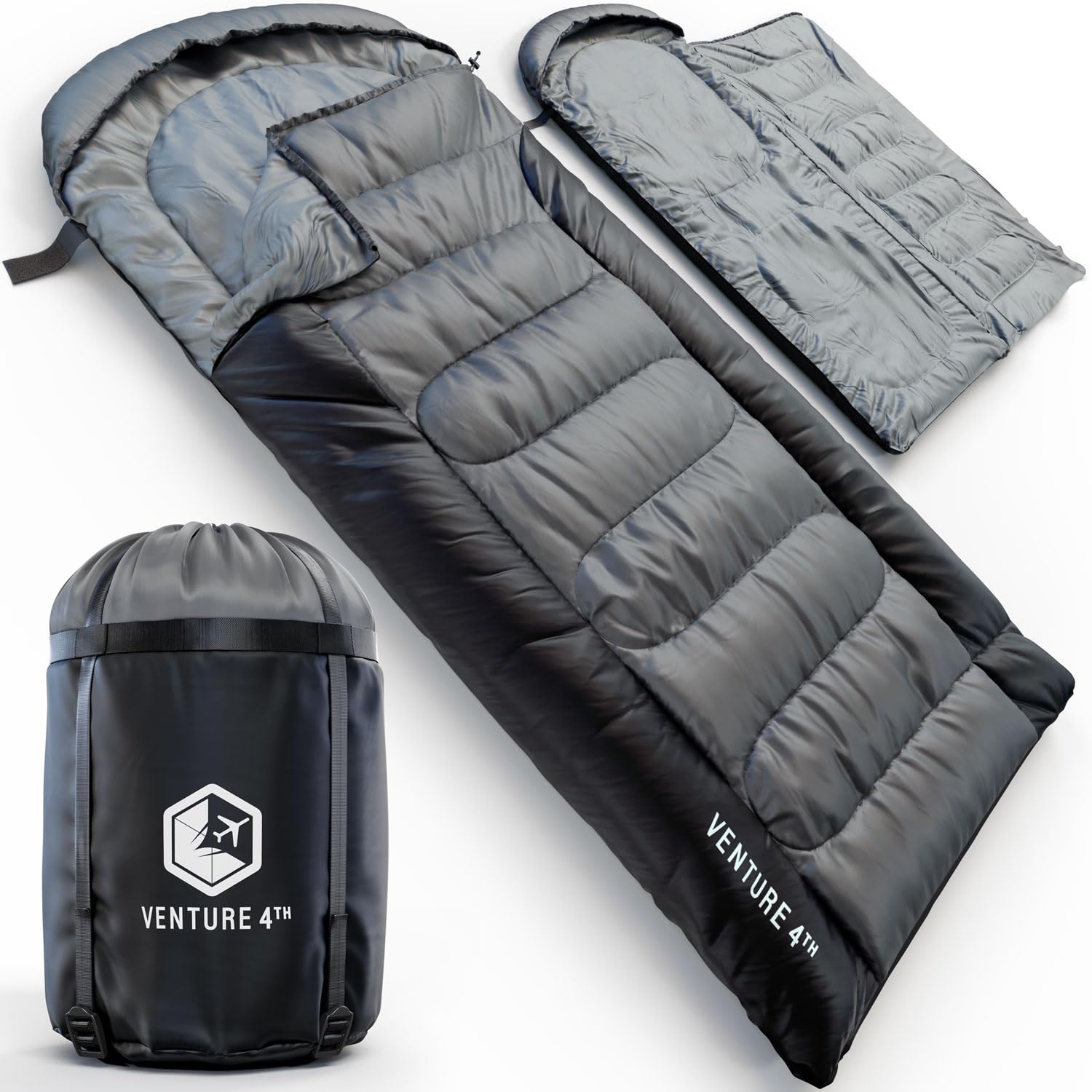
Venture 4th Sleeping Bag
Key Features
- Size: 90 x 39 in
- Weight: 4.4 lb
- Warranty: Lifetime replacement
- Temperature Rating: 30°F to 70°F
- Price: Midrange
Thirty to seventy degrees is the number that won this bag its place at the top of our list. Scan the rest of this group and you will see three-season labels on bags rated 50 to 80 — fine in July, grim on a frosty September morning in the mountains. The Venture 4th is the only one here whose stated comfort range reaches down toward freezing while still breathing in warm weather, and it backs that with a lifetime replacement guarantee none of the budget bags offer.
The XXL cut is 90 by 39 inches, and that is a lot of bag: room to turn over, room for a side sleeper’s knees, room for a large frame. Hollow-fiber fill and a water-resistant 210T shell are not exotic materials, but the shape is what you notice at two in the morning when your shoulder is not jammed against a seam. It ships with a real compression sack — straps, not a drawstring — which matters more than it sounds when you are packing up in the rain.
The trade is bulk. At 4.4 pounds it is a bag you carry to a campsite rather than forget in a pack, and 90 inches of envelope eats serious room even compressed. If you are counting ounces on a long approach, the OneTigris and the Naturehike below serve you better. The other thing we flag is the zip: it can stick, and the closure is where this bag is most likely to let you down, so run it fully open and shut at home before your first trip.
One more thing worth knowing is that the line also comes in Single and Double versions, so the XXL is not your only choice if the warranty appeals and the footprint does not. For a tall or broad sleeper, though, this is the version that makes the bag worth owning.
Pros
- Comfort rated from 30°F to 70°F
- 90 x 39 in cut suits big, tall and side sleepers
- Lifetime replacement guarantee
- Real compression sack with straps
Cons
- 4.4 lb and XXL bulk to carry
- Zipper can stick or come apart
The best three-season buy here for most campers: a 30 to 70°F window, a genuinely roomy cut and a lifetime guarantee, with bulk as the price of entry.
Best for Budget Backpacking
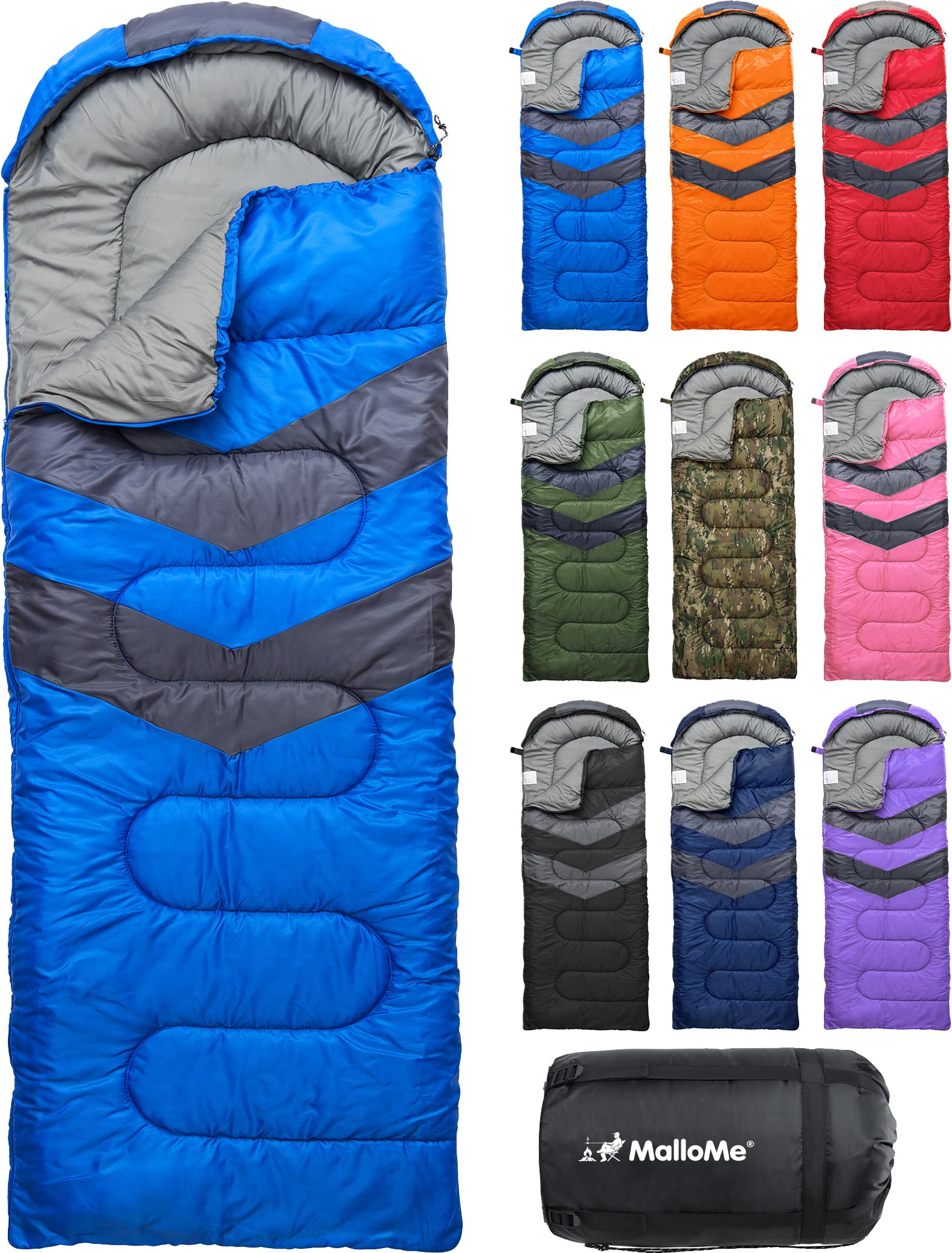
MalloMe Sleeping Bag
Key Features
- Size: 86.6 x 31.5 in
- Shape: Rectangular
- Weight: 2.87 lb
- Temperature Rating: 50°F to 80°F
- Price: Budget
There is a version of this review where the least expensive bag wins outright, and it is tempting: the MalloMe costs a fraction of almost everything else here, weighs about three pounds and rolls into a bundle small enough to live in a trunk all summer.
The 50 to 80°F rating is the honest part of the listing, and it tells you where the bag belongs. Warm summer nights, car-camping weekends, a kid’s first trip, a spare in the closet — it handles those well, and the 86.6-inch length means a six-footer is not folded up inside it. What it is not is a cold-snap bag. A 50°F comfort floor leaves you layering a fleece and a liner when the forecast drops, and that is the night you will remember.
We keep recommending it anyway, because at this end of the market you are choosing between compromises and this one picks sensible ones. The 31.5-inch width is the compromise we notice most — broad-shouldered sleepers end up against a cold seam — but it packs small, a teenager can carry it, and it is the bag we hand to families fitting out three people at once.
Pros
- About three pounds and easy to carry
- Rolls into a small bundle
- 86.6 in length fits a six-footer
- Costs far less than most bags here
Cons
- Zipper can fail; the closure is the wear point
The cheapest bag here we are happy to recommend, and the sensible buy for a first trip or kitting out a family on a tight budget.
Best for Lightweight Mummy
OneTigris Bushcrafter’s
Key Features
- Size: 82.6 x 33 in
- Weight: 3.1 lb
- Zipper: YKK anti-snag
- Temperature Rating: 3 to 14°C
- Price: Midrange
YKK zippers with an anti-snag tape are the reason to look at this one. On a page where the closure is the recurring weak point across the cheaper bags, a maker that spends money on the zip is telling you something about the rest of the build, and we rate it the best-made bag here for mild-weather trips.
The rest is bushcraft-flavored and it works: a 300T pongee shell that shrugs off splashes and morning dew, a polycotton fill, a cord-stopped hood you can cinch around your face, and machine washing on a delicate cycle at the end of the season. At 3.1 pounds and 82.6 inches it packs small and runs long enough for a tall sleeper.
The rating is where we temper expectations. The listing puts it at 3 to 14°C — roughly 37 to 57°F — which makes it a warm-weather and early-fall bag rather than a true three-season one. If your season runs May to September it is plenty of bag; if you camp into October, the Venture 4th or the Soulout covers you.
Pros
- YKK zips with anti-snag backing
- 3.1 lb mummy that packs small
- Cinchable hood and water-repellent shell
- Machine washable on a delicate cycle
Cons
- Narrow mummy taper for broad shoulders
- One-year warranty is the shortest here
A properly zipped mummy for mild three-season nights — the pick if you want a packable bag whose closure you do not have to think about.
Best for Ultralight Packing
Naturehike Ultralight
Key Features
- Size: 80.7 x 33.5 in
- Shape: Envelope
- Weight: 1.67 lb
- Temperature Rating: 59°F comfort / 32°F limit
- Price: Midrange
At 1.67 pounds this is the bag that disappears into a pack, and on a long approach that is the entire argument. It is an 80.7 by 33.5-inch envelope that packs down smaller than anything else in this group, which makes it a genuine option for the walk-in camper counting every gram.
We treat it as a warm-weather bag and we are at peace with that. The listing’s own numbers are 59°F comfort and 32°F limit, and the honest reading is that this sits closer to a zip-up quilt than to a bag you trust below 50°F. For June through early September, or as a liner inside a colder sleep system, that is a fair trade for the weight.
Where it earns its keep is travel and fast trips: hostel beds, warm-weather backpacking, an emergency bag in the car. Just do not buy it expecting the rating to hold on a frosty morning, and do not expect much structure underneath — there is little padding between you and the ground, so a decent pad is not optional.
Pros
- 1.67 lb, the lightest bag here
- Packs smaller than anything else in this set
- Roomy 33.5 in envelope cut
Cons
- 59°F comfort rating is warm-weather only
Buy it for the weight and treat it as a warm-weather bag — at 1.67 pounds it is the lightest thing here by a wide margin and it knows it.
Best for Cold-Weather Car Camping
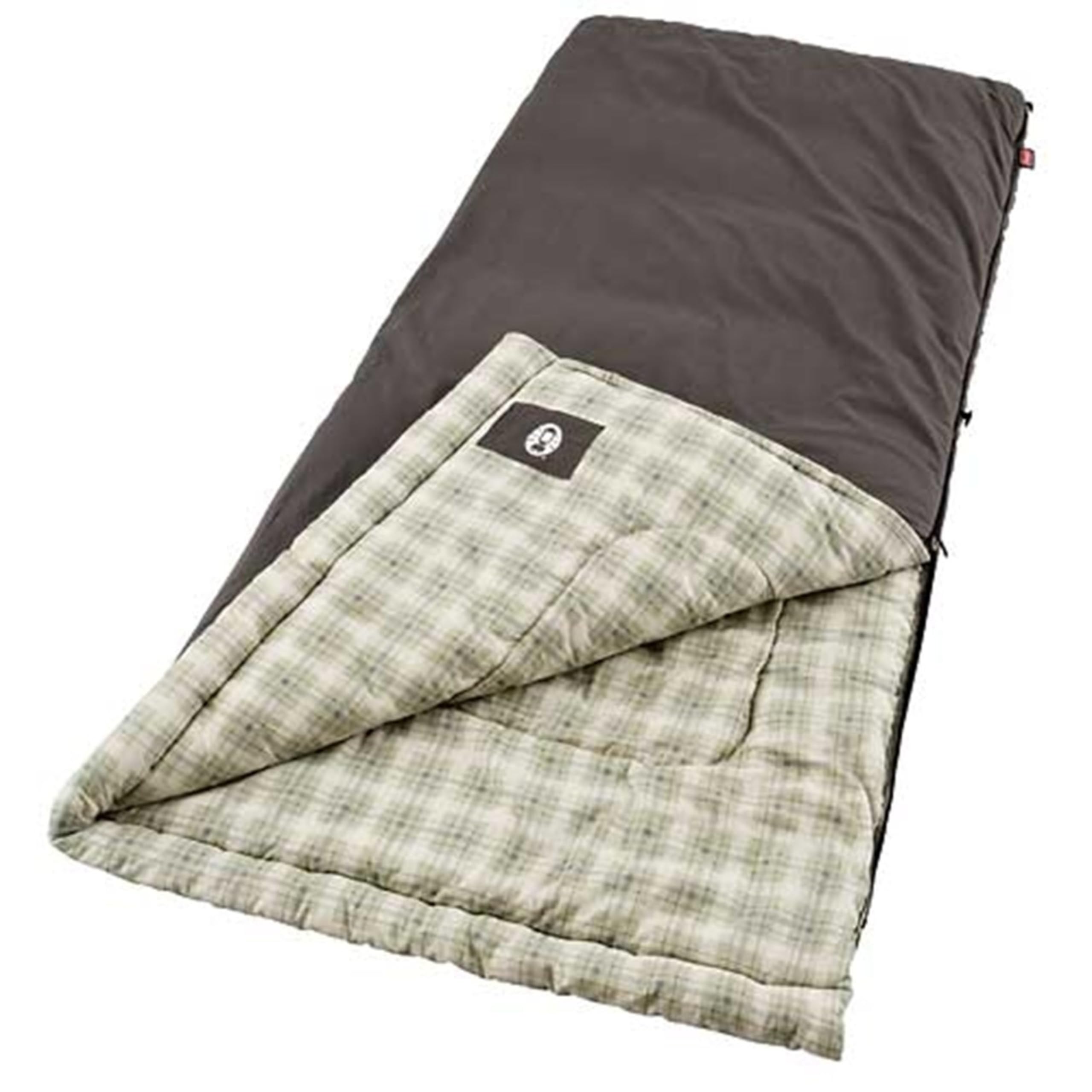
Coleman Heritage Big & Tall
Key Features
- Size: 40 x 84 in
- Weight: 8.9 lb
- Insulation: 5 lb Holofill 808
- Temperature Rating: 10°F
- Price: Premium
If you are six foot four and every bag you have owned stops somewhere around your chin, start here. The Heritage Big & Tall is 84 inches long and 40 inches wide, built for campers up to about 6 ft 7 in, and it is the only bag in this group that treats a large frame as the default rather than an exception.
We like it for exactly what it is: a cold-weather car-camping bag. Five pounds of Holofill 808, a Thermolock draft tube down the zip, FiberLock to stop the fill migrating into the corners, and a flannel liner that feels like bedding rather than a stuff sack. Rated to 10°F, it has more cold margin than anything else here, and the Wrap ‘N’ Roll storage system means you are not wrestling it back into a sack on a freezing morning.
The counterweight is 8.9 pounds. That is a bag you carry from the trunk to the tent, not one you hike with, and in July it is a sauna. For a late-season basecamp, a hunting cabin or a guest bed that has to work in February, we have not found anything in this set that comes close.
Pros
- 40 x 84 in fits campers up to about 6 ft 7 in
- 10°F rating with 5 lb of Holofill 808
- Flannel liner and draft tube for comfort
- Wrap ‘N’ Roll storage and 5-year warranty
Cons
- 8.9 lb rules out backpacking
- Too warm for summer nights
The bag for a big frame in a cold camp: 84 inches long, flannel-lined, rated to 10°F, and far too heavy to carry anywhere.
Best for Shoulder-Season Value
Soulout Sleeping Bag
Key Features
- Size: 86.6 x 32.7 in
- Weight: 4.5 lb
- Packed Size: 9.1 x 13.8 in
- Temperature Rating: 32°F to 77°F
- Price: Budget
If you want more cold margin than our budget pick without paying premium money, this is the middle ground: a 32 to 77°F window, a water-resistant shell and a lining that feels soft rather than slippery.
The shape is generous — 86.6 by 32.7 inches, a touch wider than the MalloMe — and it packs to 9.1 by 13.8 inches, so it slings onto a bike rack or into a duffel without a fight. It is the bag in this group that behaves like something far more expensive until you pick it up.
Because it weighs 4.5 pounds, which is heavy for a 32°F bag and the price of that soft lining. Fine for car camping and a two-mile walk-in; not the bag for a long approach. Kept inside that brief, it is the most warmth per dollar in this set.
Pros
- 32°F to 77°F window for the money
- Packs to 9.1 x 13.8 in
- Soft lining and water-resistant shell
Cons
- Zipper and shell seams are the weak point
The middle ground worth taking if you want colder-night margin than our budget pick without premium money, as long as the weight does not bother you.
Best for Cold-Weather Comfort
Teton Sports Celsius

Key Features
- Size: 79.9 x 33 in
- Shape: Rectangular
- Lining: Poly-flannel
- Weight: 5 lb
- Price: Premium
The detail most people skip on this one is the lining. It is a poly-flannel rather than the slippery nylon most synthetic bags use, and if you have ever spent a night sliding around inside a mummy, you will know why that matters.
The construction is old-fashioned in a good way: double-layer fiber fill, draft tubes along the zip and a stuff sack with heavy-duty straps instead of a drawstring. Left- and right-zip versions mean two bags can be joined into one quilt for a couple. At 79.9 inches and 5 pounds it is firmly a car-camping bag.
Watch the variant. The Celsius line runs from a 25°F bag down to a 0°F one, and the rating is not printed on every version’s page, so confirm which fill you are buying — the gap between those bags is the gap between a shoulder-season bag and a winter one.
It is our value pick for cold-weather car camping: warm, roomy, flannel-lined, covered by a limited lifetime warranty and priced well below the Coleman Heritage. Just do not plan to carry it anywhere.
Pros
- Soft poly-flannel lining
- Draft tubes and double-layer fill
- Left and right zips join two bags
- Limited lifetime warranty
Cons
- 5 lb and bulky, so car camping only
- Zip can work loose overnight
A warm, flannel-lined car-camping bag at a fair price, worth it if you check exactly which temperature version you are ordering.
Best for Cozy Car Camping
Redcamp Flannel

Key Features
- Size: 75 x 33 in
- Lining: Cotton flannel
- Weight: 1.98 lb
- Temperature Rating: 50°F to 77°F
- Price: Midrange
Two-way zippers on both sides let two of these bags join into one quilt. It is a small design decision that changes how the bag gets used, and it is a large part of why this one keeps its place in the set despite a short cut.
Inside is brushed cotton flannel, and it does feel like bedding rather than camping gear. The 210T ripstop shell wipes clean and shrugs off a splash, and the flannel is the sort of thing you notice on the first cool night rather than the first warm one.
The catch is length. At 75 inches it is the shortest bag here, and the claim that it fits a six-footer is optimistic once you add a pillow — anyone over about 5 ft 10 in should measure before committing.
What it is good at is comfort: a guest bed, a cabin, a festival where you are sleeping in the back of a car. As a hiking bag it is the weakest of this group; as the bag you leave made up in the van all summer, it is one we keep coming back to.
Pros
- Two-way zips join two bags together
- Cotton flannel liner feels like bedding
- Wipe-clean water-resistant ripstop shell
Cons
- 75 in length is tight for tall sleepers
- 50 to 77°F range is summer-weight
A cozy, short, mild-weather flannel bag that makes sense for couples, guests and car camping rather than for the trail.
How We Tested Three-Season Sleeping Bags
We started with a list of more than 40 bags and cut it down by reading spec sheets: fill type and fill weight, comfort rating rather than the lower limit, packed size, shell and lining fabrics, and price. That narrowed things to 12 bags spanning synthetic and down, mummy and rectangular shapes, and a wide range of prices. We tested them over eight months, from late spring through a cold snap in early fall.
Most nights happened where these bags actually get used: a backyard, three weekends in the mountains, and one memorably damp trip where it rained sideways. I set a thermometer at head height and logged readings at 10 p.m. and 4 a.m., noting where cold crept in first — shoulders, hips, foot box — and whether a bag’s rating felt honest. Every bag was weighed on a kitchen scale and stuffed into its sack to measure packed volume. Our testers ranged from 5’4" to 6’3", so we tracked shoulder room, foot room, and whether a bag let you roll over without dragging the pad along with you.
We zipped and unzipped each bag in the dark, sometimes wearing gloves, and counted snags, stuck sliders, and fabric caught in the teeth. Each one was washed twice following its care label, then checked for pulled seams, clumped fill, and baffles that let insulation migrate into the corners. Value came last: we compared what each bag delivered against what it cost, rather than ranking by price tag alone.
How to Choose a Three-Season Sleeping Bag
Three-season is a temperature window rather than a certification, and the number that decides whether you sleep is the comfort rating, not the word on the stuff sack.
Read the rating as a window, not a badge
Plenty of bags carry a three-season label and a 50 to 80°F rating, which is a July bag with a marketing problem. The ones that genuinely stretch from spring frost to warm summer nights — the Venture 4th at 30 to 70°F, the Soulout at 32 to 77°F — are what you pay for if you camp outside high summer.
Pick a comfort floor at least ten degrees below the coldest night you expect, and treat the limit number on a budget bag as the point where you stop sleeping and start enduring. Between two ratings, take the warmer bag and vent it; you cannot vent a bag that is not warm enough.
Decide whether you are carrying it before you fall for it
Car, cabin or festival: weight barely matters and a heavy flannel bag feels like a hotel bed. The same bag on a mountain is a punishment. We treat roughly four pounds as the ceiling for a bag you walk with, and nearer three if the trail goes uphill — the Naturehike at 1.67 pounds and the OneTigris at 3.1 show how wide that spread runs in this group.
Watch the word compact. On a rectangular bag it usually means it fits a car trunk, not that it disappears into a pack, and a 90-inch envelope takes real volume even when it is strapped down tight.
Match the cut to how you actually sleep
Rectangular and envelope bags give you room to turn over; mummy bags save weight and heat the space faster but taper at the knees and elbows. Width is the number people ignore. 31.5 inches is snug across the shoulders, 39 inches is generous, and 33 is where most of this group sits.
On length, buy a few inches more than you measure. A stated fit of six feet usually assumes no pillow and no curled knee, and a side sleeper should add four or five inches to a mummy’s length.
The zipper decides how long the bag lasts
Zips are the standard failure point on bags at this level: snagging on the lining, running off the track, or coming apart in the first season. A YKK zip with an anti-snag tape, as on the OneTigris, is worth paying for.
Open and close the bag fully at home and check the tape is stitched flat, and never force a snagged slider — back it out. If you plan to join two bags, confirm that left- and right-zip versions exist before you buy the pair.
Fill, shell and washing
Synthetic hollow-fiber fills dominate this bracket: they hold some warmth when damp, survive a washing machine and cost far less than down. Flannel and cotton linings feel like home but hold moisture and dry slowly, which suits car camping better than wet weather.
A water-resistant shell handles dew and drizzle, not a soaked night, so pack a dry bag either way. Wash on a gentle cycle in a front-loader and air dry thoroughly — and store the bag loose, never compressed, so the fill keeps its loft.
Frequently Asked Questions
Do I need a sleeping pad with a three-season bag?
Yes. A bag insulates what is above you, while the ground pulls heat out from below far faster than cold air does, which is why a 30°F bag on a thin summer foam pad feels like a 50°F bag by three in the morning.
Match the pad to the season: basic foam or a plain air pad in summer, an insulated pad for spring and fall, and a warmer one again if you sleep cold.
How do I get the bag back into its stuff sack?
Stop rolling it. Stuff it instead: grab handfuls from the foot end and push them into the sack, working around the edges until you reach the top, then cinch the drawcord and tighten the compression straps in stages rather than cranking one side down.
Rolling traps air and fights the bag’s own width, which is why the last few inches are always the ones that beat people.
How do I wash a synthetic sleeping bag without ruining it?
Use a front-loading machine on a gentle cycle with mild detergent and skip the top-loader with an agitator, which can tear lining and baffles. Rinse twice to clear the soap, then tumble on low with a couple of clean tennis balls or air dry it completely.
Never put it away damp and never store it compressed — hang it or keep it loose so the fill keeps its loft between trips.
Final Verdict
The Venture 4th is the bag we point most people to: a 30 to 70°F rating that genuinely covers spring through fall, a cut that fits real bodies, and a lifetime replacement guarantee that takes the sting out of its one weak point, the zipper.
If your trips run June to September and money is tight, the MalloMe does the same job for far less. Counting ounces on a long approach? The Naturehike weighs almost nothing and is honest about being a warm-weather bag. And if the bag lives in the car and the forecast looks grim, take the Coleman Heritage.