This post contains affiliate links. We may earn a small commission when you buy through our links — at no extra cost to you.
Three-person tents lie for a living. That number on the box usually means three sleeping pads if nobody minds touching, and the moment you add a duffel, a dog, or a rainy afternoon it means two people and a damp pile of gear. What a good one actually buys you is a dry night, enough floor to keep your stuff out of the puddles, and a packed weight you’re still glad to carry a mile in.
I’ve pitched tents in drizzle with numb fingers and hauled one that felt like a bag of bowling balls, so the frustrations aren’t abstract to me. Over eight months my team and I pitched 12 three-person tents — in backyards, on weekend trips, and through one memorably windy night — and the differences showed up within minutes of unrolling them. One thing worth knowing before you shop: ignore the headcount and check floor dimensions and peak height instead. The tents that got out of their own way are below.


Best for All-Round Camping
Clostnature 3-Person Backpacking Tent
Key Features
- Floor: 86.6 by 75 in
- Sleeps: 3
- Peak height: 47 in
- Packed weight: 6.2 lb
- Price: Midrange
Two doors, two vestibules and a 5000 mm coating for mid-range money is the combination that put the Clostnature at the top of this group. The floor runs 86.6 by 75 inches with 47 inches of peak height, which is the difference between three people sleeping and three people piled: three 20-inch pads leave a gap down the middle for a dry bag, and three 25-inch pads fill it edge to edge. That second door earns its weight at 2 a.m., when nobody wants to climb over two sleeping friends to get outside.
The weather spec is the highest here. Both the fly and the groundsheet carry a 5000 mm polyurethane coating, and the seams are sealed at the factory, so there is no first-evening seam-sealing ritual before you can trust it. What that buys is margin — a long, steady night of rain rather than a passing shower. The floor is coated polyester like the fly rather than a thin separate liner, so kneeling in boots to sort gear does not feel like a gamble, and the two aluminum poles go up on clips rather than sleeves.
Pitching is a one-person job: two poles, clips, and a freestanding body you can lift and shift into position before you stake anything down. At a listed 6.2 pounds it splits comfortably between two packs, and it packs small enough that we stopped thinking of it as a car-only tent.
The stakes in the bag are wire pins that bend the first time they meet rocky ground — swap them for a set of aluminum Y-stakes before the trip and the whole package feels more solid. What sells us on this one, though, is the vestibule space: one on each door, which is what lets a 45-square-foot floor work for three people and their packs at the same time.
Pros
- Two doors and two vestibules on one tent
- 5000 mm coating with factory-sealed seams
- 6.2 lb packs small and splits between packs
- Two aluminum poles with clips pitch fast alone
Cons
- Poles are the frame’s weak point in wind
We recommend the Clostnature as the default three-person tent here: two doors, two vestibules and a 5000 mm sealed floor, with a packed weight that still lets you carry it.
Best for Wet-Weather Trips
Forceatt 3-Person Tent
Key Features
- Floor: 88.4 by 72.7 in
- Sleeps: 3
- Peak height: 47.2 in
- Packed weight: 6.6 lb
- Price: Midrange
Forceatt labels this a four-season tent, and the build reads that way on paper: a 70D polyester body and fly, a full-coverage fly over two doors, aluminum poles and a 10-square-foot vestibule for packs and boots. The floor measures 88.4 by 72.7 inches with 47.2 inches of peak height, and the whole thing packs to 6.6 pounds.
We treat the four-season claim as three-season-plus, because there is too much mesh in the body for real winter. For a cold, wet shoulder-season weekend, though, this is the tent we reach for ahead of the Clostnature. Wind and rain are where it earns its place: it is the shelter in this group we trust most when the weather turns, and the two-door layout means there is no bad side to sleep on.
Inside, the shape is roomier than the numbers suggest. There is enough height to sit up in, the mesh panels run high enough that a warm night does not turn the interior into a sauna, and two adults on a double air mattress still have floor left at the sides. Three adults fit; their gear lives in the vestibule.
The roof vents are the detail we keep coming back to. Two ceiling openings plus the mesh body move air through a tent that is otherwise sealed up against rain, which is the difference between waking to a damp fly and waking to a wet sleeping bag.
Pros
- Full-coverage fly with a 10 sq ft vestibule
- Two doors, four windows and aluminum poles
- Holds up in wind and hard rain
Cons
- Pole failure is the frame’s known risk
- Sleeve poles are slower to pitch alone than clips
We take the Forceatt when the forecast is ugly: the most weather-ready three-person shelter here, and worth it if your trips are booked in advance.
Best for Backpacking Pairs
Kelty Discovery Trail 3P
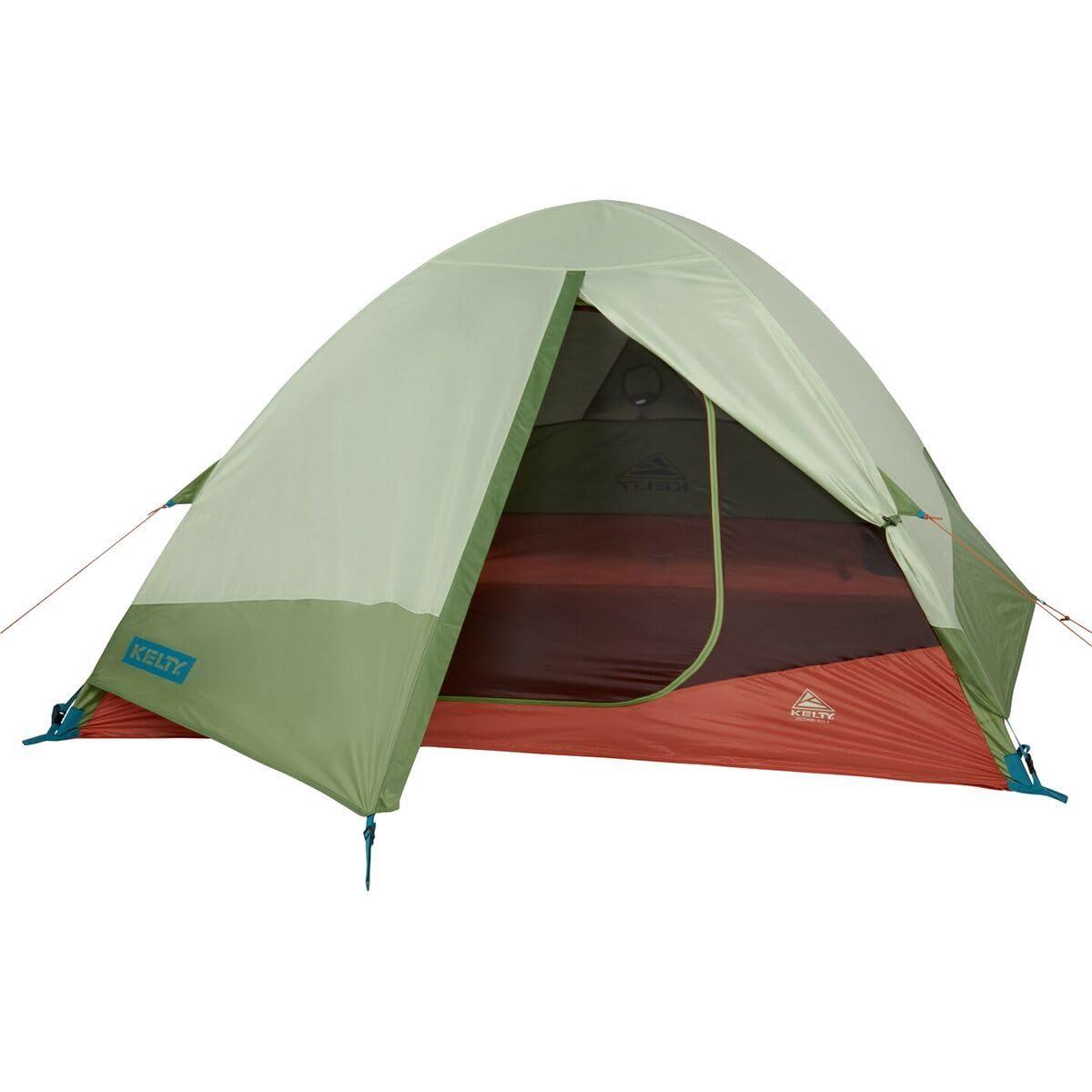
Key Features
- Size: 3P
- Doors: 1
- Floor area: 46 sq ft
- Trail weight: 6 lb
- Price: Premium
One door, one vestibule, two poles. The Discovery Trail is the tent here built by subtraction, and for the right camper that is the appeal: fewer parts to lose, fewer seams to leak, and a pitch that stays simple. Kelty’s Quick Corners and pre-attached guylines take the fiddly part out of setup, and the two aluminum poles hold the trail weight at six pounds.
For two people who want a light, honest shelter from a brand backing it with a limited lifetime warranty, this is the tent we point at first. The floor is 46 square feet, which is a real backpacking three-person floor — three pads fit across it, shoulder to shoulder, and the vestibule takes the packs. It is a trail shelter, though, and it earns its keep on the move rather than at a three-adult base camp.
Kelty rates the fly at 1200 mm and tapes the seams, which is honest three-season gear: a night of ordinary rain rather than a storm that rewrites your weekend. What you get in return is the lightest of the three on the trail, a tent that goes up in minutes, and a stuff sack with a wide opening that does not demand a packing lesson at dusk.
The warranty is the detail that keeps growing on us. A limited lifetime cover against the one and two years on the other two tents here counts for more than a feature list when you plan to keep a shelter for a decade.
Pros
- Six-pound trail weight with aluminum poles
- Quick Corners and pre-attached guylines
- Taped seams and a full-coverage fly
- Limited lifetime warranty
Cons
- Single door and one vestibule for three campers
- 46 square feet is snug for three adults
We point backpacking pairs at the Kelty: a light, simple three-pad shelter with a lifetime warranty behind the seams rather than a second door.
How We Tested the Best 3-Person Tents
We started by pulling specs on more than 40 tents and narrowing hard: floor area wide enough for three regular sleeping pads side by side, a peak height tall enough to sit up in, and a packed weight a solo camper could reasonably carry. Anything that claimed three people but listed a floor under roughly 90 inches didn’t make the cut. Twelve tents did.
Every tent got pitched in a backyard first, on a wet Saturday morning, solo and without the instructions, with a stopwatch running. We pitched them again at dusk with a headlamp, because that’s when most people actually do it. From there they went on weekend trips, where three adults slept in each one, gear got shoved into vestibules, and we noted where condensation collected by morning.
Weight and portability came down to a kitchen scale and a car trunk: we weighed every packed bag, then checked whether it went crosswise into a hatchback and strapped onto a 50-liter pack. We opened and closed every zipper dozens of times, flexed poles on gusty afternoons, and left fabric pitched through days of sun to watch for fading. A tent earned its spot by staying dry, holding up to a careless camper, and still feeling worth carrying on the second day.
How to Choose a Three-Person Tent
The number on the box is a body count, not a comfort rating — the tents worth buying give three people somewhere to sit up, somewhere to put wet gear, and a door each.
Start with floor area, not the label
A three-person tent is sized for three bodies lying shoulder to shoulder with nothing else inside. Measure your pads before you shop: three 20-inch pads need 60 inches of width, and once each person wants a dry bag and a water bottle within reach, you want most of the 75 inches a tent like the Clostnature provides. Peak height matters just as much on a wet day, because under about 48 inches everyone dresses lying down.
Our rule for three adults who are not teenagers: 45 square feet of floor and 75 inches across is the number to beat, and a length of 86 inches or more keeps tall sleepers off the end walls.
Doors and vestibules are what you actually live with
One door for three people means the middle sleeper climbs over somebody at 2 a.m., and it means the boots, packs and wet jackets share the floor you sleep on. Two doors and two vestibules cost a little weight and usually a little money, and we think they are the single upgrade worth paying for on a three-person tent.
If you mostly camp as a pair with an occasional third, a single door and vestibule is a fair trade for a lighter pack — just go in knowing which side of that line your trips fall on.
Where backpacking ends and car camping begins
Six to seven pounds is the practical ceiling for a three-person tent you carry any distance, especially once you split poles and body between two packs. Past about nine pounds you are looking at a car-camping tent, which is fine — it just should not be bought for a trip with a three-mile approach.
Compare trail weight rather than boxed weight. Stakes, a footprint and the stuff sack can add a pound or more, and the listing will not always tell you which figure you are reading.
Read the waterproofing, then read the seams
Coatings run from roughly 1200 mm to 5000 mm. A 1200 mm fly with taped seams handles a night of ordinary rain; for a trip where the forecast is genuinely poor, 3000 mm and up with factory-sealed seams is the safer buy. A fly that comes down low over the body matters more than the last zero on the coating, because most water gets in at the walls, not through the fabric.
Ask whether the seams are taped or sealed before you leave. Sealing them yourself is an evening’s work you can avoid by choosing a tent that arrives finished.
Poles, zippers and the parts that fail first
Aluminum poles last longer than fiberglass and weigh less; if a listing will not say which it uses, assume fiberglass. Clips are faster to pitch alone than sleeves, and a freestanding body lets one person stand the tent up and walk it into position before staking.
Then check the door zip. A zipper that catches on the storm flap is the most irritating failure a tent has, because you meet it every time you go in or out, usually in the dark. Pitch any new tent in the yard once before the trip so the zip and the guyline tension are known quantities.
Frequently Asked Questions
What else do I need to buy with a three-person tent?
A footprint is the extra worth having: it takes the abrasion from roots and gravel instead of the tent floor, and it is far cheaper to replace. A tarp cut to size works, as long as no edge sticks out past the floor — an overhanging edge channels rain straight underneath. Budget for better stakes too, since the wire pins in most bags bend on the first rocky pitch.
How do I stop condensation inside the tent?
Most of it comes from your breath and damp gear, not from the fabric leaking. Leave the fly vents open, use the mesh door panel rather than the solid one, and pitch with the low end into the wind so moist air has somewhere to go. On a still, cold night nothing prevents it entirely, so pack a small dry cloth for the walls in the morning. Never cook or run a fuel-burning heater inside to dry things out.
Is a three-season tent warm enough for cold nights?
A three-season tent blocks wind and rain; it does not make heat. What keeps you warm is the pad under you and the bag over you, and a peak height near 47 inches gives you room to sit up and dress without pressing against cold walls. For hard frost, a full-coverage fly and closed vents matter more than paying for a heavier coating. Upgrade the pad before you upgrade the tent.
How do I get the tent back into its stuff sack?
Fold rather than stuff. Lay the tent flat, fold it to the width of the pole bundle, then roll it tight from the door end and let the air out as you go — rolling pushes air out, stuffing traps it. If the tent goes away wet, pack it loose and dry it at home the same day, because a tent stored damp is how mildew gets started.
Final Verdict
Our pick is the Clostnature. Two doors, two vestibules and a 5000 mm sealed floor are what three people actually need from a tent, and at 6.2 pounds it works as well at a drive-in site as at the end of a walk-in.
When a trip is booked months ahead and the weather will not negotiate, we take the Forceatt instead. And for pairs who want the lightest, simplest shelter here with a lifetime warranty behind the seams, the Kelty’s single door stops being a compromise.