This post contains affiliate links. We may earn a small commission when you buy through our links — at no extra cost to you.
A sleeping bag is where backpacking gear gets personal. Skimp on warmth and you’ll spend the night curled in a ball; overbuy and you’re hauling an extra pound up every climb for warmth you’ll never use. The best bag disappears into your pack and then keeps you comfortable from the moment you crawl in. Over the past eight months, my team and I have slept in 12 of them, from budget synthetics to pricier down mummies, and the gaps between a good bag and a great one showed up fast.
One thing I’d tell a first-time buyer: the number on the tag reads more like a survival rating than a comfort rating, so plan a 10-degree buffer — and remember your pad does as much for warmth as the bag does. Fit matters, too. A bag that’s too long wastes heat, one that’s too narrow turns every midnight roll into a wrestling match, and a zipper that snags in the dark will make you resent a bag you otherwise love. The picks below held their loft trip after trip and felt worth the money.


Best for Three-Season Backpacking
Kelty Cosmic 20
Key Features
- Fill: 550 fill power down
- Weight: 2.6 lb
- Max user height: 72 in
- Temperature rating: 20°F
- Price: Premium
2.6 pounds with a 20-degree rating is the combination that made this our top pick. The Cosmic 20 is the only down bag in this guide and the lightest bag here that honestly claims three-season warmth, and both facts come from the same place: 550 fill power down traps more heat in less space than the synthetic fills the rest of these bags use. We stuffed it, packed it beside the others, and kept coming back to it whenever the pack had to be carried rather than wheeled.
So here is where we land: for anyone who carries a bag more than a couple of miles, the extra spend buys the most useful thing in this guide, because every ounce you are not carrying is a mile you do not notice. The down is traceable to specific batches and the shell carries a PFAS-free water repellent, which we appreciate as much as the weight saving. The catch is water. Soaked down collapses into clumps and stops insulating until it is properly dried, so this bag needs a dry sack inside your pack in a way a synthetic one does not.
Sizing is where the Cosmic narrows its audience. The regular length is rated to a 72-inch sleeper and the shoulders are cut close, which is exactly why the Teton ALTOS earns a place for bigger frames. Under six feet and built averagely, we did not find the cut a problem, and the footbox has enough room to keep your toes off the end. The 20-degree rating covers three-season trips in most of the country; a genuine winter bag is a different purchase entirely.
Pros
- Lightest 20-degree bag in this guide
- Down fill packs smaller than any synthetic here
- Traceable down and a PFAS-free water repellent
- Roomy, well-shaped footbox
Cons
- The priciest bag in this guide
Our pick for backpackers who count ounces: it is the lightest 20-degree bag here and the only down one, and we think the extra spend pays off on every carried mile.
Best for Budget Three-Season
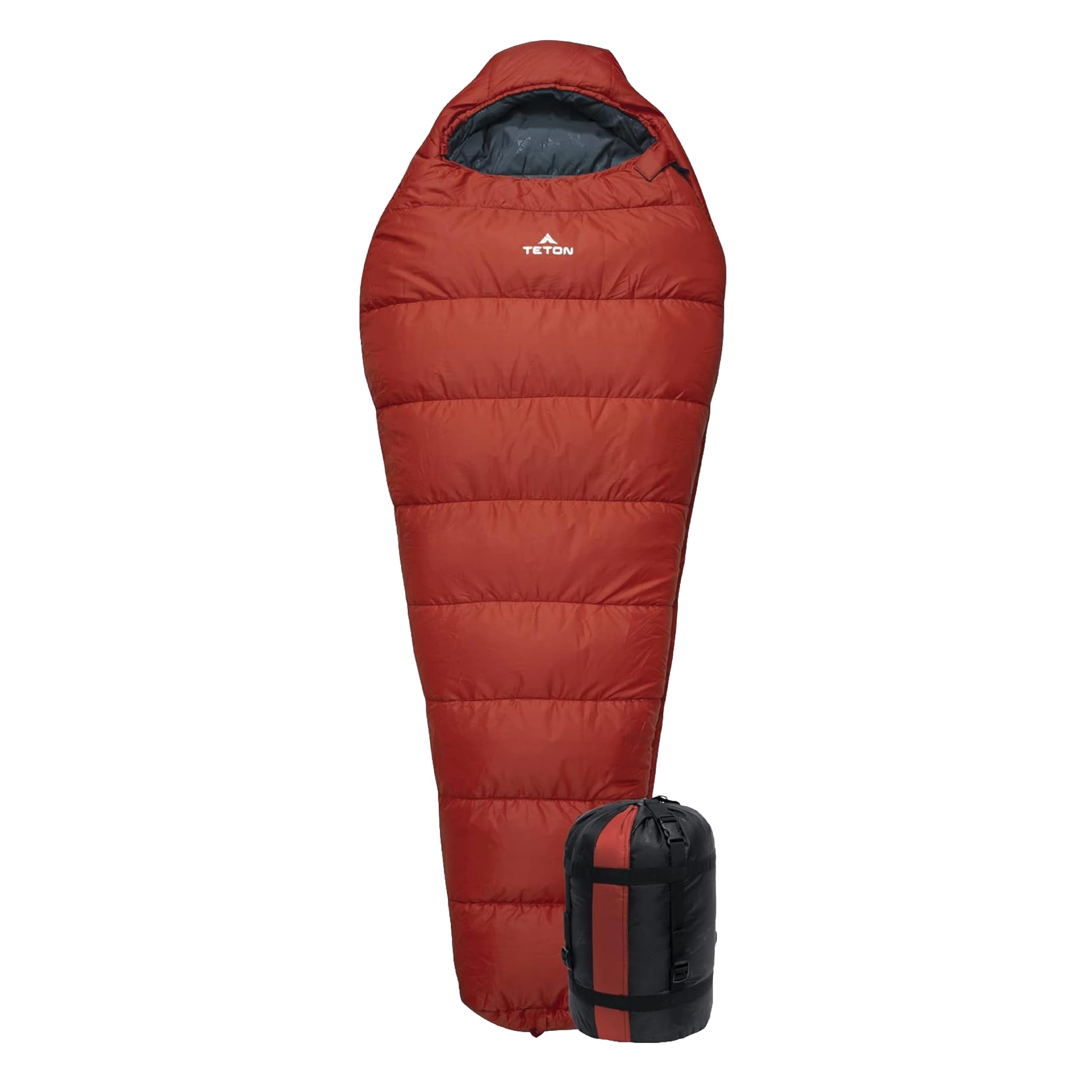
Teton LEEF
Key Features
- Fill: Microfiber synthetic
- Weight: 3.5 lb
- Dimensions: 81 x 21 in
- Temperature rating: 20°F
- Price: Midrange
The LEEF is the bag we hand to a backpacker who wants a real three-season mummy and will not pay down prices. It is rated to 20 degrees, weighs 3.5 pounds and ships with a compression sack, and it costs a fraction of our top pick. What that money buys is warmth by bulk rather than by fill power: the microfiber insulation is heavier and does not compress as small, and in exchange you get a bag that keeps working when it gets damp and does not need careful handling.
We were warm in it on cool nights with a baselayer and a pad underneath, and the mummy cut leaves little dead air to heat. The shape is long and narrow — 81 inches by 21 — so it suits a lanky sleeper better than a broad one; bigger builds will feel the width before they feel the length. There is a small pocket inside for a phone or a headlamp, the sort of thing that keeps a cold rectangle off your hip.
The compression sack is the weak point in daily use. It works, but getting the bag back in takes a wrestle every morning, and the sack is cut tighter than the bag needs. Stuff it from the foot end instead of rolling it first and the fight mostly goes away. The lifetime warranty is worth more than it sounds on a bag this inexpensive, and it is the reason we are comfortable sending a first-timer out with one.
Pros
- Genuine 20-degree mummy at a synthetic price
- Compression sack and lifetime warranty included
- Room enough to sleep on your side
- Small interior pocket for a phone
Cons
- 3.5 pounds is heavy next to a down bag
- Narrow 21-inch shoulder cut
We recommend the LEEF to anyone who wants a genuine three-season mummy without down-bag money, provided you are not broad across the shoulders.
Best for Broad-Shouldered Sleepers
Teton ALTOS
Key Features
- Weight: 3.5 lb
- Dimensions: 84 x 32 in
- Max user height: 84 in
- Temperature options: 20°F and 0°F
- Price: Premium
Mummy bags are efficient and unfriendly, and the ALTOS is Teton’s answer to the second part: 84 inches long, 32 inches across the shoulders, and a footbox that does not taper to a point. At 3.5 pounds it carries the same weight as the cheaper LEEF, so the room is bought with bulk rather than with grams.
The cold-weather details are all present. The hood cinches down around the face, there is a draft tube behind the zipper, and the shell sheds a damp morning rather than soaking it up. Teton sells this in 20- and 0-degree versions; for three-season backpacking in most of the country, the 20 is the one that makes sense.
Where the ALTOS earns its place for us is broad shoulders and side sleeping. At 32 inches across it is the roomiest mummy in this guide, and we did not expect the extra fabric to matter as much as it did — it is the difference between sleeping and lying still. One irritation: the drawstring around the face has thin padding behind it, so cinching it hard pulls the cord against your forehead. Worth knowing before a cold night.
Pros
- Widest mummy in this guide at 32 inches
- Built-out footbox leaves room for your feet
- Hood, draft tube and a water-resistant shell
- Available in 20- and 0-degree versions
Cons
- Premium price for a synthetic bag
- 3.5 pounds is a lot to carry
If mummy bags leave you feeling strapped in, this roomier cut is the one we point you to — you pay in weight and price, not in warmth.
Best for Summer Backpacking
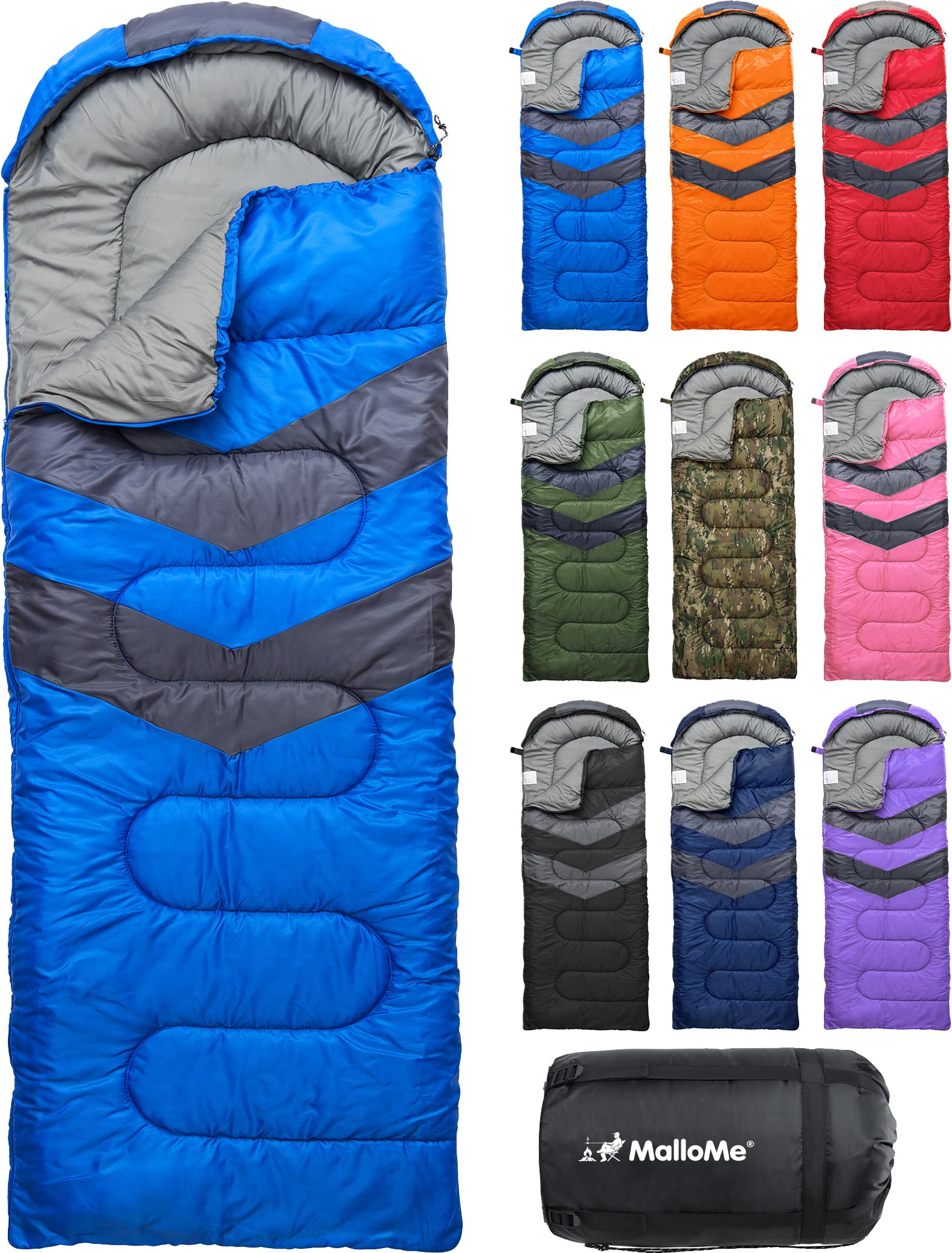
MalloMe Sleeping Bag
Key Features
- Shape: Rectangular
- Weight: 2.87 lb
- Dimensions: 86.6 x 31.5 in
- Temperature range: 50°F to 80°F
- Price: Budget
Rated from 50 to 80 degrees, this is the bag for trips where the forecast is your friend: summer overnights, cabin bunks, and the back of a car that swallows whatever you throw in it. We think it is the best value in this guide for that job, and it is the one we hand to first-time campers who do not yet know what they want.
The rectangular cut is the friendliest thing about it: 86.6 by 31.5 inches, wide enough to turn over in, and long enough for most adults. It is light for the size and it rolls back into its carry bag without a fight, which matters more than it sounds when you are packing at dawn with cold hands. The zip runs the full length, so you can open it up and cool down on a warm night instead of sweating through it.
Where it stops is the temperature. Fifty degrees is a mild night, and a bag rated to 80 at the top end is not adding warmth you did not already have; take it onto a 40-degree night and you will be sleeping in your fleece. That is not a fault in a bag this inexpensive — it is the boundary of what it is for. Buy it for summer and it will do everything you ask.
Pros
- Roomy rectangular cut that lets you turn over
- Light enough to carry on summer trips
- Rolls back into its bag without a fight
- Low cost for a first bag
Cons
- Warm-weather only, 50 degrees and up
- Shoulder width feels tighter than measured
For summer trips and cabin bunks we have not found better value in this group; just do not ask it to handle a frosty night.
Best for Warm-Weather Camping
JEAOUIA Sleeping Bag

Key Features
- Weight: 3.3 lb
- Dimensions: 86.6 x 31.5 in
- Max user height: 5 ft 11 in
- Temperature range: 50°F to 68°F
- Price: Budget
A rectangular bag with a hood is a small thing that makes a real difference. The JEAOUIA has a drawstring hood, a zipper at the foot for letting air in or out, and enough width that it does not feel like a sleeping bag at all. It measures 86.6 by 31.5 inches, weighs 3.3 pounds, and is rated from 50 to 68 degrees.
For warm-weather backpacking we found it a decent, inexpensive choice. It packs into a pack or a suitcase, the outer is a waterproof polyester, and the hood earns its keep on a night that turns cooler than forecast. What it will not do is flatter you below 50 degrees — the rating is honest and the fill is thin, so it is a summer bag rather than a three-season one.
Zippers are where cheap bags give up, and this one is no different: the zip runs smoothly when it behaves and it is the first thing to fail when it does not. A bag that unzips itself in the night is worse than a bag without a hood. Run it up and down a few times the day it arrives, and send it back if it catches or opens behind you.
Pros
- Drawstring hood adds warmth at the head
- Foot-end zipper lets you vent warm nights
- Packs into a suitcase or a pack
- Inexpensive for a hooded bag
Cons
- 3.3 pounds is heavy for the warmth
- Zipper durability is the weak point
This is the bag we hand to fair-weather campers who want a hood and room to turn over, as long as the forecast stays mild.
Best for Ultralight Summer Trips
BORULL Sleeping Bag

Key Features
- Weight: 1.5 lb
- Dimensions: 79 x 30 in
- Packed size: 4.7 x 7.9 in
- Temperature range: 50°F to 80°F
- Price: Budget
A pound and a half, packed to roughly the size of a small melon: the BORULL is the lightest bag in this guide by a wide margin, and on a trip where pack volume is the binding constraint, that is the entire argument. It is 79 by 30 inches and rated from 50 to 80 degrees, with a 100 GSM polyester microfiber fill, and the fabric is soft to the touch.
Our reservation is the room. The maker recommends it for sleepers under about 165 pounds, which tells you how much width is really there, and at 79 inches it is longer than a standard bag but shorter than either Teton here. Tall and solid is the combination that makes this one a try-before-you-commit purchase.
What earns it a place here is the packed size and the weight together: it is the least expensive way in this guide to take a pound and a half off your pack, and for summer nights it does the job without complaint. Two things decide it. There is no stated warranty at all, and the warmth is warm-weather only, so treat it as an addition to a kit rather than the bag you build one around.
Pros
- 1.5 pounds, the lightest bag here
- Packs to about eight inches long
- Long 79-inch cut for the weight
Cons
- No warranty is stated anywhere
- Maker recommends it under 165 pounds
At a pound and a half this is the one we reach for when pack space decides the trip — summer only, and it comes with no warranty at all.
Best for Damp Shoulder Season
OneTigris Bushcrafter

Key Features
- Shell: 300T pongee
- Weight: 3.1 lb
- Dimensions: 82.6 x 33 in
- Temperature rating: 3 to 14 °C
- Price: Midrange
Anti-snag zippers are the kind of detail that only impresses you after a bad night, and the Bushcrafter has them: YKK zips with a guard behind the teeth, on a bag that measures 82.6 by 33 inches and weighs 3.1 pounds. The shell is a 300T pongee treated to shed splashes, and the whole bag is machine washable on a delicate cycle.
Comfort is rated from 3 to 14 degrees Celsius — roughly the high 30s to the mid 50s Fahrenheit — so this is a shoulder-season and mild-weather bag, not a winter one. It is the widest cut in this guide, which is why it swallows a camp pillow and why bigger frames fit it without a fight.
Here is the trade. Three point one pounds is heavy for a bag that is comfortable in the 40s; a down bag half a pound lighter will keep you warmer, and our top pick does. The polycotton fill is bulky and does not compress the way microfiber does, so it also eats pack space.
We kept the Bushcrafter because of what the shell and the zip buy you: a bag for wet, mild trips — damp valley camps, a bunkhouse, a kayak hatch — where a tough washable outer matters more than grams, and where a zipper that snags at 3 a.m. is the thing you actually remember. Buy it for that, not for alpine trips.
Pros
- Anti-snag YKK zippers on a guarded track
- Widest cut here at 33 inches
- Water-repellent shell, machine washable
- Roomy enough for a camp pillow
Cons
- 3.1 pounds for a mild-weather bag
- Bulky polycotton fill eats pack space
For wet, mild-weather trips where a tough washable shell beats saving grams, this wide-cut bag earns its place; just accept the weight.
How We Chose and Tested Backpacking Sleeping Bags
We started with roughly 40 bags sold by the major outdoor retailers and trimmed the list from the spec sheets — fill power and fill weight, temperature rating, packed volume, shell fabric, price. From that we bought 12 at retail, chosen to cover the range: synthetic and down, mummy and semi-rectangular, men’s and women’s-specific cuts. Testing ran eight months, long enough to include warm summer nights and a couple of hard frosts, and every bag was used the way it would be on a real trip — stuffed, carried, slept in, aired out, stuffed again.
Most of the sleeping happened in the backyard, where I could hold the overnight low against the rating on the tag. I wore the same baselayers every time and noted at 3 a.m. whether I was warm, cold, or reaching for a hat, then checked again at dawn for drafts around the shoulders and feet. Two weekend trips added messier conditions: one damp and humid enough to see how each bag handled moisture, one with a long cold climb into camp. Between outings I stuffed and unstuffed the bags dozens of times, since that’s where wear shows up first.
Back home, I weighed every bag and its stuff sack on a kitchen scale, then packed each into the bottom of a 50-liter pack alongside a bear canister to see how much room was actually left for food. Two testers, one 5-foot-4 and one 6-foot-2, reported shoulder room and hip width and flagged where a bag felt tight. We zipped and unzipped each one in the dark, with and without gloves, counting snags, then kept working the zippers to see whether the coils or the pulls failed first. Loft was measured flat on the floor before and after the season, and I checked shells for snags and thin spots on every bag that came home dirty. Price only moved a bag up the ranking when it matched what that bag delivered in warmth and packed size.
How to Choose a Backpacking Sleeping Bag
The rating on the tag is the least useful number on its own — what a backpacking bag really costs you is weight, packed size, and how well it holds heat once the temperature drops below what the label promised.
Read the rating as a range, not a promise
A 20-degree rating does not mean you will be comfortable at 20 degrees. It is closer to the temperature at which a healthy adult gets through the night, and comfort usually sits well above it. We plan for a rating a good ten degrees below the coldest night we expect, then look at what holds the heat in: a hood that cinches around the face, a draft tube behind the zipper, a collar at the shoulders. Those three details do more for a cold night than another few ounces of fill.
Warmth-to-weight is the number you carry
Two bags can both say 20 degrees and be a pound apart. In this guide a down bag reaches that rating at 2.6 pounds while a synthetic one needs 3.5, and the difference is what you feel on the last climb of the day. Packed size follows the same logic: down compresses into a space a synthetic bag will not fit into, which matters when the rest of your kit is already fighting for room.
If you carry the bag more than a few miles a trip, pay for the weight saving. If it travels by car most weekends, you will never miss it.
Down or synthetic?
Down wins on weight and packed size and loses on water: a soaked down bag collapses into clumps and stops insulating until it is properly dried. Synthetic fill keeps more of its warmth when damp, costs less, and shrugs off being stuffed every morning. Our rule is down for dry, cold, weight-conscious trips where the bag lives in a dry sack, and synthetic for wet climates, gear that gets borrowed and abused, and anyone who would rather not baby a bag.
Fit: length, shoulders and the footbox
The measurements to check are length against your height and shoulder width against your build. The mummies here run from 21 inches across at the narrowest to 33 at the widest, and that is a bigger difference in comfort than any other figure on the page. A bag that is too narrow is not exactly cold — it is a night of not being able to roll over. Side sleepers should also look at the footbox: a tapered one saves weight, a built-out one lets your feet sit upright.
Zippers and stuff sacks are where bags fail
Most bags give up at the zip long before the insulation goes. Snagging at the shoulder is the usual trouble, and it is worse in the dark and worse in a tight mummy cut. Run the zip up and down a few times the day the bag arrives and send it back if it catches. Stuff sacks are the other weak spot: a sack cut tight for its bag turns every morning into a wrestle. Stuff from the foot end rather than rolling, and the bag goes in faster.
Frequently Asked Questions
Do I need a sleeping pad under a backpacking sleeping bag?
Yes. A bag insulates above and around you, and the ground pulls heat straight out of whatever is underneath. Any pad with real insulation works: an inflatable pad with an R-value of 2 or more for three-season nights, or a closed-cell foam mat for summer. Without one, even a 20-degree bag can feel like a 40-degree bag on cold ground.
Can I wash a backpacking sleeping bag at home?
Usually yes, with care. Down needs a front-loading machine without an agitator and a down-specific wash, then a low tumble with dryer balls to break the clumps up, since an agitator can tear the baffles apart. Synthetic bags are more forgiving and can go on a gentle cycle. Follow the bag’s own care label first — the OneTigris, for instance, is machine washable on a delicate cycle.
How long should a backpacking sleeping bag last?
Longer than most people keep one, if it is stored properly. The killer is compression: leave a bag squashed in its stuff sack in a hot garage for a season and the loft does not come back fully. Store it loose in a cotton sack or hang it by its loops, and stuff it only for the trip. Synthetic fills lose loft faster than down, so a hard-used synthetic bag will feel thinner after several seasons.
Final Verdict
If the bag is going on your back, the Kelty Cosmic 20 is the one we point you to. It is the only down bag in this guide, the lightest one here at a real 20-degree rating, and it compresses into a space the synthetic bags cannot match — which is the whole job on a long carry.
Two situations change the answer. If you want three-season warmth for less money, or a bag that shrugs off a wet week, the Teton LEEF is the better buy, with a lifetime warranty behind it. And if a mummy cut leaves you feeling pinned, spend the extra on the roomier Teton ALTOS.