This post contains affiliate links. We may earn a small commission when you buy through our links — at no extra cost to you.
Ultralight stoves promise minimal weight and fast boils. But in real conditions—wind, cold, uneven ground—many fall short. The difference between a stove that works and one that sputters often comes down to a regulator and burner design. These aren’t features you can eyeball from a spec sheet.
The lightest canister stove might save 2 ounces but tip with a 1-liter pot. A wood-burning stove eliminates fuel weight but demands dry twigs and constant feeding. There’s no single perfect stove; there’s the right one for how you pack and where you camp.
The three specs that determine real-world performance are weight, wind handling, and ignition reliability. The picks below reflect actual use patterns, not marketing labels.
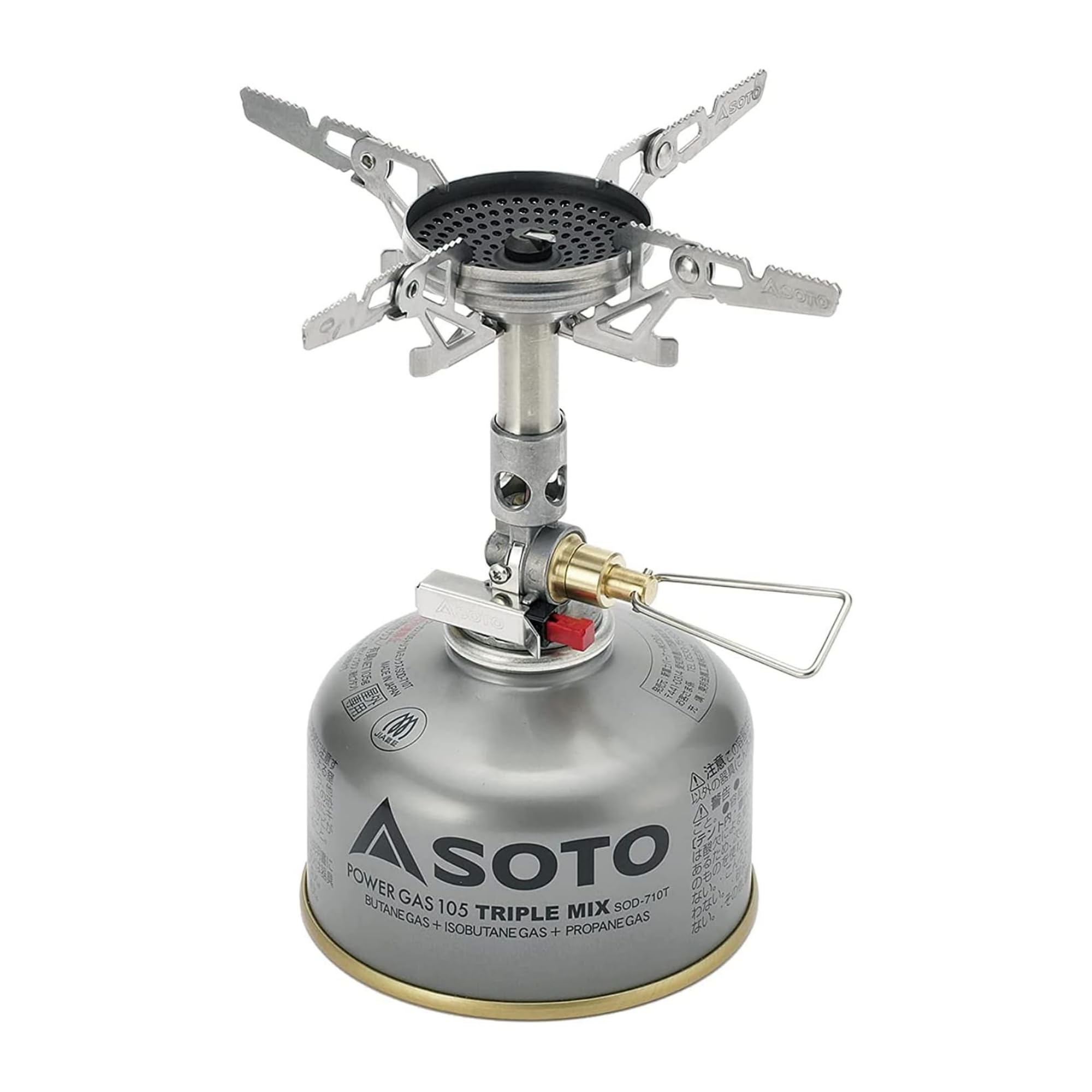


Best for Windy/cold Conditions
SOTO WindMaster
Key Features
- Weight: 2.3 oz
- Boil Time: 2.5 min/L
- Ignition: Piezo
- Price: Mid-range
The SOTO WindMaster delivers flame stability that other ultralight canister stoves cannot match in exposed conditions. Its pressure regulator keeps output consistent as the canister cools or empties, while the burner design shapes the flame to resist gusts. This means no more waiting double time for water to boil when the wind picks up.
The 4Flex pot support handles pots up to 1.5L without tipping, a rarity among sub-3 ounce stoves. At 2.3 ounces and collapsing to a palm-sized bundle, it packs easily alongside a fuel canister. Boil time hovers around 2.5 minutes per liter in calm air, and even in moderate wind it stays under four minutes.
This stove fits backpackers who camp above treeline, on coastal trails, or in any breezy setting where a standard canister stove sputters. Those who only cook in sheltered sites or want absolute minimum weight for weekend trips may prefer the simpler PocketRocket 2, but that stove loses efficiency quickly in wind. The WindMaster’s tradeoff is its piezo igniter: it can fail to spark after rain or in cold. Carrying a mini Bic lighter solves that.
Given its mid-range price, the WindMaster is a focused tool for the conditions that frustrate other stoves. It is not for budget-limited buyers or those who want an integrated pot system, but for anyone needing reliable boiling in variable weather, it justifies the premium over basic alternatives.
Pros
- Flame holds steady in wind that would extinguish most canister stoves
- Weighs only 2.3 ounces and folds small for ultralight packs
- Piezo ignition sparks reliably in most conditions
- 4Flex arms support larger cookware without tipping
Cons
- Piezo igniter can be inconsistent after moisture exposure or in cold
For backpackers who regularly cook in wind or cold, the WindMaster delivers consistent boiling performance at a weight that justifies its premium over unregulated stoves.
Best for Ultralight Backpackers
MSR PocketRocket 2
Key Features
- Weight: 2.6 oz
- Boil Time: 3.5 min/L
- Ignition: Manual
- Price: Mid-range
The MSR PocketRocket 2 is an ultralight staple that skips extra features to keep weight at 2.6 oz. While the top-pick WindMaster handles wind and cold better, this stove sticks to a straightforward design that boils water in under 3.5 minutes per liter and folds compact enough to fit in a pocket.
This stove suits hikers who want a no-frills burner for fair-weather trips. It is not intended for cooking in sub-freezing temperatures or steady wind – the lack of a pressure regulator means output weakens with cold canisters and near-empty fuel, so plan around mild conditions for consistent performance.
For those who rarely camp in exposed or cold environments, the PocketRocket 2’s simplicity and light weight make it a cost-effective choice. It pairs well with a separate pot system and offers easy ignition with a manual piezo (or backup lighter).
Pros
- Extremely lightweight and packs down to palm size
- Consistent ignition and steady flame across multiple uses
- Boils water quickly – under 3.5 minutes per liter
- Intuitive setup and pack-away with no complicated parts
Cons
- Flame output drops noticeably in sub-freezing temperatures or with a nearly empty canister due to missing pressure regulator
- Wind sensitivity: even a light breeze can cause flame flickering and uneven heating on open ground
- Simmer control is coarse – only large flame adjustments possible, not suitable for delicate cooking
The PocketRocket 2 remains a benchmark for ultralight canister stoves – ideal for three-season trips where weight matters most and wind is manageable.
Best for Real Meal Cooking
Jetboil MiniMo
Key Features
- Weight: 14.6 oz (system)
- Boil Time: 2 min
- Ignition: Push-button
- Price: Premium
The MiniMo’s regulating burner delivers consistent simmer and fast boil — a rare combo in integrated systems, where most cannister stoves either boil quickly or let you adjust flame, but not both. At 14.6 oz, it’s heavier than the ultralight Stash, but the trade-off is a 1L pot that fits one or two people and a stable base for cooking one-pot meals like pasta or rice.
This system suits backpackers who prioritize meal variety over grams saved. The push-button ignitor can be inconsistent over time, so carrying a backup lighter is a simple precaution. Not for hikers shaving every ounce — the MiniMo sits near the heavy end of integrated stoves.
Fuel efficiency is a genuine strength: the regulator maintains output even with near-empty canisters, and the pot’s heat exchanger saves gas on longer trips. The burner adjuster plastic knob has been noted to wear with heavy use, but the overall build holds up well for typical weekend trips.
Pros
- Precise flame control for simmering sauces or soups.
- Boils water in about two minutes, saving fuel and time.
- Compact package nests pot, burner, and canister neatly.
Cons
- Ignitor may become unreliable after repeated use in dusty or wet conditions.
- Plastic burner adjuster knob can break if overtightened or dropped on rock.
Packs simmer control and speed into one pot — best for backpackers who cook real meals and don’t mind an extra half-pound vs. ultralight competitors.
Best for Gram-Counting Hikers
BRS-3000T
Key Features
- Weight: 0.9 oz
- Boil Time: ~3 min/L
- Ignition: Manual
- Price: Budget
The BRS-3000T is the lightest canister stove available, weighing just 0.9 oz — a full ounce less than the classic PocketRocket. It also costs a fraction of the price, making it an attractive option for budget-conscious ultralight hikers.
The savings in weight and cost come with real tradeoffs. The pot support arms are narrow and the legs thin, so stability is poor with any pot larger than 1L. Wind easily disrupts the flame, extending boil times significantly on exposed sites. The legs can bend if overtightened or set on uneven ground, affecting long-term usability. This stove demands careful handling and site selection.
This makes the BRS-3000T best suited for the solo hiker who boils small amounts of water for dehydrated meals, packs a small pot (0.7L to 1L), and accepts that the stove is a semi-disposable item. It’s not for group cooking, cold-weather trips, or anyone who expects rugged durability.
When used within its limits, the BRS-3000T is an effective tool for shaving grams on a budget. It boils water quickly enough for a hot meal and packs down to fit inside a mug. For the weight-obsessed backpacker, it’s a rational compromise.
Pros
- Weighs only 0.9 oz — the lightest canister stove available.
- Costs far less than comparable ultralight stoves.
- Boils water quickly for its size, about 3 minutes per liter.
Cons
The BRS-3000T is for the ultralight purist who accepts its fragility and cooks solo — anyone else should look at sturdier options.
Best for Fuel-Free Cooking
Solo Stove Lite
Key Features
- Weight: 9 oz
- Boil Time: 8-10 min/34oz
- Ignition: Tinder (manual)
- Price: Mid-range
The Solo Stove Lite eliminates the need for fuel canisters by burning twigs, leaves, and pine cones — a renewable resource you find on the trail. At 9 ounces, it’s remarkably lightweight for a wood-burning stove, and its gasification design produces a clean, efficient burn for cooking.
This stove suits ultralight hikers who prefer not to carry fuel, as well as survival kits and environmentally conscious users. Be prepared to feed it small, dry twigs regularly — the stove needs constant attention to keep the fire going — and expect soot to accumulate on your pot. In wet conditions, finding dry fuel becomes a challenge, limiting its reliability.
Real-world performance shows an 8-10 minute boil time for 34 ounces of water, on par with many canister stoves. The tradeoff is that you can’t walk away — the stove requires your presence to maintain the flame. For those who enjoy the process of building and tending a small fire, this adds to the experience; for those seeking quick, hands-free boiling, it’s a dealbreaker.
Pros
- Burns free, renewable fuel found on the trail
- Lightweight for a wood stove at 9 oz
- Efficient gasification burn reduces smoke and ash
Cons
- Pot exterior collects soot during use
- Requires dry, small twigs — not reliable in wet conditions
- Needs constant feeding and attention during cooking
The Solo Stove Lite is a niche tool for hikers committed to fuel-free cooking who enjoy the ritual of tending a fire. If that describes you, it’s worth the weight tradeoff.
Best for Budget Integrated
Fire-Maple Fixed Star 1
Key Features
- Weight: 18 oz (system)
- Boil Time: ~2 min
- Ignition: Piezo
- Price: Mid-range
The Fire-Maple Fixed Star 1 delivers genuinely fast boil times — roughly two minutes for a liter — thanks to its integrated pot-and-burner design. The whole system packs down compactly, making it a space-saving option for solo trips or short excursions. At its price point, it offers the convenience of an all-in-one stove without the premium markup.
This system suits budget-conscious campers who want a quick-boil solution and already have fuel canisters. However, the piezo igniter may stop working after a limited number of uses, and the plastic components — grip rings, lid tabs — can crack or deform under heat or in cold conditions. Those issues don’t affect the boiling performance itself, but they do mean the stove may not hold up to frequent or long-term use.
The compact form factor fits easily into a pack, and the integrated pot stabilizes well on the burner — no separate pot support needed. The heat exchange fins on the pot base improve efficiency in calm conditions, though wind can still slow boil times. For a low-cost integrated system, it performs reliably for its core task of boiling water for dehydrated meals and coffee.
Pros
- Boils water in roughly two minutes — fast enough for dehydrated meals and hot drinks.
- Integrated pot-and-burner design saves space and simplifies packing.
- Costs significantly less than competing integrated systems from Jetboil or MSR.
Cons
- Piezo igniter may stop sparking after a number of uses, requiring a backup lighter.
- Plastic components (lid tabs, handle grips) can crack or warp when exposed to heat or cold.
This is the right stove for someone who wants integrated-system speed on a budget and can accept that the igniter and plastic parts are less durable than premium alternatives.
Best for Cold-Weather Performance
MSR PR Deluxe

Key Features
- Weight: 2.9 oz
- Boil Time: 3.5 min/L
- Ignition: Piezo
- Price: Mid-range
The PocketRocket Deluxe retains the compact, ultralight form of its predecessor while adding a pressure regulator that maintains consistent output in cold temperatures and with near-empty canisters. The built-in piezo igniter offers convenient push-button lighting, though it may become inconsistent after extended use—carrying a backup lighter is wise. Compared to the standard PocketRocket, the Deluxe costs notably more and adds a small amount of weight, yet does not match the wind resistance of the top-pick WindMaster. This stove suits backpackers who want steady cold-weather performance without the bulk of an integrated system, and its mid-range price reflects the added features. It is a focused upgrade for those who need consistent output in cold.
Pros
- Pressure regulator maintains steady output in cold conditions and with low fuel.
- Compact and ultralight design (2.9 oz) fits easily in any backpack.
- Built-in piezo ignition allows one-hand lighting without matches.
Cons
- Piezo ignition may become inconsistent after limited use; carrying a backup lighter helps.
- Lacks the wind resistance of top competitors like the WindMaster, making it less suited for exposed conditions.
The PocketRocket Deluxe is a smart upgrade if you frequently camp in cold weather and want a lighter alternative to integrated systems, but its added cost and igniter quirk make it a specialized choice.
Best for Solo Ultralight
Jetboil Stash

Key Features
- Weight: 7.1 oz (system)
- Boil Time: 2.5 min
- Ignition: Manual
- Price: Premium
The Jetboil Stash shaves ounces by pairing a thin-walled titanium pot with a minimalist burner, making it the brand’s lightest integrated system. For a solo backpacker counting grams, that weight saving is real — boil time remains competitive at 2.5 minutes. But the tradeoff for that lightness is a lid that can pop off during transport and burner components that have shown durability concerns after limited use. It also carries a premium price for a 0.8L pot, and lacks the simmer control that makes the MiniMo more versatile for real cooking.
Pros
- Full integrated system weighs only 7.1 oz — same as many standalone burners alone
- Nests into a compact cylinder that fits easily in a pack corner
- Boils water faster than most ultralight stoves at this weight
Cons
- In a pack, the lid can come off — not a safety hazard but a packing annoyance
- The burner assembly may degrade sooner than heavier Jetboil models
Pick the Stash if your hike demands the lightest possible integrated stove and you accept that the lid needs a rubber band and the burner is best treated as a consumable item rather than a heirloom piece.
Best for Budget Ultralight
Fire-Maple Greenpeak

The Fire-Maple Greenpeak delivers on its promise of an ultralight, budget-friendly stove for backpackers who prioritize weight savings. At 3 ounces, it packs small and pairs well with compatible pots for decent stability when boiling water. However, its piezo igniter may quit after a handful of trips, and the flame adjustment offers only on/off control — not the precision needed for simmering. Compared to the BRS-3000T in the same weight class, the Greenpeak is slightly more stable but lacks that stove’s consistent performance (igniter aside). For those who primarily boil water and don’t mind carrying a lighter as backup, this is a capable entry-level stove.
Pros
- Weighs only 3 ounces for ultralight backpacking.
- Pairs with Fire-Maple pots for a stable cooking base.
- Budget-friendly price for a lightweight canister stove.
Cons
- Piezo igniter may stop working after moderate use — keep a backup lighter on hand.
- Flame control is basic; only suitable for boiling, not simmering.
This stove suits budget-minded backpackers who boil water and don’t need precise simmer control — just carry a spare lighter.
Best for Emergency Kits
YCDMLJC Portable

Key Features
- Weight: 3.8 oz
- Boil Time: ~3 min/L
- Ignition: Piezo
- Price: Budget
The YCDMLJC Portable Camping Stove delivers on its promise of low cost and compact size, making it a natural fit for emergency kits or as a lightweight backup. It boils water quickly for basic needs, but the flame tends to concentrate in the center, which can scorch food in small pots. Stability also becomes a concern with larger cookware, so this stove suits small pots and calm conditions rather than everyday backpacking.
Pros
- Budget-friendly price for a functional stove
- Small and light enough for emergency kits or backup
- Heats water quickly for basic needs
Cons
- Flame may concentrate in the center, increasing the chance of scorching food in small pots
- Pot stability can be an issue with larger cookware
This stove works best as an emergency backup or for budget car camping where weight and precise flame control are not priorities.
How to Choose
The lightest stove isn’t always the best stove — real-world performance depends on wind handling and fuel efficiency.
Weight vs. Stability
A lighter stove often means thinner pot supports and a narrower base. The BRS-3000T at 0.9 oz saves ounces but its folding arms bend under a loaded 1L pot, making spills likely. Stoves in the 2-3 oz range like the SOTO WindMaster or MSR PocketRocket use stronger metal arms that handle standard cookware.
For solo hikers with small titanium pots, the lightest option works fine. If you cook for two or use a wider pot, a slightly heavier stove with wider pot supports is safer and more stable.
Boil Time in Practice
Advertised boil times (2-3 minutes per liter) are measured in a lab with full canisters and no wind. In real conditions — cold fuel, partial cans, a breeze — expect 4-6 minutes. Pressure-regulated stoves like the WindMaster and PocketRocket Deluxe maintain output as the canister cools, keeping boil times closer to the claimed number.
If you only boil water for dehydrated meals, any stove under 4 minutes per liter is fine. For simmering or cooking, a slower boil is acceptable if you get good heat control.
Wind Resistance
Wind is the biggest enemy of a canister stove. A light breeze can cut flame temperature by 50%, wasting fuel and extending cook times. Stoves with a recessed burner head or integrated wind screen (like the WindMaster) handle gusts far better than open-flame designs.
Wood stoves are naturally less affected by wind because they use a combustion chamber, but they still need a sheltered spot to keep the fire fed. For exposed alpine camps, a stove with proven wind resistance is a must.
Ignition Reliability
Piezo igniters are convenient — press a button and you’re cooking. But they can fail after a few trips due to moisture, debris, or a weak spark. Manual stoves require a lighter or matches, which always work if you keep them dry.
If you choose a piezo stove, carry a backup lighter. Models with push-button igniters (like Jetboil systems) tend to be more durable than budget piezo units, but none are immune to failure.
Simmer Control
Most ultralight canister stoves are designed for full-blast boiling — they either blast or they’re off. True simmer control requires a regulator that can throttle gas flow precisely. The Jetboil MiniMo and MicroMo have this; the SOTO WindMaster does not.
If you cook rice, pasta, or one-pot meals, a regulated stove with a wide heat adjustment range is worth the extra weight. If you only boil water, skip the simmer feature and save ounces.
FAQ
Why does my backpacking stove igniter stop working after a few trips?
Most igniters are piezo crystals that produce a spark by mechanical impact. Moisture, dirt, or a weak spring can reduce the spark strength. Solutions: keep the igniter dry, and always carry a disposable lighter as backup. If the igniter fails, it’s usually a cosmetic inconvenience — the stove still works with a manual light.
Can I use a standard pot on a Jetboil stove?
Jetboil integrated systems (MiniMo, Flash, etc.) come with a specific pot that couples to the burner for efficiency. You can use other pots with the burner base, but you lose the wind protection and fuel efficiency of the coupling. For best performance, stick with the matching pot. Separate stoves like the PocketRocket or WindMaster accept any standard cookware.
How do I keep my ultralight stove from tipping over with a large pot?
Ultralight stoves have narrow bases and flexible pot supports. For pots larger than 1L, choose a stove with wide, rigid pot arms (like the MSR PocketRocket Deluxe or SOTO WindMaster with 4Flex). Alternatively, use a smaller pot or cook on a flat, stable surface. Avoid the BRS-3000T with anything larger than a 700ml pot.
Is a wood-burning backpacking stove practical for multi-day hikes?
Wood stoves work well where dry twigs are abundant and you have time to tend the fire. They require constant feeding, produce soot on pots, and are nearly useless after rain. For a 3-day hike in dry forest, it’s a fuel-free option. For a longer trip in variable weather, a canister stove is more reliable — wood stoves are best as a backup or in dedicated practice.