This post contains affiliate links. We may earn a small commission when you buy through our links — at no extra cost to you.
Many travel first aid kits sell you on piece count, but a 298-piece kit won’t fit in your daypack – and half the contents are safety pins. The real need is a compact kit with supplies that actually work when you’re on the trail.
The challenge is finding a balance: enough real medical items (bandages that stick, antiseptic wipes, a tourniquet) without the bulk of a home medicine cabinet. For hikers and carry-on travelers, a 100- to 150-piece kit is the sweet spot.
The best travel first aid kits prioritize portability, organization, and essential features – the ones that let you grab the right kit for your trip, whether that means branded medicines for everyday cuts or a blanket and tourniquet for backcountry safety.


Best for Hiking & Camping
Protect Life 100pc
Key Features
- Piece Count: 100
- Portability: 7.76 oz
- Case Durability: Hard shell, waterproof
- Price: $$
The Protect Life kit stands out for including a tourniquet and emergency blanket in a compact 100-piece design, making it suitable for both daily travel and outdoor emergencies. The doctor-developed contents cover minor cuts, blisters, and sprains while the guide walks through response steps.
This kit weighs just 7.76 ounces and fits easily in a backpack or glove box. The hard case is water-resistant but can crack if dropped repeatedly – a tradeoff that matters more for rough backpacking than car storage. It is best for hikers, campers, or travelers who prioritize emergency tools over sheer quantity.
Pros
- Includes a tourniquet and emergency blanket typically found only in larger survival kits.
- Compact 7.5 x 5.2 x 1.5 inch case fits in a glove box or daypack.
- Doctor-written medical guide helps treat common injuries on the go.
Cons
- Hard plastic case can crack if dropped onto a hard surface; occasional QC variance in case durability.
For hikers and travelers who want emergency preparedness without excess weight, this kit delivers the essentials in a portable package.
Best for Everyday Carry
BAND-AID Travel 80pc
Key Features
- Piece Count: 80
- Portability: 6.88 oz
- Case Durability: Soft pouch
- Price: $
BAND-AID delivers what most travel kits skimp on: actual name-brand medicines and bandages you recognize. The soft pouch is small enough for a purse or glove box, and the 80-piece count covers minor cuts, scrapes, and headaches with Neosporin, Tylenol, and Band-Aid. That focus on everyday convenience means you won’t find scissors, tweezers, or an emergency blanket, and the soft case won’t shield contents from crushing like a hard shell would. This kit suits parents, commuters, and travelers who want known brands in a TSA-friendly package, not backcountry trauma gear.
Pros
- Includes name-brand Neosporin, Tylenol, and Band-Aid for quality assurance.
- Extremely compact soft pouch fits easily in purse, glove box, or backpack.
- Good value for the price with essential medicines and bandages for minor injuries.
Cons
- Soft pouch offers less protection than a hard case; contents may shift in transit.
- Lacks scissors, tweezers, and emergency blanket, limiting usefulness beyond minor cuts.
A solid everyday companion for minor mishaps, but not a backcountry emergency kit.
Best for Serious Hikers
Surviveware 98pc
Key Features
- Piece Count: 98
- Portability: 1 lb
- Case Durability: 600D polyester, water-resistant
- Price: $$$
The Surviveware 98-piece kit stands out for its rip-resistant 600D polyester case with labeled compartments and MOLLE loops, making it easy to attach to a backpack or keep sorted. While it packs a CPR mask and first aid guide into a compact 6x4x8-inch pouch, the premium price reflects the organizational design rather than the piece count. This kit suits serious hikers and preppers who need modular, durable gear but not travelers looking for maximum supplies per dollar.
Pros
- Labeled compartments and MOLLE system keep supplies organized and accessible
- Durable 600D polyester case resists water and rough use
- Includes a CPR mask and printed first aid guide in a compact size
Cons
- Premium price for 98 pieces; some users may expect more supplies for the cost
Best for backpackers who prioritize organization over piece count — not the cheapest per item, but the most thoughtfully arranged kit in this category.
Best for Budget Travel
General Medi Mini 150pc
Key Features
- Piece Count: 150
- Portability: 7.76 oz
- Case Durability: Soft pouch
- Price: $
The General Medi Mini packs 150 pieces into a 7.76-ounce soft pouch, making it the most content-dense travel kit near the $15 mark. Its compact size fits a large fanny pack or backpack, ideal for budget travelers or as a backup for car or home. The main tradeoff: the soft pouch offers less protection than a hard case, and zipper quality can vary between units – a reasonable compromise for the weight savings and piece count.
Pros
- 150 pieces at a budget-friendly price – one of the best per-piece ratios in travel-sized kits.
- Lightweight and compact, fits easily in a large fanny pack or backpack.
Cons
- Soft pouch provides less protection than hard cases, and zipper quality can be inconsistent over time.
Best for budget-conscious travelers who prioritize piece count and portability over case durability.
Best for Family Travel
KeepGoing Kids 130pc
Key Features
- Piece Count: 130
- Portability: 9.6 oz
- Case Durability: Fabric pouch, water-resistant
- Price: $$$
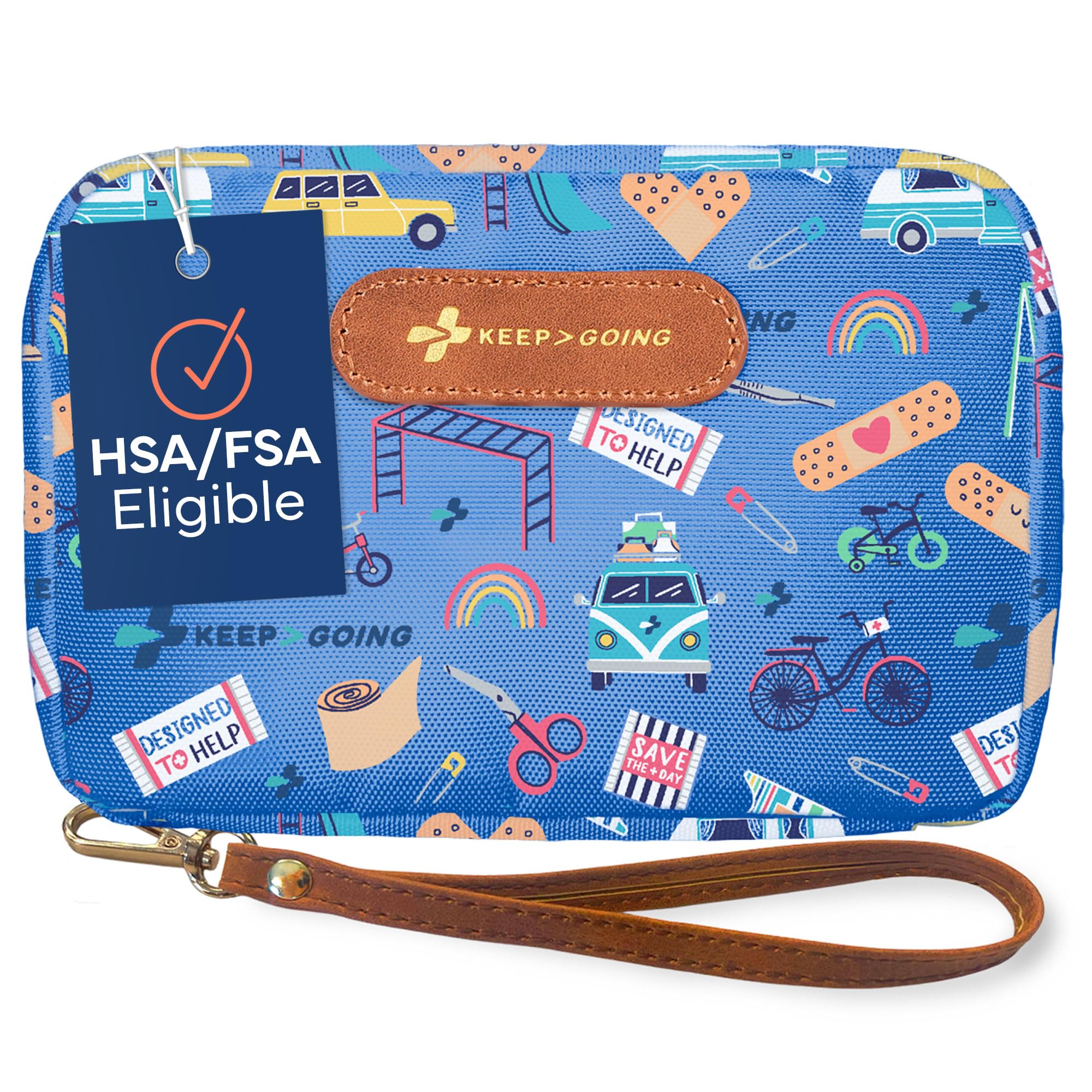
Where the Protect Life kit focuses on outdoor emergencies, this one targets families with young children: a 130-piece kit packed with kid-friendly extras like stickers and lip balm, plus latex-free bandages. The fabric pouch slips into a diaper bag or purse, and the included first-aid guide helps newer parents handle minor scrapes and bumps. That said, the premium price reflects the thoughtful design rather than raw piece count, and the soft pouch offers less protection against wet conditions than a hard case would.
Best for parents who want a grab-and-go kit for daily outings or travel — not for solo hikers, budget-focused buyers, or anyone needing a fully waterproof container.
Pros
- Cute design with stickers and lip balm appeals to kids and makes first aid less scary.
- Compact size fits diaper bags or purses; latex-free bandages suit sensitive skin.
- Well-organized with a first-aid guide — parents can find what they need quickly.
Cons
- Premium pricing for the piece count may feel steep compared to basic kits with similar quantities.
- Fabric pouch is water-resistant but not waterproof; heavy rain or spills can soak the contents.
The KeepGoing kit is for parents who value a cheerful, organized travel first aid kit over piece-count bargains — it fits the diaper bag beautifully, just keep it dry.
Best for Ultralight Hiking
THRIAID Mini 100pc

Key Features
- Piece Count: 100
- Portability: 0.53 lb
- Case Durability: Hard shell EVA
- Price: $
The lightest kit in this set at 0.53 lb, with a protective hard shell EVA case and included carabiner for clipping onto a pack or glove box. At 100 pieces, the contents cover basic cuts and scrapes but skip trauma gear like tourniquets or emergency blankets. The case can arrive with a strong chemical odor that needs a few days of airing out – a minor hassle for those sensitive to smells. This suits ultralight backpackers and travelers who prioritize minimal weight over comprehensive supplies.
Pros
- Weighs only 0.53 lb – the lightest kit reviewed.
- Hard shell EVA case with carabiner protects contents and clips onto bags.
Cons
- Case may emit a strong chemical smell that requires airing out before use.
Best for ultralight backpackers or glove box stashes where every ounce counts, as long as you don’t need a comprehensive trauma kit.
Best for Budget Hygiene
Be Smart 125pc

Key Features
- Piece Count: 125
- Portability: 9.95 oz
- Case Durability: Pouch
- Price: $
This kit adds toilet seat covers and face masks to the usual bandages – a smart touch for travelers concerned with hygiene. The price is hard to beat for 125 items. However, the soft pouch and zipper can show wear over time, and the contents lean heavily on band-aids rather than a diverse set of supplies. It works best as a disposable glove-box kit rather than a daily carry for rugged trips.
Pros
- Includes toilet seat covers and face masks – practical for travel hygiene
- Budget-friendly price for a 125-piece one-and-done kit
Cons
- Zipper and case durability can be inconsistent – the pouch may show wear with frequent use
A practical pick for hygiene-focused travelers who want a one-off kit for a trip or car stash, not for those who need rugged daily carry.
Best for Minimalist Carry
DMI 76pc

Key Features
- Piece Count: 76
- Portability: 0.22 lb
- Case Durability: Plastic box
- Price: $
This 76-piece kit packs into a pocket-sized hard plastic case weighing just 0.22 lb, making it the most portable option for stashing in a purse, glove box, or kids’ backpack. The contents are limited to bandages and alcohol pads — no medicines or trauma tools — and the case can crack under pressure, so it’s best as a disposable backup rather than a primary kit for hiking or emergencies.
Pros
- Extremely affordable – cheapest kit in its class for hassle-free stashing.
- Smallest and lightest design; fits in a pocket or coin purse with ease.
Cons
- Plastic case may crack under heavy pressure or drops, reducing protection for supplies.
Best for those who want a dirt-cheap, ultra-portable backup for minor scrapes — not for outdoor trips or as a primary first aid kit.
Best for Stylish Gift
BLINGSTING 75pc

Key Features
- Piece Count: 75
- Portability: 6.4 oz
- Case Durability: Hard case, gold finish
- Price: $$
This 75-piece kit fits neatly in a purse or glove box, with a well-organized interior and eye-catching gold finish. That said, the piece count is low and some consider it overpriced — better suited as a gift or for minimal first-aid needs than for serious travel or outdoor use.
Pros
- Stylish gold hard case with pink interior appeals to those who want a fashionable kit.
- Compact size fits in glove box or purse, with organized contents.
Cons
- Only 75 pieces at a mid-range price; some may find the quantity insufficient for the cost.
Best for buyers who prioritize aesthetics over piece count — a thoughtful gift or a tidy glove-box addition for minor scrapes.
Best for Home/car
First Aid Only 298pc
Key Features
- Piece Count: 298
- Portability: 1 lb
- Case Durability: Soft-sided zippered
- Price: $
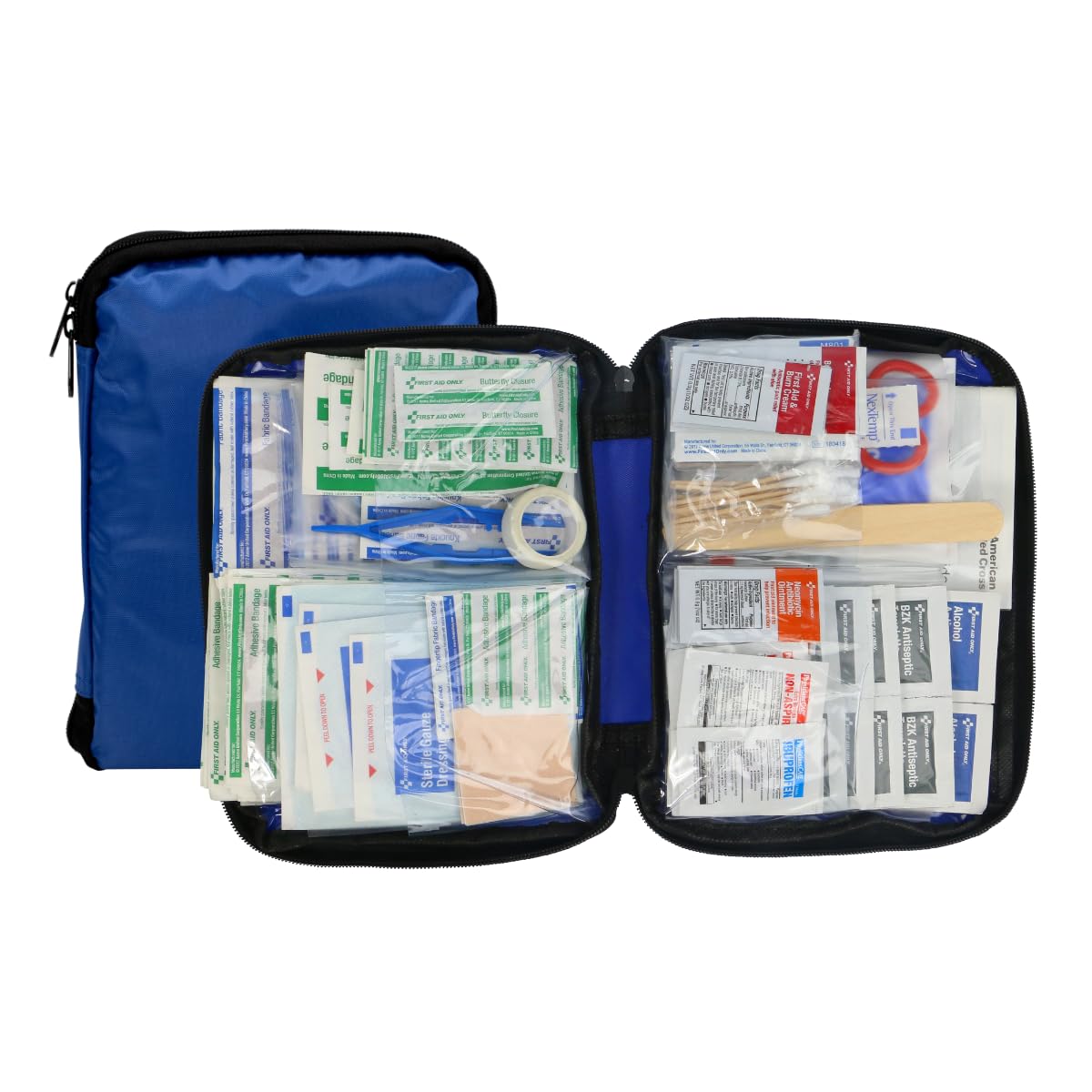
This 298-piece kit offers outstanding value and comprehensive supplies for home or car, but at nearly double the travel-friendly piece limit, it is too bulky and heavy for carry-on or backpack. The soft case is not water-resistant, so keep it dry. Best suited for stationary use.
Pros
- Covers a wide range of minor injuries with 298 pieces.
- Exceptional value for the price — budget-friendly for home or car.
Cons
- At 298 pieces, too large and heavy for carry-on or backpack use.
Best kept in a home, office, or vehicle glove box where its size and weight are not a concern.
How to Choose
The most important factor in a travel first aid kit is not the piece count – it’s whether the supplies match your activity and the case can survive a drop on the trail.
Piece Count
A higher piece count sounds reassuring, but many kits artificially inflate numbers with tiny safety pins, cotton rounds, and paper-thin bandages. For travel, a 100- to 150-piece kit provides enough real supplies without the bulk.
The hidden trade-off: more pieces usually mean a larger, heavier case. On a trail, those extra ounces add up. Focus on the variety of adhesive bandages, antiseptic wipes, and gauze – not the total count.
Portability and Size
The physical footprint of a kit determines whether it lives in your backpack or stays at home. Look for kits that weigh under 1 pound and fit in a standard glove box or daypack side pocket.
The mechanism: a soft pouch saves weight but offers less protection against moisture and impact. Hard cases add a few ounces but can be clipped to a pack or belt. For hiking, 7-8 ounces is the sweet spot – any heavier and you’ll leave it behind.
Case Durability
Case material dictates how long the kit lasts. Soft pouches – common in budget kits – are prone to zipper failure and water seepage if left in a damp backpack. Hard EVA or polyester shells resist crushing and rain better.
A common failure: zippers on pouches bend or jam after a few restocks. Hard shells with double zippers or waterproof gaskets hold up longer, but aren’t truly submersible. For outdoor use, a water-resistant hard case with a carabiner clipping point is ideal.
FAQ
Can I take a 150-piece first aid kit in my carry-on luggage?
Yes, most 150-piece kits are TSA-compliant as long as they don’t contain sharp objects like scissors or tweezers with metal blades. Protect Life and THRIAID kits fit easily in a carry-on. If your kit has a tourniquet, that’s also allowed – just keep it accessible for inspection.
Why do my first aid kit bandages keep falling off when hiking?
Cheap bandages often use low-tack adhesive that fails under sweat and movement. Look for kits that include fabric or flexible cloth bandages (like Band-Aid brand) rather than hard plastic ones. For wet conditions, add a small roll of medical tape to secure dressings.
What’s the best first aid kit for backpacking that won’t weigh too much?
A 100-piece kit weighing under 8 ounces is ideal. The Surviveware 98pc or Protect Life 100pc both hit that target with durable cases. Skip kits over 1 pound – the weight is better spent on food or water.
Are hard shell first aid kits worth it for outdoor travel?
Hard shell kits protect contents from being crushed and keep out rain better than pouches. The trade-off is slightly more weight and bulk. If you’re ultralight, a soft pouch is fine as long as you pack it in a dry bag. For regular hiking, a hard case with a carabiner is worth the extra 2-3 ounces.