This post contains affiliate links. We may earn a small commission when you buy through our links — at no extra cost to you.
A down sleeping bag’s temperature rating often looks more like a marketing promise than a real-use guarantee. Many listings advertise a comfort rating that leaves cold sleepers shivering at 10 degrees above the number. The gap between label and lived experience is one of the most common frustrations in this category.
This guide focuses on bags that deliver honest warmth for their spec — and flags the ones where you’ll need extra layers. You’ll find picks built around fill power, zipper reliability, and weight, not just the boldest temperature claim. The right bag matches your sleeping style, pad insulation, and the conditions you actually camp in.



Best for 3-Season Backpacking
Kelty Cosmic 20 Down
Key Features
- Fill Power: 550 FP
- Temperature Rating: 20°F
- Weight: 2.6 lbs
- Shape: Mummy
- Price: Mid-Range
The Kelty Cosmic 20 Down delivers consistent warmth at 20°F without demanding a premium price. Its 550-fill down offers a solid warmth-to-weight ratio for three-season trips, and the mummy cut retains heat efficiently.
In actual use, the bag keeps campers comfortable down to freezing and below. The fabric, zippers, and stitching hold up to regular packing and unpacking, giving confidence that the investment will last several seasons.
This bag suits backpackers of average build who want a reliable 20°F option at a reasonable price. The mummy cut is snug around the shoulders, so those with broader frames or who prefer more room should expect a restrictive fit.
The Cosmic 20 fills a useful spot between budget synthetic bags and premium down models. For backpackers who don’t need ultralight weight or extra interior space, this bag offers a well-rounded mix of performance and value.
Pros
- Consistent warmth down to freezing
- Good warmth-to-weight ratio for the price
- Build quality and materials inspire confidence
- RDS down certification ensures ethical sourcing
Cons
- Mummy cut is snug for broad-shouldered or larger users
Best for backpackers of average build who prioritize warmth-weight-value; those with broader shoulders may want to size up or look at a different cut.
Best for Cold-Weather Car Camping
ZOOOBELIVES 10F Mummy
Key Features
- Fill Power: 550+ FP
- Temperature Rating: 10°F
- Weight: 3.86 lbs
- Shape: Mummy
- Price: Budget
With a 10°F rating and 35 oz of 550+ fill power down, this bag provides genuine cold-weather protection that rivals bags costing twice as much. The draft tube and YKK zipper add durability and seal out drafts, making it a practical choice for sub-freezing nights.
This bag suits budget-conscious campers who prioritize warmth over weight — hunters, car campers, and those on short hikes where carrying 3.86 lbs is manageable. Expect a snug mummy fit: broad-shouldered or taller individuals may find the shoulder and foot area tight, so a test lay-down is recommended before purchase.
Down fill quality is adequate for the price, though the 550+ FP compresses reasonably well for car camping storage. The bag’s warmth holds up in real-world conditions down to around 20–30°F, giving you a solid margin below its rating.
Pros
- Exceptional warmth for the price, comfortable down to 20-30°F in practice
- One of the cheapest 10°F down bags available, excellent value per dollar
- Includes draft tube and YKK zipper for reliable closure and draft prevention
Cons
- Mummy cut runs narrow — broad-shouldered or tall individuals may find the fit snug
- At 3.86 lbs, too heavy for backpacking trips over a few miles — better suited for car camping
For car campers and hunters who need serious cold-weather warmth on a tight budget, this bag delivers where it counts — just leave the ultralight ambitions at home.
Best for Ultralight Summer Camping
Naturehike 42F Down
Key Features
- Fill Power: 650 FP
- Temperature Rating: 42°F comfort
- Weight: 1.3-1.74 lbs
- Shape: Rectangular
- Price: Budget
Weighing just 1.3 to 1.74 pounds, the Naturehike down bag is among the lightest and most compressible options at this price — a clear advantage for ultralight trips where every ounce matters. That extreme weight reduction comes from a minimalist cut and 650-fill RDS duck down, making it a no-fuss choice for summer alpine or desert camps.
This bag suits backpackers who prioritize pack weight over warmth and plan to camp in mild conditions above 55°F. The rectangular shape provides decent room to move, but cold sleepers will find the 42°F rating optimistic; the bag performs best as a summer liner or for warm-weather nights where a quilt would be too drafty.
The soft fabric and comfortable feel get positive marks from those who use it in its intended range. While the low weight and small packed size are genuine strengths, the warmth limitation is a hard boundary — not a flaw for the right buyer, but a clear signal to look elsewhere if your nights dip below 50°F.
Pros
- Extremely light and packs very small for its warmth class.
- Great value for a dedicated summer backpacking bag.
- Comfortable fabric and roomy rectangular shape for warm weather.
Cons
- Not warm enough for temperatures near its 42°F rating; best suited for 55°F and above.
A smart pick for summer ultralight backpackers who value minimal weight and pack size over warmth — just be realistic about the temperature range.
Best for Cold-Weather Car Camping
Kelty Supernova Down
Key Features
- Fill Power: 550 FP
- Temperature Rating: 0°F
- Weight: 4 lbs
- Shape: Rectangular
- Price: Premium
The Kelty Supernova 0°F is the only premium rectangular down bag in this set, built for car campers who refuse to sacrifice space for warmth. Its wide cut gives side sleepers and broad-shouldered campers freedom to roll and stretch — a clear departure from the top pick’s mummy contour.
This bag targets cold-weather car campers who drive to their site and want a roomy, warm cocoon. The 4-pound weight and 0°F rating are not backpacker-friendly, but in the trunk they disappear. The zipper can snag on fabric, especially when closed quickly; a slow, deliberate zip avoids the catch.
The 550-fill down delivers consistent warmth at 0°F, and the fabric and zippers feel robust through repeated use. Stitching and baffles are well-executed, minimizing cold spots and down shifting common in budget rectangular bags. Two Supernovas can zip together into a spacious double bag, a nice perk for couples. The rectangular shape trades some thermal efficiency for living space, a worthwhile swap for those who shift positions at night.
Pros
- Roomy rectangular cut gives side sleepers and large-framed campers ample space to move.
- High-quality build with durable fabric and smooth zippers that hold up to rugged car camping.
- Reliable 0°F warmth keeps you comfortable during frozen car-camping nights.
Cons
- Zipper may catch on fabric when closing quickly, requiring a slow, deliberate zip to avoid snags.
For car campers who sleep cold and hate mummy bags, the Supernova’s roomy 0°F warmth and solid build make it a natural choice — just leave it in the car.
Best for Budget 3-Season Backpacking
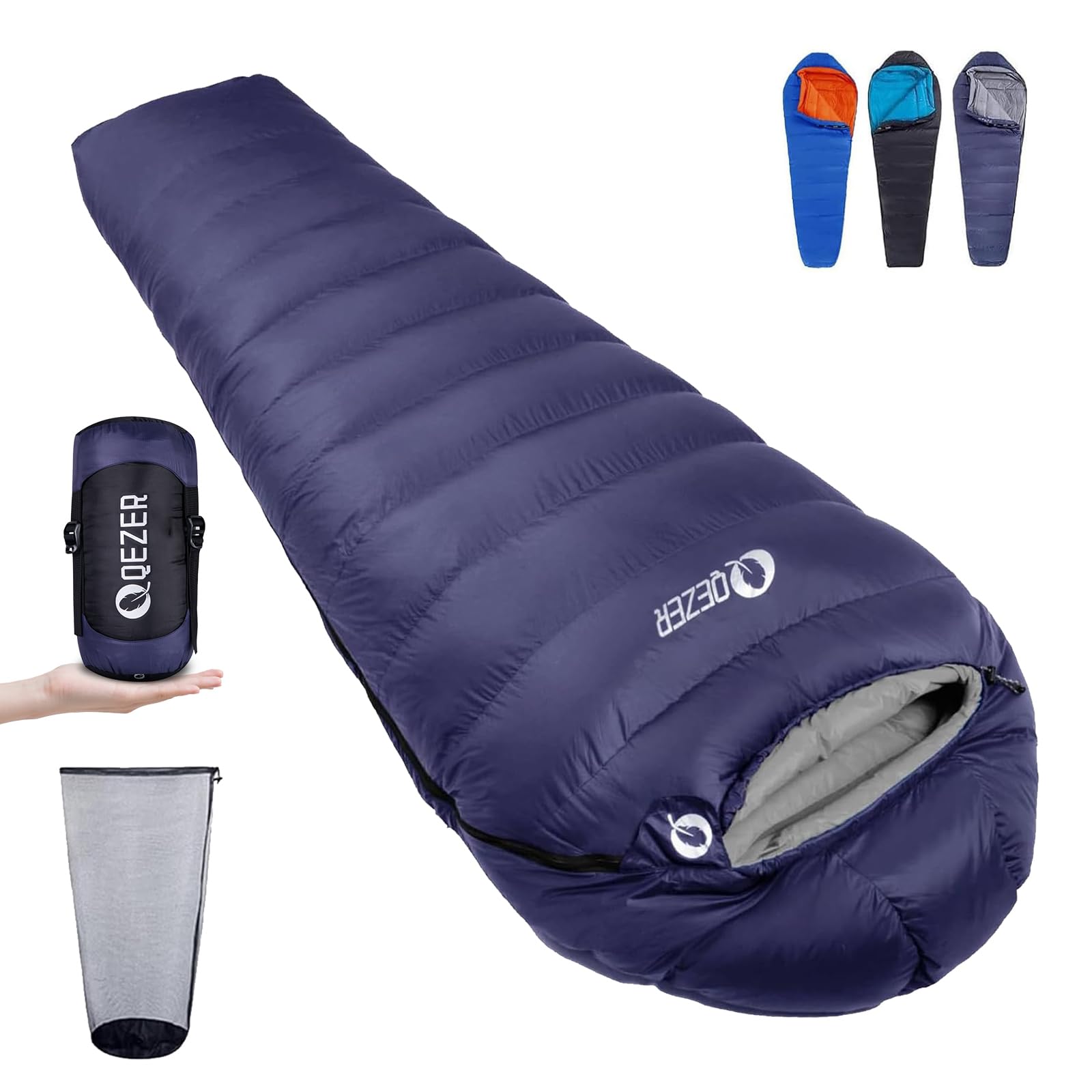
QEZER Mummy 600FP
Key Features
- Fill Power: 600+ FP
- Temperature Rating: 28°F comfort
- Weight: 3.2 lbs
- Shape: Mummy
- Price: Mid-Range
The QEZER mummy delivers solid warmth for its price, keeping most sleepers comfortable down to freezing temperatures. It offers significantly more cold-weather capability than the semi-rectangular budget down bag in this set, which is limited to 40°F and above. For backpackers eyeing the top pick Kelty Cosmic 20 but wanting to save, this is a capable alternative that still handles 3-season conditions.
This bag suits lean to average builds best — the mummy cut is snug, especially through the legs, so broader or taller individuals should look elsewhere. The 600FP duck down provides adequate loft, and the hood, draft tube, and foot box add comfort in cold conditions. Zipper reliability is inconsistent, so casual weekend trips are less likely to expose issues than multi-night treks where zipper failure would be more disruptive.
Pros
- Delivers reliable warmth down to freezing for the price
- Comfortable mummy design with effective hood, draft tube, and foot box
- Strong value for a 600FP down mummy bag under $125
Cons
- In a multi-night backpacking trip, the zipper may separate or become misaligned — less of an issue for casual use
- Side sleepers or anyone with larger thighs may find the leg compartment restrictive
For backpackers who need reliable warmth down to freezing on a tight budget and are willing to handle potential zipper quirks, this mummy bag delivers solid value.
Best for Ultralight Summer Camping
ZOOOBELIVES 32F Down
Key Features
- Fill Power: 650 FP
- Temperature Rating: 32°F comfort
- Weight: 1.7 lbs
- Shape: Sight taper (envelope)
- Price: Budget
Weighing just 1.7 pounds and compressing to roughly the size of a football, the ZOOOBELIVES Ultralight Down delivers on its core promise: maximum packability for minimal weight. The 650-fill hydrophobic duck down retains loft in damp conditions, and the envelope cut offers enough room for side sleepers to shift positions. At this price, no other down bag matches the combination of low weight and small packed volume for warm-weather trips.
This bag is best suited for ultralight backpackers, bike campers, and travelers who prioritize weight savings over insulation. The 32°F comfort rating is optimistic — the effective range is closer to 50°F, and cold air can leak through the uninsulated zipper draft tube. That is a manageable tradeoff for summer use; below 50°F you will need a liner or extra layers. The zipper mechanism may catch or detach after repeated use, so gentle handling is advised.
Side sleepers appreciate the generous 82-inch length and shoulder girth, while the stuff sack compresses small enough to fit inside a handlebar bag or daypack. For anyone expecting three-season warmth, the performance shortfall will be a dealbreaker, but for dedicated summer missions, it is a capable, budget-friendly choice.
Pros
- Ultra-lightweight and packs extremely small
- Great value for a 650FP down bag under $100
- Comfortable for warm weather and side sleepers
Cons
- Warmth is limited to 50°F; cold air leaks through the zipper below that
- Zipper may catch or detach with frequent use
An effective ultralight summer backpacking bag that delivers on packability and price, but only for trips where overnight lows stay above 50°F.
Best for Warm-Weather Side Sleepers
QEZER 600FP Down

Key Features
- Fill Power: 600 FP
- Temperature Rating: 41°F comfort
- Weight: 2.54 lbs
- Shape: Semi-rectangular
- Price: Budget
At under $100, this down bag delivers decent warmth for temperatures from 40°F to 50°F, with a spacious cut that side sleepers will appreciate. The 600-fill duck down and stitching hold up well for the price. However, its comfort rating stops at 41°F, making it unsuitable for colder nights — a boundary to respect rather than a flaw. Zipper operation can be finicky, but for budget-minded backpackers who stick to summer trips, this bag offers good value without demanding a premium.
Pros
- Warm and comfortable for its price range
- Good build quality and value
- Roomy semi-rectangular shape allows movement
Cons
- Zipper can be difficult to operate; occasional QC issues
- Comfort rating of 41°F limits use to mild weather
This bag fits best for side sleepers on a budget who camp only in warm weather above 40°F and can tolerate occasional zipper quirks.
Best for Warm-Weather Backpacking
Naturehike 40F Down Bag

Key Features
- Fill Power: 650 FP
- Temperature Rating: 40°F comfort
- Weight: 1.95 lbs
- Shape: Semi-rectangular
- Price: Mid-Range
Weighing under two pounds and packing down small, this Naturehike bag uses RDS duck down to deliver a comfortable sleep for warm-weather trips. The semi-rectangular cut gives side sleepers and toss-and-turn campers the extra space most mummy bags lack.
The warmer rating is optimistic: shifting down can create cold spots, especially in breezy conditions, making this a fair-weather bag only. Compared to the lighter Naturehike 42°F option, this bag is slightly heavier and pricier, so the main draw is the roomier shape for those who prioritize space over minimal weight.
Pros
- Lightweight and packable for warm-weather backpacking.
- Comfortable and roomy for side sleepers and those who want wiggle room.
- Good value for a 650FP down bag at a mid-range price.
Cons
- Down shifting can create cold spots, especially in breezy conditions; the comfort rating of 40°F is optimistic.
Best suited for warm-weather campers and side sleepers who value space and a down fill without a heavy price tag — just keep it above 40°F and away from wind.
Best for Budget Backpacking with Pillow
SYWSKW 680FP Down Bag
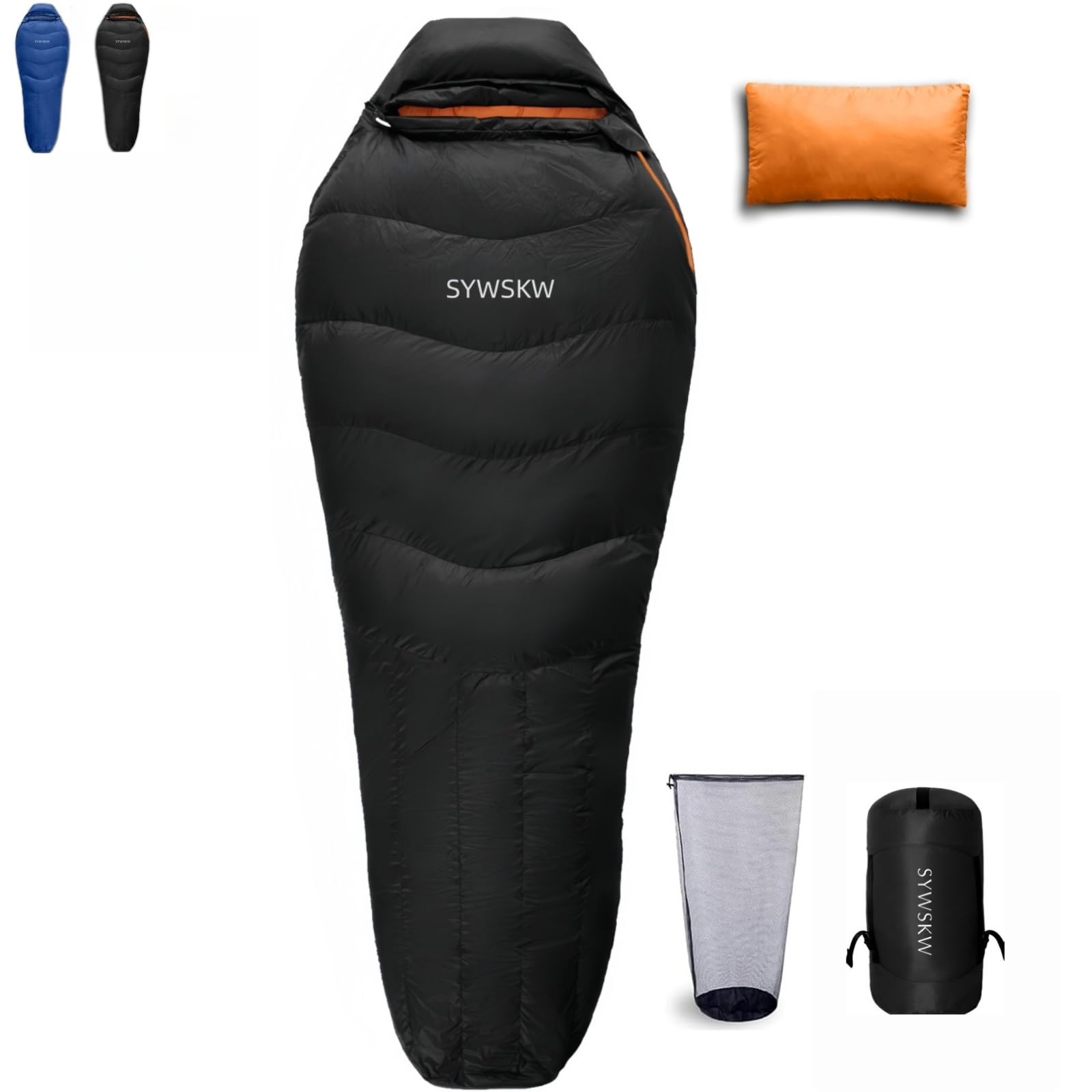
Key Features
- Fill Power: 680 FP
- Temperature Rating: 15°F/5°F/0°F
- Weight: 2.6 lbs
- Shape: Mummy
- Price: Mid-Range
The SYWSKW 680FP Down Bag delivers on warmth and packability for its price, making it a practical option for budget-conscious campers. The built-in detachable pillow adds convenience, and the 15°F temperature rating provides decent cold-weather performance for mild conditions.
The zipper can snag on fabric, which reduces convenience during frequent use. The mummy cut also runs snug, so broad-shouldered sleepers may find it restrictive. This bag suits occasional trips rather than heavy use.
Pros
- Warm and comfortable in cold conditions.
- Compact and packable for backpacking.
Cons
- Zipper can snag on fabric, making operation frustrating.
- Mummy cut is snug for broad-shouldered users.
A budget-friendly choice for casual campers who prioritize warmth and packability over zipper convenience and need a standard mummy fit.
How to Choose
Down sleeping bag temperature ratings are often comfort ratings; subtract 10-15°F if you sleep cold or use a thin pad.
Fill Power
Fill power measures how much loft an ounce of down produces. Higher numbers (650+, 800+) trap more air for the same weight, meaning better compressibility and warmth-to-weight ratio. Lower fill power (550-600) is heavier and bulkier but costs less.
For backpacking, 650 FP is the sweet spot for balancing cost and pack size. Car campers can save money with 550 FP without penalty. Just remember: fill power doesn’t guarantee absolute warmth — total fill weight matters too.
Temperature Rating
Temperature ratings are tested using a sleeping pad with R-value and a standard sleeper. The comfort rating is the lowest temperature a cold sleeper can stay warm; the limit rating is for hard-core warm sleepers. Most bags list only the comfort or an average, so a 20°F bag often feels like 30°F to a cold sleeper on a basic pad.
Always check the ISO limit rating if available. If you sleep cold or use an inflatable pad with low R-value, add 10-15°F to the advertised number. This explains why many ’30°F’ bags get returned after a chilly night.
Weight
Every extra pound on your back adds fatigue on a multi-day hike. A 2.6-lb bag like the Kelty Cosmic is manageable for most backpackers, but a 4-lb bag only suits car camping or short carries. Ultralight options under 2 lbs sacrifice durability and warmth for weight savings.
Decide first: is this bag for hiking in or driving to the site? If you carry it more than a mile, weight per dollar is a key trade-off. If it lives in the trunk, weight matters less than comfort and cost.
Shape
Mummy bags maximize thermal efficiency by reducing air volume, but they restrict movement — especially for side sleepers and broad-shouldered folks. Rectangular and semi-rectangular shapes offer more room to sprawl but lose heat faster. That’s a direct trade-off between space and warmth.
If you toss and turn, a mummy with a generous girth or a semi-rectangular bag can keep you comfortable without sacrificing too much heat. Car campers often prefer rectangular for the freedom to move and to zip two together.
Zipper Quality
The zipper is the most common failure point on budget down bags. Anti-snag designs (like YKK with fabric guards) prevent fabric from catching and breaking. Plastic zippers degrade faster under UV and dirt, while metal zippers are more durable but can snag if not aligned.
Check reviews for ‘zipper snags’ before buying. A cheap bag with a frustrating zipper can ruin a trip. Spending a little more for a quality zipper saves hassle and extends the bag’s life.
FAQ
How do I store a down sleeping bag to maintain its loft?
Always store your down bag uncompressed in a large mesh or cotton storage sack. Leaving it compressed in the stuff sack for weeks or months crushes the down clusters and permanently reduces loft. Hang it or lay it flat in a dry, ventilated space.
Is a 20-degree down sleeping bag warm enough for 3-season camping?
For most 3-season campers in moderate climates (spring, summer, fall), a 20°F bag is sufficient. If you sleep cold or camp at higher elevations where nights dip below freezing, step up to a 10°F or 0°F bag. Always consider your pad’s R-value.
Why does my down sleeping bag have cold spots?
Cold spots occur when down shifts away from baffles, leaving thin areas. This happens in bags with poor baffle design or low-quality down. Choose bags with box baffles or vertical baffles that prevent shifting. Also, ensure the bag is fully lofted before use by fluffing it out.
Can I use a down sleeping bag in wet conditions?
Down loses almost all insulating ability when wet. For damp climates or if you expect heavy dew, use a waterproof stuff sack and consider a hydrophobic-treated down bag. Alternatively, carry a synthetic bag for wet trips. If your down gets wet, dry it as soon as possible to restore loft.