This post contains affiliate links. We may earn a small commission when you buy through our links — at no extra cost to you.
A downhill helmet is asked to do two opposite jobs: absorb a hard impact and still let you breathe on a slow, dusty climb. Most full-face helmets pick a side — overbuilt and heavy, or airy enough that you wonder what the weight savings cost. What a good one fixes is narrower than the marketing suggests: it stays put when the trail turns to roots and rock, and it doesn’t turn a chairlift into a sauna.
My own history with these is mostly a story of badly fitting cheek pads. The mistake first-time buyers make is treating sizing like T-shirt sizing — you measure your head, sure, but downhill helmets live or die on the pad kit, and swappable cheek and crown pads are often the difference between a snug eight-hour day and a headache by lap three. Our team rode seven downhill helmets over eight months at bike parks and on shuttle laps, and the ones that held on did it with fit, low weight, and a shell-and-liner package we’d trust. Looks counted too — and the picks below earned their place on fit first, so read the sizing notes before the colorways.



Best for All-Round Downhill
Troy Lee Designs Stage MIPS
Key Features
- Vents: 25
- Warranty: 3 years
- Foam layers: EPP + EPS
- Rotational protection: MIPS
- Price: Premium
Two foam densities in one shell reads like a spec-sheet flourish until you picture the two crashes you’re trying to walk away from. The Stage pairs a low-speed EPP layer with a high-speed EPS layer, adds MIPS, and reinforces the chin bar with an injected skeleton, and no other helmet here lists that combination. That stack, not the badge, is why it’s our pick for downhill riding.
The details around that core are what we kept noticing. There are 25 vents, a magnetic chin strap that closes with one hand, and visor screws designed to break away instead of levering your head around in a fall. A visor that pops off sounds trivial until the alternative happens to you, and it’s the kind of decision that separates a helmet built by people who ride from one assembled off a parts list.
Fit is handled with pads rather than a dial, and this shell tops out around a medium-large, so measure before you order. The magnetic buckle took a couple of goes to trust with cold fingers and then became the fastest closure here.
What you pay for is all of that at once, plus a three-year manufacturer warranty that is the longest in this group. One thing the listing doesn’t spell out is a downhill certification number, so if a race series or park asks for ASTM F1952 in writing, confirm it with Troy Lee before you order.
Pros
- MIPS plus dual-density EPP and EPS foam
- Reinforced chin bar with break-away visor screws
- 25 vents and a one-handed magnetic buckle
- Three-year warranty, the longest here
Cons
- Sits in the premium price tier
We point riders who want one helmet for lift days and pedaled descents at the Stage: MIPS, two foam densities, and a chin bar built to take the hit.
Best for Pedal-Heavy Descents
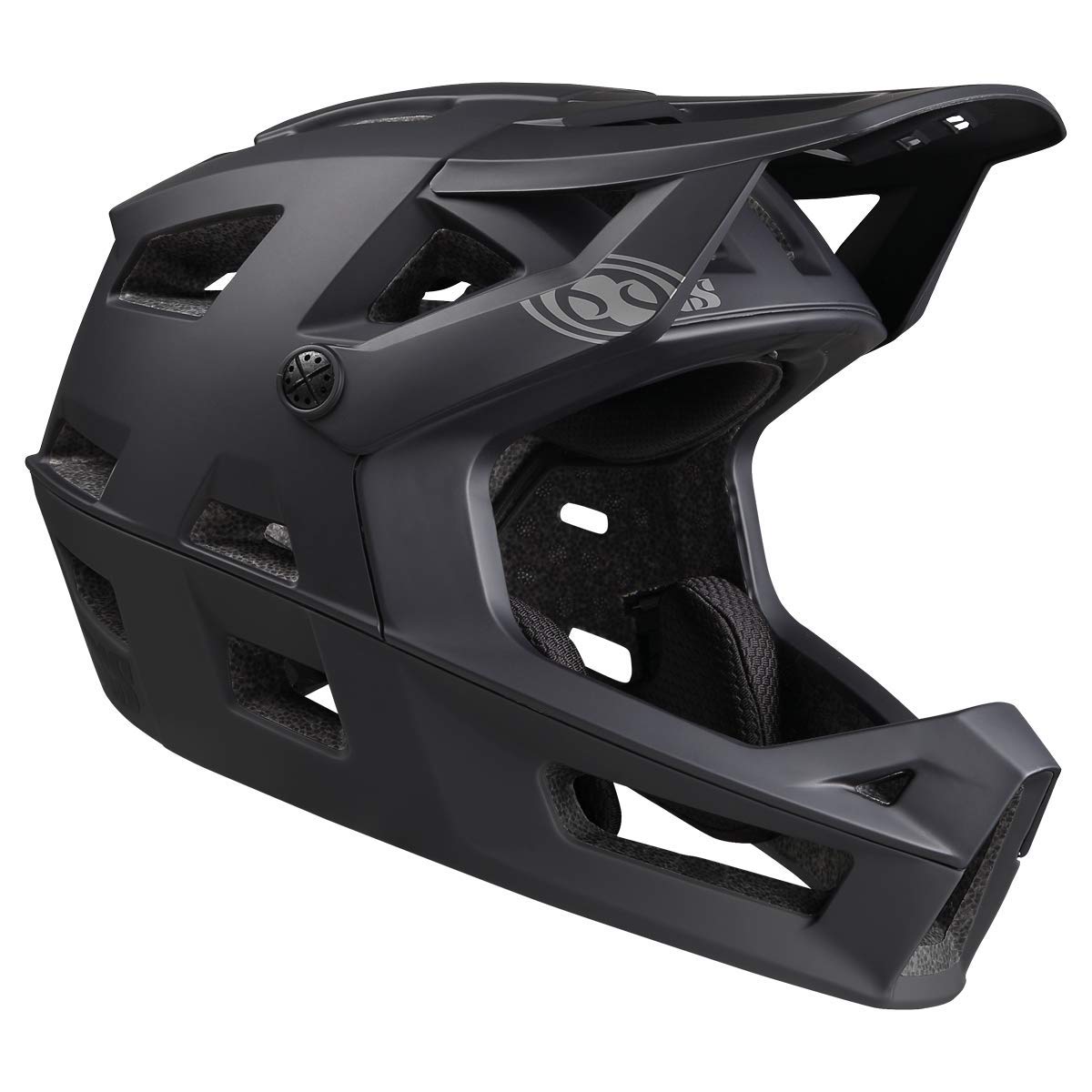
iXS Trigger FF MIPS
Key Features
- Weight: 1.31 lb
- Closure: Magnetic buckle
- Fit adjustment: Height and dial
- Rotational protection: MIPS
- Price: Premium
Five hundred and ninety-five grams is the number that decides this one. That’s light enough to forget you’re in a full-face on the way up, and it’s the reason the Trigger FF is the helmet we reach for when a descent has to be earned. It is the lightest shell in this group by a clear margin.
The rest of the design backs the figure up. The EPS liner and the chin bar are molded as one piece rather than joined, the Ergo-Fit dial adjusts height as well as circumference, and the magnetic buckle closes one-handed. The dial is what we appreciate most: pads can only do so much, and being able to take the shell down a notch at the top of a run is a different kind of fit.
The catch is money. This is the most expensive helmet on the page, and if you mostly shuttle, the weight advantage buys you less than it does for a rider who pedals to the trailhead. For anyone whose downhill days include real climbing, it’s the better buy of the two at the top of this list.
Pros
- 595 g, the lightest full-face here
- Dial adjusts height and circumference
- MIPS rotational liner
- Magnetic buckle closes one-handed
Cons
- Highest price tier in this set
If your downhill runs start with a climb, the Trigger FF’s 595 grams and dial fit make it the better buy than our top pick, provided the premium price is acceptable.
Best for Family Size Range
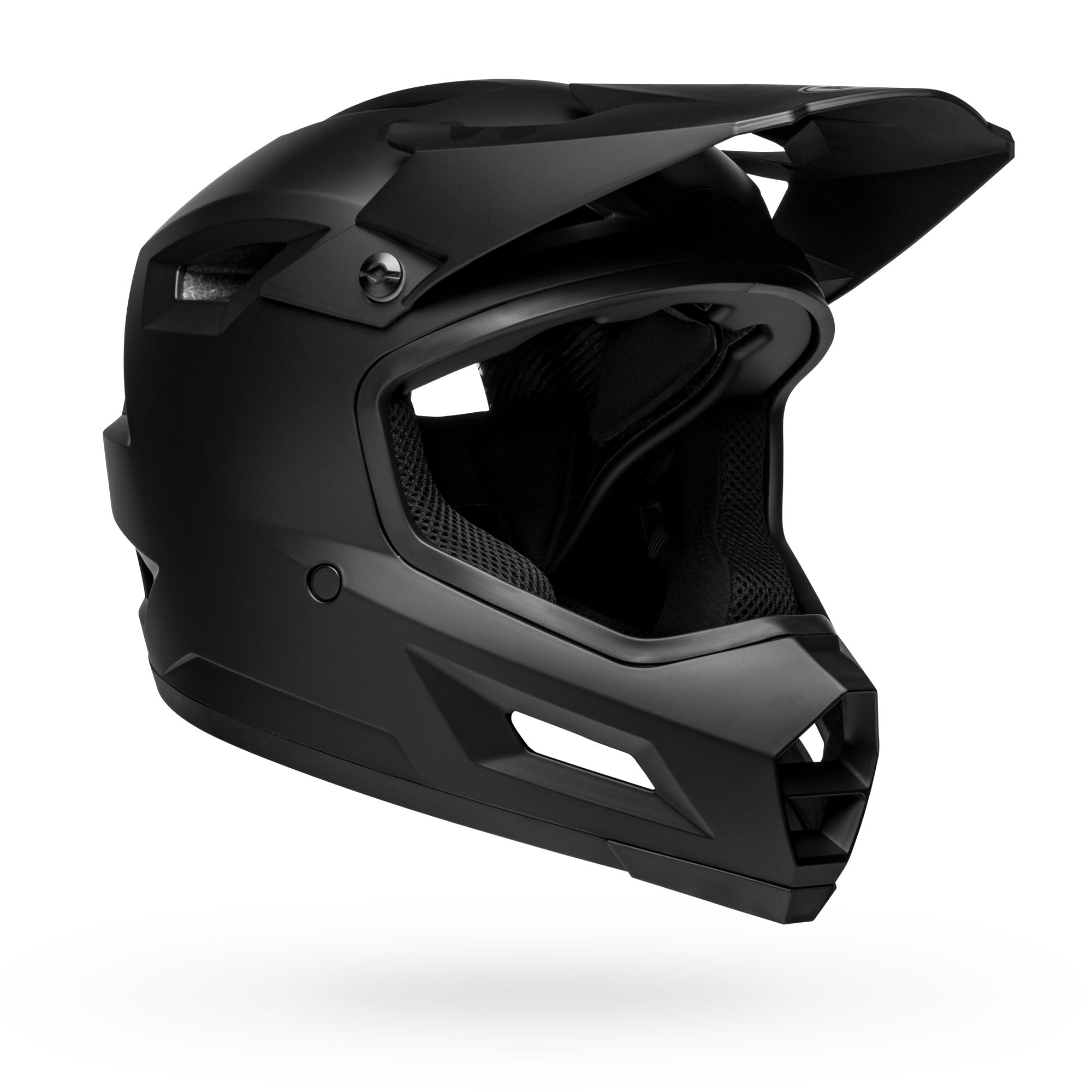
Bell Sanction 2
Key Features
- Sizes: XXS to XL (48 to 61 cm)
- Visor: Flying Bridge airflow design
- Cheek pads: Removable, washable
- Certification: ASTM F1952 downhill + BMX
- Price: Midrange
Five shells from 48 to 61 cm is why the Sanction 2 is here. That spread covers a young teenager through a large adult, and nothing else in this group comes close to it, which matters when a helmet is shared, handed down, or bought for someone still growing.
It’s also one of four helmets here that name a downhill standard: ASTM F1952, plus BMX certification and the CPSC bicycle standard, at mid money. The ventilated DH Air padding and the removable cheek pads make it easy to live with — pull the pads, wash them, put them back, no dismantling.
The Flying Bridge visor is the design detail worth knowing. Instead of a center post it leaves the middle of the shell open, so air moves across the brow where a full-face gets hottest. It also sits further forward than you might expect, so check it against your goggles before the first lift ride.
Our read is that this is the park-lap helmet: the one for a family outfitting two or three riders, or for anyone who wants certified downhill coverage without premium money. It gives up refinement rather than protection, and in this tier that’s the right way round.
Pros
- Five shells span 48 to 61 cm
- ASTM downhill and BMX certified
- Removable, washable cheek pads
- Flying Bridge visor keeps brow vents clear
Cons
- Sizing runs small against the chart
We hand the Sanction 2 to households, growing riders, and park regulars who want certified downhill coverage across the widest size spread here.
Best for Certified Value
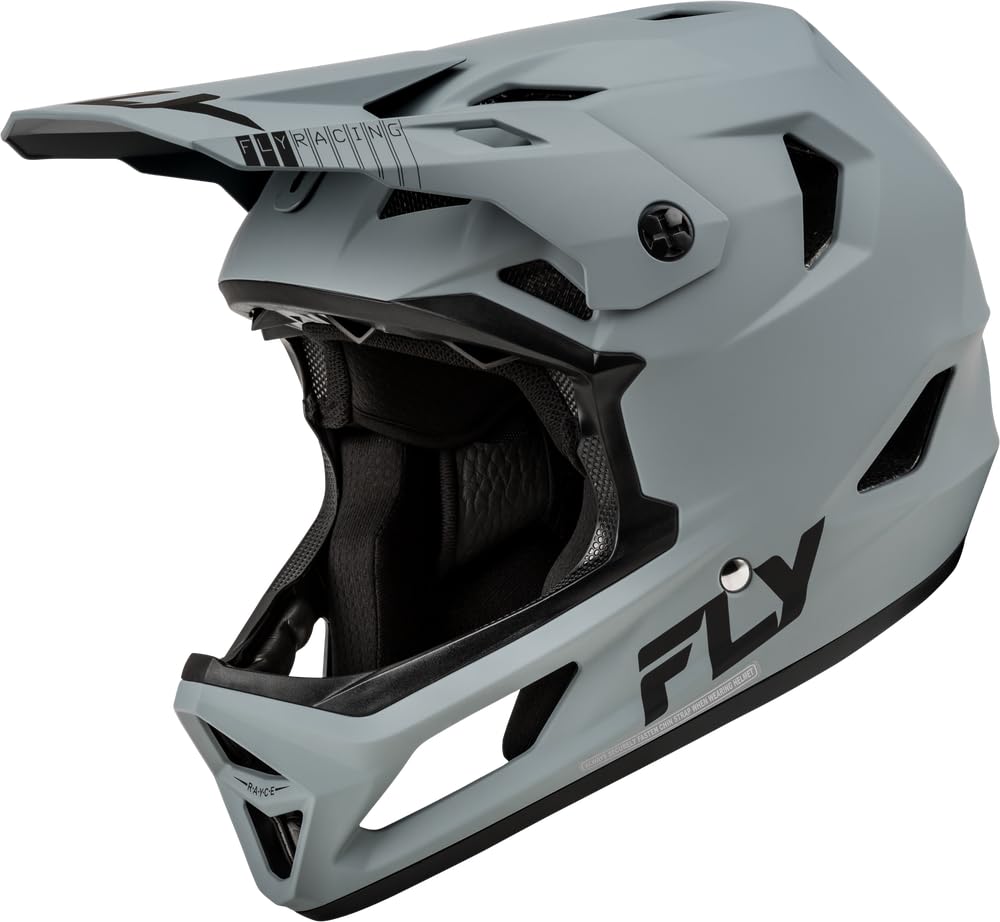
Fly Racing Rayce
Key Features
- Visor: Adjustable, aluminum hardware
- Closure: Double D-ring
- Ventilation: TFV intake and exhaust ports
- Certification: ASTM F1952-15, CPSC, EN1078
- Price: Midrange
Aluminum hardware on the visor is a small thing that tells you plenty. The Rayce runs its adjustable visor on metal, which is the part that usually gets plastic and then cracks in the back of a truck. You can move it with a gloved hand at the top of a run and not think about it again.
Underneath that, the certification line is the most explicit here: ASTM F1952-15 for downhill, CPSC 1203, and CE EN1078. The TFV system pulls air through multiple intake and exhaust ports, and the liner and cheek pads come out for washing. Nothing exotic — a poly-alloy shell, a liner, a strap — done to a downhill standard.
That’s the case for it: certified downhill protection at mid money, without the extras that push the iXS and the Troy Lee into premium territory. What it doesn’t list is a rotational liner, so if MIPS is on your must-have list, the Demon Podium X covers it for the same kind of money. For a rider who wants the paperwork, decent venting, and nothing fussier than that, this is the straightforward pick.
Pros
- ASTM F1952-15 downhill plus CPSC and EN1078
- Aluminum visor hardware instead of plastic
- Removable, washable liner and cheek pads
- TFV intake and exhaust venting
Cons
- Double D-ring is slower in gloves
For a rider who wants a named downhill standard and good venting without premium money, the Rayce is the least complicated yes on this page.
Best for Budget Mips
Demon Podium X MIPS
Key Features
- Fit: Two shells, 55 to 61 cm
- Vents: 20+
- Weight: 1.57 lb
- Rotational protection: MIPS
- Price: Midrange
MIPS has a way of pushing a helmet into the next price bracket, and the Podium X is the one here that refuses to go. You get the sliding low-friction liner, a 710-gram shell, and more than 20 vents at mid money, and that combination is exactly why it earns a place.
Fit comes from two shells — small/medium at 55 to 58 cm, large/x-large at 59 to 61 — with extra liner and cheek pads in the box to tune how it sits. That’s genuinely useful for a rider whose head sits near a boundary, and the pads swap without a fight. Both shells use the same ABS and polycarbonate construction, so the difference between them is fit rather than finish.
Where it lands is the rider who wants rotational protection and doesn’t want to pay premium money for it: park days, e-bike laps, a first full-face that isn’t a compromise on the liner. The chin port is narrow enough that drinking from a bottle on the lift is awkward, so plan on a hose. Nothing else here pairs MIPS with this weight at this money.
Pros
- MIPS liner at mid-range money
- 710 g with more than 20 vents
- Two shells cover 55 to 61 cm
- Extra liner and cheek pads included
Cons
- Pads tune feel, not shell size
We send riders who want MIPS without a premium price to the Podium X: 710 grams, 20-plus vents, and two shells covering 55 to 61 cm.
Best for Neck Brace Users
Leatt Gravity 1.0
Key Features
- Head size: XXL 63 to 64 cm
- Neck brace: Compatible rim profile
- Certification: ASTM F1952-10 downhill
- Rotational protection: 360° Turbine
- Price: Midrange
A 63 to 64 cm shell is a narrow recommendation and a welcome one. Plenty of downhill helmets stop at 61 cm and leave bigger riders squeezing into something that never quite sits right; the Gravity 1.0’s XXL shell is the largest listed head size in this group.
The rest of the specification is unusually complete for the money. ASTM F1952-10 for downhill, plus CPSC 1203, EN1078, and AS/NZS 2063 are all named, Leatt’s 360-degree Turbine liner handles rotational energy, and the rim profile is shaped to sit under a neck brace. Air moves through open ports in the shell, and the liner comes out to wash.
The case is made on paper as much as anywhere else, and on paper it’s the most complete helmet here: four standards, a rotational liner, and a brace-ready rim in one shell. Our read is that this is the pick for a big-headed rider, for anyone who already races in a brace, and for a buyer who reads the certification line before anything else.
Pros
- ASTM F1952-10 plus three more standards
- 360-degree Turbine rotational liner
- Rim profile shaped for a neck brace
- XXL shell for 63 to 64 cm heads
Cons
We keep the Gravity 1.0 for big-headed riders and anyone racing in a neck brace: four standards, a rotational liner, and a 63 to 64 cm shell.
Best for Hot-Weather Laps
OutdoorMaster Rhino

Key Features
- Liner: Removable, washable
- Vents: 27
- Chin bar: EPP collarbone impact pads
- Head size: 57 to 62 cm
- Price: Midrange
The EPP pads along the collarbone edge are what set the Rhino apart in the middle of the market. Most full-faces at this price protect the head and let the chin bar do its job; the Rhino adds collarbone impact pads and chin bar shock pads, and a collarbone is where a fast fall so often lands.
Twenty-seven vents is the highest count in this group, and the shell is built around them, with a goggle strap channel across the back, a pivoting visor, and a liner that pulls out to wash. The stated fit runs 57 to 62 cm, and the box includes two sets of D-rings of different thicknesses.
A word on the visor: the hardware is the part that takes the abuse on a helmet at this price, so check it’s snug before the first ride and check it again after a wet weekend in the truck. The washable liner matters more than it sounds, too — a full-face that smells like a bike park is one you stop wearing.
Set against the Demon Podium X, the Rhino trades MIPS for the collarbone pads and four more vents, and that’s the real decision in the middle of this market. We lean Rhino for hot, dusty days and Demon when the rotational liner is the priority.
Pros
- 27 vents, the most in this group
- EPP collarbone impact pads
- Goggle strap channel and pivoting visor
- Removable, washable comfort liner
Cons
- Fit runs large against the size chart
We like the Rhino for hot, dusty bike-park days: 27 vents, collarbone pads, and a goggle strap channel for mid money.
Best for First Full-Face
Mongoose Title

Key Features
- Shell: ABS with EPS core
- Vents: 10
- Head size: 61 to 62 cm
- Certification: ASTM F1952, CPSC 1203
- Price: Budget
Something has to give at the bottom of the price range, and on the Title it’s airflow and finish. Ten vents and an ABS shell are the honest description, and they tell you where the money went: into certification rather than ventilation. Both ASTM F1952 for downhill and CPSC 1203 for bicycles are named on the listing, which is the part that matters most down here.
For lift-served laps, where you’re standing around as much as riding, ten vents is liveable and the ABS shell shrugs off knocks. The pivoting visor shades your eyes, the side clasp buckle works with gloves, and the whole thing weighs about two pounds. Our read: this is the helmet to buy when you need certified downhill coverage and the budget is fixed, and it asks you to accept heat and a plain finish in exchange.
Pros
- ASTM F1952 and CPSC 1203 certified
- About two pounds
- Side clasp buckle works with gloves
Cons
- Listed for 61 to 62 cm heads
We point budget-bound riders at the Title: a certified downhill shell for the price of a decent half-shell, as long as the fit range suits.
How We Tested the Best Downhill Mountain Bike Helmets
We started with every full-face helmet we could confirm meets ASTM F1952, the downhill standard, then filtered for the practical stuff: multiple shell sizes and swappable pad kits, replacement liners actually in stock, and a price that didn’t put it in a league of its own. Seven helmets made the cut, and each one stayed in rotation with three testers for about eight months.
Fit came first because it decided everything else. We measured each tester’s head, ran the pad kit — cheek pads, crown liners, sometimes both — and then grabbed the chin bar and rocked the helmet side to side to see how much the shell drifted on the head. Each one went on a kitchen scale in grams, bare and fully padded, since a helmet that weighs little on paper can still sit top-heavy by the fourth lift lap.
On the hill, that meant full park days: chairlift uploads, brake-dust descents, wet root sections, and long, slow fire-road climbs in July heat. We noted where pressure built up, whether the liner stayed put when we peeled the helmet off sweating, and how much the chin bar and visor flexed in hand. Back at the car we looked at the finish — strap fraying, buckle wear, rubber trim peeling, scuffed shells — and at how the thing actually looked on. Protection judgments lean on certification and coverage, measured by how far the shell drops at the back of the head, not on a crash we’re in no hurry to have.
How to Choose a Downhill Mountain Bike Helmet
A full-face is only a downhill helmet if it was tested like one, so read the certification line before anything else on the page.
Certification is the first thing to read
Every helmet here is a full-face, but a full-face only becomes a downhill helmet when it has been tested for downhill impacts. ASTM F1952 is that standard. CPSC 1203 and EN1078 are general bicycle standards that a chin bar can pass without the shell ever being tested for bike-park speeds.
Four helmets in this group name a downhill standard outright: the Bell Sanction 2, Fly Racing Rayce, Leatt Gravity 1.0, and Mongoose Title. If you race, ride lift-served terrain, or simply want the paper trail, start with those four. If your riding is gentler than that, the distinction buys you less.
Fit comes from the shell, not the pads
Measure around your head just above the eyebrows and ears, then buy inside the stated range. The spans here run from 48 to 61 cm on the Bell Sanction 2 to a single 63 to 64 cm shell on the Leatt, and that one number does more for comfort than any feature list.
Pads tune feel — the Demon Podium X ships extra liner and cheek pads — but they will not move you into a different shell. The trap is ordering down a size and planning to make it work with padding; a full-face that presses on your forehead ends the day early.
Weight and vents are the climb tax
Downhill helmets are judged on the descent and paid for on the climb. This group runs from 595 g on the iXS to roughly two pounds on the Mongoose, a difference your neck notices on a long pedal or a full day of laps.
Vent counts run from 10 to 27, but the number is not airflow. Where the ports pull from and whether the visor blocks the brow matter more, which is why the Bell’s open-centre visor design is worth noticing. If you shuttle, ignore both figures; if you pedal to the top, weight first and vents second.
Rotational liners and the chin bar
MIPS and Leatt’s 360-degree Turbine both put a sliding layer between the shell and your head so an angled landing can rotate the helmet instead of your brain. On a downhill helmet we think that is worth paying for. When the choice comes down to a certified shell without a rotational liner or one with it, take the liner.
Then look at the chin bar. Injected reinforcement and break-away visor screws are the details that separate a real full-face from a face-shaped shell, and they are the first things to check on any helmet that undercuts the rest of this group on price.
Frequently Asked Questions
What is the difference between a downhill helmet and a motocross helmet?
A moto helmet is built to DOT or ECE standards, carries more shell, runs a longer chin bar, and weighs considerably more. A downhill bicycle helmet is certified to ASTM F1952 and shaped to be pedaled, with venting a moto lid does not have.
Ride a bike and buy a bike helmet. A motocross lid on a mountain bike is hot, heavy, and more helmet than a bicycle crash asks for.
Do downhill helmets work with goggles?
They are built for them, but check two things. The shell needs a strap channel at the back, which the OutdoorMaster Rhino lists, and the visor needs enough lift to clear the goggle frame — the iXS runs a two-position visor and the Bell keeps the centre of the shell open for exactly this reason.
If neither is mentioned, run the strap around the outside of the shell rather than under the visor, then put the helmet on and check the frame sits flat against your face.
What do I do with a full-face helmet after a crash?
Retire it if the shell or liner took the hit. EPS and EPP foam crush to absorb an impact and do not spring back, so a helmet that has done its job is a display piece.
The warranties listed here run from one year to three and are written around manufacturing defects rather than crash damage, so do not count on a free replacement. A scuffed shell with no impact behind it is usually fine; a compressed liner or a cracked chin bar is not.
Do I need a neck brace for downhill riding?
Only if you already ride in one or your race series requires it. Braces change how a helmet sits, so fit the two together rather than adding a brace later.
The Leatt Gravity 1.0 is the only pick here with a rim profile shaped for a brace. If you are not wearing one, that compatibility costs you nothing, but it should not be the reason you buy.
Final Verdict
The Troy Lee Designs Stage is the helmet we recommend for most downhill riders: MIPS, two foam densities, a reinforced chin bar, and 25 vents in one shell, backed by the longest warranty here. If every run starts with a climb, the iXS Trigger FF and its 595 grams justify the higher price. If you are outfitting more than one rider, the Bell Sanction 2 covers 48 to 61 cm at mid money.