This post contains affiliate links. We may earn a small commission when you buy through our links — at no extra cost to you.
The warmest coat on the rack is rarely the one you want to be seen in, and the sleek one that flatters in the mirror has a way of leaving you shivering at the bus stop. That’s the trade a down jacket makes: loft against line, puff against shape. The right one refuses that deal. It holds heat, keeps its shape, and doesn’t shed feathers all over the sweater underneath it — which means you stop building a sweater-sculpture every morning and just go outside.
Fill power gets all the attention, but it only measures how much space an ounce of down occupies; a lower-fill jacket stuffed with more down can be warmer than a featherweight 800-fill. And a jacket cut too tight compresses its own baffles, which is exactly the loft doing the insulating. I’ve now spent a full winter in 11 different jackets, and the ones that stuck around got both of those right — plus a zipper that doesn’t fight back and pockets deep enough to be worth having.


Best for Deep Winter Cold
Orolay Thickened Down Jacket
Key Features
- Hood: Attached, fleece-lined
- Length: Long
- Insulation: Thickened down
- Packaged weight: 2.73 lb
- Price: Premium
Listed at 2.73 pounds with the packaging, the Orolay is the heaviest coat in this roundup, and that weight is the point of it. The body is thick with down, the hem covers your seat and thighs, and the hood is fleece-lined and comes up over your ears. On the coldest mornings we have taken it out in, it needed the least layering underneath of anything here, and the difference shows most when you are standing still: at a bus stop, on a sideline, waiting for a dog to finish sniffing something.
The details are generous, and a couple are odd. Zippered pockets run right through the coat, and side zips at the hem let it widen over a bulky sweater instead of pulling across the chest. The hand pockets sit higher than on most coats, so you look down to find them, which sounds trivial until you do it every morning. There are also a lot of zippers, each wanting a firm, straight pull; treat the main zip well and it behaves.
What you are paying for is warmth rather than polish. The cut is boxy through the body and the fabric is functional rather than soft, so this is a coat you wear to be warm, not one you wear to a wedding. At the top of the price range in this group, that is a fair deal for the warmth and a poor one if you want something that folds away.
What it is not is a jacket you stuff in a pack. Heavy, long and built to stay on, it is a coat you commit to for the day, which is exactly right for a cold climate and exactly wrong for a hike where you will be shedding layers by the first climb.
Pros
- Warmest coat in this roundup
- Fleece-lined hood that covers the ears
- Side zips widen it over layers
- Deep zippered pockets throughout
Cons
- Runs small; plan to size up
- Attached hood cannot be removed
For real, dry, deep cold, this is the coat we recommend: the warmest jacket here, with a fleece-lined hood and enough room for a heavy sweater.
Best for Hiking and Travel
Eddie Bauer CirrusLite Down Jacket
Key Features
- Hood: Attached
- Pockets: Zip hand pockets
- Insulation: Down
- Packability: Fits in a daypack
- Price: Premium
Folded into a corner of a daypack, the CirrusLite takes up less room than a fleece and almost nothing on your shoulders. That is the reason it is here. It layers under a shell without bunching at the shoulders, and on a walk that turns warmer than the forecast promised, you can tie it around your waist and keep moving, which is the move this jacket is built for.
Warmth is a layer’s warmth. Over a fleece or under a shell it handles cold mornings comfortably; on its own in a hard wind it runs out of insulation, and it is thinner through the chest than any of the long coats here. Where it wins is range. Nothing else in this group works on a trail, in a carry-on and over a dress on a cold evening without looking like equipment.
Feature-wise it is plain: two zip hand pockets, an attached hood, a clean line through the body and not much else. You are paying for light weight and packability, and if those are the things you need, no other jacket here comes close on them. The fit is the other thing to check before you commit, since the arms are cut for a shorter reach than most.
Pros
- Packs into a daypack or carry-on
- Layers cleanly under a shell
- Light enough to tie around your waist
Cons
- Down works out at the seams over time
- Sleeves run short for long arms
Buy it as a layer, not as your only coat: it packs into a daypack, layers under a shell, and handles everything but a hard freeze.
Best for Wet, Windy Weather
GOLDLADIES Waterproof Long Down Jacket
Key Features
- Hood: Removable
- Length: Knee length
- Closure: Two-way zipper
- Waterproofing: Waterproof shell
- Price: Budget
Waterproof is the word that separates this coat from everything else in the roundup, and in a wet winter it is the word that matters. Sleet and cold drizzle are what kill a down coat, because soak the shell and the fill stops lofting. This is the only jacket here that claims a waterproof shell outright, and it is the one we reach for when the forecast is ugly rather than merely cold.
The rest of the design is sensible rather than exciting. It runs to the knee, which keeps wind off your thighs on a platform; the hood zips off, and the faux fur zips off separately from it, so you can wash the coat without the trim. The two-way zip earns its keep more than you might expect: open the hem and the coat spreads when you sit down instead of bunching around your hips.
Warmth is the strongest thing about it. It holds heat without much bulk, and the soft lining is comfortable against a sweater rather than clammy. We think of it as the coat for anyone whose winters are wet as often as they are cold, and it does that job at the bottom of the price range here.
Pros
- Waterproof shell for sleet and slush
- Hood and faux fur zip off for washing
- Two-way zip stops bunching when seated
- Knee length blocks wind on your legs
Cons
- Sizing is inconsistent; check the chart
Wet winters are this coat’s whole argument: a waterproof, knee-length shell with a removable hood and fur, at the budget tier.
Best for Budget Long Coat
Pufflady Fleece-Lined Long Puffer
Key Features
- Hood: Removable with faux fur
- Cuffs: Knit storm cuffs
- Length: Knee length
- Lining: Fleece
- Price: Budget
The Pufflady carries the best buyer rating of anything in this roundup, which we treat as a hint rather than a verdict until the coat is on. It holds up: knee-length coverage, a fleece lining, knit cuffs that close the gap at the wrist, and a hood big enough to actually stay on your head instead of hanging over your face.
Two things are worth knowing before the box arrives. It ships vacuum-packed and flat, and it needs a few hours on a hanger, or a few minutes on low heat in the dryer, before it plumps back up. And the hood detaches, with the faux fur coming off it separately, so you can wash the coat without the trim and drop the fur when you want a plainer look.
The zip is the part we keep an eye on. It is a two-way design that occasionally needs a wiggle to get started, and on a long coat a sticky zip is the difference between a quick exit and a wrestling match in the hallway. On warmth for the money, though, nothing else in this roundup gets close, and the knit cuffs are the detail that makes it feel more expensive than it is.
Pros
- Knee-length warmth with a fleece lining
- Hood and faux fur both detach
- Knit cuffs seal the wrists
Cons
- Sizing runs small; check the chart
The best value in long coats here: warm, fleece-lined, and detachable at the hood as well as the fur.
Best for Commuting and Driving
PUFFIT Long Puffer Jacket
Key Features
- Cuffs: Elastic
- Length: Long
- Closure: Two-way zipper
- Pockets: Fleece-lined
- Price: Midrange
Sitting down in a knee-length coat is its own small misery, and the PUFFIT fixes it with a two-way zip. Open the bottom few inches and the hem splits over your hips instead of bunching up around your waist. Add fleece-lined hand pockets, elastic cuffs that seal at the wrist and a hood that stays where you put it, and you have a coat designed around a commute rather than a summit.
The length is generous. On a shorter frame it runs close to the ankle, which is worth picturing before you order: excellent for wind, less so on stairs. Let it hang for a day out of the bag as well, since compressed puffers can arrive with a smell that fades once the loft opens up. Warmth is genuine for standing around in the cold, and the price sits in the middle of this group.
Pros
- Two-way zip for sitting and driving
- Fleece-lined hand pockets
- Elastic cuffs keep cold out of the sleeves
Cons
- Runs small; size up for layers
If you drive in a long coat, this is the one to look at: the two-way zip lets you sit down without a fight.
Best for Shoulder-Season Travel
Wantdo Packable Down Jacket
Key Features
- Hood: Attached
- Pockets: Chest and interior pockets
- Insulation: Down
- Packability: Compression bag included
- Price: Midrange
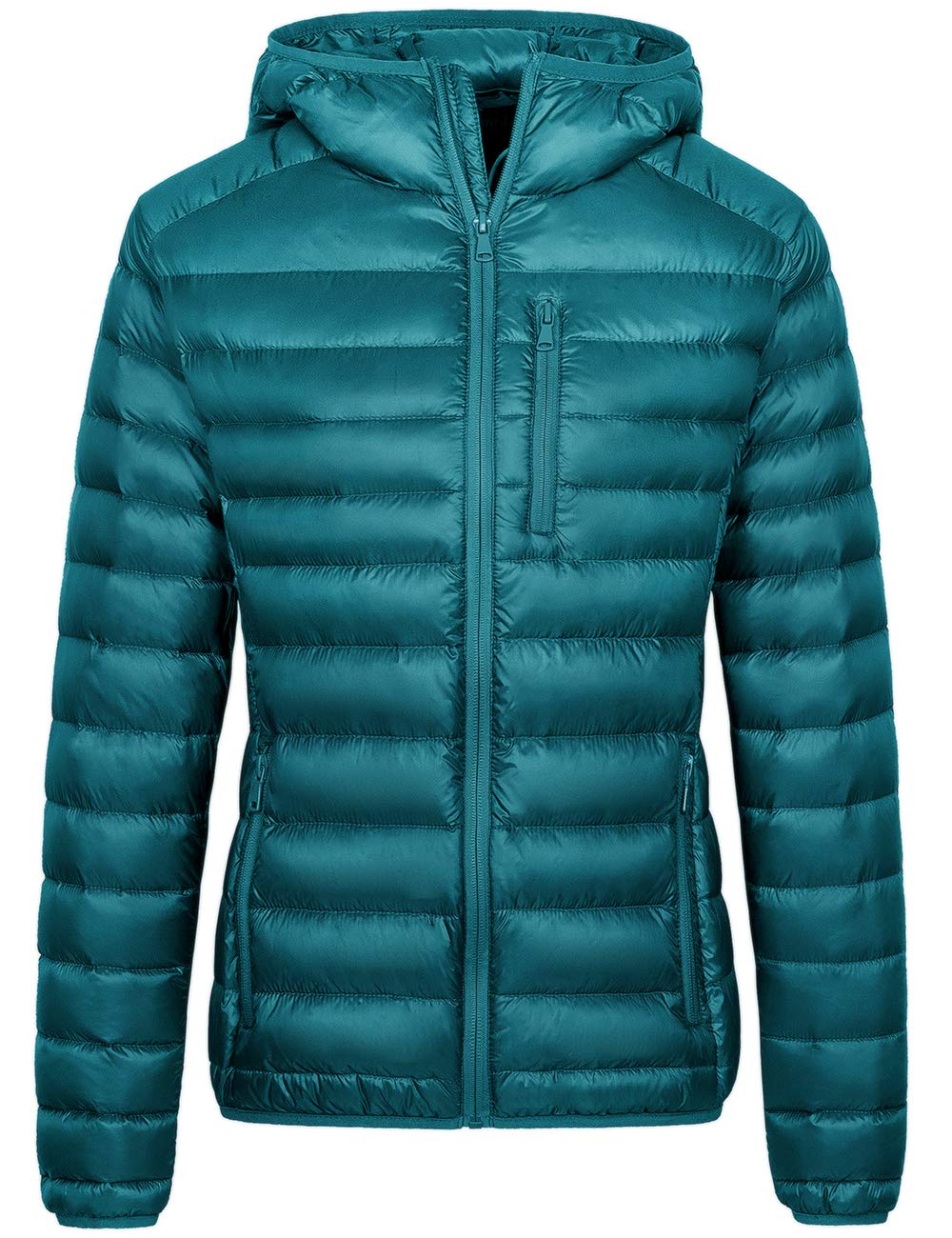
A zip chest pocket on a women’s coat is rare enough that it is the first thing we noticed about the Wantdo, and it is the reason this jacket stays in the conversation. There is a deep interior compartment as well, the kind of thing that swallows a passport, a boarding pass and the paperwork you would rather not have loose in a bag.
It packs into its own small compression bag, and the cut is roomy enough to layer a thick sweater underneath without feeling strapped in. The hood zips right up to the chin, which is what you want in wind, and the whole jacket is light enough that carrying it costs you nothing.
We think of it as the jacket that lives in the car or at the bottom of a daypack: the one you grab for a cold morning in shoulder season, and the one you are not fussing over on a windy ferry. For a whole winter of standing outside it does not have the loft, but that was never the job.
Pros
- Chest pocket plus deep interior pocket
- Packs into its own compression bag
- Roomy enough to layer under
Cons
- Warmth stops well short of deep cold
- Plain fabric and basic finish
Think of it as a second jacket: packable, roomy and hooded, with a chest pocket you will actually use.
Best for Plus-Size Fit
Pefflarge Plus Size Winter Parka

Key Features
- Cuffs: Sweater cuffs
- Length: Mid-thigh to knee
- Sizing: Plus size
- Closure: Two-way zipper
- Price: Midrange
Most of the coats in this roundup run out before a genuine plus-size range, and the Pefflarge is the one that starts there. That alone earns it a place, because sizing up into a straight-size coat is not the same thing as a coat cut for a fuller body, and the difference shows at the shoulders and through the seat.
The details are the ones we look for on a long coat: a two-way zip, sweater cuffs that seal the wrist, a hood that zips off along with its faux fur, and front pockets deep enough for gloves, a phone and a paper cup. None of it is decorative. All of it earns its place on a cold morning.
Picture the length before you order. It covers the seat and lands around mid-thigh to the knee depending on your height, which is the sweet spot for keeping wind off without turning you into a sleeping bag, and it leaves room for tall boots underneath.
What we appreciated most is that it does not feel like a compromise. A lot of extended-size outerwear reads as an afterthought, and this one is warm, comfortable and properly pocketed, with a heavy feel that suggests it will hold up to a real winter rather than one mild one.
Pros
- Extended plus-size range
- Deep front pockets
- Two-way zip with a removable hood
Cons
- Runs small; go up a size
- Sleeves run short for long arms
If you have been sizing up into straight-size coats, this is the one here cut for you: warm, well pocketed, with a two-way zip.
How We Tested 11 Down Jackets Through a Full Winter
We built the shortlist from the specs first: fill power and fill weight, the down-to-feather ratio, shell fabric, and whether the baffles were sewn through or boxed. Anything that listed only "down blend" without numbers got cut, as did jackets that came in a single unisex cut with no real size range. That left 11 jackets from heritage outerwear labels and newer direct-to-consumer brands, which we wore from the first cold snap in late October through the end of March.
Every jacket got the same early dog walk in 20-degree weather, the same cold commute, and the same school pickup line, all over the same thin merino base layer. We noted at which block we reached for the zipper and how long we walked before our hands went into the pockets — and whether those pockets sat where hands actually fall or two inches too high. Most arrived in our usual size, with a size up ordered where the size chart was vague, so we could feel what happens when you layer a heavy sweater underneath and the shoulders start to ride up.
The zipper test was one-handed and gloved, on a genuinely cold morning: how many tries to seat the pin, whether the draft flap snagged, whether the pull was easy to grab. Feather durability got the black-shirt treatment — a week of wear over a dark top, then a count of quills at the seams and cuffs. We weighed and packed each jacket into its own pocket or stuff sack and carried it in a tote on the train, since thickness you can’t compress is thickness you won’t travel with. And because these get worn to dinner, not just to the trailhead, we judged appearance and comfort the honest way: in a car seat, at a restaurant table, and in the mirror, asking whether it read as a coat or a sleeping bag.
How to Choose a Women’s Down Jacket
The most common mistake is buying for the coldest temperature you can imagine rather than the winter you actually live in, which is how people end up with a coat that is too much for nine days out of ten.
Start With the Winter You Actually Have
Warmth in a down jacket comes from loft, meaning trapped air, plus how much of you the coat covers and how well it keeps wind out. That is why a thick thigh-length coat and a thin packable jacket can both be warm in their own lane. Be honest about your winter: dry, deep cold rewards loft and length, wet cold rewards a waterproof shell, and a mild winter is better served by a layer you can take off indoors.
Water and Wind Are Where Down Struggles
Down loses its loft when it soaks through, and a wet jacket stops being a warm one. If your winters arrive as sleet and slush, put a waterproof shell near the top of your list, which is why the GOLDLADIES is here, or plan to wear a thin down jacket under a rain shell, which is how the CirrusLite and the Wantdo earn their keep. Wind is the quieter problem: a close fit at the hem, cuffs and hood matters as much as another inch of fill.
Length, Hood and Cuffs Do More Than Extra Fill
Two coats with similar fill can feel very different in February. A knee-length coat keeps wind off your thighs while you stand around; a hip-length jacket is easier to walk, cycle and drive in. A hood that comes up over your ears is worth more than a detachable one you leave at home, though removable hoods and faux fur make washing far simpler. Knit or sweater cuffs seal at the wrist better than a plain elastic edge, and they are the detail you notice on a windy corner.
Sizing and Zippers Are Where These Coats Go Wrong
Sizing across this group is inconsistent enough that your usual label means very little: some run a size small, others are roomy in the body and narrow in the arm. Measure your chest over the sweater you will actually wear underneath and compare that to the size chart rather than ordering your default. Then work the zip as soon as the coat arrives, opening and closing it half a dozen times, including from the bottom on a two-way, because the closure is the first thing to fail and the easiest thing to send back.
Frequently Asked Questions
How do I wash a down jacket without flattening it?
Wash it as rarely as you can and spot-clean instead. When it needs a real wash, use a front-loading machine or a bathtub with a mild down-specific detergent, skip the fabric softener, and run an extra rinse. Tumble it on low with two or three dryer balls until it is completely dry; if it still feels clumpy, it is damp, and storing it wet is how down goes sour. Zip off the hood and fur trim first.
Can I wear a long down coat while driving?
Yes, with the right closure. A two-way zip lets you open the hem before you sit so the coat spreads over the seat instead of bunching at your hips, and the PUFFIT, GOLDLADIES and Pefflarge all have one. If the hem catches on the pedals or the coat stops you turning to check a blind spot, take it off to drive. Warmth is worth less than your visibility.
How do I pack a down jacket so it takes up less room?
Stuff it rather than folding it. Push it from the bottom into its own pocket or a small compression bag and the fill collapses into a fraction of the space, which is what the Wantdo’s included bag is for. Shake it out and hang it for an hour when you arrive and the loft comes back. Don’t leave it compressed between trips, because down stored flat for months loses some of the bounce that makes it warm.
Final Verdict
For most winters, the Orolay is the coat we recommend: the warmest jacket here, the best hood of the group, and side zips that make room for a heavy sweater. The trade-off is weight, because it is a coat you wear rather than one you carry.
If you hike, travel, or live somewhere wet, the Eddie Bauer CirrusLite is the better buy. It layers under a shell and folds into a daypack, which the Orolay will never do.