This post contains affiliate links. We may earn a small commission when you buy through our links — at no extra cost to you.
The trouble with an ultralight headlamp is arithmetic: every gram you shave comes out of the battery, the housing, or the headband. Push too far and you get a light that’s a joy on the scale and a misery at 9 p.m., dimming just when you need it most. A good one disappears on your forehead — no bounce, no hot spot in your eyes, enough beam to pick out a root before you trip on it. What you’re really buying is more hours of moving after dark without hauling a brick.
Years of early starts and late finishes have taught me that the numbers on the box are mostly fiction: lumen counts get measured for a second at full charge, and runtime figures usually describe the dimmest setting, not the one you’ll actually use. My team and I spent six months wearing 12 ultralight headlamps on night hikes, pre-dawn runs, and camping trips, plus one unplanned evening in a dark basement. Brightness and weight get all the attention, but the ones we kept reaching for stayed comfortable, held their charge as promised, and didn’t flicker when the strap got sweaty. The picks below are sorted by where you’ll actually wear them.


Best for Backpacking and Running
Nitecore NU20 Classic
Key Features
- Weight: 1.34 oz (38 g)
- Charging: USB-C
- Max output: 360 lumens
- Runtime on low: Up to 97 hours
- Price: Budget
The NU20 Classic weighs 1.34 ounces on its headband, and that number is the whole reason it is our top pick. On a long climb you stop noticing it somewhere around the first switchback — no forehead ache, no strap cranked down hard to stop the body sliding. We wore it through sweaty evening miles and forgot it was there until we needed it.
What those grams buy is more than the weight suggests. Nitecore rates it at 360 lumens with a beam that reaches 119 yards, enough to pick out a junction ahead of you, and the low mode runs up to 97 hours, which makes a weekend charge a formality rather than a plan. Charging is USB-C and takes a little over an hour, and an indicator shows where the battery stands before you leave the car.
The mode set is the part we appreciate most. Three white levels cover camp chores, walking, and the odd fast descent, with SOS and beacon there for the day you hope never comes. There is also a soft reading light and a red auxiliary with two levels, so you can sort a tent or read a map without blasting a companion’s night vision.
The trade is a sealed battery. There is no cell to swap on the trail, so a trip past a few nights means a power bank and a habit of topping up at lunch. And 360 lumens is a walking beam, not a racing beam. If your evenings involve technical ground at speed, the Fenix below is the light to carry instead; for everything else, this is the one that keeps ending up in our packs.
Pros
- 1.34 oz on the headband, barely felt on a climb
- Up to 97 hours on low, so a weekend needs one charge
- USB-C recharge in just over an hour
- Red and reading light for tent use
Cons
The ultralight headlamp we recommend first: 1.34 ounces, a trail-ready beam, USB-C charging, and a weekend of runtime for backpackers and runners who count grams.
Best for Camp Chores
Nitecore NU25
Key Features
- Weight: 1.9 oz with headband
- Max output: 360 lumens
- Beam distance: 88 yards
- Water resistance: IP66
- Price: Midrange
Two auxiliary LEDs sit beside the main beam on the NU25: a high-CRI white that renders color the way daylight does, and a red emitter that leaves your night vision intact. That combination is why it stays in the pack. Reading a map, sorting a first-aid kit, or cooking in a dark camp is much easier when cool white light is not turning contour lines into a smear.
It is the light we take when a trip involves more sitting around camp than moving after dark, and at 1.9 ounces with the headband it is still light enough to forget you have it on. The red and white emitters each get their own button, so there is no cycling through a menu to reach the one you want, and the controls are big enough to find with gloves on. The 360-lumen main beam reaches 88 yards, which handles a fire road or a familiar trail.
What dates it is the port. This is the 2017 version, and it charges by micro-USB while the rest of our kit has moved to USB-C — one more cable to remember, and the reason it is not our top pick despite costing more. If you already carry a micro-USB cable for a camera or a bike computer, the annoyance mostly evaporates, and the red-plus-high-CRI pair still has no equal here.
Pros
- High-CRI white light for maps and first aid
- Red light with its own separate button
- 1.9 oz with the headband
- Controls usable with gloves on
Cons
- Micro-USB charging on a 2017-model light
Buy it for the red and high-CRI beams that make camp chores and map reading easy on the eyes, not for its aging micro-USB port.
Best for Night Hiking
Fenix HM50R v2.0
Key Features
- Weight: 2.75 oz
- Max output: 700 lumens
- Runtime on low: Up to 42 hours
- Water resistance: IP68
- Price: Premium
At 2.75 ounces the HM50R v2.0 is the heaviest light in this group, and we think the weight is well spent. The body is machined aluminum rather than plastic, it is rated IP68, and it puts out 700 lumens with a beam that reaches 377 feet — the difference between seeing the next trail marker and guessing where it went.
The feature we ended up using most is the mount. The body slides out of the bracket and works as a small handheld flashlight, or clips to a pocket, a belt, or a pack strap. That turns one purchase into two tools: headlamp for the approach, handheld for digging through a pack or lighting a stove. It also takes a spare cell, so a multi-day trip does not hang on finding an outlet.
The rest is practical rather than clever. USB-C charging, 42 hours on the lowest mode, and a beam pattern built for reach — it lights the trail ahead rather than the ground at your feet. If most of your after-dark hours are spent walking, this is the pick that will feel most capable, and the aluminum body is the reason it survives being thrown in a truck bed.
Pros
- 700 lumens with 377 feet of reach
- Body detaches as a handheld or clip light
- Aluminum body rated IP68
- USB-C charging and a swappable spare cell
Cons
- Heaviest light in this group at 2.75 oz
- Top level builds heat quickly
Worth the extra weight and money when your nights are spent moving: 700 lumens, IP68, and a body that pops out of the band as a handheld.
Best for Packs and Cars
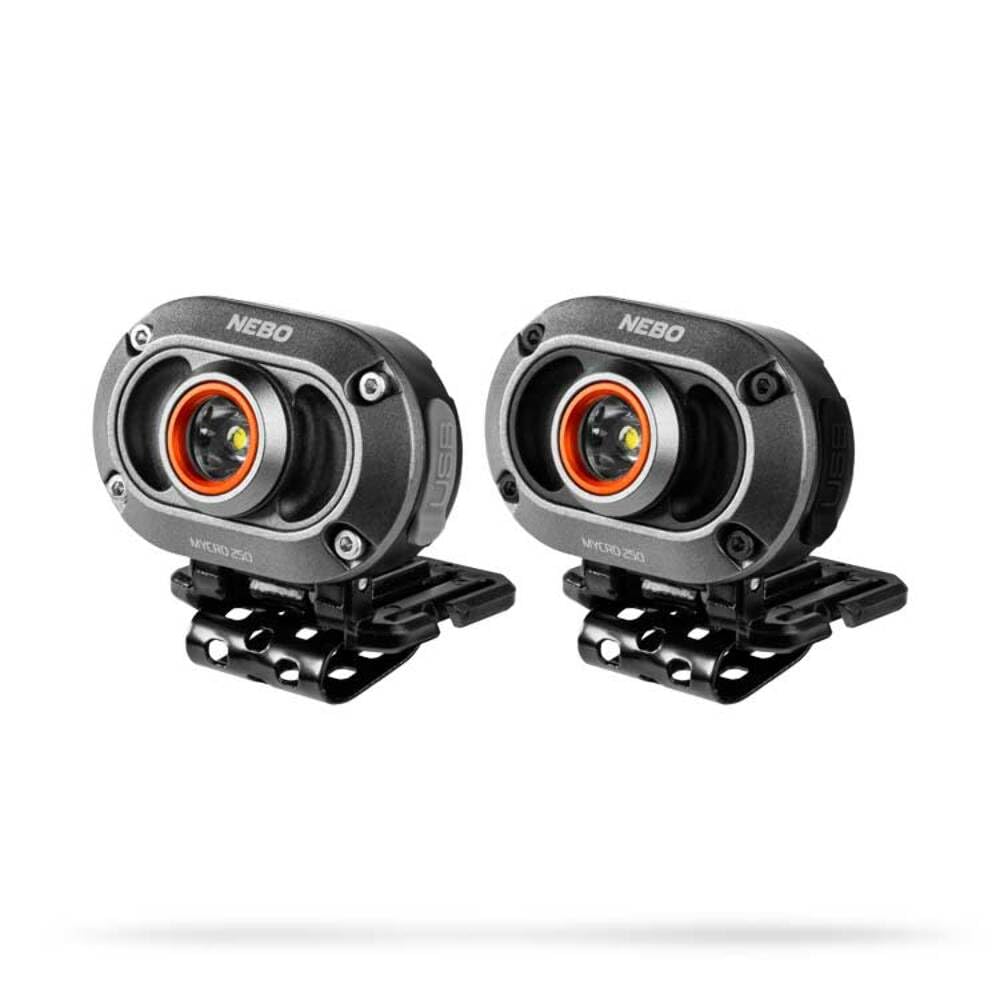
NEBO Mycro 250 (2-Pack)
Key Features
- Charging: USB-C
- Pack size: 2 headlamps
- Max output: 250 lumens
- Runtime on low: Up to 5 hours
- Price: Budget
Two lights, one charger, one purchase: that is the Mycro’s argument, and it is a good one. We keep one clipped to a cap brim in the daypack and the other in the glovebox, which means the light we need is already where we are rather than in the pack we left at home. The clip tightens onto a hat bill and the head tilts 135 degrees, so it aims where you look instead of into the trees.
Each unit runs 250 lumens on high, 50 on medium, and 15 on low, with up to five hours on the lowest setting and USB-C charging from the same cable as everything else. Three modes is the entire menu, which we count as a virtue at night with cold hands — no cycling through settings you never use. What you give up is reach and a red mode, so this is a light for camp, cars, chores, and tent interiors rather than for moving fast after dark.
Pros
- Two lights in a single purchase
- Clips to a cap brim with 135-degree tilt
- USB-C charging, three simple modes
Cons
- No red or night-vision mode
- Five hours on low is short for multi-day trips
Two USB-C lights with a cap clip, bought once and stashed everywhere — the pair to keep in a pack, a car, and a kitchen drawer.
Best for Fast and Light
Petzl Bindi

Key Features
- Weight: 1.23 oz
- Battery: 680 mAh lithium-ion
- Charging: Micro-USB
- Max output: 200 lumens
Thirty-five grams is the number that sells the Bindi, and the body is small enough to close a fist around. Petzl’s tilt design lets the beam drop to your feet or lift to the trail ahead, and the band is thin enough to wear around your neck instead of over your head — which is how we ended up using it on warm-ups and dawn runs where the sky is already going grey.
The 200 lumens are spread as a flood, which suits running and close work better than long-distance route-finding, and Petzl’s 50:50 brightness-to-burn-time rating means output holds up through the middle of the battery instead of collapsing in the first twenty minutes. There is a red mode, and a lock function that has saved us from pulling a dead light out of a pack more than once.
The catch is charging. It is micro-USB, and charge holding is the weak spot — a Bindi that has been sitting can go flat between outings, so we top it up before every trip and lean on the lock switch to stop the button firing in transit. That is a routine, not a dealbreaker. At 35 grams it is still the light we take when every gram gets argued over, and it disappears into a jacket pocket when the sun comes up.
Pros
- 35 g, the lightest rechargeable here
- Wears around the neck as well as on the head
- Output holds through the burn time
- Lock function prevents accidental drain
Cons
- Micro-USB charging on a current model
For runners who want the least possible weight above their eyes, the Bindi’s 35-gram body and neck-wear option make it an easy carry.
Best for Emergency Backup
Petzl e+LITE

Key Features
- Max output: 30 lumens
- Storage life: Up to 10 years with batteries
- Operating range: -22°F to 140°F
- Water resistance: Submerged 3 ft for 30 minutes
- Price: Midrange
Ten years. That is the claim that makes the e+LITE worth owning: Petzl says it can be stored with its batteries installed for up to a decade and still switch on. We treat it as the light that lives in the bottom of a daypack or a car console, gets checked once a year, and is there for the flat tire, the late finish, and the power cut.
For that job it is thoughtfully built. Thirty lumens covers a tent zipper, a map, a stove, or a fire road walk back to the trailhead, the red strobe makes you findable from a distance, and the locking switch means it cannot turn itself on in storage. The ratings are the interesting part: -22°F to 140°F, and thirty minutes under three feet of water. It comes with a whistle on the cord, the kind of detail that only matters on the worst day.
What it is not is a night-hiking light — as a sole source for moving through terrain after dark, it runs out of beam well before the terrain runs out of features. Keep it as the backup that never needs charging and always works. The one sour note is that it costs more than our top pick while doing a fraction of the work; you are paying for shelf life, not output.
Pros
- Stores for up to ten years with batteries in
- Locking switch stays off in a pack
- Rated -22°F to 140°F and submersible
- Whistle included on the cord
Cons
- 30 lumens: backup duty only, not night hiking
- Not rechargeable; relies on replaceable cells
Buy it as the emergency light that lives in your pack for a decade, not as the one you plan a night hike around.
Best for Camp Lighting
FLEXTAILGEAR 600

Key Features
- Weight: 2.1 oz
- Runtime: 4h-100h
- Max output: 600 lumens
- Water resistance: IP67
- Price: Midrange
Six hundred lumens from 2.1 ounces is the best-looking spec on this page, and on paper it is. In the dark it is more complicated. Running it against the NU20 on high, the two land closer than the numbers imply: the Nitecore’s tighter beam reaches further down the trail, while the FLEXTAILGEAR spreads a wider pool of light closer in.
What it does well is flexibility. Six modes cover mixed light, spotlight, flood, red, SOS, and beacon, the 700 mAh battery is rated for 4h-100h depending on setting, and USB-C means the same cable as your phone. IP67 and a two-meter drop rating handle rain, dust, and the kind of drop that happens when you set a light down on a rock in the wind.
The controls are the friction. To shut it off you cycle through the modes rather than press and hold, so a quick burst of light to check a map turns into a sequence, and reaching full output takes deliberate presses. In gloves, at night, with cold hands, that is the sort of thing you notice every single time you use it.
We would put this in a kit where a wide, bright camp light matters more than a long throw, and we would take it over a no-name bargain light without hesitating. The honest limit is that the beam does not punch as far as the lumen figure suggests, so if your evenings are about covering ground rather than lighting a camp, look at the Fenix instead.
Pros
- 600 lumens at just 2.1 oz
- Six modes including red, SOS, and beacon
- IP67 and a two-meter drop rating
- USB-C with a battery indicator
Cons
- Must cycle through modes to switch off
- Throw falls short of what 600 lumens implies
A 2.1-ounce, 600-lumen camp light with every mode you need, provided you are willing to learn its button and don’t need long throw.
Best for Budget Spare
EverBrite 400LM

Key Features
- Weight: 1.59 oz with headband
- Max output: 400 lumens
- Light modes: 7, including red and green
- Water resistance: IP67
- Price: Budget
The EverBrite is the cheapest light here, and that is the whole argument. It is the one we hand to people who want a headlamp in the car, the shed, and the fishing bag without spending real money on any of them. At 1.59 ounces with the headband it is light enough to forget, and the clip works on a cap brim or a shirt collar when you do not want a strap at all.
Seven modes is more than most lights in this roundup: white low, white high, eco, red, red flashing, green, and a turbo boost you hold the button to reach. The red and green options cover the jobs white light does badly, like reading in a tent or moving through a dark camp. IP67 means rain and a dropped-in-a-puddle recovery are both survivable.
Where the savings show is the mount. The body clips into a plastic bracket that feels less substantial than the rest of the light, and it is the part most likely to give out first. On a light this cheap, treat the clip as a wear item rather than something to yank on with cold hands, and it will last a good deal longer.
For the money, we are not going to pretend it is not useful. It is a second light, a car light, a light for the cabin drawer — the one you do not mind losing or lending. It is not the light we trust for a night descent, but it is not priced like one either. Buy it as backup and it earns its keep; make it the only light on a serious trip and you will feel the compromise.
Pros
- Cheapest light in this group
- 1.59 oz including the headband
- Red and green modes plus a hat clip
- IP67 rated
Cons
- Plastic mount is the wear item
- 400 lumens only in a held turbo mode
A cheap, genuinely light second headlamp for the car and the shed, with a plastic mount that won’t take much abuse.
How We Tested 12 Ultralight Headlamps, Mostly After Dark
We started with a list of every headlamp the major outdoor brands and a handful of budget names sell at roughly 3 ounces or less, then crossed off anything that couldn’t lock on its highest setting, ran only on disposable batteries, or had no low or red mode for camp and tent use. That left 12 lights, priced from stocking-stuffer to serious-backpacking, and we bought each one at retail rather than accepting samples.
Everything got weighed on a kitchen scale with fresh batteries installed and compared against the claimed figure, because a headlamp that’s honest about grams is usually honest about everything else. We timed runtime on high until the beam dropped below what we’d call usable on a trail, checking output every 20 minutes, and we walked the same stretch of local path with each light aimed at a marker about 100 feet out to see how far the beam actually carried. Portability got judged by whether the whole thing, strap included, would fit in a hipbelt pocket without a fight.
Comfort we tested by wearing each one for two-hour stretches — on climbs, on descents, and over a beanie — noting pressure points, strap creep, and whether the buttons were findable with gloves on. For durability and reliability, we stuffed them loose into pack lids, dropped them waist-high onto concrete, and ran each under a faucet for five minutes to see if water got into the battery compartment or fogged the lens. A few came back out for a second season of loan-outs to friends, which is where the weak switches and dying cells showed up.
How to Choose an Ultralight Headlamp
The best ultralight headlamp is the one you forget is on your head until you need it, which puts weight, sustained runtime, and beam shape ahead of whichever listing shouts the biggest lumen number.
Decide the job before the lumens
Two very different products get sold as ultralight headlamps. One is a primary light for moving after dark: it needs enough reach to read a junction from a distance and enough sustained output to keep doing that for hours. The other is a backup that lives in a pack for the night something goes wrong. A 30-lumen emergency light is a fine thing to own and a miserable thing to navigate by.
Be honest about which one you are shopping for. If you run at dawn or finish hikes after sunset, buy for reach and runtime. If you already own a good primary, a tiny sealed backup with a locking switch is the smarter second purchase.
Weight, and where it sits
Weights are quoted with and without the headband, and the band is what you actually wear. Our top pick is 1.34 ounces on the band; the bare body is lighter still. Compare the number that includes the strap, because that is the mass your neck is holding by hour three.
Total grams are only half the story. A heavier light with a wide, stable band can be more comfortable than a lighter one you have to crank tight to stop it bouncing. The tell is the strap: thin elastic with a plastic toggle needs tension to stay put, and tension is what gives you a headache.
Runtime on the setting you will actually use
Maximum output is a burst, not a mode. A 360-lumen light running all evening at its middle setting is doing real work; the same light on its top level is a few minutes of camera-flash brightness. Look at the low and medium runtimes instead — the picks here range from about five hours to ninety-seven — and convert that into the number of evenings it covers.
Cold mornings cut lithium capacity, so build in a margin in winter and keep the light in an inside pocket until you switch it on. One charge per trip is achievable; one charge per season is not.
Charging, cells, and the cable you already carry
USB-C has become the default, and a micro-USB port on an otherwise current light means one extra cable in the ditty bag. Built-in batteries are lighter and cannot be swapped; a light that takes a replaceable cell runs all week on spares but weighs more doing it. Decide which of those costs you less.
Whatever you choose, check for a lockout before the light goes in a pack. A soft switch pressed against a stuff sack will drain a battery long before you turn the thing on, and the lock is the difference between a charged light at dusk and a dead one.
Frequently Asked Questions
Why not just use my phone’s flashlight?
A phone light is a spare, not a system. It ties up a hand, it points wherever the phone points, and it drains the battery you may want for maps and a call. A 1.3-ounce headlamp keeps both hands free for poles and a map and leaves the phone charged for the things only it can do. Carry the light; treat the phone as the backup.
What’s the difference between lumens and beam distance?
Lumens measure total light output; beam distance measures how far a usable amount of it reaches. The two do not move together — a wide flood can post a big lumen number and still fade at forty yards. Compare throw figures in the same unit, since listings mix yards and feet, then match the beam to the job: reach for route-finding, spread for camp.
How do I clean a headlamp without ruining the strap?
Hand wash the band in cool water with a little mild soap, rinse it, and air dry away from radiators and direct sun. Skip the washing machine and the dryer, because heat and tumbling destroy elastic and reflective trim. Wipe the body with a damp cloth rather than dunking it, and rinse sweat and sunscreen out after a trip — both break down elastic faster than mileage does.
Final Verdict
The Nitecore NU20 Classic is the ultralight headlamp we point most people to. At 1.34 ounces it disappears on your head, 360 lumens with 119 yards of reach covers real trail, and up to 97 hours on low with USB-C charging means one cable and one charge for a weekend.
If your nights are spent moving rather than sitting, the Fenix HM50R v2.0 earns its extra weight: 700 lumens, an IP68 aluminum body, and a light that slides out of the band as a handheld. For camp-heavy trips where red and high-CRI light matter more than reach, the Nitecore NU25 is the one — just pack its micro-USB cable.