This post contains affiliate links. We may earn a small commission when you buy through our links — at no extra cost to you.
An ultralight down jacket is a compromise you wear: warmth on one side of the scale, a few ounces of nylon and feathers on the other. The best ones make the tradeoff disappear — you stuff one into its own pocket, shake it out on a 35-degree morning, and forget you own anything heavier. The worst ones remind you all day, leaking a slow trail of feathers down your sleeve or tearing on the first branch they brush past.
Over the past eight months, my team and I have worn 11 of them on commutes, weekend hikes, and drafty flights, and the differences come down to details the spec sheets skip. Fill power gets the headlines, but baffle design and how much down sits in the shoulders decide whether a jacket is actually warm at 30 degrees. Fit matters just as much — down only insulates where it touches you, so a shell that’s roomy with no way to cinch it is dead weight. The jackets below are the ones we kept reaching for.
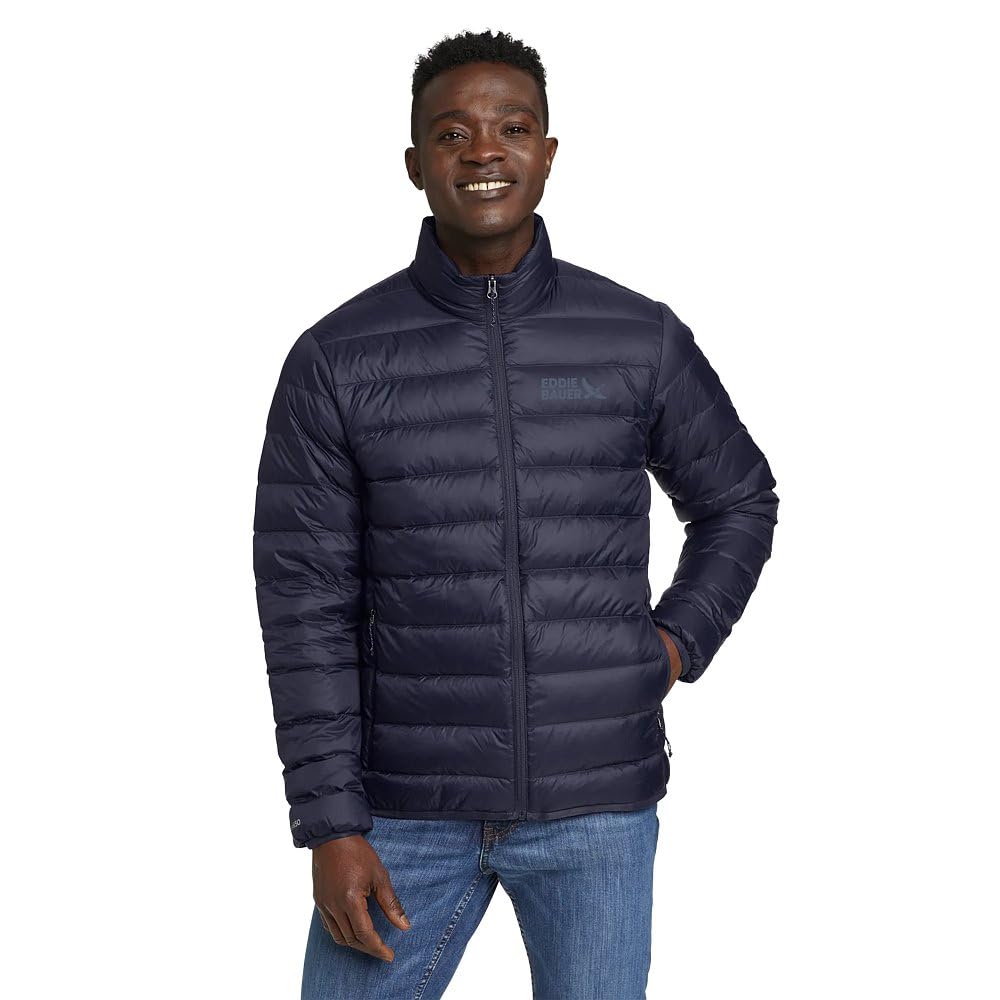


Best for All-Round Layering
Eddie Bauer CirrusLite
Key Features
- Pockets: Two zip outer, two inner
- Department: Men’s
- Insulation: Down
- Price: Midrange
Start here if you want one down jacket to cover most of the year. The CirrusLite is the jacket we point to first when someone wants a packable layer and doesn’t want to think about it any further: hip-length, light enough to forget in a daypack, and mid-priced against everything else on this page. None of its features are exotic. The basics are simply right.
Warmth is why it works. It’s comfortable on its own through the 40s and 50s, and under a shell it keeps going well below that. The cut is relaxed enough for a fleece or a heavy sweater without flattening the down, and the hem sits at the hip, where it stays clear of a pack belt.
The catch is the fabric. It’s thin — that’s where the weight saving comes from — and down can work its way out through the seams over time, which you notice as small quills on the layer underneath. It won’t sink the jacket, but if you plan to push through brush or wear it under a loaded pack every weekend, that thinness is a genuine cost rather than a theoretical one.
Two zippered hand pockets and two interior drop pockets is a better layout than the price suggests, and the whole thing stuffs into a small pouch, small enough to earn a permanent place at the bottom of a daypack. For travel and three-season hiking, that’s the combination that matters: a jacket you never have to decide whether to bring.
Pros
- Packs small enough to live in a daypack
- Comfortable from the 40s into colder weather with a shell
- Four pockets, two of them zippered
- Mid-priced for the warmth on offer
Cons
- Thin shell sheds down and snags easily
The jacket we recommend to most people: warm, genuinely packable, mid-priced and easy to layer, provided you can live with a thin shell that sheds a little down.
Best for Hiking and Moving
Columbia Delta Ridge II
Key Features
- Lining: Reflective
- Department: Men’s
- Insulation: Down
- Designed for: Hiking
- Price: Premium
The lining is the reason to look at this one. There’s a reflective layer inside the Delta Ridge II that bounces body heat back at you, and it does the most work in the places a down jacket usually loses ground: standing still at a viewpoint, sitting on a cold rock at lunch, waiting for the rest of the group to catch up.
We think it’s the best hiking jacket in this group, and the cut carries a lot of that. It’s the slimmest jacket here — it slides under a shell without bunching across the shoulders and stays out of the way when you’re swinging your arms. Broad-chested hikers should go up a size; the athletic fit doesn’t leave much room across the back.
Warmth is strong for the weight. It’s a 30s-and-40s layer over a baselayer, it warms up quickly when you pull it on after a climb, and it packs down without a fight at the bottom of a bag. The shell has more substance to it than the budget jackets here, which is part of what you’re paying for.
The premium is the honest trade-off. You’re buying the reflective lining and a hiking-specific cut, not a dramatically warmer jacket, and someone whose jacket mostly commutes will get the same warmth for less from the Eddie Bauer. If yours is going to see a hill most weekends, this is the one that earns the extra.
Pros
- Reflective lining adds warmth when you stop
- Slim cut layers under a shell without bulk
- Warms up quickly after a climb
- Light enough to stuff into a pack
Cons
- Athletic cut leaves little room across the chest
The hiking pick: a slim, reflective-lined men’s layer that warms fast on the move and slides under a shell without bulk.
Best for Cold-Weather Travel
32 Degrees 3/4 Down Jacket
Key Features
- Fit: Slim
- Hood: Detachable
- Insulation: Down
- Water resistance: Water repellant
- Price: Budget
Length is what separates this one. The hem drops well below the hip, so it covers your seat and the tops of your legs — the part of you that gets cold on a platform, waiting for a shuttle, or walking into a wind coming across open ground.
As a travel jacket, that’s the right compromise. It packs into its own pouch and weighs about as much as a couple of shirts, but it covers more of you than any other jacket here. Warmth lands in the 30s and 40s, it doesn’t overheat you on a bus or in a shop, and the detachable hood and water-repellent shell mean you can travel with one jacket instead of two.
Sizing is the thing to sort out first, because it’s the one place this jacket is inconsistent: some sizes come up roomy enough to size down, others fit close. Work from the size chart and your chest measurement rather than from the label you normally buy. The other cost is down working through the shell and onto whatever you’re wearing underneath — over dark layers you’ll barely notice, so pack a dark baselayer and a lint roller and it stops mattering.
Pros
- Longer hem covers seat and thighs
- Packs into its own pouch for travel
- Detachable hood and water-repellent shell
- Comfortable in the 30s without overheating indoors
Cons
- Down sheds through the shell onto layers underneath
If your cold-weather trips mean standing around in wind, this longer women’s jacket covers more of you than anything else here and still packs into its own pouch.
Best for Layering under Shells
wantdo Women’s Packable Jacket
Key Features
- Length: Short
- Department: Women’s
- Insulation: Down
- Packed storage: Own pouch
- Price: Budget
This is the jacket that lives in the bottom of a pack. It’s short, thin and one of the least expensive options here, and it does the one job a layering jacket has: adding warmth without changing how your shell fits over the top.
On its own it’s a 40s-and-50s piece. Under a hardshell or a snowboard jacket it punches well above its weight, and the roomy body leaves space for a fleece without flattening the down underneath. It rolls into the pouch it comes with — small enough to shove in a tote or a bike bag — and the colors are easy to spot on a trail.
Two things to check before you order. Sizing: sleeves run short on some and the body runs big on others, so if you’re between sizes and planning to layer, go by chest measurement rather than the size you wear in a fitted coat. Pockets: some versions come without outside hand pockets, so look at the photos if that matters to you.
Get the size right and it’s the layer you’ll wear more often than the jacket on top of it — which is the highest compliment a midlayer can get.
Pros
- Slips under a shell without changing the fit
- Roomy enough for a fleece underneath
- Rolls into its own pouch
- Budget price for a down layer
Cons
- Mild-weather warmth only, not a winter coat
A cheap, packable women’s layer that’s at its best under a shell — buy it for layering and cool mornings, not as your only winter coat.
Best for Mild-Weather Packing
SLOW DOWN Packable Puffer
Key Features
- Department: Men’s
- Insulation: Down
- Packability: Packs down small
- Price: Budget
The channels are lightly filled, and that tells you what this jacket is. Even by ultralight standards it’s a thin piece — closer to a windbreaker with down in it than to the insulated jackets at the top of this page — and that’s precisely why it packs to the size of a paperback and costs what it does.
For the right trip, it’s excellent value. It’s a camp and commute jacket: warm on a cool morning, warm around a fire in the evening, and small enough that a bikepacker can justify carrying it. Layered under a shell with a fleece it handles the 40s; on its own in wind it runs out of insulation quickly, and that’s the boundary to buy it against.
Fit runs slightly big, which is what you want if you’re layering a hoodie and less of what you want over a t-shirt. The shell is thin enough that a rough pack strap or a branch can mark it, so treat it as a town-and-camp jacket rather than something to bushwhack through.
Where it earns its place is the freedom that comes with the low price. Throwing it in a boat bag or using it as a pillow on a bus doesn’t feel like a risk, and on a real trip that carelessness counts for more than another few grams of fill.
Pros
- Packs down small enough for a bike bag
- Warm for cool mornings and camp evenings
- Lowest-priced down jacket in this group
Cons
- Light fill runs out fast in wind and cold
Buy it for mild-weather trips and camp use: the fill is light, the packed size is tiny, and it’s the cheapest down layer in this group.
Best for Hooded Hiking Layer
YZG Packable Down Jacket

Key Features
- Hood: Detachable
- Pockets: Two zip outer, two inner
- Department: Women’s
- Insulation: Down
- Price: Budget
The hood zips off, and that small detail does more for this jacket than it sounds. Hood up on an exposed ridge, hood off and stowed for the walk back down — that’s the flexibility you want from a layer you’ll wear all day.
Four pockets is generous at this weight: two zippered hand pockets and two deep interior ones, one of which the jacket folds into. It’s warm for cool mornings, it copes with a shower long enough to get you off a ridge, and it’s cut roomy enough for a hoodie underneath — which is the point of a hiking layer.
The fit is where you’ll need to make a call. It runs roomy through the body and the hood sits forward enough to stay up in wind, which is right for layering and wrong if you want something close-fitting — size down if you’ll mostly wear it over a baselayer. Packing is the weaker suit: it folds into its own pocket, but it doesn’t compress as flat as the pouch jackets here, so it takes a little more room in a daypack.
For a hood, four pockets and a price at the bottom of this group, that’s an easy trade to accept.
Pros
- Detachable hood zips away when not needed
- Four pockets, two of them zippered
- Warm for cool mornings at a budget price
- Folds into its own pocket
Cons
- Doesn’t compress as flat as the pouch jackets here
A hooded, pocket-heavy women’s layer at a budget price — the pick if you want a detachable hood and real storage, and you’re happy to size for a roomier fit.
How We Wore, Weighed, and Washed 11 Ultralight Down Jackets
We started with roughly 40 jackets from brand lineups, retailer bestseller lists, and reader emails, then narrowed by fill power, packed size, weight, and price until 11 were worth wearing. Each one got weighed on a kitchen scale and compared against its claimed weight, which is how we found the jackets that quietly run an ounce or two heavy.
Those 11 went through eight months of real wear: dog walks in the low 30s, an exposed ridge on a windy day, drafty plane cabins, and under a rain shell when the weather turned. We noted when a jacket ran hot on a brisk walk, where cold spots showed up, and whether the cuffs and hem actually sealed out wind. For fit, we layered each one over a t-shirt and then a midweight fleece, measured sleeve and body length flat, and reached overhead to see whether the hem rode up. Comfort came down to small things — collar height, how the shoulders felt under a pack strap, whether the fabric rustled against a bare arm.
Durability was less glamorous. We pushed through scrub oak and brushed against granite, then counted feathers escaping into the stuff sack, onto a black t-shirt, and around the collar after a week of wear. Every jacket got a home wash and tumble dry with dryer balls to see whether the down clumped or spread back out evenly — how the feathers held up after washing turned out to be the quiet divider between the thin shells that survived and the ones that went flat. We finished by judging the small parts: zippers, cord locks, stitching, and whether the price made sense for what’s actually in the jacket.
How to Choose an Ultralight Down Jacket
The lightest jacket on the rack is rarely the warmest, and the warmest is rarely the one you end up carrying — so buy for the conditions you’ll actually meet, not the ones you’re worried about.
Warmth comes from loft, not from bulk
Ultralight describes the shell and the total weight, not the warmth. A paper-thin jacket can hold plenty of heat if the down is high-loft and the baffles are filled evenly, and a thick one can be cold if the fill has slumped into the corners of each channel. Look at how consistently the down sits across the body and how much air those channels trap — that is the insulation. Then match the jacket to a temperature range rather than to a number on a hangtag. The jackets here run from mild-morning layers to something you’d wear into the 30s over a baselayer. If you want one jacket to cover both, buy the warmer one and vent it.
Packed size is the spec that changes your trip
A jacket that stuffs into its own pocket is different gear from one that needs a separate sack, and both are different from one that only folds flat. In a daypack, the question is whether the jacket eats room you had earmarked for water and food. Compression matters more than grams: two jackets can weigh the same and one will take twice the space because of how the channels are sewn. If a listing says packable without saying what it packs into, assume there’s no pocket and plan on a stuff sack.
Down retention and shell durability
Thin shells are what make these jackets light, and thin shells are also where down escapes. Feathers working through the seams and turning up on your baselayer is the most common long-term complaint in this category, and it’s worse on jackets with a loose weave or widely spaced stitching. Run a hand along the seams before you commit, and look at whether the baffles are sewn through or boxed. If you’ll wear the jacket under a loaded pack strap or push through scrub, weigh durability against the weight saving — that’s the deal you make with every ultralight piece.
Fit it over what you’ll actually wear
An ultralight down jacket is usually a midlayer, so size it over a fleece or a heavy sweater, not over a t-shirt. You want room across the chest and shoulders without squashing the down flat, and sleeves long enough that they don’t ride up when you reach overhead. Sizing is inconsistent between brands and even between men’s and women’s cuts within this group, so go by chest measurement and the size chart rather than the label in your closet. If you’re between sizes and plan to layer, take the larger one.
Hoods, collars and wind
A hood adds warmth no collar can match, and a detachable one gives you the choice back. The jackets here differ: at least one hood zips off, several are collarless at the top, and a couple have no hood at all. On an exposed ridge, a hood that sits forward and cinches down is worth more than a few extra grams of fill. Watch the cuffs and hem too — an elasticated cuff that seals at the wrist keeps you warmer than a slightly thicker jacket that lets wind run up your sleeves.
Frequently Asked Questions
How do I wash an ultralight down jacket without ruining the loft?
Use a front-loading machine or hand-wash with a detergent made for down rather than ordinary washing powder, and skip fabric softener entirely. Rinse thoroughly, then tumble on low with two or three dryer balls until the jacket is completely dry and the baffles feel evenly puffed again — a half-dry jacket clumps and stops insulating.
Check the care label first. Some of these shells won’t tolerate a dryer, and a down jacket that air-dries without agitation stays lumpy.
Down or synthetic for a packable jacket?
Down wins on warmth per ounce and on packed size, which is why every jacket in this guide uses it. Synthetic insulation holds more of its warmth when it’s wet and dries faster, so it’s the better call for wet climates and hard, sweaty output.
For cold, dry trips where pack space is tight, stay with down and carry a shell for the rain.
Do I need a down jacket if I already own a fleece and a rain shell?
Only if you’re getting cold. A fleece plus a shell handles wind and rain well, but a packable down layer is warmer for the same bulk and takes up less room than the fleece it replaces — that’s the whole reason it ends up in the pack.
Where the fleece wins is during hard effort or in steady rain, when you’ll be damp. If your trips are wet and above freezing, put the money into a better shell first.
Final Verdict
Buy the Eddie Bauer CirrusLite. For travel, cool mornings and layering under a shell it suits more trips than anything else here, and nothing in this group does as much for the money.
Spend more only if the jacket is going to live on the hill: the Columbia Delta Ridge II’s reflective lining and slimmer cut are worth the premium for regular hiking. On a tight budget, the SLOW DOWN men’s jacket and the wantdo women’s jacket are honest mild-weather layers that pack small and ask little.