This post contains affiliate links. We may earn a small commission when you buy through our links — at no extra cost to you.
For years my headlamp ritual was the same: dig through the junk drawer, shake three AAAs out of the TV remote, and hope they lasted a predawn dog walk. Rechargeable felt less like an upgrade than a small weight lifted — no more scrounging, no dim yellow beam three miles from the trailhead. What a good one actually fixes is reliability: it’s charged when you reach for it, it holds its brightness instead of fading out over a season, and it stops eating the batteries you were saving for something else.
Rechargeable headlamps also flatter themselves on the packaging. A four-digit lumen count means little if the light throttles down after 40 seconds, and a battery pack that feels fine on the kitchen table can swing like a brick a mile into a run. I’ve worn 14 of them since late summer — predawn walks, a blacked-out basement, under a car hood, one very wet camping weekend — and a couple of cheap ones outlasted models that cost twice as much. The picks below are the ones I kept reaching for.



Best for Trail and Camp
Foxelli USB-C Headlamp
Key Features
- Weight: 2.4 oz
- Runtime: 40 hours
- Warranty: 1 year
- Max brightness: 180 lumens
- Price: Midrange
Two and a half ounces and a quoted 40 hours of runtime are the numbers that decided this one for us. The Foxelli is what we hand someone who asks for a single headlamp to cover three-season hiking, camp chores, and the walk back from the tent: light enough that the band disappears, sealed to IPX5, and sold in pairs so one can sit on a charger while the other goes in your pack. The ceiling is brightness. At 180 lumens this is honest light for a marked trail, a tent, and a late dinner, and not much use for picking a line down loose ground at speed. If that’s your hiking, pay for the Coast instead.
The beam is a clean spot with enough spill to keep your feet visible, and the head tilts 45 degrees so you can drop it onto a stove or a map without craning your neck. Red light for around camp, an SOS strobe, and a stretch band that stays put without being cranked tight. Five modes is two more than we want on a cold night in gloves — you’ll learn the click sequence quickly, and you’ll still hit the strobe by accident at least once.
USB-C handles charging, and the pair is what makes the wait painless: swap lamps rather than sit out the charge. The warranty is better than most here — 120 days money back plus a year of cover — which is the sort of thing you only value the week a lamp stops working.
Pros
- Barely noticeable at 2.4 ounces
- Up to 40 hours of quoted runtime
- Two lamps in the box for rotation
- USB-C charging and IPX5 sealing
Cons
- A full charge takes a few hours
Our default pick: light enough to forget you’re wearing it, with two lamps in the box and runtime to spare for a night out.
Best for Long-Range Spotting
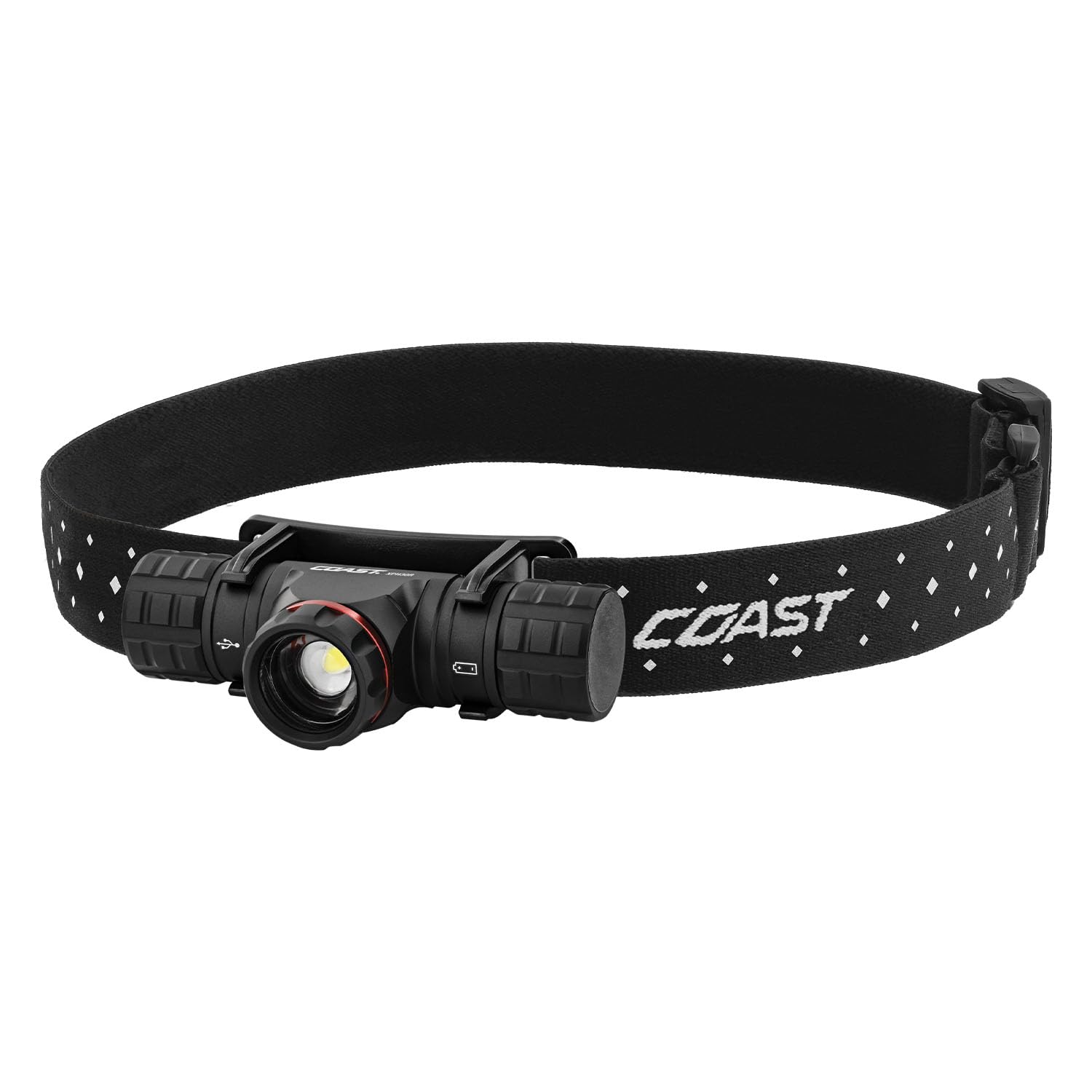
Coast XPH30R
Key Features
- Runtime: 6.75 hours (high), 10 hours (medium), 28 hours (low)
- Charging: USB-C
- Max brightness: 1200 lumens (turbo)
- Water resistance: IP54
- Price: Premium
Weight is the first thing you notice about the XPH30R. An aluminum housing, a lens assembly that hangs well forward of the band, and a battery big enough to feed 1200 lumens all sit above your eyebrows, and after a couple of hours you know it’s there. What that buys is the most capable light in this group.
The output steps are published per mode, which we wish every maker did: 1200 lumens on turbo, 500 on high, 160 on medium, 46 on low, with 6.75 hours on high and 28 on low. Turbo is a burst for finding a marker, not a setting you walk with. Medium carried us through an evening of camp work with light to spare, and the honest numbers meant we knew when to stop pushing it.
Then there’s the part that made this our pick for anything beyond walking: the body releases from the bracket and the magnetic base holds it to a hood, a fusebox, or a tailgate, so the lamp becomes a work light for the ten minutes you need one. IP54 and a one-metre drop rating cover weather and clumsiness, USB-C handles charging, and the focus ring turns easily in gloves — which matters more in February than any spec sheet admits.
Pros
- 1200-lumen turbo with a true 500-lumen high
- Runtimes published per brightness mode
- Body detaches magnetically as a work light
- Twist focus from flood to spot
Cons
- Lifetime cover excludes the battery
We keep coming back to this one for real light: turbo brightness, a twist focus that shifts from flood to spot, and a body that pops off the strap.
Best for Budget Two-Pack
Lepro Rechargeable 2-Pack
Key Features
- Weight: 2.65 oz
- Runtime: 15 hours
- Max brightness: 2000 lumens
- Water resistance: IPX4
- Price: Budget
Two lamps, one box, and a price below most of the singles here — that’s the pitch, and it holds up. Each unit weighs 2.65 ounces, cycles through six modes including spot, flood, and red, tilts 45 degrees, and charges over USB-C. The band is a sweat-proof elastic that adjusts without a fight, which is more than we can say for some pricier lamps.
Lumen figures on budget lamps deserve suspicion, and we don’t put much weight on the one printed here. What matters is that the spot throws far enough for a fire road, the flood is wide enough to cook by, and the brightness lands where you can leave it on without wrecking your night vision. The red mode does what red modes should — enough to sort gear in a tent without blinding yourself or the person next to you.
Two people hiking together, or a car kit with a charged spare: this is the pair we recommend for both. The listing quotes up to 15 hours, which will be the dimmest setting, so top both lamps up before a long night rather than trusting the headline. Treat the pack as one lamp plus a spare and the value argument gets a lot more convincing.
Pros
- Two lamps without stretching the budget
- Spot, flood, and red across six modes
- Comfortable band that adjusts easily
Cons
- IPX4 covers rain, not a soaking
We like these for two-person trips and glovebox spares: they cover the basics without asking much of your budget.
Best for Hard-Hat Work
POKISEED Wide-Beam Headlamp
Key Features
- Battery: 5000 mAh
- Beam angle: 230 degrees
- Max brightness: 1500 lumens
- Water resistance: IPX6
- Price: Midrange
Most lamps here throw a spot you aim. This one lays a bar of light across 230 degrees of everything in front of you, thirty-one LEDs behind the strip and a separate red lens on the back of the band. It’s a different idea of what a headlamp is for: less about reaching the next marker, more about seeing the whole job at once.
For work, the bar wins. Crawl spaces, engine bays, a ceiling you’re wiring — you stop turning your head to find the edges of what you’re doing, and the taillight means the person behind you can see where you are. The 5000 mAh cell and IPX6 sealing suit a damp basement or a wet evening, and the clips let you fix the lamp to a hard hat instead of stretching a band over it. This is what we put on when the job matters more than the walk to it.
Where it gives ground is consistency. Some units have quit inside the first month, so run yours hard for a week while the return window is still open, and keep a cheap spare in the truck. Judged as a work light rather than a hiking light, the wide beam and the taillight still earn their place.
Pros
- 230-degree bar lights the whole work area
- Red taillight for visibility from behind
- 5000 mAh battery and IPX6 sealing
- Hard-hat clips included
Cons
- 270 g makes the band bite after an hour
This is the one we put on a hard hat, because the wide bar covers the whole work area and the taillight makes you visible from behind.
Best for Camp Chores
BIAT Wide-Beam 2-Pack

Key Features
- Pack size: 2 pack
- Beam angle: 230 degrees
- Max brightness: 350 lumens
- Water resistance: IPX4
- Price: Midrange
Cooking dinner at camp with both hands full, or lying under a car with one arm up a wheel arch — that’s where the wide silicone bar earns its place, and it’s why a pair lives in our camp box. The light lies flat across your forehead instead of perching on it, so there’s nothing to knock and nothing to aim, and the motion sensor means a wave turns it on when your fingers are covered in food or grease.
Runtime is the compromise: this is a lamp for an evening’s cooking and the walk back to the tent, not for a full night on the move. The sensor is also the feature to learn first, because fumbling for a button in the dark is exactly what it exists to prevent. Wear it for camp and the garage and it’s an easy recommendation; wear it for a long night hike and you’ll want more reach.
Pros
- Wide 230-degree bar for close work
- Motion sensor works with gloves on
- Light, comfortable band on the head
Cons
- Durability is the weak point over a season
We keep a pair in the camp box: wide, light, and cheap enough for kids to wear, as long as the night doesn’t run too long.
Best for Truck and Toolbox
DanForce Bold-S

Key Features
- Weight: 8.8 oz
- Material: Aluminum
- Max brightness: 1080 lumens
- Water resistance: IP54
- Price: Midrange
Aluminum instead of plastic is the reason to look at the Bold-S first. It’s a metal housing with real heft, the sort of thing that survives a drop onto concrete or a season rattling around a toolbox, and it doesn’t flex when you grip it.
The beam is a zoom design: twist to widen it for close work or narrow it to punch down a driveway, with 1080 lumens behind it, a red secondary light for reading a map, and a red safety light on the back of the band. The head tilts to 90 degrees, enough to point it straight down at whatever your hands are doing.
At 8.8 ounces it’s one of the heavier lamps here, and the mass sits forward. On the wide strap that’s tolerable for stationary work; on a climb you’ll be adjusting it every ten minutes. If your head is on the small side, set the strap before you start rather than halfway up.
We rate it as a task light that happens to be wearable — for a farmer, a mechanic, or anyone whose evenings happen under a hood. Pair it with a lighter lamp for the walk there and you’ve covered both jobs without paying twice for the same beam.
Pros
- Aluminum housing instead of plastic
- Zoomable 1080-lumen beam
- Red secondary and rear safety light
Cons
- 90-day warranty is short for a work light
Aluminum body, zoom beam, red rear light: we like this one in a toolbox and leave it home on long hikes.
Best for Garage and Yard
Blukar K9116

Key Features
- Weight: 9.74 oz
- Runtime: 18 hours
- Max brightness: 8000 lumens
- Water resistance: IPX6
- Price: Budget
Eight thousand lumens is what the box says, and we treat it as marketing. It’s an 11.2-watt, three-LED light; the physics doesn’t stretch that far. What is true is that it’s bright — a broad, even wash that fills a garage or a loft — and the zoom ring and 90-degree tilt put it where you need it.
For garage, yard, and loft work this is the lamp we grab. Five modes cover the main, side, and combined beams, the head rotates to point at a bench, and IPX6 with a sealed battery compartment means a wet evening doesn’t end the job. It isn’t refined: the flashing mode sits in the same rotation as the ones you want, and you’ll hit it by accident more than once.
The weight is the real trade. At 276 g it’s heavy for a headlamp, and the strap has to be tight enough to stop it sliding when you lean over a wing. That’s fine standing at a bench and less fine flat on your back under a car. Buy it for the light, not for the fit.
Pros
- Bright enough for a garage or loft
- Zoom ring plus 90-degree tilt
- IPX6 with a sealed battery compartment
Cons
- 276 g pulls the strap tight when you lean over
We reach for this for garage and yard jobs, where a lot of light beats a light head.
Best for Family and Crew
WopkDupk 5-Pack

Key Features
- Runtime: 8 hours
- Pack size: 5 pack
- Beam angle: 230 degrees
- Max brightness: 350 lumens
- Price: Premium
The light bar lies flat across your forehead rather than hanging off the front, and that changes how it feels: nothing to snag, nothing to knock, and no hotspot bouncing back off a wall you’re working beside. It’s the shape we’ve come to prefer for camp and close work, and this is the only way here to get five of them at once.
Each bar runs 350 lumens through five modes, with a motion sensor for gloved hands, IPX4 sealing, a clip for a hard hat, and a USB-C cable for every lamp in the box. At 2.47 ounces they’re the sort of thing you can hand to a kid or leave in a glovebox without worrying about it.
Keeping five of them charged is the actual chore of a five-pack — the included cables help, and so does the motion sensor, which saves you hunting for a button in the dark. These are comfortable, light lamps rather than armored ones, so treat them as camp gear rather than site gear.
Judged as a kit rather than a headlamp, it makes sense: one for each pack, one for the car, one for the shed, and a spare for whoever forgot theirs. For a family or a work crew it solves more problems than a single expensive lamp does.
Pros
- Flat bar sits steady and doesn’t bounce
- Motion sensor for gloved hands
- Five lamps and five charging cables
- Hard-hat clips included
Cons
- A charge doesn’t stretch to a long night
- IPX4 only, so keep it out of a downpour
Five light bars for a family or a crew is the practical buy here; we just don’t expect them all to survive years of use.
How We Tested Rechargeable Headlamps
I started by pulling together a shortlist of roughly 60 current models from brands with a track record on lights, then cut anything with a proprietary charging cable, no true low-output mode, or a battery that only fit its own strap. That left 14 headlamps, which I wore over four months from late summer into winter.
For brightness, I marked distances on a backyard fence and aimed each lamp at a target 40 feet out on high beam and on its lowest setting, noting whether the light threw one hot spot with no spill or an even wash I could actually walk in. I ran every lamp on maximum until output visibly stepped down, timing how long the honest bright stretch lasted versus the number on the box, and checked how far each dimmed before it died.
Comfort and bulkiness came down to wearing them: over a beanie, under a bike helmet, and on a three-mile run, then looking for red marks and checking whether the battery block bounced. I weighed each one, stuffed them into jean pockets and hipbelt pockets next to keys, and noted which ones snagged. For durability, lamps got dropped from waist height onto concrete, dunked in a sink, and left out overnight in the rain, and I ran more than 20 charge cycles on each while leaving a few charged in a bag for a month to see how much they drained. Value was the last filter — what came in the box, and whether the runtime justified what the light asked of you.
How to Choose a Rechargeable Headlamp
The two things that decide whether a headlamp works for you are the beam shape and the brightness mode its runtime is quoted in — the lumen number on the box tells you least of all.
Beam shape before lumen count
A spot beam reaches down a trail; a flood or a wide bar lights the ground around you. If you hike at any speed you want a spot with a little spill, so you can see both the next marker and your feet. If you work with your hands — under a hood, in a loft, in a tent — a 230-degree bar like the POKISEED or the BIAT saves you turning your head every few seconds.
The trap is buying on the headline figure. The huge numbers are usually burst modes that step down within minutes, and the largest claim in this group comes from an 11-watt light. Ask what the beam looks like at the setting you’ll leave on for an hour.
Runtime is quoted in the mode you won’t use
A single runtime figure with no mode attached is almost always the dimmest setting. The Coast is the exception here, publishing 6.75 hours on high, 10 on medium and 28 on low — the only format that lets you plan a night out. Budget the hours you’ll spend at a brightness you can actually walk with, then double it if the route is unmarked or the trip is long.
Every battery in this guide is sealed in, so a spare lamp or a power bank in the pack is your backup rather than a fresh set of cells. A second lamp that charges while the first is on your head is the simplest version of that insurance.
Weight and balance decide whether you keep wearing it
Under about three ounces — the Foxelli, the Lepro pair, the BIAT bar — you stop noticing the lamp, which is what matters on a climb. Past eight ounces, as with the Coast and the DanForce, the mass sits forward of the band and the strap has to be tighter to hold it steady, and you feel that in your forehead after an hour.
That weight buys output and battery, so it suits stationary work far better than running or fast hiking. When you’re between the two, buy the lighter lamp for the trail and keep the heavy bright one for jobs where you’re standing still.
Charging, sealing, and surviving a wet night
USB-C has replaced micro-USB on most of these, and it’s worth having: one cable covers your phone, your power bank and your lamp. Sealed port covers only work when the flap is pressed fully home, so check it every time you charge.
IPX4 shrugs off rain and splash; IPX6 handles a hose-down or a soaked pack. None of these lamps is a dive light. If you’re out in proper weather, the rating matters less than where you store the lamp once you’re back inside.
Warranty tells you what the maker expects
Cover ranges from 90 days on the DanForce to a lifetime on the Coast, with the Foxelli and the Lepro pair at a year. Read the exclusions as closely as the term: Coast’s lifetime cover stops at the battery and charging gear, which is the part most likely to fade.
Long cover on a lamp you use weekly is worth having; short cover on a cheap second lamp matters less. If two picks are otherwise level, take the better warranty.
Frequently Asked Questions
Can I wear a headlamp over a beanie or a climbing helmet?
Yes. The bands on these adjust far enough to go over a winter hat, and the low-profile bars like the BIAT and the WopkDupk sit close enough to the head that they don’t snag on a shell. On a helmet, run the band around the outside of the shell rather than underneath it, and check the lamp doesn’t tip forward when you look down.
If you need a fixed mount rather than an elastic band, the POKISEED and the WopkDupk both ship with hard-hat clips.
Is a headlamp worth it when my phone has a flashlight?
For anything where you need both hands — pitching a tent, cooking, changing a tyre — yes. A phone light ties up a hand, points wherever the phone points instead of where you look, and drains the device you may need for navigation or a call.
Keep the phone as the backup and put the headlamp on your head. That way an empty phone battery is an inconvenience rather than the end of your evening.
How do I clean a headlamp band?
Detach the band if the design allows it, hand-wash in cool water with a little mild soap, and air-dry away from heat. Wipe the housing and lens with a damp cloth; don’t soak the lamp even at IPX6, because the seals are built for splashes rather than submersion.
A rinse every few trips keeps salt and sweat out of the elastic, which is what usually turns a band stiff and smelly before the light itself gives up.
Final Verdict
Start with the Foxelli two-pack. It’s the least fussy way to be reliably lit: light enough to forget you’re wearing it, sealed against rain, and paired so one lamp charges while the other works. For most hikers and campers that’s the whole decision.
The requirement that changes it is reach. If you need to see across a field or work under a truck, the Coast XPH30R is the pick, and the weight on your forehead is the price of that beam. If two people are walking the same trail on a tight budget, the Lepro pair covers it.