This post contains affiliate links. We may earn a small commission when you buy through our links — at no extra cost to you.
A bad running headlamp announces itself within the first mile: it slides down your forehead, throws a weak puddle of light at your feet, or dies halfway through a pre-dawn loop. A good one mostly disappears—bright enough to pick out roots and potholes, steady enough that you forget it’s there, and adjustable enough to fit over a cap or a bare head without pinching. That is what this list is built around. Over four months, my team and I ran with 14 headlamps in the dark, in rain, and in the last gray light of evening, and the differences were not subtle.
Brightness alone rarely makes a winner. The models that earned a place in my running bag balanced a trustworthy beam with battery life that lasts past the first hour, plus a housing that doesn’t feel like a brick on your forehead. I also weighed value: a light should feel worth its price after a season of sweaty, rainy runs, not just on the spec sheet. The picks below cover quick neighborhood laps and long trail efforts alike.



Best for Night Running
Lepro Rechargeable Headlamp 2-Pack
Key Features
- Weight: 2.65 oz
- Runtime: 15 hours
- Max output: 2000 lumens
- Water resistance: IPX4
- Price: Midrange
The number we kept coming back to is 2.65 ounces. That is the lamp and band together, and it is why this one stays where you put it when you drop into a descent instead of creeping down over your eyebrows. Weight is what ruins a running headlamp, and Lepro has kept almost none of it.
The beam splits into a spot and a flood, and that pairing does more for a night run than the headline output figure does. Spot on high throws a line down the trail far enough to read roots; flood on low fills the shoulder of a road without bouncing glare back at you. The 45-degree tilt aims the light a few strides ahead rather than into the trees, and the red mode is there for camp rather than for the run.
Charging is USB-C with a cable in the box, and two lamps in the pack mean one can sit on the charger while the other goes out with you. The band is elastic, sweat-resistant and washable, which matters more in August than any specification on the page.
This is the pair we point most runners toward, and the reason is that nothing about it asks you to compromise on the run itself: it is light, it is bright enough for unlit pavement, and it charges from the same cable as your phone. Two of these cost less than one premium lamp, so the spare lives in the car and you stop thinking about headlamps altogether.
Pros
- 2.65 oz sits still on descents
- Spot and flood cover trail and road
- USB-C charging, cable included
- Second lamp for car or partner
Cons
- Runtime figures assume the low setting
- IPX4 handles rain, not submersion
The one we hand most runners: 2.65 ounces, a spot and a flood, and USB-C charging, with a second lamp for the car at no real extra cost.
Best for No-Charge Reliability
Energizer PRO-360 LED Headlamp
Key Features
- Power: 3 AAA batteries
- Weight: 3.52 oz
- Runtime: 50 hours
- Max output: 360 lumens
- Price: Budget
If you know you will never remember to charge a headlamp, this is the one to own. Three AAA cells, 360 lumens, a beam that reaches 85 meters and a claimed 50 hours — the Energizer is the rare battery light that does not feel like a punishment at running pace. At 3.5 ounces it is still light enough to forget you have it on.
VisionGuard is the feature we did not expect to care about and now do. The light ramps up gradually instead of snapping to full, so switching on under a dark sky does not leave you blinking for the first fifty meters. Seven modes is more than a runner needs, but the wide-low setting earns its keep on an unlit road, and the spot is there when the path turns into woods.
A simple elastic band, no top strap and a shatterproof lens: the build matches the money rather than exceeding it, and at this weight the single band is enough. Lithium AAAs are worth the extra in winter, when alkalines fade in the cold and leave you with a dim orange glow at the worst possible moment. It is the light that lives in a car door pocket all season and still works in February.
Pros
- Gradual ramp protects night vision
- 360 lumens with an 85-meter reach
- 3.5 oz with cells on board
- No charging routine to remember
Cons
- 50-hour rating is a low-mode figure
- Alkaline cells become a recurring cost
Buy this one if charging a headlamp is the step you always skip: three AAA cells, 360 lumens, and a beam that reaches the far side of a field.
Best for Budget Runs
Lepro LED Headlamp
Key Features
- Weight: 2.86 oz
- Runtime: 30 hours
- Max output: 300 lumens
- Water resistance: IPX4
- Price: Budget
Strip away the sensors and the extra modes and a running headlamp needs three things: light, a band that holds, and a way to recharge. The single Lepro does all three for less than anything else in this guide. Three white levels plus a red, 2.86 ounces, USB charging, IPX4 sealing — the plainest specification sheet here and one of the easiest to live with.
What you give up is range and headroom. The beam is a single cone rather than a spot-and-flood pair, so a technical descent at pace wants more light than this puts down. Longevity is the bigger question: this is the model here where a charging failure in the first couple of months is a real possibility, and that kind of failure ends the light rather than annoying you. For twice-a-week running with a spare in the drawer, it is a gamble worth taking; for a race, it is not.
Pros
- 2.86 oz and comfortable for an hour
- 30-hour rating on one charge
- USB charging, no cells to buy
Cons
- Red mode is dim away from camp
Our budget pick: it does the three things a running lamp has to do, for less than anything else here, as long as you accept the longevity gamble.
Best for Build Quality
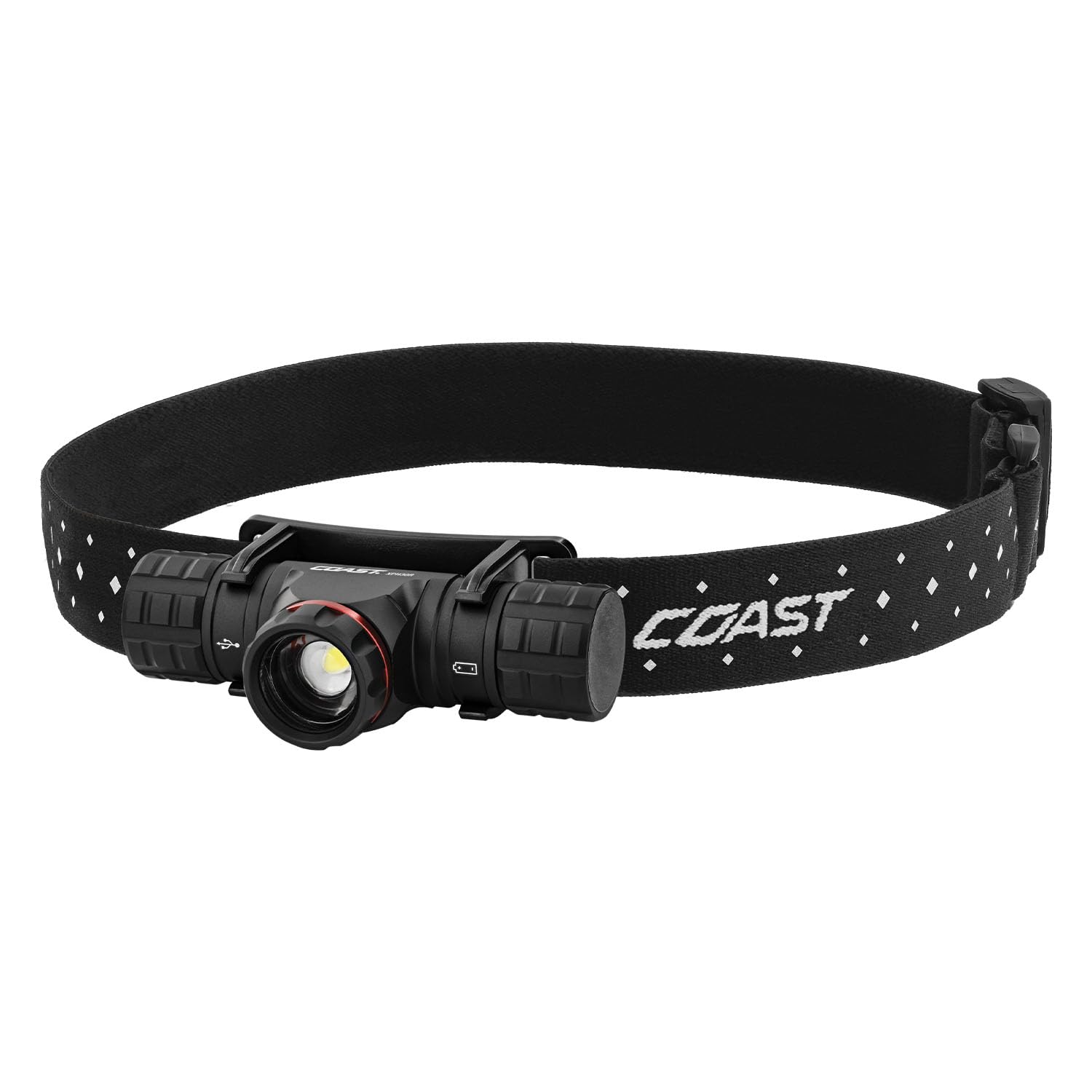
Coast XPH30R
Key Features
- Runtime: 6.75 hours on high
- Charging: USB-C
- Turbo output: 1200 lumens
- Water resistance: IP54
- Price: Premium
Twist the bezel and the Coast goes from a wide pool of light to a tight spot that reaches the far end of a field. Nothing else in this guide focuses mechanically, and for anyone running the same trail in the dark week after week, narrowing the beam to the line ahead is worth more than another hundred lumens.
The output figures are honest about the cost. Turbo is 1200 lumens, high is 500, and you get about 6.75 hours at that high setting before you are reaching for the cable, or 28 hours on low. The body is aluminum, it lifts off the bracket, and a magnet in the base lets it stick to a car hood or a steel post — a second life that matters when the run is part of a longer day out. USB-C charging and a lifetime warranty round it out.
On your head it is the heaviest light here that still counts as a running lamp, and the weight sits forward of the band, so on a long descent you feel it working against you. Keep the band snug and it is manageable. Treat it as a do-everything light that also runs, rather than a dedicated running light, and the price makes more sense.
Pros
- Twist focus goes wide to spot
- Aluminum body, lifetime warranty
- Detaches as a magnetic work light
- USB-C charging
Cons
- IP54 is splash resistance, not rain-proof
Worth the money if you want one metal, focusable light for running and everything else — just know you are carrying more weight on your forehead.
Best for Backup Pair
GearLight S500 2-Pack
Key Features
- Power: 3 AAA batteries (not included)
- Weight: 3 oz with batteries
- Runtime: 10 hours
- Max output: 200 lumens
- Price: Budget
Two working headlamps in one box is the entire reason this pair earns a place. At 200 lumens each they are walking lights rather than running lights — enough for a familiar path, a tent, a fuse box, or letting the dog out — and at about three ounces with cells fitted they are light enough to keep in a pack without noticing.
The beam is one wide cone with a 45-degree tilt, so there is no spot to punch down a dark trail; on an unlit road you see the next few strides and not much past them. The band is comfortable and washable, and the AAA cells are available anywhere, which is the point of a light like this: it is the one you do not mind losing. Ours live in a glovebox and a daypack, and both have been the right tool in both places.
Pros
- Two lamps for the price of one
- Runs on AAA cells from anywhere
- About 3 oz with batteries fitted
Cons
- Plastic band adjuster is the first thing to break
A pair of honest 200-lumen lamps for the car, the pack and the drawer — buy it for backup, not for the trail.
Best for Detachable Use
SLONIK Rechargeable Headlamp

Key Features
- Body: Aluminum alloy
- Weight: 4 oz
- Runtime: 4 hours
- Max output: 1000 lumens
- Price: Premium
Four hours is the listed runtime, the shortest of any light here, and it shapes how you own the SLONIK: on the charger after every run, the way your watch goes on the charger. What you get in exchange is 1000 lumens from an aluminum body that feels like a torch rather than a toy — and a light that slides off the band to become exactly that.
The detachable body is the reason to pick it. Off the band it is a pocket flashlight for the tent, the car, the fuse box; on the band it swivels through 90 degrees and stays where you aim it. One large button is easy to find with a cold hand or a glove, and six brightness steps let you trade output for time.
A wide elastic band with hooks for a helmet keeps the light close to your forehead rather than out on a stalk, which is why four ounces here bothers you less than it should. It is the light we hand someone who wants one torch for the tent, the car and the trail — and who will actually plug it in.
Pros
- Body detaches into a pocket torch
- Aluminum rather than plastic
- One big button works with gloves
- 90 degrees of tilt
Cons
- Plastic mounting bracket is the weak link
Pick it when you want one light that detaches into a pocket torch; the aluminum body and aimable head earn the compromise on runtime.
Best for Work and Camp
Blukar 3-Light Headlamp

Key Features
- Beam: Zoom and 90° tilt
- Weight: 9.74 oz
- Runtime: 18 hours
- Water resistance: IPX6
- Price: Midrange
Set this on a bench and it is one of the most useful lights in the guide; put it on your head and run, and you will want it off again. At 276 grams it sits heavy above your eyebrows and moves when you move. Running is simply not the job it was built for, whatever the listing says.
Three emitters — a spot, a wide side light and both together — plus a zoom ring and 90 degrees of tilt mean you can put light exactly where you are working and then widen it to see the whole job. IPX6 is the best water resistance here by a margin, and this is the light that stays out in the rain while you finish.
USB-C charging and an 18-hour runtime mean the cable can stay in the car between trips — this is not a lamp you top up every morning. The headband is fabric and adjustable, and the whole thing feels like a work light with a strap rather than the other way round.
So it earns its place for the hours around the run: packing the car at a dark trailhead, fixing a brake, cooking in the wind, hunting for the tent zip. If your night out is a five-mile loop and nothing else, take one of the light lamps instead. If it is a whole evening outdoors with a run somewhere in the middle, this is the one that stays on your head longest.
Pros
- IPX6 sealing beats everything here
- 18-hour runtime between charges
- Zoom and 90-degree tilt aim the beam
Cons
- Five hours to recharge from empty
Not a running light — a tough, IPX6 work light that happens to have a headband, and the best thing here for camp chores and repairs.
Best for Family Camping
EverBrite 5-Pack Headlamp

Key Features
- Runtime: 4 hours on high
- Batteries: 15 AAA included
- Pack size: 5 headlamps
- Max output: 300 lumens
- Price: Midrange
Five lamps, fifteen AAA cells and five colors — this is the pack you buy the week before a family camping trip. Each lamp weighs about two ounces, runs 300 lumens on high, and adjusts down small enough for a child’s head, which is the whole point: everyone gets their own and nobody argues about whose turn it is.
The modes are more thoughtful than the money suggests. Red and green are there for night vision and for finding a kid in the dark without blinding the rest of the camp, and a memory function brings back the last mode instead of making you cycle through five settings every time. The beam is a wide 65-degree cone — good in a tent, adequate on a known path, thin on anything technical.
As a running light it is a spare rather than a first choice, and the band is happier at walking pace than at pace. As a family kit it is the best value here by a distance — five usable lamps with cells in the box and a two-year warranty — and the one you will be glad of when the power goes out.
Pros
- Five lamps and 15 AAA cells included
- Red and green modes for night vision
- Adjusts down to a child’s head
- Memory returns to your last mode
Cons
- Four hours on high from AAA cells
The family pack: five usable lamps, batteries included, for less than one good running light costs on its own.
How We Tested Running Headlamps
I started by reading specs and customer reviews for dozens of headlamps, then narrowed the field to 14 based on beam pattern, claimed runtime, weight, strap design, power source, and price. The goal was a mix of budget picks and more polished options, not a parade of the brightest claims. We spent four months running with each light on pre-dawn road loops, after-work trail runs, and one wet, muddy weekend that tested every seal and button.
On the run, I noted whether the beam lit the trail ahead without blinding me in fog or washing out roots, and whether the light bounced when I picked up the pace. Three testers with different head sizes and hairstyles—including a ponytail—adjusted each strap while moving, over a cap and on bare heads. I weighed each lamp after charging and wore it for a 45-minute run to judge pressure points and bulk; then I tried to stuff it into a jacket pocket to see how it carried when not on my head.
For battery life and reliability, I started each light on its highest setting and checked output every 30 minutes until it stepped down or died, then repeated the test on a lower setting. Durability got the unglamorous treatment: sweaty runs, rain, a rinse in the sink, and a week loose in a gear bag, followed by a check for fogged lenses, stiff buttons, and stretched straps. Value came down to whether the light still felt solid and simple to use after all that—not just whether it was cheap.
How to Choose a Running Headlamp
The lamp that ruins a night run is rarely the dim one — it is the one that bounces, slides or dies, so weight, fit and honest power matter more than the lumen number on the box.
Weight and stability come first
Once a lamp passes about four ounces, you feel it on every descent, and the band has to work harder to keep it still. Under three ounces, a single elastic band usually holds fine; above that, look for a second strap over the top of the head or a battery pack sitting at the back.
The trap is the weight figure itself. Some listings quote the lamp alone, some quote it with cells fitted, so compare like with like before deciding one light is meaningfully lighter than another — and if you run in a smooth synthetic cap, the lighter lamp is the one that stays put.
Built-in battery or AAA cells
A rechargeable lamp means a cable, a routine and no shopping. AAA cells mean a stock in a drawer and no planning. We lean rechargeable for anyone running three times a week: the cost of cells adds up, and a lamp that lives on the charger is always full when you leave.
Choose cells for the light that lives in a car or a pack and might sit for a month. A lithium battery left unused and uncharged is a worse bet than a fresh set of AAAs, which is why the battery-powered pick here is the one that never needs remembering.
Beam pattern: spot, flood or focus
A spot throws a narrow line down the trail so you can read the ground at speed; a flood lights the width of a path and everything around your feet. Most running wants both, with the spot doing the work and enough spill to keep your peripheral vision useful.
A pure flood feels impressive in a garden and useless at pace, which is the mistake to avoid. If you run technical ground regularly, a focusable bezel like the Coast’s is worth the weight it costs, because it lets one light be both wide and far-reaching.
Weather sealing, read as digits
IPX4, which most lights here carry, means rain and splashes from any direction. IPX6 means jets strong enough to hose off mud. A listing that says waterproof without a rating almost always means the first.
For road and trail running, IPX4 is enough. What matters as much is the little rubber flap over the charging port, because that is how water actually gets into a headlamp — check that it seats flush before every wet run.
Controls you can work with cold hands
One large button beats three small ones when your fingers are numb, and a light that remembers your last setting saves a cycle every time you switch it on. Watch the sequence as well as the count: seven modes in a single loop can put a strobe between you and the setting you want.
Switch the lamp on and off a few times with gloves on before you commit, and turn it on in a dark room rather than a bright one. The best controls disappear entirely, which is what you want at the bottom of a climb.
Frequently Asked Questions
How many lumens do I need to run at night?
For lit streets and easy paths, 200 to 300 lumens is plenty. Unlit singletrack is more comfortable around 400 to 600, and a technical descent at pace wants more than that. Past roughly 600 lumens you are buying weight and battery drain faster than visibility, which is why a well-shaped 360-lumen beam often beats a vague four-figure claim.
Do I need a red light on a running headlamp?
Not for the run itself — red costs you detail and depth, and you want white light on the move. Red earns its place at camp, in a tent or a shared bunkroom, where it preserves everyone’s night vision and does not wake the person beside you. Treat it as a bonus for the hours around the run rather than a reason to pick one lamp over another.
Can I wear a headlamp over a cap or a beanie?
Yes, and in winter you should. Loosen the band, sit the lamp over the hat and tighten until it is snug; a smooth synthetic cap gives less grip than hair, so a light under three ounces stays put where a heavier one slides. Give your head a hard shake before you set off — if the beam moves, the band is too loose.
Alkaline, lithium or rechargeable AAAs for winter running?
Lithium AAAs hold their voltage in the cold and last longest, which makes them the simple answer below freezing. Alkalines fade quickly in low temperatures and can leak if a lamp sits unused for months. Rechargeable NiMH cells work fine, but their lower voltage can take the edge off the brightest mode, so keep a lithium set as the cold-weather spare.
Final Verdict
Buy the Lepro two-pack. At 2.65 ounces it answers the question that actually matters on a night run — will this stay where I put it — and it answers it with a spot for the trail, a flood for the road and a USB-C cable you already own. The second lamp goes in the car, and the whole decision stops costing you attention.
If a charging routine is a fiction in your house, the Energizer PRO-360 is the alternative: three AAA cells, 360 lumens, no cable to lose. And if you want one metal light to run with and work under, the Coast XPH30R earns its premium — just expect to feel it on your forehead.