This post contains affiliate links. We may earn a small commission when you buy through our links — at no extra cost to you.
The worst place to find out your headlamp is dim, fiddly, or dead is a mile from the trailhead at dusk. A good one disappears on your forehead and throws a clean pool of light whether you’re setting up camp or walking the dog before work. It also has to survive pack life, rain, and cold-handed adjustments. Over six months, my team and I wore 14 hiking headlamps on after-dark trails, around campsites, and through a couple of power outages.
The headlamps that earned a place in my pack weren’t the brightest on paper; they were comfortable, stable, and easy to adjust with gloves. Battery life mattered more than a long mode list, and a little extra bulk was fine when the build felt solid and the switches stayed reliable. Value came down to usable light and dependable performance, not marketing numbers. The picks below are the ones I’d trust after dark.



Best for Trail Hiking
Foxelli USB-C Headlamp
Key Features
- Weight: 2.4 oz
- Runtime: 40 hours
- Max brightness: 180 lumens
- Water resistance: IPX5
- Price: Budget
Lift the Foxelli off the table and there’s less to it than almost anything else here: 2.4 ounces, most of that headband. That lightness is why it became the light we reach for on an ordinary evening hike. A headlamp you forget you’re wearing gets carried; a heavy one stays in the drawer, and this one sits steady without cranking the strap tight enough to leave a mark.
The beam suits walking rather than searching. Foxelli rates it at 180 lumens, and the light spreads wide instead of punching a hotspot, so at a normal pace you see the trail edge and the roots under your feet rather than a bright circle ringed with darkness. The head tilts 45 degrees, enough to aim it down a slope or up at a blaze without moving your neck.
Power arrives over USB-C, which we topped up from a power bank inside a tent, and the quoted 40 hours belongs to the low setting — a week of evenings rather than one long night on high. There’s a red mode for camp and an SOS strobe for emergencies, and the IPX5 body took the rain we wore it through. Five modes on one button is the whole interface, which is the right amount for a light you operate in the dark.
Fast, unmarked descents are the one place it runs out of ideas, because a wide low beam shows you the path and not the line down a rock face. For the walk back to the trailhead, the pre-dawn start, and the camp tidy-up, this is the one that earns its space in the pack.
Pros
- Light enough to forget at 2.4 ounces
- Up to 40 hours on the low setting
- USB-C charging from a power bank
- Red light and SOS strobe built in
Cons
- High mode shortens the 40-hour claim sharply
- Rain-grade IPX5, not submersible
We hand most hikers the Foxelli: 2.4 ounces you forget about, USB-C charging, a wide beam for walked trails, and a red mode for camp.
Best for Rough Night Routes
Coast XPH30R
Key Features
- Weight: 4.37 oz
- Max brightness: 1200 lumens (turbo)
- Runtime on high: 6.75 hours
- Water resistance: IP54
- Price: Premium
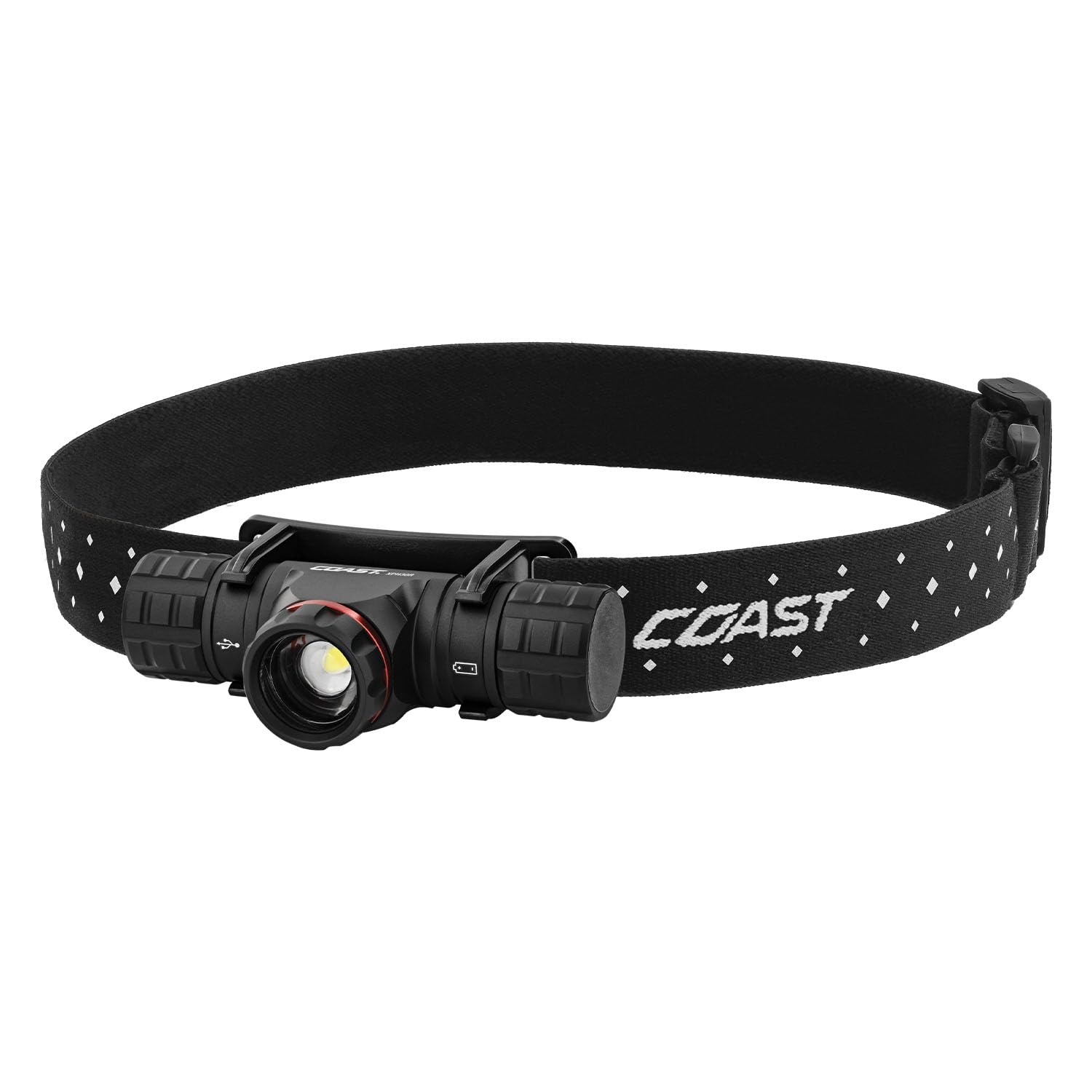
The Coast is the priciest light in this group and the only one that lets you shape the beam while it’s on your head. Twist the bezel and the optic slides from a tight spot that throws 165 meters to a wide flood with no hotspot in the middle. Most headlamps here give you one fixed pattern and a tilt; this one gives you a lens.
What we appreciated most is the body. It pops off the bracket and the magnetic base holds it to a truck hood, a stove, or a tent frame while you work with both hands, and the aluminum housing feels like a tool rather than an accessory. Coast backs it with a lifetime warranty. On unmarked ground nothing else here throws a beam you can tighten onto a cairn 150 meters out and then open up for the walk between them.
The trade lands on your forehead. At a bit over four ounces with the mass sitting forward, it bobs when you break into a jog and leaves a pressure point on a long climb, so it’s a light for walking with poles and stopping to look rather than for running. Sustained output is 500 lumens on high for 6.75 hours; turbo is the burst you use to find the next marker, not the setting you walk with.
If your nights finish on steep, cairned ground where you need to see what’s coming before you commit, the extra outlay buys the best beam control in this article. If your hiking is an hour on a rail trail, the Foxelli does the same job with half the weight.
Pros
- Twist focus from spot to flood
- Detachable magnetic body for camp work
- Aluminum housing and lifetime warranty
- 165-meter beam reach
Cons
- IP54 splash rating only
- Turbo is a burst, not a walking mode
For steep, unmarked ground we take the Coast: twist-focus from spot to flood, a metal body, and a lifetime warranty, traded against weight.
Best for Long Nights Out
Energizer PRO-360
Key Features
- Weight: 3.52 oz
- Runtime: 50 hours
- Max brightness: 360 lumens
- Water resistance: IPX4
- Price: Budget
The last hour of a long day is where a headlamp earns its keep, and the PRO-360 is built for that hour. At 360 lumens it’s the brightest light in this article that runs on ordinary batteries, and the tight spot reaches roughly 85 meters — enough to pick up blazes and cairns well before they’re on top of you.
The modes go further than most hikers need: high and low spot, high and low wide, green, and red or flashing. VisionGuard ramps the output up gradually instead of snapping on at full brightness, which we were glad of at a campsite where everyone else had already turned in. Three AAA cells run it, so a spare set in a hip pocket is a full recharge with no cable and no outlet.
What we kept coming back to is how little thought it asks for. One button, a genuine low mode for reading a map or sorting a pack, and no charging ritual to plan a trip around. Cold hands can change the cells in under a minute, which on a February night matters more than any battery indicator, and the band comes off the bracket so the light clips to a hat brim or a belt when your head is already covered.
Pros
- 360 lumens on three AAA cells
- Up to 50 hours on low
- Gentle VisionGuard ramp-up
- Red and green night modes
Cons
- High mode drains AAA cells fast
- No rechargeable battery option
Our pick for anyone who prefers spare batteries to a charging cable: 360 lumens, a real low mode, and three AAA cells to run it.
Best for Two-Person Trips
Energizer PRO-260 2-Pack
Key Features
- Runtime: 35 hours
- Batteries: 6 AAA included
- Max brightness: 260 lumens
- Water resistance: IPX4
- Price: Midrange
Two headlamps and the six AAA cells to run them — that’s what comes out of the box, and it’s why this is the pair we hand to a couple or a family heading out for a weekend. Each light is the same 260-lumen unit, IPX4 rated, with dimming that slides from 10 percent to full instead of stepping through three fixed levels.
The dimmer is the part we used most. Hold the control and the output walks up or down, so you can drop to something that won’t blind the person ahead of you on a fire road and push it back up for the rough section. The 80-meter beam is modest, the red mode covers camp, and the switch is simple enough to talk a first-timer through in the dark.
Cells are the running cost. There’s no charging circuit here, so a two-light household wants a stock of AAAs on the shelf, and the quoted 35 hours is a low-setting promise rather than a full evening on high. What you get for that is a light you can leave in a pack for a season and still trust. The band is soft and wide, and neither unit sags when you tip your head down to check your footing.
Pros
- Two lights plus six AAA batteries
- Stepless 10 to 100 percent dimming
- Red night-vision mode
- Soft, wide, stable headband
Cons
- Alkaline only — no rechargeable option
For two people hiking together, we like this pair: two 260-lumen lights, batteries in the box, and a dimmer that goes from tent-friendly to trail-bright.
Best for Camp and Backup
Lepro Rechargeable 2-Pack
Key Features
- Weight: 2.85 oz
- Runtime: 30 hours
- Max brightness: 150 lumens
- Water resistance: IPX4
- Price: Budget
A 150-lumen beam is where this pair starts, and it’s worth being straight about what that covers: a groomed trail, a campsite, the walk to the water after dinner, all handled comfortably. Point it at a rock garden you have to pick through and the beam runs out of reach in a hurry.
As a budget pair we think it’s easy to defend. The 2.85-ounce body sits low and doesn’t flop, the band is wide and elastic, and the two-light format means one charges on USB while the other goes out with you — the real advantage of buying rechargeable in pairs rather than singly. USB charging also means no drawer full of half-used cells.
Charge holding is where this pair varies most. The 30-hour figure is an intermittent-use number; a full night on high will empty them, and a unit that stops taking a charge is the fault to watch for. Bought as camp and close-range lights rather than expedition ones, they’re good value, and ours have stayed in the kit for exactly that.
Pros
- A pair of rechargeables at a budget price
- 2.85 ounces each and stable to wear
- 30-hour runtime on low
- One charges while the other is out
Cons
- Sealed battery can’t be replaced
- Red mode is too dim for walking
For camp and close-range work, this pair is our budget answer: two rechargeable 150-lumen lights at 2.85 ounces each.
Best for Car and Emergency
GearLight S500 2-Pack
Key Features
- Weight: 3 oz
- Runtime: 10 hours
- Batteries: 3 AAA (not included)
- Max brightness: 200 lumens
- Price: Budget
Every car, pack, and kitchen drawer in the house could hold one of these, and that’s the pitch: two 200-lumen headlamps with a red mode, a 45-degree tilt, and a washable band, running on three AAA cells you supply yourself.
Seven modes is more than anyone needs — white high and low, red, strobe, and combinations — and clicking through them with cold hands takes a few presses. The hardware around the light is better than the outlay suggests: the tilt holds its angle under a hat brim, the band adjusts down to a child’s head, and at 3 ounces the lamp sits where you put it.
We treat this pair as the lights that live in the car and the emergency bin rather than the one on your head for a planned night hike. Two hundred lumens and a 10-hour runtime will get you off a trail you started too late on, but the beam doesn’t carry the way the lights above it do at range. As insurance — one in the glovebox, one in the daypack — they’re the easiest purchase here to justify, and losing one to a muddy trip won’t ruin the season.
Pros
- Two working lights for a backup kit
- Red mode and 45-degree tilt
- Washable band fits kids and adults
- Runs on easy-to-find AAA cells
Cons
- Batteries not included
- Headband hardware is the wear point
We buy these as insurance, not as a primary: two 200-lumen lights with a red mode, no charging to remember, and batteries you supply.
Best for Camp and Workshop
Blukar K9116

Key Features
- Weight: 9.74 oz
- Runtime: 18 hours
- Light sources: 3 LEDs
- Water resistance: IPX6
- Price: Midrange
The Blukar has the biggest head of anything here: three emitters in a block that sits proud of your forehead on a wide strap, with the balance point out in front of you rather than snug against your skull. Standing at a workbench that’s fine. On a climb you’re aware of it in a way you never are with the two-ounce picks.
What the size buys is range and toughness. Two white emitters and a red one give you a spot, a flood, and both together; the head tilts through 90 degrees, and the zoom ring narrows the wash down to something you can throw across a parking lot. The IPX6 rating is the most water-resistant in this article, the runtime is quoted at 18 hours, and charging runs over USB.
Eight thousand lumens is the headline number, which is many times anything else here and not a figure we repeat to friends. Whatever the true output, the practical result is a broad, bright wash that lights a trailhead, a truck bed, or an unlit shed better than anything else in the group — and it’s why we keep it by the door rather than in the pack.
So this is the one for the trips where the headlamp isn’t the only thing you’re carrying: base camp, the truck, night repairs, a shed with no wiring. For a hike where the light rides on your head for four hours, one of the two-ounce picks is better company.
Pros
- Three emitters in spot, flood, or both
- IPX6 — the best water resistance here
- 18-hour quoted runtime
- 90-degree tilt and zoom
Cons
- 276 grams is heavy for a hiking headlamp
The Blukar earns its place at base camp and in the workshop: three emitters, IPX6, and more light than anything else here, at a weight you’ll feel.
Best for Camp Chores
BIAT 230° Wide Beam 2-Pack

Key Features
- Charging: USB rechargeable
- Beam angle: 230 degrees
- Max brightness: 350 lumens
- Water resistance: IPX4
- Price: Midrange
The BIAT doesn’t light a trail so much as light everything in front of you: a 230-degree bar of LEDs across the brow that puts illumination on your hands, your feet, and the tent wall at the same time. On a path it’s oddly diffuse — you see the width of the world and not much depth down it.
The motion sensor is the feature we were surprised by. Wave a hand in front of the lamp and it switches without a press, which is the difference between a clean hand and a muddy one when you’re doing something at camp after dark. Six modes, a silicone body that packs flat, and a rechargeable battery finish the package, and two come in the box.
Two things pull it back. There’s no red or night-vision setting anywhere in the cycle, so every camp use throws white light across the site and through the wall of the tent next to you. Charge holding is the other soft spot: the battery is small enough that a night on high is a stretch, and a unit that stops taking a charge is the fault to watch for.
Around camp we keep reaching for it — cooking, sorting a pack, finding a guy line — because the wide wash does more there than a spot ever could. For the walking part of a night hike, a shaped beam from the Foxelli or the Coast is the better tool.
Pros
- 230-degree bar lights hands and feet
- Motion sensor for muddy hands
- Lightweight silicone body packs flat
- Two lights in the box
Cons
- No red or night-vision setting
The BIAT is the camp light of this group: a 230-degree wash that lights your hands and feet, with no red mode and a small battery.
How We Tested Hiking Headlamps
We started by gathering headlamps and reading through specs for weight, battery type, claimed runtime, weather resistance, and price. From that pool, we narrowed to 14 models across hiking uses, then bought them at retail so no brand had a say in the results. For six months, we wore them on evening hikes, pre-dawn dog walks, campsite dinners, tent repairs, and a few household blackouts. On the trail, we switched between low and high modes to see how far the beam actually reached, whether the hotspot washed out the edges, and how easy it was to tilt the light down to the path without blinding a hiking partner.
Battery life got its own routine: we timed each lamp on its highest usable setting, noted how quickly it stepped down, and checked whether the charge held after a week in a pack. We also charged each one from empty and logged how long it took. For durability, we dropped them onto rocks from waist height, stuffed them into crowded packs, and ran them through a wet, cold morning to see if the seals held or the switches got finicky. Adjustability was judged with gloves on: could we loosen the strap, tilt the beam, and find the power button without taking the lamp off?
Bulk and comfort showed up after the first hour. We noted pressure points against a hat or hood, whether the battery pack bounced, and how much room each lamp took up in a hip-belt pocket. Reliability mattered more than any single spec: we watched for flickering, accidental mode changes, and loose battery doors. When we compared value, we asked whether the price bought usable light, a trustworthy battery, and controls that worked in the dark, not just a long list of modes we’d never use.
How to Choose a Hiking Headlamp
The right hiking headlamp is the one whose beam, runtime, and weight match the nights you actually walk — brightness is only the first question, and rarely the deciding one.
Brightness is a beam question
Lumens tell you how much light leaves the lamp, not where it lands. A 180-lumen beam spread wide shows you the trail edge and the roots at your feet; a 1200-lumen spot picks out a marker 150 meters away and leaves your toes in the dark. For marked trails after dark we think roughly 150 to 300 lumens in a wide pattern is plenty.
If you route-find, cross scree, or finish descents in the dark, pay for focus or for more output — the Coast’s twist ring and the Energizer PRO-360’s spot are there for exactly that. Watch the trap: a turbo figure is usually a burst, not a setting you can walk with for an hour.
Runtime is a mode, not a number
Every runtime printed on a box belongs to a particular setting, and it is nearly always the dimmest one. A light quoting 40 or 50 hours is telling you it will run for a week of short evenings on low; run it on high and you’ll be swapping cells or hunting for a cable.
Decide which kind of hiker you are. If the lamp lives in a pack for months between trips, AAA cells and a spare set in the lid pocket are the more dependable arrangement. If you hike often and resent buying batteries, USB-C charging from a power bank is simpler.
Weight, balance, and the strap
The difference between 2 ounces and 9 is the difference between a light you forget and one you’re aware of on every climb. For three-season hiking we look for something under about 4 ounces, with the battery sitting close to the head rather than out in front.
Strap width matters as much as weight: a wide elastic band spreads the load and stops the lamp sliding when you tip your head down to check footing. If you wear a cap or a beanie on cold mornings, try the band over it before you commit.
What the water ratings actually cover
IPX4 means rain and splashes from any direction, IPX5 adds jets of water, and IPX6 handles more forceful spray; IP54 pairs dust protection with splash resistance. None of them means submersible, and none covers a USB port cover left flapping open.
For three-season hiking, IPX4 is enough for a wet evening, and the port seal is the part to check first. Anything described only as water resistant, with no IP number, is a fair-weather light.
Controls and the red light
You will operate this light in the dark, probably in gloves, possibly in the rain. One button cycling through modes is fine on a light with three settings and irritating on one with eight — count the presses to reach red before you buy, and try it with a glove on.
Motion sensors are handy when your hands are full or filthy. And if you share a campsite, a red or low-white mode is worth more than another 200 lumens, because it lets you sort a pack without waking the tent next door.
Frequently Asked Questions
Do I need a headlamp if my phone has a flashlight?
A phone light costs you a hand and drains the battery you may need for navigation, and it points wherever the phone points rather than where you’re looking. Carry a headlamp on any hike that could finish after dark, including a short day hike — the Foxelli and the GearLight pair both weigh around three ounces or less.
Do headlamps work in cold weather?
Alkaline AAA cells lose voltage as they chill, and rechargeable packs do the same, so a light that ran all evening in September can fade early on a frosty night. Keep spare cells in an inside pocket where your body warms them, never mix old and new batteries in one lamp, and start a winter trip on a full charge.
Can I wear a headlamp over a hat or a helmet?
Yes for hats — the elastic bands here adjust far enough to sit over a beanie, though try it before you leave, because a band that’s snug on bare hair can be tight over wool. Over a helmet, run the band above the brim and check the lamp doesn’t rock when you look up. The Coast’s body detaches from its bracket and has a magnetic base, which makes it the easiest of these to move off your head and onto something metal.
Final Verdict
If you want one answer, it’s the Foxelli. Two and a half ounces on your head, a wide beam that suits a walked trail, USB-C charging, and a red mode for camp add up to the light we put on our own heads for an ordinary evening hike, and it has never been the reason a trip went wrong.
The pick changes for two buyers. On steep, unmarked ground where you need to see the next cairn before you commit, the Coast’s twist focus and metal body are worth the weight and the outlay. For a pack that lives in a car or a cabin for months at a time, the Energizer PRO-360 and a spare set of AAA cells make more sense than any charging cable.