This post contains affiliate links. We may earn a small commission when you buy through our links — at no extra cost to you.
A headlamp has one job—keep your hands free—but the trade-offs start as soon as the sun drops. A beam bright enough to pick out a trail marker can drain a battery in a couple of hours, and the lightest models sometimes feel like they’ll crack if you cram them into a pack. The right one disappears on your head until you need it, then throws a steady pool of light where you’re looking. Over six months, I’ve worn 12 headlamps on predawn dog walks, camp dinners, attic trips, and a rainy car repair.
The surprise was how often a higher lumen count lost to a better beam pattern and steadier output; a light that dims after ten minutes is worse than a dimmer one that holds. I learned to check port covers and strap hardware before trusting a headlamp in rain—reliability is boring until it isn’t. Rechargeable models won me over, but only when the battery lasted an evening and the light didn’t feel bulky under a hood. Picks below run from featherweight backups to bright workhorses.



Best for All-Round Hiking
Lepro Rechargeable Headlamp 2-Pack
Key Features
- Weight: 2.65 oz
- Runtime: 15 hours
- Brightness: 2000 lumens
- Water resistance: IPX4
- Price: Budget
Lepro puts two headlamps in the box, and each one weighs less than three ounces. That pairing is the whole argument: one lives on the charger while the other rides in your pack, so you never start a night walk with a dead lamp. Each is rated at 2,000 lumens with a 500-foot reach — plenty to pick out a trail edge, light a tent, or find a valve in a dark basement.
The beam options are what make these worth more than their price. Spot and flood are separate modes rather than one beam trying to do both, so you can throw a narrow light down the trail or widen it over a camp stove. There’s a red mode for inside a tent, and the 45-degree tilt covers map-reading at waist height. Six modes is more than anyone needs, but the sequence is short enough to learn by feel.
The 15-hour runtime figure is a low-setting number; run them on high and you’ll be reaching for the cable most evenings, which is exactly why having two in the box is handy. The single button is easy to find with gloves on, and the band stretches over a winter hat without a fight.
Pros
- Two lamps, so a spare is always charged
- 2.65 oz each — easy to forget on your head
- Separate spot and flood beams plus red
- USB-C charging with the cable included
Cons
- IPX4 only — rain-proof, not for dunks
Two bright, light rechargeable lamps in one box: our pick for anyone who hikes, camps, or works after dark and wants a spare already charged.
Best for Rough Work
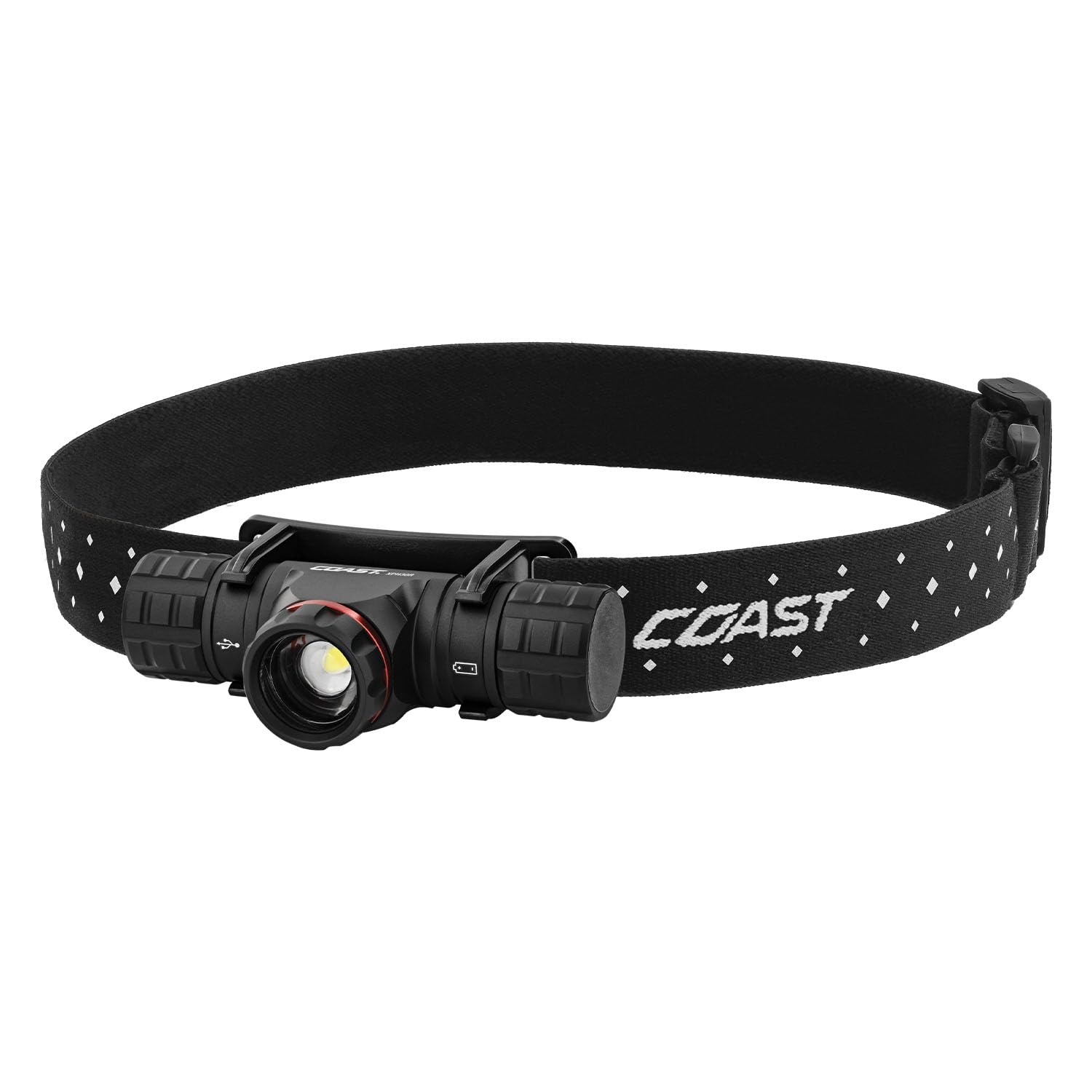
Coast XPH30R
Key Features
- Weight: 4.37 oz
- Runtime: 28 hours (low)
- Max output: 1200 lumens
- Water resistance: IP54
- Price: Premium
Coast charges a premium here, and you can feel where it went the moment you pick this up: an aluminum body with a brushed finish, a twist ring that focuses the beam from a wide flood to a tight spot, and none of the hollow rattle the plastic lights have.
The body pops off its bracket and has a magnet on the side, so it becomes a small work light you can park on a fuse box or a steel shelf while both hands are busy. On your head it runs 1,200 lumens on turbo, 500 on high, 160 on medium and 46 on low. Turbo is for spotting something across a lot, not for the whole walk.
Charging is USB-C, the body is IP54 and rated for a one-meter drop, and Coast covers it with a lifetime warranty against defects — the only light here that does. The focused beam has a clean edge with no hot spot in the middle, which matters when you’re reading a wiring diagram rather than a trail.
The trade is weight. At 4.37 ounces the light sits well forward on the band, and after a couple of hours you feel it — this is not a running lamp, and it’s the reason the Coast isn’t our top pick. For a toolbox, a pack, a truck, or a hard hat, the metal, the magnet and the warranty are worth the extra ounces.
Pros
- Twist focus from flood to tight spot
- Body detaches and sticks to steel
- Aluminum shell with a lifetime warranty
- USB-C charging and 28 hours on low
Cons
- The most expensive light in this group
The headlamp to buy if it has to survive a job site: a metal body, a focusable beam, and a light that detaches to work on its own.
Best for Trail Running
Foxelli MX200B 2-Pack
Key Features
- Weight: 2.4 oz
- Runtime: 40 hours
- Brightness: 180 lumens
- Water resistance: IPX5
- Price: Midrange
At 2.4 ounces this is the lightest headlamp here, and on a run that matters more than output does. The stretch band sits flat against your head, the housing is small enough to disappear in a jacket pocket, and the whole thing stays where you put it — this is the one we take out the door for a run, not the brightest lamp in the group.
You give up reach for that. 180 lumens and a 300-foot beam is plenty on a road, a towpath, or a groomed trail, and not enough for route-finding through brush. What you get back is runtime — Foxelli rates 40 hours — plus a red mode, an SOS strobe, USB-C charging and IPX5. The 45-degree tilt covers the ground in front of your feet.
It ships as a two-pack, which is the practical bit most people miss: keep one in the running vest and one in the car, and you’re never hunting for the one you left on the charger. The mode sequence is short enough to cycle by feel in the dark.
Pros
- 2.4 oz — the lightest lamp here
- 40-hour rated runtime
- Two lamps in the pack
- USB-C charging and IPX5
Cons
- 180 lumens is modest off-trail
Our running pick: 2.4 ounces that stay put, with a 40-hour rating that covers a week of early miles between charges.
Best for Emergency Kits
Energizer Vision HD+ PRO 2-Pack
Key Features
- Runtime: 35 hours
- Batteries: 3 AAA per light
- Pack size: 2 headlamps
- Brightness: 260 lumens
- Price: Budget
There’s no cable in the box and nothing to remember: this Energizer pair runs on three AAA batteries per light, and the batteries come installed. That alone makes it the pick for a glovebox, a storm kit, or a cabin where the power goes out twice a year.
What we appreciate most is the dimming. Output dials from 10% to 100% rather than stepping between fixed levels, so you can drop the beam to something gentle enough to read a book in a tent without lighting up the whole campsite. At 260 lumens on full it’s bright enough to walk a dog or find the fuse box, and Energizer rates 35 hours of runtime.
Three modes — high, spot, wide — keep the switch simple, the headband is soft enough to wear over a beanie, and the IPX4 body handles rain. The cost is ongoing: alkalines are money, they fade fast on high, and they run out at the worst possible moment. If you’ll use it weekly, rechargeable AAAs pay for themselves.
Pros
- Batteries included, nothing to charge
- Stepless dimming from 10% to 100%
- Two lights for home and car
Cons
- Disposable AAAs are an ongoing cost
The pair to keep in the car and the kitchen drawer: batteries included, no charging ritual, and dimming that goes low enough to read by.
Best for Camp and Workshop
Blukar K9116
Key Features
- Weight: 9.74 oz
- Runtime: 18 hours
- Brightness: 8000 lumens
- Water resistance: IPX6
- Price: Budget
Blukar lists this at 8,000 lumens, several times anything else here, and the hardware backs up the intent if not the exact number: three LEDs in a 276-gram housing, an IPX6 rating, and a head that tilts 90 degrees.
That makes it a workshop light as much as a headlamp. Strap it on and you can flood an engine bay, a cellar, or a whole camp kitchen with white light. The five modes include a red setting and an all-LED combination, and USB-C charging means you aren’t buying batteries for it.
The catch is on your head. At 276 grams it’s roughly four times the Foxelli, and because the weight sits forward the band has to be cranked down to keep it from sliding when you look up. This is a light for a repair or a camp kitchen, not for covering miles — and for those jobs the beam and the water rating are worth the weight.
Pros
- Enormous, wide beam for sites and repairs
- IPX6 — the highest water rating here
- 90-degree tilt and five modes
Cons
- 276 g, front-loaded on the head
The floodlight of the group: a huge beam for a campsite or an engine bay, with the weight that a battery that size brings.
Best for Hard-Hat Wear
Slonik Rechargeable Headlamp

Key Features
- Weight: 4 oz
- Runtime: 4 hours
- Brightness: 1000 lumens
- Water resistance: IPX4
- Price: Premium
One large button on top, an aluminum cylinder, and a head that swivels 90 degrees: the Slonik is the easiest light here to run with work gloves on, and the body detaches from the band to become a handheld torch.
Slonik rates it at 1,000 lumens with six brightness levels and three modes including an SOS strobe. It charges over USB-C, the body is IPX4, and at 4 ounces it’s light enough to forget on a hard hat and solid enough to feel like a tool in the hand.
The mounting bracket is plastic, and it’s the piece under the most stress every time you tilt the head — worth knowing if the light will live on a ladder or a helmet and take knocks. Treated as a truck, toolbox, or hard-hat light, the metal body and the single big button make it an easy one to live with.
Pros
- One large button works with gloves
- Aluminum body with a detachable head
- Six brightness levels plus SOS
Cons
- Rated runtime of just 4 hours
A metal-bodied light with one big glove-friendly button; buy it for the truck or the hard hat, not for a week on the trail.
Best for Around the House
Lepro 150-Lumen 2-Pack

Key Features
- Weight: 2.85 oz
- Runtime: 30 hours
- Brightness: 150 lumens
- Water resistance: IPX4
- Price: Budget
150 lumens is dim next to everything else here — a fraction of the Lepro pair at the top of this list — and that’s fine for what these are. They’re drawer and glovebox lamps: the fuse box, the tent, the dog walk, the power cut. They are not lights for finding a trail marker in bad weather.
What the money buys is two lamps, 30 hours of rated runtime, three white levels and two red, USB charging, and a band that comes off for washing. The red mode is gentle enough to use inside a tent without waking anyone, and the tilt is enough to aim at your hands.
We hand these to people who need a headlamp a few times a year and don’t want to think about it: charge both, keep one by the door and one in the car, and they’ll be there when the power goes out. The plastic feels like the money, but so does getting a second lamp in the box.
Pros
- Two lamps in the pack
- 30-hour rated runtime
- Removable, washable headband
Cons
- Sealed battery can’t be replaced
The cheap pair for the kitchen drawer and the car: dim for the trail, but two lights with 30 hours each and nothing to think about.
How We Tested 12 Headlamps in Real Life
We started by pulling together a shortlist from brands we already trust for outdoor gear, then filtered it by battery type, claimed run time, weight, and whether the controls could be used with gloves. That left 12 headlamps, which we used over six months in the places headlamps actually earn their keep: predawn dog walks, camp dinners, attic and crawlspace trips, a couple of rainy car repairs, and one long power outage.
Brightness got judged by beam pattern, not just the number on the box. We pointed each light at a trail marker 50 feet out, then at a fuse box three feet away, and noted whether the hotspot was too tight, the spill too wide, or the beam flickered when we switched modes. For battery life, we started every light at full charge and ran it until output dropped enough to notice, timing the run and checking whether rechargeable models accepted a charge through a covered port.
Durability and reliability were tested with less ceremony: each light got dropped from waist height onto concrete, stuffed into a pack with keys, and worn in rain until we could see whether the housing, strap, and port cover shrugged it off. Weight and bulkiness mattered most under a hood or bike helmet, where we noted whether a lamp pressed into the forehead, slid sideways, or made us want to take it off after an hour. We also compared what came in the box and how simple the controls were, since value isn’t just brightness per dollar—it’s whether the light is easy to live with.
How to Choose a Headlamp
Most headlamp shopping comes down to three things — how much light you actually need after dark, what powers it, and how much weight you’ll tolerate on your forehead — and the price tags don’t sort any of that out for you.
Beam shape beats the lumen number
Lumen figures aren’t measured to one standard, and a listing can quote a peak that holds for a minute. What changes how a light feels on a trail is the beam. A tight spot throws far and picks out a marker a hundred feet ahead; a flood fills the ground around your feet and your hands. Lights that offer both cover more situations than one hot beam — the Lepro pair switches between separate spot and flood modes, and the Coast focuses between them with a twist ring.
For walking and camp chores, a well-shaped beam at a few hundred lumens does more than a huge number on the box. Save the big outputs for lighting a whole site or an engine bay, which is the job the Blukar’s flood is built for.
Rechargeable or AAA: pick the discipline you’ll keep
USB charging saves money and is why the rechargeable picks here cost little to run, but it depends on a routine: a cable in the car, a power bank on a long trip, and the habit of topping up after every use. Alkaline lights like the Energizer pair never need a cable and work from a drawer of AAAs, at the cost of buying those batteries and swapping them at inconvenient moments.
One more thing to weigh: in a sealed body, the light’s lifespan is the battery’s. If you want a lamp still working in a decade, a body that takes replaceable cells is the safer bet.
Weight decides whether you’ll actually wear it
A headlamp is worn, not carried, so ounces count for more than they do on a flashlight. Under three ounces — the Foxelli at 2.4 and the Lepro pair at 2.65 — you stop noticing it after a few minutes, which is exactly what you want for running or a long climb. From four ounces up the lamp starts to pull, and you tighten the band to compensate.
The heavier lights here earn their weight with metal bodies and bigger batteries. Match the ounces to the longest stretch you’ll wear it in one go, not to the spec sheet’s most impressive line.
Mounting, controls, and weather
Three details separate a light you keep using from one that annoys you. The mount: a detachable body with a magnet or a clip turns a headlamp into a work light, and a tilt range that reaches your hands saves a lot of crouching. The switch: one big button you can find with gloves beats five small ones you can’t. And the rating: IPX4 handles rain, IPX5 and IPX6 handle heavier spray, and none of these lamps is meant to be submerged.
A red mode is worth having for tent use and for keeping your night vision, but check that it’s genuinely dim. A red light bright enough to read a novel by defeats the point.
Frequently Asked Questions
How long do these headlamps actually run on high?
Shorter than the box suggests. Runtime figures usually describe a low or medium setting, and the honest listings say which: Coast publishes 6.75 hours on high against 28 hours on low for the same lamp. When a number appears with no mode attached, assume it’s the dimmest setting, and carry a cable or spare batteries for anything longer than an evening.
Can I wear a headlamp over a helmet or hard hat?
Usually, with the right strap. The lamp has to sit on the shell rather than your forehead, so look for a long adjustable band, a detachable body, or a bracket that clips on — the Coast’s body pops off its bracket and the Slonik’s does too. Try the fit before you depend on it: a band that just closes on a bare head won’t stretch over a helmet.
Do I need a headlamp if my phone has a flashlight?
For a one-off, no. For anything regular, yes. A phone occupies a hand you need, points wherever the phone points rather than where you look, and drains the battery you might want for a call. A 2.4-ounce lamp on your head solves all three and leaves the phone charged for what it’s actually good at.
What happens when a rechargeable headlamp stops holding a charge?
Check the warranty before you bin it. Coverage varies widely in this group: Lepro and Blukar offer a year, Foxelli adds a money-back window to its year, Slonik covers 180 days, and Coast backs its lamp for life. Outside the warranty, a sealed body means the light is finished — which is the argument for an AAA model if longevity is your priority.
Final Verdict
Our default is the Lepro two-pack. It’s bright enough for any trail, light enough to forget you’re wearing it, and the second lamp turns a dead battery into an inconvenience rather than the end of an evening.
Spend more only for something specific: the Coast for a light that lives in a toolbox, the Foxelli for running, the Energizer pair for a kit that never sees a charger.