This post contains affiliate links. We may earn a small commission when you buy through our links — at no extra cost to you.
A headlamp is the one piece of gear you bet your night on. I’ve been halfway up a switchback when my beam faded to a dull orange dot, and I’ve watched a friend’s strap slide down her forehead every third step. The right light keeps your hands free for the map, stove, and tent stakes, and it makes a dark camp navigable. We’ve spent eight months taking 14 headlamps on overnight trips, and the differences come down to more than lumens.
Brightness gets the attention, but one harsh hotspot can wash out roots and turn the trail beyond into a blur. I want a beam that shifts from floody camp light to a focused trail spot, a battery that survives a cold night, and a strap I can adjust with gloves on. Weight and bulk matter too—a light that slides down your forehead is one you’ll leave in the pack. The best value is the one that still works when the trip runs long; the picks ahead are the ones I’d trust when the sun beats me to camp.



Best for All-Round Backpacking
Lepro 320014-2
Key Features
- Weight: 2.65 oz
- Runtime: 15 hours
- Light output: 2000 lumens
- Water resistance: IPX4
- Price: Budget
At 2.65 ounces, the Lepro 320014-2 is the light we hand to anyone who asks what to pack for a backpacking trip, and the reason is that number. The lamp head is small enough to sit under a beanie, and the elastic band took up the slack on every head we tried it on. We wore it through whole evenings of cooking, filtering water, and reading in a tent, and it never became the thing we wanted off.
The 2,000-lumen headline is a turbo figure — a burst for finding a trail junction, not a setting you hike by. The range underneath is what makes it useful: a flood that fills a cooking area, a spot that reaches down the trail, and a red mode that saves your night vision and your tentmate’s temper. The head tilts through 45 degrees, enough to aim at a stove or a paperback.
Charging runs over USB-C, so one cable covers the lamp and the phone, and the 15-hour claim is a low-mode number that matches how we used it: a couple of hours a night for several days between top-ups. Two lamps come in the box, which means the spare can live in a resupply box or the car instead of on your head.
Pros
- 2.65 oz, disappears under a hat
- USB-C charging shares a phone cable
- Spot, flood, and red modes cover trail and camp
- Two lamps per pack for a spare
Cons
- IPX4 only, so no submersion
This is the one we recommend to most backpackers: light enough to forget, bright enough to hike by, and charged from the same cable as a phone.
Best for Route-Finding, Rough Use
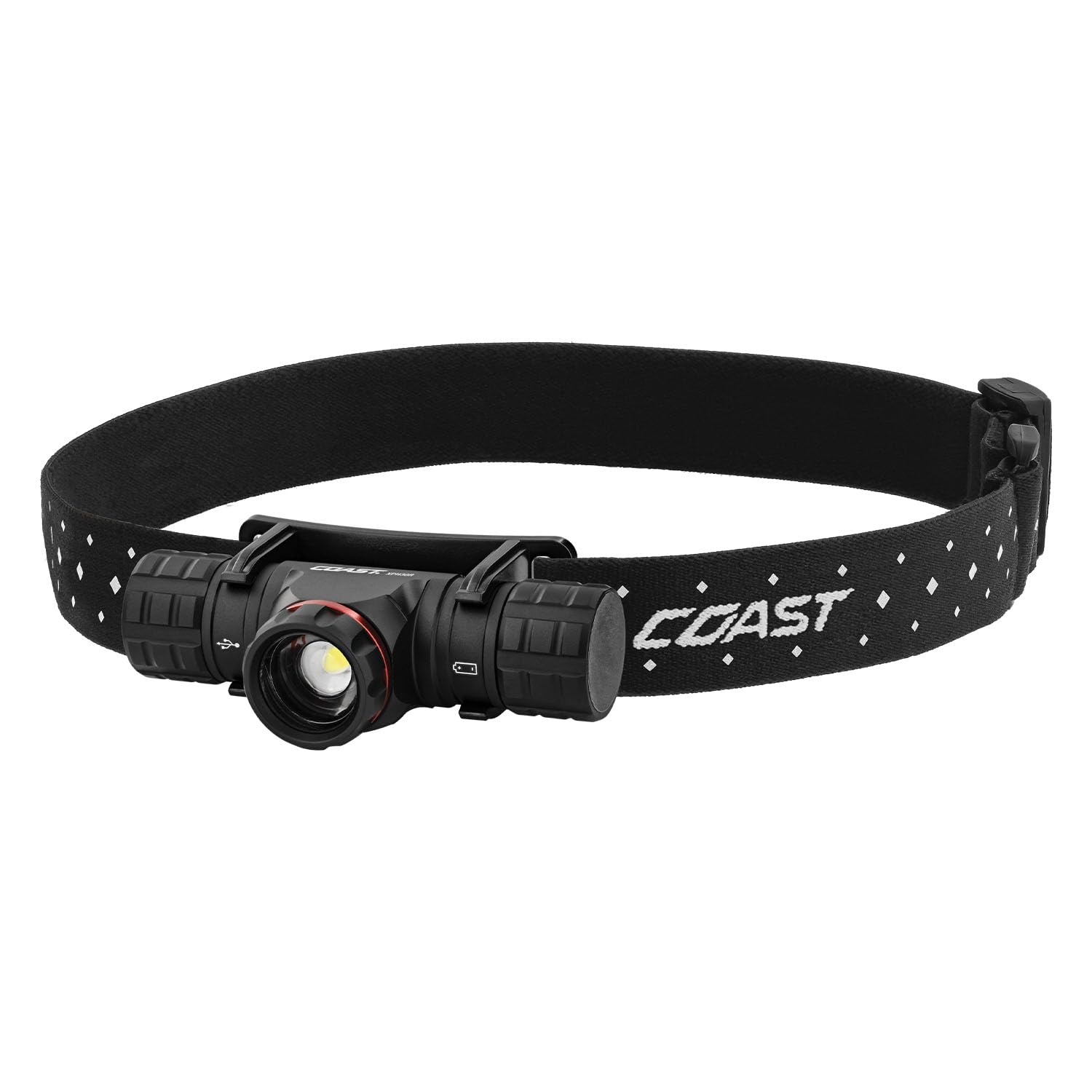
Coast XPH30R
Key Features
- Runtime: 28 hours (low)
- Charging: USB-C
- Light output: 1200 lumens (turbo)
- Water resistance: IP54
- Price: Premium
A quarter turn of the ring on the Coast XPH30R takes the beam from a wide pool that lights an entire cooking area to a narrow shaft that reaches the next trail marker. That one control is why it kept ending up in our packs after the novelty of the cheaper lights wore off.
The rest of the package backs it up. The body is aluminum rather than plastic, it is sealed against rain, charging is USB-C, and the lamp head pops off the bracket to stick to a stove lid or a truck hood on its magnetic base — genuinely handy when both your hands are busy. Coast backs it with a lifetime warranty, the longest of anything in this guide, and the switch felt the same on every press.
Where it costs you is on your forehead. There is more mass up front than on the 2.65-ounce Lepro, and to keep it from sliding when you look down, the band has to be snug enough that you notice it after a few hours. For a trip where the lamp is out for an hour at camp, that is an easy trade; for a thru-hike where every ounce gets argued over, it is not.
Pros
- Twist ring shifts from flood to spot
- Magnetic head detaches for hands-free work
- Aluminum body with a lifetime warranty
- USB-C charging
Cons
- Heavier on the forehead than the light picks
- IP54 sealing, not submersible
We reach for the Coast when a trip cannot afford a dead light — the focusing beam and metal body are worth carrying the extra ounces for.
Best for Long Trips, No Power
Energizer PRO-360
Key Features
- Power: 3 AAA (included)
- Runtime: 50 hours
- Light output: 360 lumens
- Water resistance: IPX4
- Price: Budget
Three AAA cells and a claimed 50 hours of runtime is the entire argument for the Energizer PRO-360, and on a trip long enough that a power bank runs dry, it is a good argument.
VisionGuard ramps the output up gradually instead of slapping you awake, which sounds like a marketing line until you are the one switching it on at two in the morning in a shared tent. Red and green modes sit alongside the white ones, the head tilts, and 360 lumens is enough for a marked trail at walking pace. It arrives with cells installed, so it works on the drive to the trailhead.
Alkaline AAA cells are the catch. On high the light drains them quickly, and in real cold they sag; swap in lithium AAAs for a winter trip and drop to the wide low setting around camp. What you get in exchange is a lamp with nothing to charge, nothing to leave behind in a wall socket, and a spare set of cells that costs less than the light.
Pros
- Runs on three AAA cells, included
- Claimed 50-hour runtime on low
- Red and green modes plus gradual dimming
Cons
- Burns through AAA cells on high
- No built-in rechargeable battery
Our pick for trips with no power bank: three AAA cells, a long low-mode runtime, and nothing to recharge at the end of the day.
Best for Backup and Car Kit
GearLight S500
Key Features
- Power: 3 AAA per light (not included)
- Weight: 3 oz
- Runtime: 10 hours
- Light output: 200 lumens
- Price: Budget
Two headlamps for less than any single light in this guide is the pitch, and if you want one in the car, one in the pack, and a spare for whoever forgot theirs, it is a good pitch.
Each unit takes three AAA cells you supply, weighs about 3 ounces, tilts 45 degrees, and cycles through seven modes including red and strobe. The band adjusts small enough for a kid, which is part of the appeal for family trips, and the lamp is comfortable enough to forget you have on while you set up a tent in the dark.
Where it runs out of road is the dark itself. Two hundred lumens is fine for zipping a tent or walking to a latrine and thin for picking your way down a rocky descent. The straps are the other weak point: the band and its anchor are what give out. As the light you navigate by, we want more output and a sturdier band; as the one that lives in the pack just in case, it is hard to beat.
Pros
- Two lamps per pack
- 3 oz body with red and strobe modes
- Band adjusts down to a child’s head
Cons
- 200 lumens is dim for night hiking
- Thin straps break at the anchor
We keep a pair of these in the car and the pack as backup lights, not as the lamp we navigate a dark trail with.
Best for Gloves and Hard Use
SLONIK 1000

Key Features
- Weight: 4 oz
- Runtime: 4 hours
- Light output: 1000 lumens
- Water resistance: IPX4
- Price: Midrange
The SLONIK 1000 is the one here that does not feel like plastic: an aluminum cylinder that slides off the band and works as a compact flashlight on its own.
One large button runs six brightness levels and three modes, and it is easy to find and press with gloves on — the sort of detail that only matters when it is cold and your hands are numb. The 1,000-lumen top end throws a long way across a clearing, charging runs over USB, and at 4 ounces the lamp is light enough to wear under a hard hat all shift.
Two things to know before a trip. The 4-hour runtime is a high-mode figure, and on the brightest settings the cell empties within an evening. The plastic bracket that joins the body to the band is the likelier failure point — it is the part to watch, not the light itself.
Pros
- Aluminum body, not plastic
- One big button works in gloves
- Detaches as a pocket flashlight
- 4 oz with USB charging
Cons
- Short runtime on high
- Plastic mounting bracket is the weak link
We like it for gloved work and for anyone who wants a metal body; ounce-counting backpackers should start with the Lepro instead.
Best for Basecamp and Truck
Blukar K9116

Key Features
- Beam: Zoom, 90 degree tilt
- Weight: 9.74 oz
- Runtime: 18 hours
- Water resistance: IPX6
- Price: Budget
At 276 grams the Blukar K9116 is the one lamp here you notice putting on, and that mass buys a large battery, three LED sources, and a zoom beam that reaches a long way across a field.
IPX6 is the best water protection in this group, and the sealed battery compartment backs that up — this is the light for a wet coast or a rainy work site. The head rotates through 90 degrees, the zoom narrows the beam down to a searchlight, and an 18-hour runtime claim covers a long evening.
For backpacking, the arithmetic does not work. A lamp this top-heavy tugs at the band, and you spend the evening re-tightening it; on a long climb you feel every gram. In a camp box, a truck glovebox, or a workshop, though, it is a lot of light for the outlay, and the sealing means you do not have to baby it.
Pros
- IPX6 sealing for wet weather
- Zoom beam with 90 degree tilt
- Long 18-hour runtime claim
Cons
- 276 g is too much for a pack
- Top-heavy head unit shifts when you look up
Our verdict: it belongs in the camp box and the truck, where its sealing and beam reach earn their keep, not in a backpacking pack.
How We Tested Backpacking Headlamps
We built a shortlist from research and specs first, filtering by beam pattern, battery type, weight, and price, then cut anything that required a proprietary cable or felt bulky in a hipbelt pocket. That left 14 headlamps, from minimalist AAA models to rechargeable lights with external battery packs.
Over eight months, I wore each one through the same rotation: a two-night backpacking trip with a late arrival, a rainy morning of breaking camp, a night hike on a rooty trail, and an evening of cooking and reading in the tent. I timed battery life from a full charge to the first noticeable step-down on high, then noted how long low mode lasted after that. I weighed each light with fresh batteries on a kitchen scale and wore it for a full evening to see if it slid down or left a pressure point. I also tried tightening the strap and tilting the beam while wearing thick gloves.
For durability, I dropped each from chest height onto rock, stuffed them into a pack alongside cook pots, and ran them in steady rain and near-freezing temperatures. I noted whether the housing felt solid or plasticky and whether the buttons clicked cleanly by feel in the dark. At the end, I compared what each light delivered at its price—brightness alone never won; a reliable, comfortable light with honest battery life did.
How to Choose a Backpacking Headlamp
A backpacking headlamp spends most of its life switched off, which is why the numbers that sell it and the numbers that matter are rarely the same ones.
Weight Is a Comfort Spec
Every lamp here puts its mass at the front of your skull, held by an elastic band, and the heaviest one in this group weighs more than three times the lightest. You feel that difference by the second hour of an evening, because a heavy lamp needs a tighter band to stop it sliding when you look down at a stove, and a tight band is what leaves a red mark on your forehead.
Our rule: buy the lightest lamp that covers the brightness you need, and leave the second unit of a two-pack at home unless you are sharing it. The big, high-output lights earn their weight at basecamp, not on a climb.
Rechargeable or AAA: Pick Your Power Plan
Match the lamp to the trip. A two- or three-night hike is easy on a USB-C light: top it up from the same power bank that charges your phone and skip spare cells entirely. Past about four days, or in temperatures well below freezing, replaceable AAA cells start to win, because you can carry fresh ones and there is nothing to charge.
The trap is trusting the runtime figure. Those long numbers are quoted on the lowest setting; on high, most of these lights are good for hours rather than a whole night. Plan your camp lighting around the low and red modes and keep the bright settings for the trail.
Beam Shape Beats the Lumen Number
A headlamp’s top figure is a turbo burst — bright enough to blind the person across the fire, and usually stepped down by the electronics within minutes. What you actually use is the middle of the range: a spot narrow enough to pick out a trail, a flood wide enough to cook by, and enough tilt to aim it at your hands. Focusing optics, like the twist ring on the Coast, give you both from one lamp.
Red light is worth having. It keeps your night vision intact in the tent and lets you read a map without waking anyone.
Water Ratings, Straps, and What Actually Breaks
IPX4 handles rain and splashes; IPX6 handles a dropped lamp in a creek or a night of serious weather. Neither survives a swim, so do not plan on it. The part that fails on these lights is rarely the LED: it is the strap, the plastic bracket where the band meets the body, or the switch.
Before a trip, tug the bracket, look at the stitching on the band, and make sure the switch clicks cleanly rather than mushing. Then pack a second light — the cheapest insurance in the backcountry is a spare that runs on the same cells.
Frequently Asked Questions
Can I fly with a rechargeable headlamp?
Yes. A headlamp with an installed lithium-ion cell can go in a carry-on or a checked bag as long as it is switched off and protected from accidental activation. Spare lithium cells and power banks are the exception: they have to stay in the cabin with you, with terminals taped or in a case.
How many lumens do I need for backpacking?
Between 200 and 400 lumens is plenty for walking a marked trail at night, and most of the time you will be on a setting well below that. Reserve the thousand-lumen modes for route-finding, a river crossing, or a wrong turn after dark. A lamp with a good low mode and a red light serves you better than a brighter one that cannot dim.
Should I pack spare batteries?
Yes, whatever the lamp. In cold weather alkaline AAA cells lose voltage fast, so lithium AAAs are worth the extra outlay — they hold up below freezing and weigh less. Know which cells your light takes before you leave: the rechargeable picks here take none, and the AAA lamps take three apiece.
How do I stop a headlamp from switching on inside my pack?
Look for a lockout before you buy: on many lights, holding the power button for a few seconds locks it until you hold it again. If yours has no lockout, loosen the battery cap or flip one cell around before the lamp goes in the pack. A light that runs itself flat against a cook pot is a bad way to start an evening.
Final Verdict
Most backpackers should buy the Lepro 320014-2 and stop reading. It is the lightest lamp in this group, it charges from the cable you already carry, and its low and red modes are the ones you will actually use at camp. Step up to the Coast XPH30R if you want a focusing beam and a metal body that shrugs off a drop on rock, or choose the Energizer PRO-360 if your trip is long enough that nothing gets charged.
Whichever you take, take a second light. That is the decision that matters more than any of the numbers above.