This post contains affiliate links. We may earn a small commission when you buy through our links — at no extra cost to you.
The first time I zipped back into a sleeping bag after a season under a quilt, it felt like a straitjacket. Quilts enter most backpackers’ lives the same way they entered mine: I wanted to drop a pound without sleeping colder, and a backless, hoodless bag was the fastest route there. What a quilt really fixes is the weight you carry for warmth your pad and puffy are already supplying. What it adds is the draft — and after eight months with 12 quilts, the gap between one that holds heat and one that leaks it stopped being subtle.
Nobody warns first-time buyers that quilt temperature ratings aren’t standardized the way sleeping bag ratings are, so a 20-degree quilt from one maker can sleep nothing like another’s. Warmth comes down to whether the thing stays put: straps that actually grip the pad, a footbox that doesn’t gap, edges that seal when you roll onto your side. Cut and length matter just as much, since a quilt too narrow for how you sleep loses warmth no matter what the label promises. The picks below are the ones I’d pack again, including a couple that cost meaningfully less than the rest.


Best for Three-Season Backpacking
Featherstone Moondance 25
Key Features
- Fill: 850-fill RDS duck down
- Weight: 1.4 lb
- Dimensions: 75.6 x 54 in
- Temperature rating: 26°F
- Price: Premium
Twenty-six degrees Fahrenheit and 1.4 pounds are the two numbers that put this quilt at the top of our list, because a comfort rating that low usually costs you another half pound of down or a much bigger bill. The Moondance does it with 850-fill RDS duck down under a 10-denier shell that’s calendered to hold the down in while still letting moisture out. What we noticed was on humid nights: none of the clammy film you get from a coated bag.
The cut is 75.6 by 54 inches, and the draft collar sits exactly where a cold night gets in, at the back of the neck, with a drawstring to close it. Pad straps come in the bag and are the one part that takes practice: thread them onto the pad before you unroll the quilt rather than after, and they stop fighting you. It also works as a plain blanket or an underquilt when the night turns out warmer than forecast, which is more useful than it sounds on a trip where the weather moves.
Against the SENSORY4U, the premium buys about half a pound less weight and a fit that isn’t capped at five foot nine. Against the OneTigris Featherlite, it buys the better part of a pound and a rating that keeps working well below freezing, where the synthetic one stops around forty. If you’re counting ounces on a three-season trip, that is the whole trade.
The limited lifetime warranty is the part we hope you never test, but it’s real: repair, replace or refund on defects for the life of the quilt. Our one reservation is the width. Fifty-four inches is generous on paper and snug in practice if you sleep with your arms tucked inside rather than out.
Pros
- Best warmth-to-weight in this set
- 10D shell holds down in without clamminess
- Draft collar and drawstring seal the neck
- Lifetime warranty on defects
Cons
- Narrow across the shoulders for arm-inside sleepers
The quilt we recommend to anyone counting ounces: 850-fill down, a 26°F rating and 1.4 pounds, with the build quality to justify the premium.
Best for Budget First Quilt
OneTigris Featherlite Quilt
Key Features
- Fill: Polyester
- Weight: 2.2 lb
- Max height: 72 in
- Temperature rating: 5 to 20 degrees Celsius
- Price: Budget
Synthetic fill has one job in a quilt: keep working when the weather stops cooperating. The Featherlite’s polyester batting sits under a 20D ripstop shell with a soft pongee lining, and because there’s no down to soak, you can drape it over a damp sleeping bag, a hammock or a kid’s camp cot without the anxiety a down quilt brings to a wet forecast.
What keeps it on our list is how much quilt is actually sewn into it: a convertible footbox with a hook-and-loop closure, a hollowed back so the insulation lies over your pad instead of under you, and a three-season rating of 5 to 20 degrees Celsius. Hook-and-loop isn’t as tidy as snaps, but it lets you peel the foot end open on a warm night without undoing the whole thing.
Thirty-five ounces and a stuff sack about the size of a gallon jug is the trade, and it’s the honest one for this price. On summer and shoulder-season trips, for hammock layers and for anyone buying their first quilt before they know whether they’ll like sleeping under one, we think the bulk is worth what it buys.
Pros
- Convertible footbox with hook-and-loop closure
- Hollowed back sits over a sleeping pad
- Synthetic fill tolerates damp nights
Cons
- Rated to about 40°F, so shoulder season only
If you want a real footbox and a pad-ready back without spending down-quilt money, this synthetic one is where we point first-time buyers.
Best for Shorter Sleepers
SENSORY4U Top Quilt
Key Features
- Fill: 850-fill down
- Weight: 2 lb
- Max height: 175 cm
- Temperature rating: 20 to 32 degrees F
- Price: Midrange
For a shorter backpacker who wants 850-fill down without the top pick’s bill, this is the quilt: the same fill power, a 20 to 32 degree Fahrenheit rating, a two-year warranty and a fraction of the price. The catch is printed right in the specifications, where the maximum height recommendation is 175 centimetres, about five foot nine. That isn’t a suggestion, and the cut runs true to it rather than generously past it.
What you get for the money is a simple quilt done properly: a drawstring closure, pad straps and a mesh storage bag in the box, and a shell that stuffs into a small bundle for a weekend pack. It’s about half a pound heavier than the Moondance and carries the lowest temperature claim in this group, twenty degrees at the bottom of its range. Under five foot nine and sleeping warm, those are the numbers that decide it.
Pros
- Same 850-fill down as our top pick
- 20°F low end is the coldest claim here
- Pad straps and mesh bag included
Cons
- About half a pound heavier than our top pick
Buy this if you’re about five foot nine or shorter and want 850-fill warmth for a fraction of what our top pick costs.
Best for Wet-Weather Trips
Wise Owl Outfitters Camping Blanket
Key Features
- Fill: Synthetic
- Weight: 29.7 oz
- Dimensions: 78 x 55 in
- Packed size: 17 x 6.5 in
- Price: Midrange
Twenty-nine and a half ounces is not ultralight by the standards of this page, and we’re at peace with that, because the number that matters on a wet trip is a different one. The fill is a synthetic down alternative that keeps insulating when it’s damp, and the ripstop shell carries a water-resistant coating that beads a spilled bottle and a misty morning.
The rest is built for handling: 78 by 55 inches, quilted channels that keep the fill from migrating into one corner, integrated snaps that let you wear it as a wrap or hang it as an underquilt, and corner loops for tying it down. It rolls into a 17 by 6.5 inch bundle, bigger than the down quilts here and smaller than most sleeping bags.
Where it earns its place is the trip nobody wants to cancel: coastal fog, a drizzly September weekend, a canoe route where everything gets splashed. A soaked down quilt is a very expensive pile of feathers; this one keeps most of its warmth and doesn’t ask for special handling on the trail. That’s worth half a pound to us.
Pros
- Synthetic fill keeps insulating when damp
- Snaps work as a wrap or underquilt
- Machine washable shell and fill
Cons
- Air-dry only, so washing costs a day
For wet, muddy, kid-and-dog trips we reach for this washable synthetic rather than any down quilt on the page.
Best for Car and Camp
Get Out Gear Down Blanket

Key Features
- Fill: 650-fill down
- Shell: Water-resistant nylon
- Weight: 1.1 lb
- Price: Budget
A rectangle of 650-fill down, 1.1 pounds, and hand loops at one end: that’s the whole idea, and for a lot of trips it’s enough. It drapes over a sleeping bag on a cold night, wraps around you at a trailhead lunch, and takes less room in a daypack than a fleece. It doesn’t seal around you, so we use it as a layer rather than as somewhere to sleep.
The part we appreciate most is how little it asks. It goes back into its stuff sack without a wrestling match, the water-resistant shell handles a damp picnic table, and there’s nothing to adjust, thread or snap in the dark. Ours lives in the car between trips and comes out far more often than any dedicated quilt here, which is its own kind of recommendation.
Pros
- 1.1 pounds and stuffs down small
- 650-fill down at the low end of the range
- Water-resistant shell and hand loops
Cons
- No published temperature rating
We keep one in the car: a 1.1-pound down blanket for lunches, festivals and summer nights that never pretends to be a sleep system.
Best for Hammock or Ground
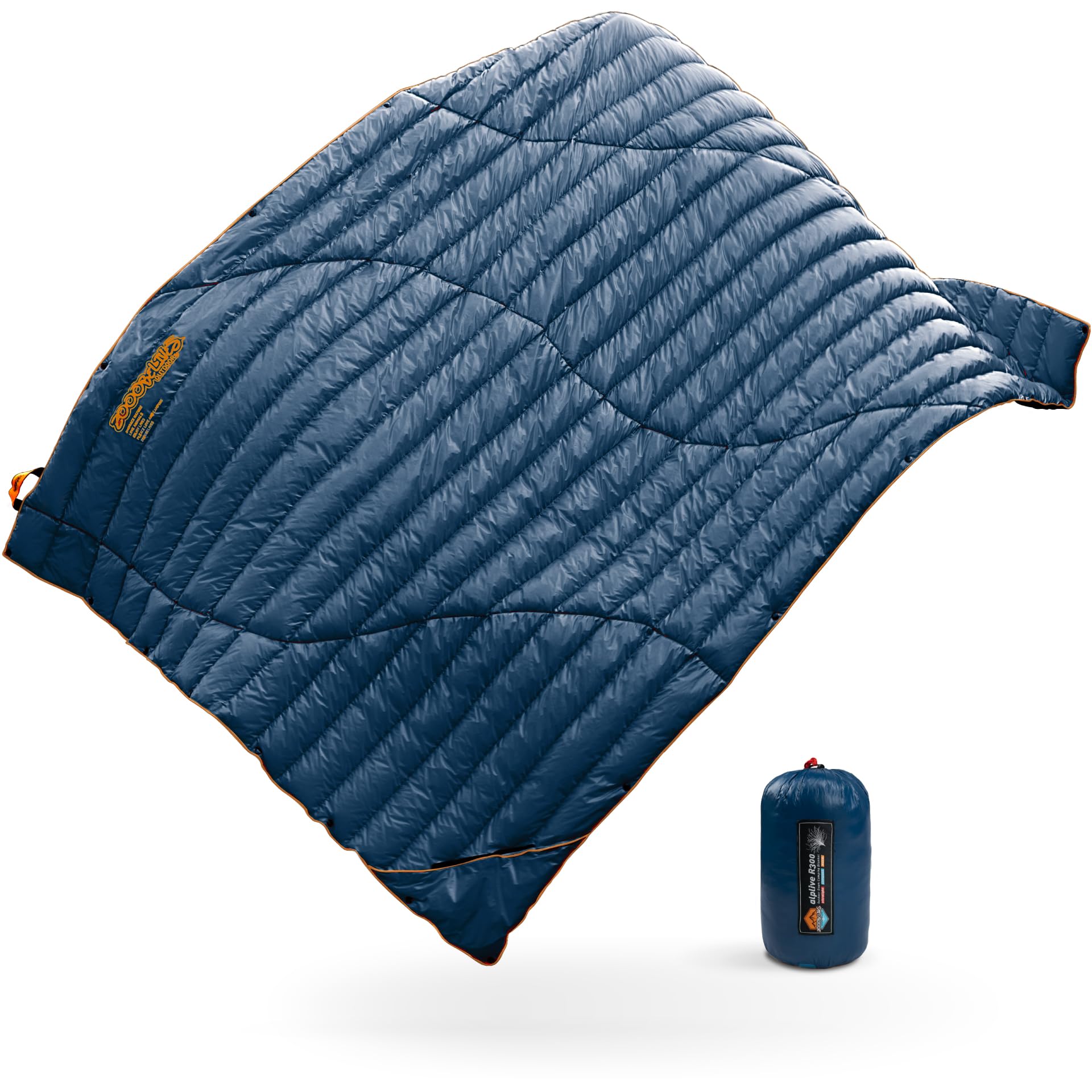
ZOOOBELIVES Alplive R300
Key Features
- Fill: 650-fill duck down
- Weight: 10.6 oz
- Dimensions: 78 x 54 in
- Packed size: 12.2 x 5.9 in
- Price: Budget
A stuff sack that lives in its own corner pocket is a small thing that keeps paying off: you never dig for it at the end of a trip and you never leave it in the car. That kind of thinking runs through the Alplive R300, from the side and bottom snaps that turn a flat quilt into a footbox or a cape, to the separate lining that feels like fabric rather than plastic, to the mesh bag that lets the down breathe between trips.
The numbers are sensible for a summer-to-shoulder quilt: 650-fill duck down under a 20-denier ripstop shell with a durable water-repellent finish, 78 by 54 inches of coverage, and a packed size of roughly 12 by 6 inches. That last figure is what sold us for a small pack, where a quilt that swallows half the main compartment changes what else comes along.
What we like is the flexibility. The snaps give you a footbox on a cold night and a cape at breakfast, and the shell is the same 20D nylon the pricier quilts use. The caution is that snaps are not pad straps, so on a breezy night check that the sides haven’t lifted before you settle in, because a gap at the edge undoes a lot of good insulation.
Pros
- Snaps make a footbox or a camp cape
- Stuff sack sewn into a corner pocket
- 650-fill down in a 20D ripstop shell
Cons
- Hand wash preferred over machine washing
We rate it the most flexible light down quilt here: snaps for a footbox or a cape, a shell that handles mist, and a packed size that disappears.
Best for Summer Packing Light
Noora North Down Quilt

Key Features
- Fill: 650-fill down
- Weight: 1 lb 1 oz
- Closure: 14 snaps and drawstring
- Dimensions: 77 x 52 in
- Price: Budget
On the figure this guide is about, the Noora North beats our top pick: 1 pound 1 ounce against 1.4 pounds, in a 77 by 52 inch quilt with 650-fill down and 14 snaps plus a drawstring to close the foot end. On paper it’s the lightest down quilt here.
What that weight doesn’t include is margin. Lower fill power and less of it means less loft, so this is a summer and warm-weather quilt rather than the three-season one the Moondance is. The 52-inch width is also the narrowest in this group, which is fine on a still night and noticeable when the wind gets under the tarp.
The snaps are the fussy part. Line them up properly and set the foot end before you commit to it, because pulled tight and misaligned a pair can pop open in the night. Get that right and the quilt stays where you put it, and the drawstring gives you a properly sealed footbox instead of a folded-over end.
For summer backpacking, hostel travel and anyone working out whether they like sleeping under a quilt, this is an easy recommendation: light, compact in its stuff sack, and inexpensive enough that a wrong guess costs little. It just isn’t the quilt for a frosty night, and it doesn’t pretend to be.
Pros
- Lightest down quilt here at 1 lb 1 oz
- Snaps and drawstring make a sealed footbox
- Packs into a very small stuff sack
Cons
- No published temperature rating
Our pick when the scale matters more than margin on a cold night: light, packable and inexpensive enough to try quilts out.
Best for Warm-Weather Backpacking
ROSE FEATHER Down Blanket

Key Features
- Fill: 90% goose down
- Dimensions: 79 x 55 in
- Fill weight: 1.1 lb
- Price: Budget
Goose down at the bottom of the price range is where listings usually get creative, so we looked hard at what the Rose Feather actually promises: 90 percent goose down, 500 grams of fill, a 20-denier nylon shell with a durable water-repellent finish, and a 79 by 55 inch rectangle. That’s a serious amount of fill on paper for the least expensive quilt in this group.
The design is more thoughtful than the price suggests. A run of snap buttons down the sides lets you close it into a sleeping-bag shape or wear it around camp, and the drawstring at the bottom end is the detail we like most: pull it shut and the flat blanket becomes a top quilt with a sealed foot, which is more than most budget blankets bother with.
Where it comes back to earth is the edges. There’s no draft collar and nothing to hold it to your pad, so cold air finds the openings on a breezy night, and this is a summer and mild-weather quilt rather than a shoulder-season one. On a still, warm night none of that matters.
For summer backpacking, a hammock layer or a blanket that lives in the van, it’s a lot of down for the money, and the footbox drawstring makes it far more useful than a plain rectangle. It isn’t what we reach for when the forecast drops below freezing, but as a warm-weather quilt that packs small, it earns its spot.
Pros
- Goose down at the lowest price here
- Bottom drawstring seals a footbox
- Packs small in its own carry bag
Cons
- Snap closure only, no pad straps
A warm-weather quilt we’re happy to recommend for summer trips and van life, and for anyone testing whether quilts suit them.
How We Tested the Best Ultralight Quilts
We started by pulling every quilt we could find that weighed under roughly two pounds and published real fill weights and loft numbers, then cut anything without a workable pad attachment system or with sizing limited to a single length. That left 12 quilts, which we used over eight months: Sierra overnighters, a wet weekend in the Blue Ridge, and a run of backyard sleep-outs during a cold snap, plus floor nights on different pads to isolate how each attachment system behaved.
Warmth got tested the honest way — sleeping in each quilt at temperatures close to its stated rating with a thermometer at the head end and noting where we woke up cold, which was almost always the shoulders and hips where the edges gap. Loft we measured with a ruler after a good shake and again after two weeks of daily stuffing, which is where cheaper quilts quietly lose thickness. We also opened each one flat as a blanket on mild nights and doubled it under a bag when the forecast dropped, since most people won’t use a quilt one way forever.
Fit and attachment were a rolling test. Testers from 5-foot-4 to 6-foot-2 slept in both regular and long cuts, deliberately rolled from back to side to stomach, and we swapped straps between pads of different widths to see which buckles slipped and which edges stayed sealed. We tracked strap stretch, hardware grip, and how much fumbling it took to get the quilt positioned in the dark.
Durability came down to abuse: repeated stuffing, yanked straps, seams and stitch lines inspected at the footbox and along the edges, and shells checked for snags after nights on granite and roots. For value, we weighed what each quilt delivered against its price rather than the price alone — ounces saved, fill quality, and how many lengths and widths a maker offers.
How to Choose an Ultralight Quilt
A quilt is half a sleep system, so the rating on the tag describes what happens above you and nothing at all about what’s underneath.
What a temperature rating actually promises
A quilt has no hood and no insulation under your back, because your pad does that job. A 26-degree rating describes a comfortable night for a warm sleeper on an appropriately warm pad, not the point at which you are safe. The claims in this group run from 20 degrees Fahrenheit at the low end to no published rating at all, and the quilts without a number are summer layers however much down they contain.
If you sleep cold, buy one step warmer than the number you think you need. If you sleep warm, the tag is roughly honest. Either way, treat a rating as the ceiling of a good night rather than the floor of a survivable one.
Down or synthetic
Down wins on warmth per ounce and on packed volume, and the fill power tells you how much: the 850-fill quilts here stay under a pound and a half, while the 650-fill options carry more bulk for similar warmth. Down’s weakness is water. Soaked down collapses and stops insulating, so a waterproof liner is part of the purchase rather than an accessory.
Synthetic fill gives up some of that weight advantage and keeps working when it’s damp, which is why we keep pointing coastal, canoe and family campers toward it. It also tends to be the cheaper way into a real footbox and pad attachment.
Weight and packed volume
The lightest down quilt here is 1 pound 1 ounce and the heaviest synthetic is 35 ounces. That gap is a day of food or a warm layer, and on a long carry it’s the difference you feel on the last climb. Packed volume matters just as much in a small pack: a quilt that fills a gallon jug leaves less room for everything else than one that rolls to roughly 12 by 6 inches.
Weigh the whole system, straps and stuff sack included, before deciding you’ve saved anything.
Footbox, pad attachment and drafts
This is where quilts are won and lost. A closed or convertible footbox, plus something that holds the quilt to your pad, is what separates a sleep system from a blanket. A flat rectangle with no way to seal the bottom drafts at the feet and shoulders, and no amount of fill fixes an open edge.
Snaps are quicker to use; pad straps hold better if you roll around. The trap is assuming a snap closure does the work of a strap — it doesn’t, so set the whole thing up once in daylight before you rely on it in the dark.
Fit: length, width and how you sleep
Length gets the attention and width decides the night. The quilts here run 52 to 55 inches across, which is enough for a back sleeper and snug for a broad-shouldered side sleeper who likes their arms inside. Check the listed maximum height too: one quilt here caps at 175 centimetres, and a quilt that ends at your chest instead of your chin is a cold night.
Measure from shoulder to toe, add a little room, and size up rather than hope.
Frequently Asked Questions
Why sleep under a quilt instead of a sleeping bag?
A bag’s hood and the insulation under your back are weight you carry whether or not they do anything. Under a quilt, your pad handles the bottom and the down above you never gets compressed, which is why quilts save weight and why people who roll over tend to prefer them.
The trade is that hood. Below freezing you’ll want a down jacket or a warm hat, and a draft collar like the one on our top pick does a lot of that work for you.
Can I use an ultralight quilt in a hammock?
Yes, and it’s one of the better reasons to own one. The quilt goes inside the hammock over you, but it only warms what’s above, so you still need an underquilt or a pad beneath you. The snaps on several quilts here let you wrap one around the outside instead.
For a first hammock setup, a pad inside is the cheaper experiment. Add an underquilt once you know you’ll keep hanging.
How do I wash a down quilt without wrecking the loft?
A front-loader or a bathtub, a gentle detergent, no bleach and no fabric softener, then a low tumble until it stops clumping. A half-dry quilt loses most of its warmth, so give the drying more time than feels necessary and shake it out to bring the loft back.
Check the label first: several quilts here are machine washable, but our synthetic pick is air-dry only, which costs you a day. Between trips, store down loosely in a mesh bag rather than compressed in the stuff sack.
Final Verdict
Counting ounces, the Featherstone Moondance 25 is the recommendation: 850-fill down, a 26°F rating and 1.4 pounds, with the shell, draft collar and warranty to make that rating mean something on a real night. When budget or climate points elsewhere, the OneTigris Featherlite is the quilt we hand to first-timers and damp-weather campers, and the SENSORY4U is the down bargain for anyone about five foot nine or under.
The rest are specializations: the Wise Owl for wet trips and family camping, the ZOOOBELIVES for hammock flexibility, the Rose Feather and Noora North for summer, and the Get Out Gear blanket for the car. Start with your coldest expected night, then buy the lightest quilt that clears it.