This post contains affiliate links. We may earn a small commission when you buy through our links — at no extra cost to you.
The wrong trail shoe announces itself on the first wet root: your heel slips, your toe jams, and the downhill you were looking forward to becomes a careful shuffle. A proper trail shoe fixes that—rubber that bites into mud and rock, a toe box that lets your toes splay, cushioning that saves your feet on long descents, and arch support that keeps your stride steady without feeling like a lump. I’ve run in 12 pairs over eight months, from burly mountain models to lighter road-to-trail crossovers, and the differences in traction, comfort, and build quality are not subtle.
Fit is the first lesson: a shoe that feels great in the store can turn into a blister machine after 10 miles, so comfort has to hold up over hours, not steps. Don’t assume a roomy toe box means a sloppy fit—some of the best pairs I tried had plenty of room up front but still locked my midfoot down. Versatility and appearance matter too: the pairs that made this list handled wet rock, loose gravel, and the occasional paved connector, and a few looked presentable enough for post-run errands. Durability varied wildly—some uppers frayed by mile 80; others barely showed wear. Here are the ones worth lacing up.


Best for All-Round Trail Running
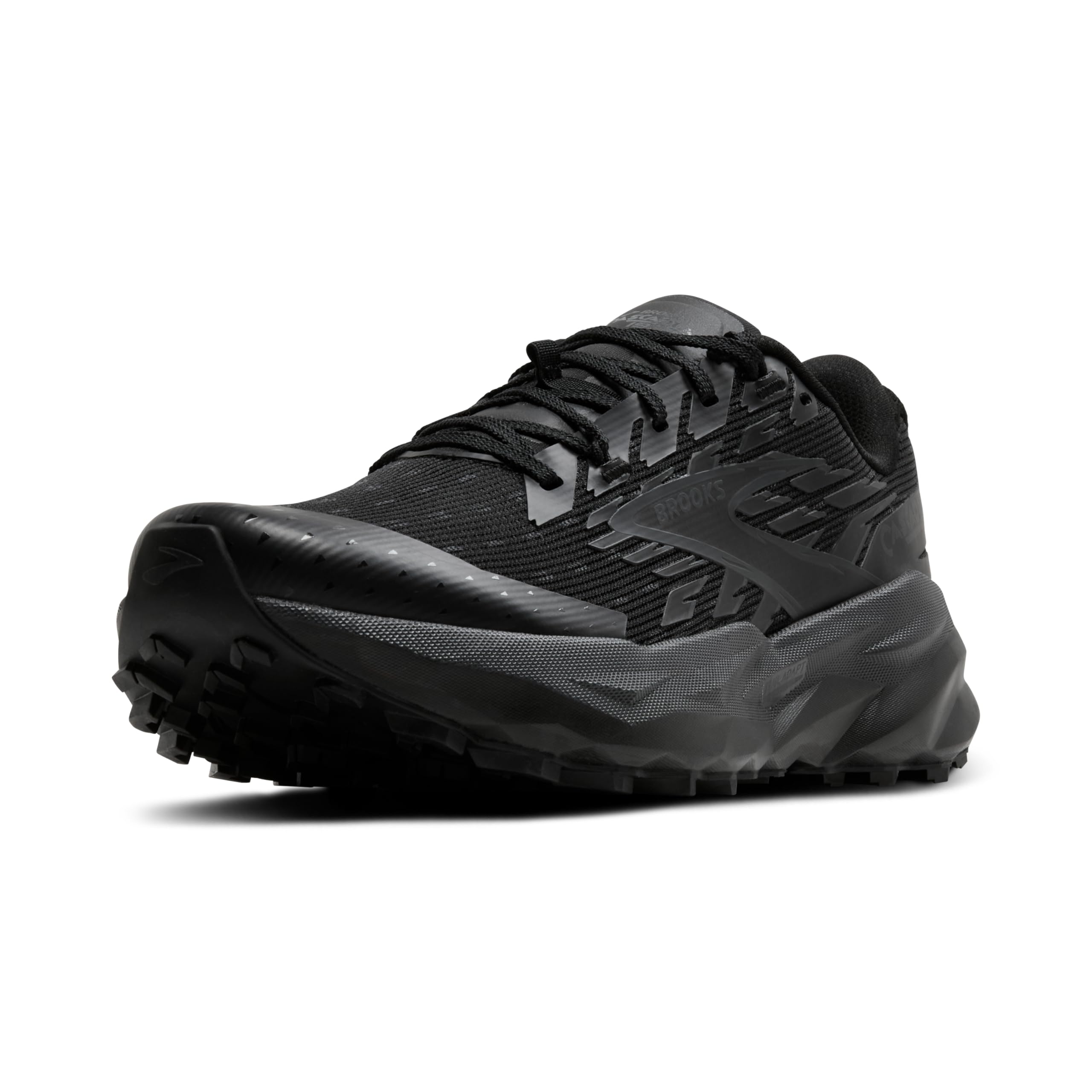
Brooks Cascadia 19
Key Features
- Model: 110457
- Toe box: Wide
- Department: Men’s
- Best terrain: Technical trail and road
- Price: Midrange
Wide, lugged, and built for ground that moves under you — that is the Cascadia 19, and it is the shoe we recommend first. There is more rubber under your foot at the moment it lands, which is what keeps it planted on loose gravel and slick rock, and the toe box is cut roomy enough that a long descent does not turn into a toe-jamming contest. Plenty of trail shoes make you pick between a soft ride and a steady one; this one gives you a good measure of both.
The cushioning is the part we keep coming back to. It is well padded and springy rather than mushy, so miles on hardpack do not beat up your legs, and the midsole still has enough structure that the shoe reads as a trail shoe rather than a marshmallow. That firmness through the middle is what turns a rolling root into a shrug instead of a stumble.
Sizing deserves a minute of your attention. The toe box is generous, but the fit sits on the small side of true, and going up half a size is what turns a shoe you notice into one you forget about. It is the single most useful thing to know before you order.
Pros
- Wide, planted platform on loose ground
- Padded midsole that stays supportive
- Roomy toe box for long descents
- Grip that holds on slick rock
Cons
- Tread thins early on abrasive rock and pavement
We make the Cascadia 19 our default trail shoe: it grips loose ground, cushions long miles, and fits a wide range of feet without a break-in period.
Best for Long Days, Packs
Salomon XA Pro 3D
Key Features
- Fit: Narrow through the midfoot
- Closure: Quick-pull lacing
- Department: Men’s
- Best terrain: Rough trail and hiking
- Price: Premium
Plenty of trail shoes can handle a trail run. The XA Pro 3D is the one here that keeps working when the day turns into a hike, a scramble, or a slow march home under a loaded pack. A stable chassis and a stiff structure through the middle all point at the same job: keeping your foot where you put it when the ground is doing its worst.
We think it is the most versatile shoe in this group, and the lacing is a big part of why. You pull the cord, tuck the tail, and stop thinking about it — no bow to come undone in mud, no readjusting halfway up a climb. Grip is steady rather than aggressive: the tread sheds mud instead of packing it, and there is enough flexibility to feel what is underfoot on rock.
Longevity is the quiet argument for the price. A stiff, structured shoe tends to hold its shape where softer ones here go vague, and the outsole is built for hard, repeated use rather than a single season. If you want one pair to cover trail runs, weekend hikes, and the odd loaded mile, this is the one that keeps showing up by the door.
Pros
- Quick-pull lacing that stays set
- Stable under a pack on rough ground
- Outsole and structure hold up over seasons
- Tread sheds mud instead of packing it
Cons
- Runs narrow through the midfoot and toe box
- Firm, structured ride feels like a lot of shoe
We hand the XA Pro 3D to anyone running with a pack or staying out all day: it holds the foot steady and the laces never need a second thought.
Best for Wide Forefeet
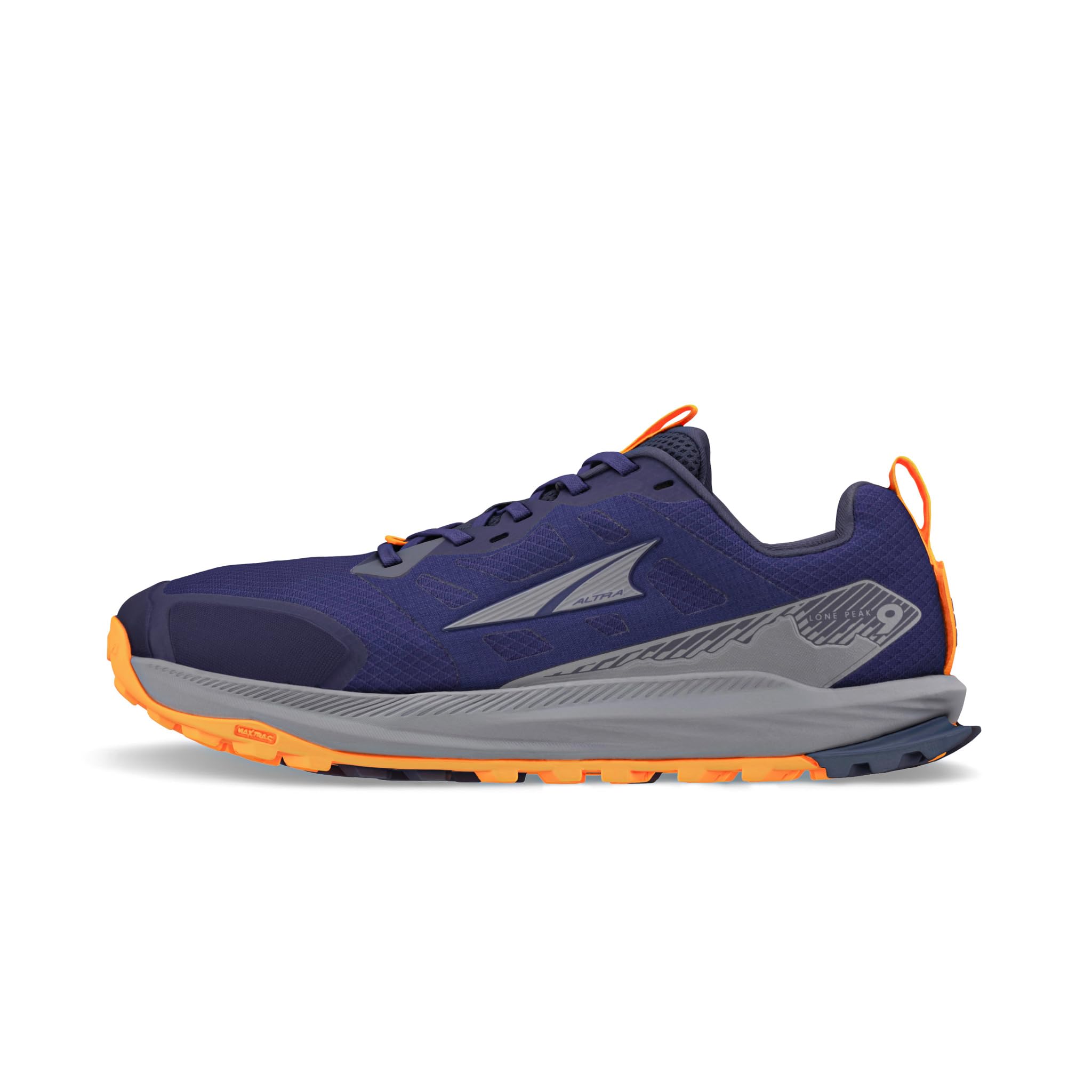
Altra Lone Peak 9
Key Features
- Model: AL0A85PG000
- Toe box: Extra roomy
- Department: Men’s
- Best terrain: Technical trail
- Price: Premium
The Cascadia 19’s toe box is roomy; the Lone Peak 9’s is in a different category altogether — and for a wide forefoot, that is the whole reason to buy it. Altra shapes this shoe around a wide, foot-shaped platform, and if your toes have spent years being squeezed by tapering uppers, the first step feels strange in the best way.
We are glad this shape exists in this group, because no amount of cushioning fixes a shoe that is the wrong shape. The upper is soft where it needs to be while the midfoot still holds, which is not a given once a toe box gets this wide. Traction is confident on wet roots and loose dirt, and the shoe works as well on a muddy dog walk as it does on a proper trail day.
The room is the product, and you pay for it. If you have a narrow foot, or you like a close, snug ride that tells you exactly where the ground is, this will feel like too much shoe and you will spend the run gripping with your toes. Everyone else can stop hunting.
Pros
- Widest toe box in this group
- Soft upper that still holds the midfoot
- Confident traction on wet roots and dirt
Cons
- Sole and upper wear faster than the price suggests
Our pick for wide forefeet: the Lone Peak 9 gives toes room to spread without making the midfoot feel loose.
Best for Wet, Muddy Trails
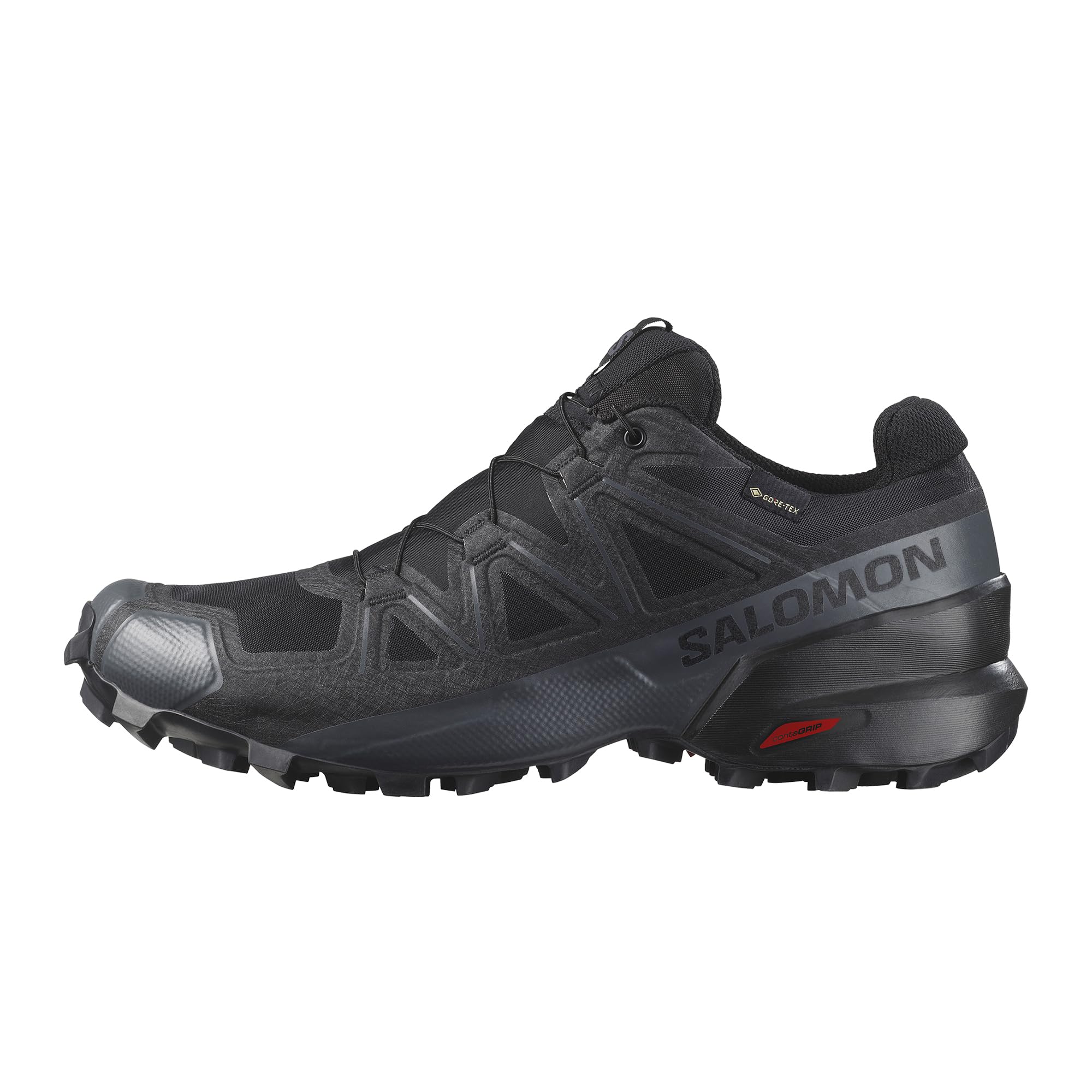
Salomon Speedcross GTX
Key Features
- Model: L41309400
- Upper: Waterproof
- Department: Men’s
- Best terrain: Wet and muddy ground
- Price: Premium
Winter trail running in most shoes is a negotiation: you pick the dry line, you hop the puddles, and you finish with cold, wet feet anyway. The Speedcross GTX is the shoe in this group built to end that. The upper is sealed against rain and standing water, and the tread is deep and widely spaced so mud clears rather than packing in.
We rate it highly for exactly those conditions. On a cold, soaked, soft-ground morning it is the best shoe here, and the drawstring closure means there is nothing to re-tie with numb fingers. The tread clears mud instead of loading up, which is the difference between grip and a heavy, slipping sole halfway through a wet run.
Sort the fit before you commit. It runs narrow through the toe box and about half a size small, so size up unless you know you like a close fit. If you have a wide forefoot, the Lone Peak 9 is the better use of your money.
Pros
- Waterproof upper for rain and puddles
- Deep tread that clears mud
- Drawstring closure with nothing to tie
Cons
- Deep lugs feel vague on smooth, wet rock
- Sealed upper runs warm once the weather turns mild
For cold, wet, muddy runs we take the Speedcross GTX over anything else here — it is the only shoe in the group built to keep water out.
Best for Budget Trail Miles
Under Armour Bandit Trail 3
Key Features
- Model: 3028371
- Department: Men’s
- Best terrain: Gravel, hardpack, everyday wear
- Price: Budget
Sizing is the one thing to settle before you commit. The Charged Bandit Trail 3 runs close to size but sits on the small side of it, and half a size up is the difference between a shoe you forget about and one you feel on every descent.
Get that right and this is the best value in the roundup. It is a real trail shoe — lugged grip that holds on gravel and hardpack, a supportive upper, and a toe box that does not cramp — and it sits at the bottom of the price range here while doing the job on packed dirt and rooty singletrack that the premium shoes do.
We point newer trail runners at it for a reason. It does not demand a technique change the way a stiff, aggressive shoe does, and it doubles as a walking and everyday shoe without looking like a hiking boot, which matters if it is going to be your only pair.
Pros
- Lugged grip that holds on gravel
- Supportive upper for the money
- Doubles as a walking and everyday shoe
Cons
- Pinches across wide forefeet
We recommend the Charged Bandit Trail 3 to new trail runners and anyone shopping on a tight budget: real grip and support for very little.
Best for Women’s Trail Fit
New Balance Nitrel V6

Key Features
- Model: WTNTRGP6
- Toe box: Roomy
- Cushioning: Firm and thin
- Department: Women’s
- Price: Midrange
A women’s trail shoe is often a colorway rather than a shape. The Nitrel V6 is the exception in this group: the upper has room across a wide forefoot and over a high instep, the heel locks down without a stiff collar digging into your ankle, and nothing about the fit feels scaled down from a bigger shoe.
The heel is the detail we cared about most. A collar that rubs ends a run faster than a thin midsole does, and this one stays smooth against the ankle through a long day. Traction is dependable on mixed terrain — dirt, gravel, wet roots — and the tread keeps its bite where the path turns slick.
Order half a size up if you are between sizes, because the length runs short more often than not. On price it sits mid-pack, and the money goes into the upper and the shape of the fit rather than into foam, which is the honest way to describe a shoe this firm.
Pros
- Roomy forefoot with a locked-in heel
- No ankle rub on long days
- Dependable traction on mixed terrain
Cons
- Thin, firm cushioning underfoot
We point women with wide forefeet to the Nitrel V6: the upper has room where it counts and the heel stays put.
Best for First Trail Shoes
New Balance 410v9

Key Features
- Midsole: Fresh Foam
- Department: Men’s
- Best terrain: Mixed trail and pavement
- Price: Budget
This is the least expensive shoe in the roundup, and it is built like it: a simpler upper, thinner padding, and a shoe that knows what it costs. That is not automatically a criticism. The question is where the savings land.
Mostly they land in the right places. Traction is the surprise — the outsole holds on rocky trail and wet pavement alike, and it does not feel like a compromise on gravel or packed dirt. The ride is light and flexible, which suits easy miles and mixed surfaces better than it suits anything technical.
Fit is the usual caveat with this one. It runs narrow and short for a lot of feet, so size up if you are wide or between sizes, and treat it as a first trail shoe or a knock-around pair rather than the one you take up a mountain.
Pros
- Cheapest real trail shoe here
- Traction holds on rock and wet pavement
- Light, flexible ride for easy miles
Cons
- Outsole and upper show early wear on abrasive ground
At the bottom of the price range, the 410v9 is a real trail shoe — we think it is the right first pair for anyone testing whether trail running sticks.
Best for Light Trail, Walking
Saucony Excursion TR13

Key Features
- Midsole: Versafoam
- Department: Women’s
- Best terrain: Path, road, and light trail
- Price: Budget
The upper is the part of the Excursion TR13 that decides how long you keep it. It is thin around the ankle and across the sides, and it is the first thing to fray, tear, or split — which is a shame, because the rest of the shoe is a lot of trail shoe for the money.
We keep it in the roundup for the outsole. Traction is genuinely good on wet roads, damp sidewalks, and trail rock, the shoe is light enough for long walk-runs, and it works as an everyday sneaker as well as a trail shoe. For canal paths, rail trails, and gentle singletrack, that combination is hard to argue with.
Sizing runs narrow and slightly short, so go up if you are wide or between sizes. On rocky, technical ground the thin upper and the modest padding underfoot will let you down, so treat it as a light-trail shoe rather than a mountain one.
Pros
- Grip that holds on wet roads and rock
- Light enough for long walk-runs
- Low price for a women’s trail shoe
Cons
- Thin ankle and side panels fray and tear early
We keep the Excursion TR13 on the list for walk-runs and easy trails: light, grippy, and one of the least expensive women’s options here.
How We Chose and Tested the Best Trail Running Shoes
We started by pulling together 12 pairs from brands with a real trail line—lugged outsoles, protective toe caps, and a mix of drops and stack heights—and filtered out road shoes with a token tread pattern. Each pair lived on my feet for eight months on local trails: wet, rooty singletrack, loose gravel fire roads, rocky ridgelines, and the paved connector I take to get there. I ran the same muddy climb and wet rock slab in every pair to see whether the rubber stuck or skated, and wiggled my toes on steep descents to check the toe box—did they jam, or did they have room to splay?
Fit and arch support got tested on long runs with different socks, and I kept a log of hot spots and arch aches. Comfort and cushioning were judged on runs over two hours; I noted whether the midsole felt lively at mile 10 or packed out, and whether the upper breathed on hot days. Durability was a mileage check—I inspected outsole lugs for wear and uppers for fraying at 50 and 100 miles. Overall build quality came down to stitching, overlays, and whether the shoe held its shape.
For appearance, I asked whether I’d wear them to a coffee shop after a run—not a dealbreaker, but a real-world detail. Versatility meant taking each pair from road to trail without feeling like I was swapping tools mid-run. The final picks are the ones that stayed comfortable, gripped when it mattered, and didn’t fall apart.
How to Choose a Trail Running Shoe
Trail shoes fall short in three places — the outsole, the fit, and the upper — and the right pair is the one whose weakest point you can plan around.
Start With the Ground You Actually Run
Trail is a broad word. Loose gravel, wet root, slick rock, and packed dirt ask different things of an outsole, and no shoe here is best on all of them. Deep, widely spaced lugs clear mud and bite in soft ground — the Salomon Speedcross GTX is the extreme case — while shallower tread and softer rubber hold better on wet rock.
Be honest about the majority of your miles. If you run the same hardpack loop three times a week, buy for that surface, not for the alpine day you do twice a year.
Fit and Toe Box Beat Any Spec Sheet
Sizing is the most common regret in this category, and it runs in both directions: several shoes here run short or narrow enough that a half size up is the right call, and wide forefeet get squeezed by uppers that taper toward the toe. Measure late in the day, when your feet are at their largest, and fit the shoe with the socks you actually run in.
If you want room, the Altra Lone Peak 9 is the widest here. If you want lock-down, the Salomon XA Pro 3D holds tighter through the midfoot.
Cushioning, Ground Feel, and Protection
More foam is not automatically better. A plush midsole like the one on the Brooks Cascadia 19 protects you on long, rocky days and leaves your legs fresher, but it blunts the feedback that helps you place a foot on technical ground. A firmer, thinner shoe like the New Balance Nitrel V6 feels quicker and more precise, and it punishes you on a long descent.
Match the ride to the length of your usual run, not to the longest run you have ever done.
Waterproof or Breathable
A waterproof upper keeps rain and puddles out and holds sweat in. A sealed shoe like the Salomon Speedcross GTX is the right choice for cold, wet, muddy conditions, and the wrong one for hot days or routes with a creek crossing, because once water comes over the collar it drains slowly.
If your trails are wet half the year, the sealed version earns its keep. If you run in heat, stick with mesh and accept wet feet.
What the Extra Money Buys
The shoes here run from budget to premium, and the difference is not grip — cheap trail shoes grip fine. The money goes into the upper, the midsole, and how consistent both stay: a better upper resists fraying at the collar and across the toe, and a better midsole holds its shape deeper into its life.
If you run three times a week, that durability is worth paying for. If you get out once a week on easy ground, a budget pair is the smarter buy.
Frequently Asked Questions
Can you run on pavement in trail shoes?
Yes, for the stretch between the car and the trailhead. Trail lugs are softer and shallower than road rubber, so they wear quickly on asphalt and feel vague through corners. Keep pavement to link sections rather than the bulk of your week.
If your routes are half road, choose a mixed-surface shoe over a mud-specific one — the Brooks Cascadia 19 is the one here we take on a route with a pavement link.
How do I know when trail shoes are worn out?
Flip the shoe over and look at the lugs under the ball of your foot and along the outer heel, which is where trail shoes die first. Once the pattern is flattened to a smooth patch, the grip and the underfoot protection are gone even if the upper still looks fine.
A torn ankle collar or a split toe seam is the other signal. Retire the pair then, not after the next wet run.
What should I check before my first run in a new pair?
Two things. Lock the heel: lace through the top eyelets, then press a thumb behind your heel — it should not lift when you take a step. And wear them indoors for an hour before you commit, since several of these run short or narrow enough that a half size up is the fix.
Keep the box and the tags until you have walked a few laps on carpet.
Final Verdict
Most trail runners should start with the Brooks Cascadia 19. It grips loose ground, cushions long miles, and fits more feet than anything else here — and its weaknesses, sizing on the small side and tread that thins on abrasive rock, are ones you can plan around rather than discover on a descent.
If your runs involve a pack or a full day out, the Salomon XA Pro 3D’s stability justifies the step up in price. If your forefoot needs room, the Altra Lone Peak 9 gives you the most of it.