This post contains affiliate links. We may earn a small commission when you buy through our links — at no extra cost to you.
A hiking pole has two jobs: it takes load off your knees on the climb and it catches you when the ground gives way on the descent. The second job is where pairs fall apart, literally. A lock that slips a quarter inch under your weight turns a helpful stick into a hazard, and you find out halfway down a scree slope with a full pack. A good pair fixes that, and the smaller miseries too: burning quads, swollen hands, the wrist ache that arrives around mile eight.
I’ve hiked with cheap poles that clicked and rattled the whole way, and with pairs that felt welded to the trail. Over the past eight months, my team has put a dozen pairs through day hikes, a loaded overnight, and a lot of wet rock — and the pattern is consistent: the lock matters more than the weight, and the lock is the one thing a product page can’t tell you. Sizing is the other quiet mistake; most people buy too long and end up gripping below the handle. Below are the pairs worth carrying, sorted by who they suit.


Best for Everyday Trail Use
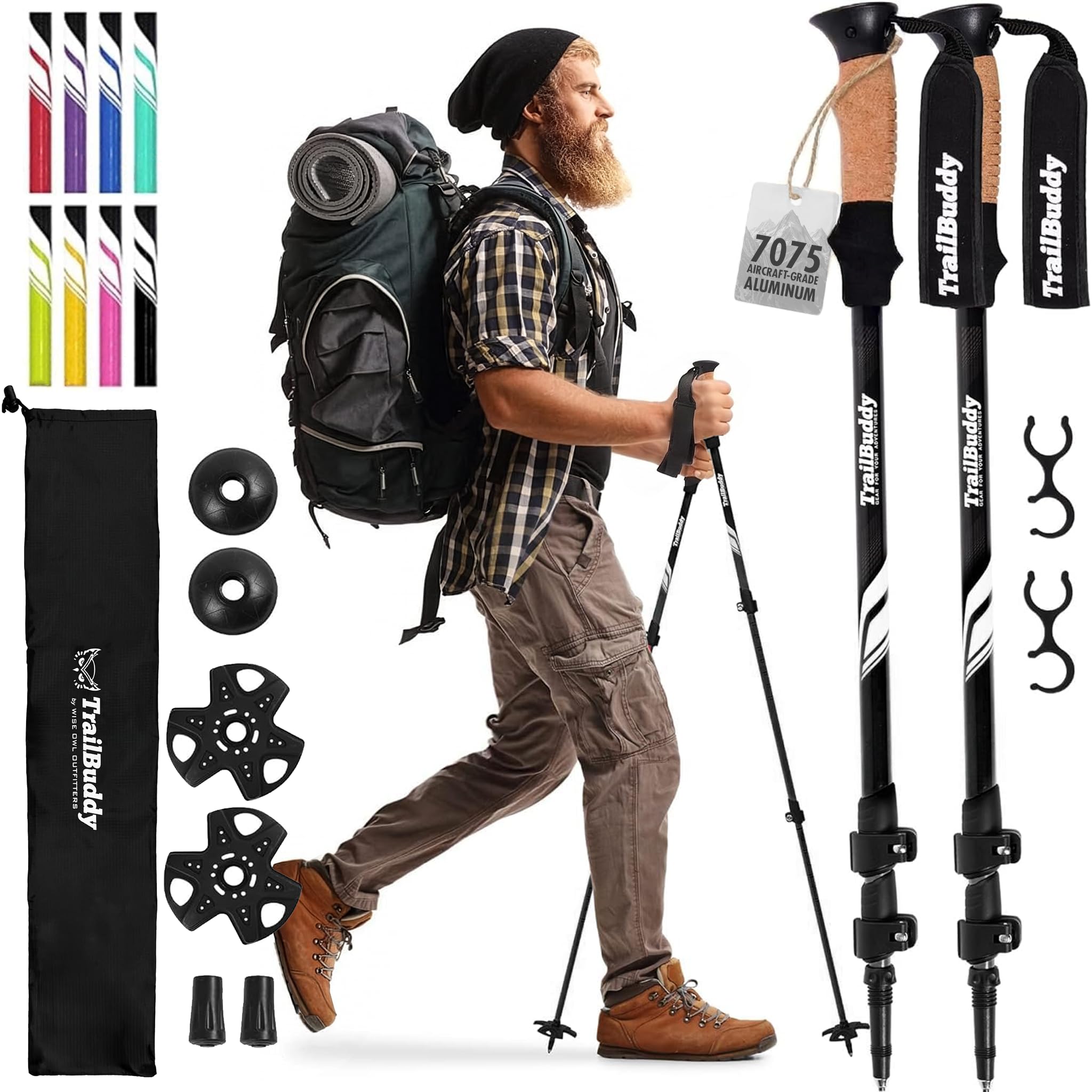
TrailBuddy Trekking Poles
Key Features
- Grip: Cork
- Lock type: Lever
- Height range: 24.5 to 54 in
- Weight per pole: 9.7 oz
- Price: Midrange
The lever is the reason these are our default pick. It flips open and snaps shut under the heel of one hand, so you can set both poles at the trailhead without taking your gloves off, and it holds the setting once it is closed. Twist locks, which most budget poles still use, need two hands and a bit of faith. That single difference is why we recommend these first.
The rest of the package is genuinely well judged. Each pole weighs 9.7 ounces in 7075 aluminum, adjusts from 24.5 to 54 inches, and collapses short enough to strap to a daypack — a range wide enough to cover a tall adult and a child on the same walk, which is why this is the pair we suggest for families. The cork grips mold to your hands over a few hikes and stay tacky when they are damp, and the straps are padded rather than flat webbing.
Where we hesitate is the shaft. Aluminum bends rather than shatters, which is the safer failure, but a pole can still snap under a hard stumble or a full-body lean, and that is the weak spot here. The five-year limited warranty is the backstop, and it is longer than the one-year terms most of this group carries. If you routinely load your poles with a heavy pack on rough ground, the carbon Cascade below is the more conservative buy.
One detail that rarely gets mentioned: four rubber tips come with the pair, along with mud and snow baskets and a carry bag. Since the rubber boot is the part that meets pavement and rock, having spares in the box means the poles do not go out of service the week a tip wears through.
Pros
- One-handed lever locks set in seconds
- Cork grips that mold and stay grippy
- 24.5 to 54 inches covers a whole family
- Five-year warranty and a full tip kit
Cons
- Shafts can snap under a hard fall or heavy lean
For most hikers these are the pair to buy: lever locks you can work with gloves on, cork grips that hold when wet, and a five-year warranty behind an affordable pole.
Best for Long-Distance Backpacking
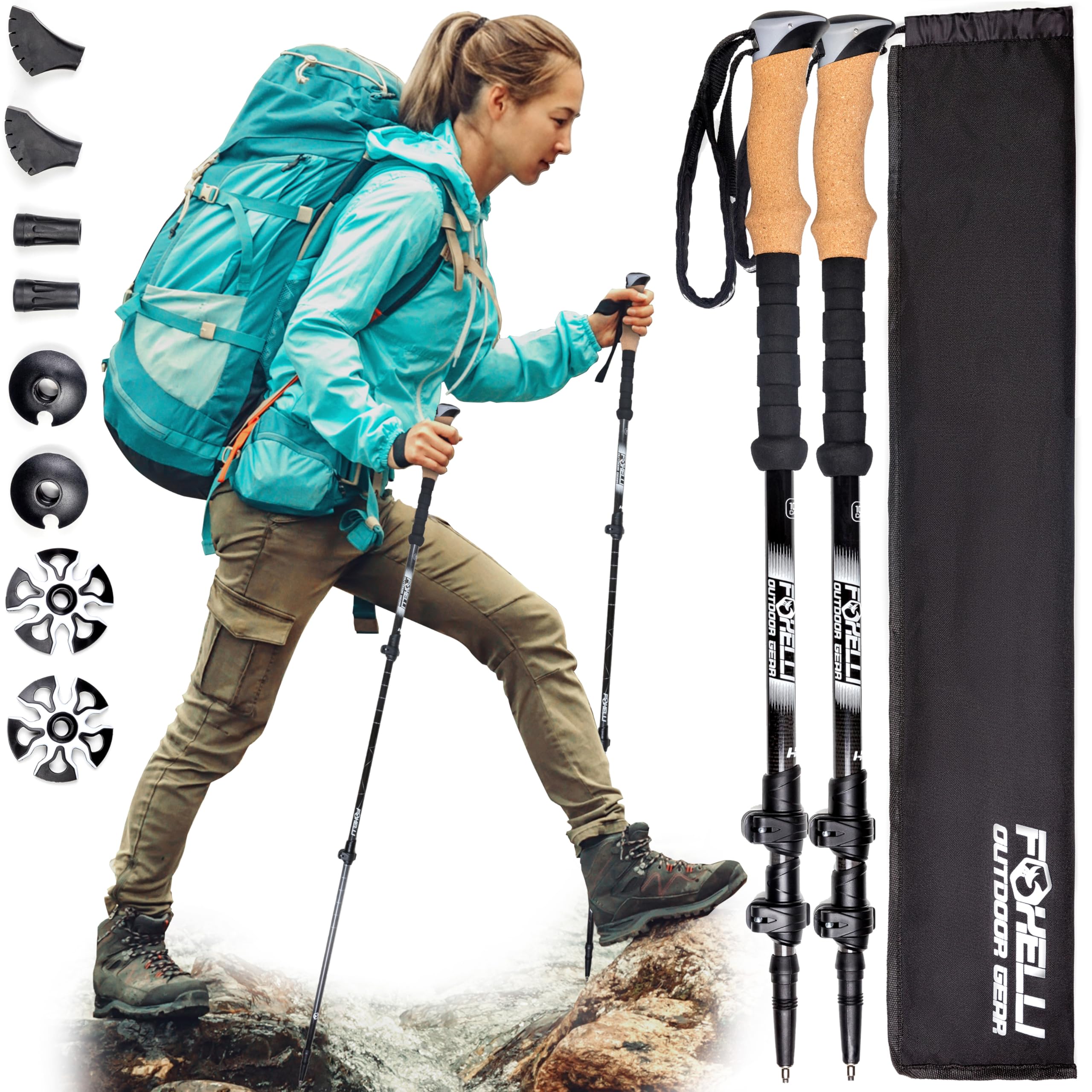
Foxelli Carbon Fiber Trekking Poles
Key Features
- Grip: Cork with foam extension
- Shaft: Carbon fiber
- Height range: 24 to 54 in
- Weight per pole: 7.6 oz
- Price: Premium
Seven and a half ounces is the number to start with. Each Foxelli pole weighs 7.6 ounces in 3k carbon fiber, roughly two ounces lighter per pole than our top pick — weight you swing forward and back with every step, all day. On a long climb that is the difference between poles you notice and poles you forget you are carrying.
The weight saving has not been taken out of the grip. There is natural cork, a foam extension below it for choking down on steep ground, and padded straps. Stability is the standout: these are the most planted poles in this group when you weight them on a descent, and the flip locks hold the height without the creak you get from cheaper clamps. A carry bag and the usual baskets and tips come in the box.
The trade-off is how carbon fails. It does not bend, it cracks, and a shaft jammed between two rocks on a stumble is finished. That is not a reason to avoid it — the stiffness is exactly what you are paying for — but it is a reason to keep the rubber boots on when you are on rock rather than bare carbide. Against the aluminum picks here they also cost noticeably more, and that is the real decision.
Pros
- Lightest poles here at 7.6 oz each
- Cork grip with a foam extension
- Planting stability when you weight them
Cons
- Carbon shafts crack rather than bend on impact
- Premium price against the aluminum picks
If you are counting ounces on long days, this is the pair we point to: 7.6-ounce carbon shafts with a proper cork grip, provided you accept that carbon cracks instead of bending.
Best for First-Time Buyers
KINGGEAR Trekking Poles
Key Features
- Grip: Cork with EVA extension
- Lock type: Flip lock
- Height range: 25.5 to 54 in
- Weight per pole: 9.35 oz
- Price: Budget
KINGGEAR does nearly the same job as our top pick for less money: 7075 aluminum, a flip lock on each section, natural cork with an EVA extension, and 54 inches of reach. On paper the two are close enough that the decision comes down to polish.
At 9.35 ounces a pole it is the lightest aluminum pair here, and the 25.5-inch collapsed length straps to a pack without drama. The cork grip runs long, so you can slide a hand down onto the foam when the trail tips up rather than stopping to shorten the pole — the same trick the Cascade pair uses, and one we reach for constantly on uneven ground. KINGGEAR also states a lifetime guarantee, a longer commitment than most of this group makes.
The reservation is the lock, which is where KINGGEAR feels its price. The clamps hold, but the tension screws work loose over a few trips and want a check before a long day. Carry a small screwdriver, snug them at the trailhead, and the poles behave; forget, and you will be re-setting the height halfway up. For a first pair, that ritual is a fair exchange. The TrailBuddy lever is the more forgettable mechanism, and forgettable is exactly what you want in a lock.
Pros
- Lightest aluminum pole here at 9.35 oz
- Cork grip with an EVA extension
- 54-inch reach for tall hikers
Cons
- About 2 oz per pole heavier than the carbon picks
The value pick: 7075 aluminum, cork grips, and 54 inches of reach for less than our top pick, with a lock that wants a snug before every big hike.
Best for Steep Traverses
Cascade Mountain Tech Aluminum
Key Features
- Grip: Cork with EVA extension
- Shaft: 6061 aluminum
- Height range: 26 to 54 in
- Weight per pole: 10.1 oz
- Price: Budget
The extended EVA section under the cork is the reason to pick this pair. On a traverse, or on steps cut into a steep pitch, you want your hand lower on the shaft without stopping to shorten the pole, and this grip lets you slide down and keep walking. It sounds minor until you have done a mile of side-slope with a hand cramping on a short grip. That is why we rate these the best of this group for steep, side-sloped ground.
Everything else is conventional and competent: 6061 aluminum at 10.08 ounces a pole, 26 to 54 inches, quick levers, cork handles, and a full kit of carbide tips, rubber boots, and mud and snow baskets. The one thing to set up is lever tension — a clamp that is not snug will creep under your weight, so open it, turn the screw in, and test it with a real lean before you commit to a descent. Set them up properly and they take a lot of punishment for the money; skip it and you will be re-setting the height every half mile.
Pros
- Extended EVA grip for steep traverses
- Cork handle with a full tip and basket kit
- 26 to 54 inches covers most adults
Cons
- The heaviest stated pole weight here at 10.08 oz
Our pick for steep, side-sloped ground: slide your hand down onto the EVA extension and keep moving, with a cork grip and a full tip kit behind it.
Best for Packing Small
Hiker Hunger Foldable Poles
Key Features
- Grip: Cork
- Height range: 100 to 120 cm
- Packed length: 15 in
- Weight per pole: 9.95 oz
- Price: Midrange
Fifteen inches folded is the whole pitch. These break down into four sections and drop inside a daypack, a duffel, or a suitcase — something the telescoping poles here cannot offer, since most of them collapse to 24 or 25 inches and end up strapped on the outside.
We like the folding system for travel days in particular. Push the sections together until the buttons click, set the single height latch, and walk; after the first attempt it takes seconds. The metal flip lock on the height section is what decides whether you trust them, so set the tension when they arrive rather than at the trailhead.
Sizing is the catch. This is the short variant, 100 to 120 centimeters, which suits roughly 5 foot 8 and under; anyone taller needs the 115 to 135 cm version. The trade for that 15-inch pack is one more joint to look after — rinse the ferrules after a muddy day and dry them before storage, and the sections keep clicking together cleanly. At 9.95 ounces a pole with a cork grip and a foam extension, they are competitive with the telescopers on everything except that extra joint.
Pros
- Folds to 15 inches for a daypack or duffel
- Cork grip with a foam extension
- 9.95 oz per pole in the short version
Cons
- This variant tops out around 47 inches
For travel and small packs these are the ones: they fold to 15 inches and weigh under 10 ounces a pole, provided you are about 5 foot 8 or shorter.
Best for Entry-Level Carbon
Cascade Mountain Tech Carbon

Key Features
- Grip: Cork with EVA extension
- Shaft: Carbon fiber
- Height range: 26 to 54 in
- Weight per pole: 8.1 oz
- Price: Premium
If you want carbon but the Foxelli price is a step too far, this is the middle option: the same Cascade design as the aluminum pair on this page, with the shaft changed to carbon fiber for 8.1 ounces a pole.
You keep the cork handle and the extended EVA section, the 26-to-54-inch range, quick levers, and the tip kit. The saving over the aluminum version is two ounces a pole, which is real but smaller than the jump to the 7.6-ounce Foxelli — you feel it on a long day more than on an afternoon.
Where we land: the carbon shaft is worth the extra money if you hike often and carry weight, because it damps the chatter out of rocky ground and lightens every swing. What we do not love is the lock, which is the same design that can work loose over a season; a check of the clamp screws every few hikes keeps it honest. Between this and the Foxelli, the Foxelli is lighter and this is the cheaper carbon, so pick on which of those two things matters more to you.
Pros
- Carbon shaft at 8.1 oz per pole
- Cork grip with an EVA extension
- Two ounces lighter than the aluminum version
Cons
- Locks can work loose over a season
- Pricier than the aluminum version
A sensible step into carbon: 8.1-ounce shafts, the same comfortable grip as the aluminum version, and a lock that wants an occasional check.
Best for Travel and Daywalks
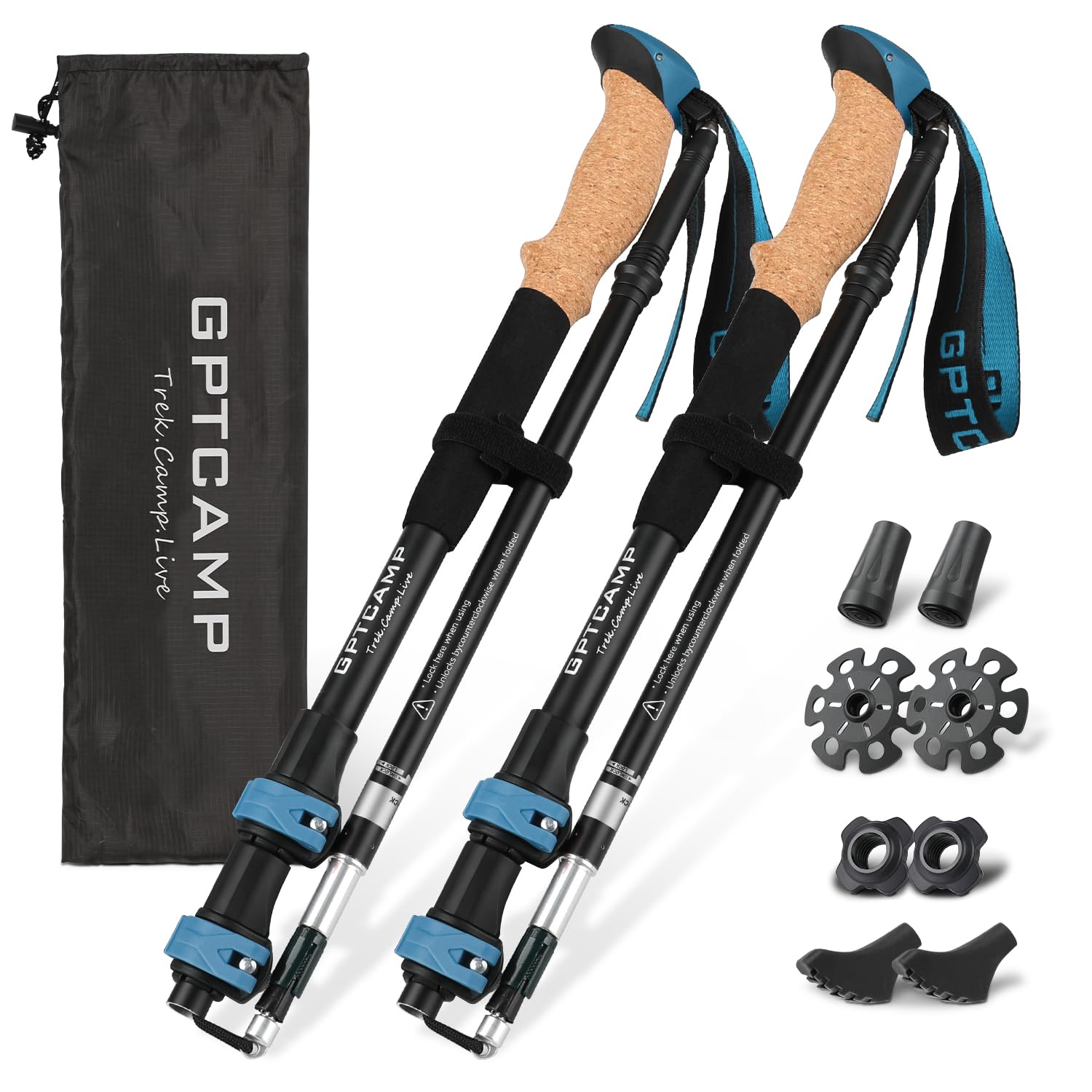
covacure Collapsible Hiking Poles
Key Features
- Grip: EVA foam
- Lock type: Quick lock
- Height range: 43 to 51 in
- Packed length: 35.5 cm
- Price: Budget
Start with the ceiling, because it decides more than anything else here: these adjust from 43 to 51 inches, a shorter range than almost everything else on this page, which puts tall hikers out of the running.
What you get for the money is a tri-fold pole. It collapses to 35.5 centimeters, comes with its own mesh case, and assembles in seconds by pushing the sections together. The EVA handles are shaped rather than round, and three shapes of rubber tip come in the box, so you can match the foot to pavement, dirt, or rock with the same pair.
The shaft is 7075 aluminum, the harder alloy, and the whole package is light enough to leave in a daypack between trips. The joints are where it gives ground — a folding pole that is not fully seated will shift under load, and a pole that has been leaned on hard can bend.
So we see these as a travel and casual-walking pole rather than a mountain tool. For canal paths, city breaks, and the occasional hill they do everything you need at the lowest price in this group, and the short packed length is genuinely useful when luggage space is tight. Load them with a heavy pack on a rough descent and you will feel the joints move.
Pros
- Folds to 35.5 cm with its own case
- 7075 aluminum at a very low price
- Three tip shapes for different ground
Cons
- Tops out at 51 inches, so tall hikers should look elsewhere
- Joints can shift under hard load
A cheap, packable pair for travel and easy trails: they fold to 35.5 cm and undercut everything else here, but 51 inches is the ceiling and the joints are not built for mountains.
Best for Easy Paved Walks
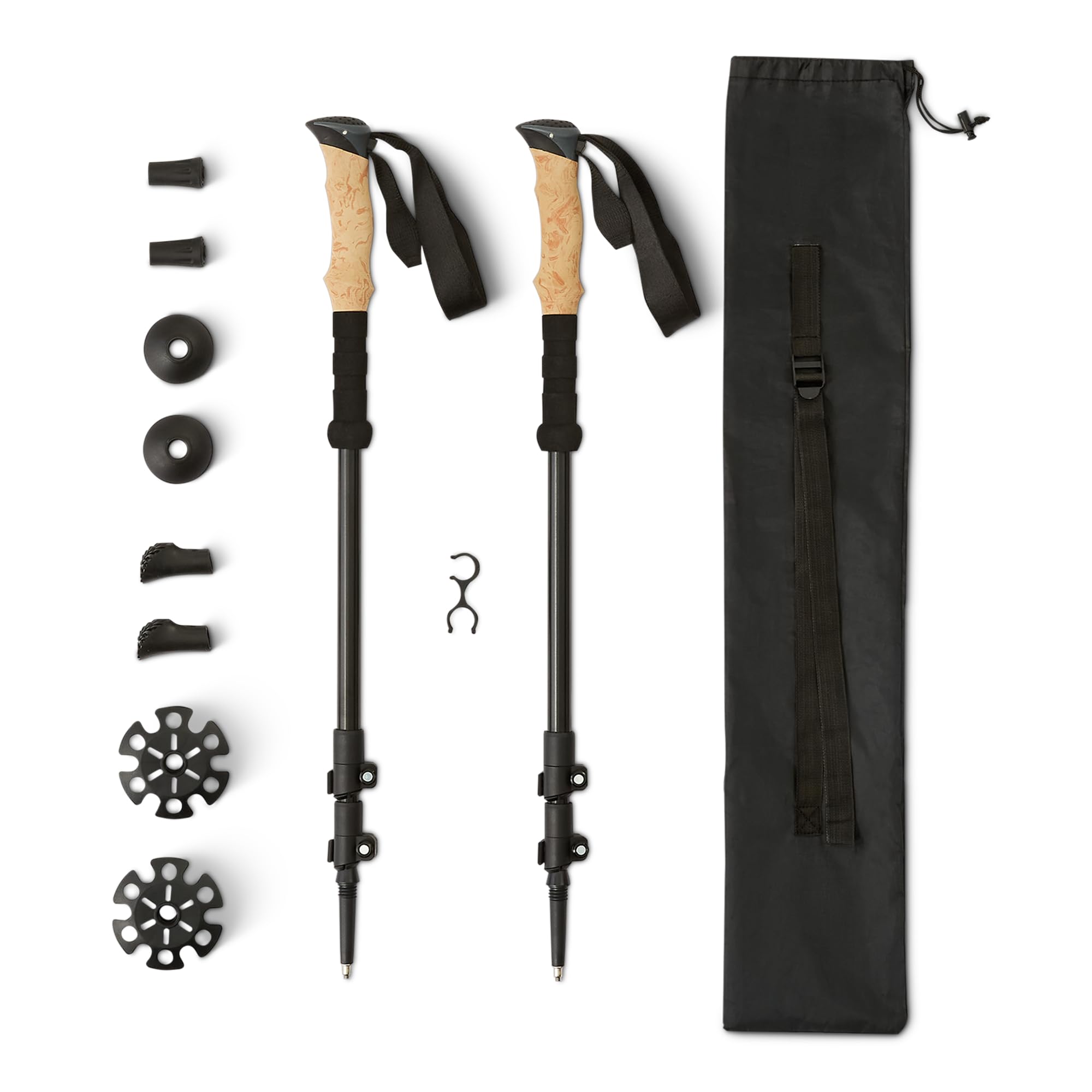
Amazon Basics Trekking Poles
Key Features
- Grip: EVA foam
- Lock type: Quick lock
- Height range: 25.2 to 53 in
- Weight per pole: 9.3-10 oz
- Price: Budget
There is no story here, and that is fine: 6061 aluminum, EVA handles with a fabric lower grip, quick levers, 25.2 to 53 inches, and an accessory set with rubber boots, mud and snow baskets, and tip covers.
What we noticed is how little goes wrong at this level of simplicity. The telescoping sections lock without slipping once the tension is set, the grips are shaped rather than tubular, and the pair is light enough to forget in a pack. It is the sort of pole you buy for a walking habit, a recovering knee, or a first hike where you would rather find out whether you like poles at all before spending properly.
Our honest read: for a walker on pavement, park paths, and the occasional easy trail, these do everything asked of them and the search ends here. They stop at 53 inches, which costs very tall hikers a little reach, and there is no cork and no extended grip — both of which start to matter the moment the ground tilts. Above that line, on real elevation with a loaded pack, the cork grips and tighter clamps further up this page earn their extra cost.
Pros
- Quick levers that lock without slipping
- Light pair with a full accessory kit
- 25.2 to 53 inches of adjustment
Cons
- Stops at 53 inches, so very tall hikers lose reach
For pavement, park paths, and a first pair of poles these are enough: light, simple, and steady once the clamps are snug, without cork or carbon pretensions.
How We Tested the Best Hiking Poles
We built a shortlist of roughly 30 pairs from manufacturer specs, retailer inventories, and our own trail time, then cut anything without a published weight, a clearly identified locking mechanism, or an adjustable range that could fit both a 5-foot-2 and a 6-foot-2 hiker. Twelve pairs made the cut. We tested them for eight months on local day hikes with real elevation gain, one loaded overnight trip, and more than a few wet, muddy mornings.
Each pole was collapsed and extended at least 30 times, and we leaned our full body weight onto it after wrapping the shaft in tape so any creep would show. On descents we planted hard into rock and loose dirt and listened for rattle. Every pair went on a kitchen scale to compare against the claimed weight, then into a daypack to check packed length and how quickly it came out. One tester walked a short loop deploying each pole one-handed, mid-stride, to see how much fumbling it took.
Over the season we watched the slow stuff: tips that rounded off, straps that frayed at the stitching, lower sections that stayed slightly bent after a stumble, grit working into the locks until they stiffened. We also noticed which pair we reached for without thinking on the way out the door — that turned out to be a better signal than any spec sheet.
How to Choose Hiking Poles
A pole only helps if it holds, so we start every buying decision with the lock and work outward from there.
The lock is the whole product
Lever locks, sometimes called flip locks, open and close with a thumb, keep their setting, and can be re-tensioned when they loosen. Twist locks need two hands and a firm grip, and when they let go they tend to let go under load, which is exactly when you are leaning on them. On the poles we recommend, the levers are the single most important specification on the page.
Test any pole before you trust it: extend it, close the lock, and put your full weight on it at the trailhead. If the section creeps, the clamp is not tight enough. Treat that as a setup job rather than a defect.
Aluminum or carbon fiber
Aluminum bends. That sounds like a weakness, but a bent pole usually still gets you home, and the shaft gives some warning before it fails. Carbon is lighter and stiffer and takes the chatter out of rocky ground, but it fails suddenly: jam a carbon shaft between two rocks and it can crack rather than bow.
Across this group the weight runs from 7.6 ounces per pole in carbon to just over 10 in aluminum. If you hike a handful of times a season, aluminum is the sensible buy. If you are counting grams on long days with a pack, carbon earns its premium — just accept that it has one failure mode you cannot nurse back to the car.
Fit comes before features
Set the pole so your forearm sits parallel to the ground with the tip planted and your hand on the grip; most adults land somewhere around 110 to 125 cm, shorter for climbing and longer for descents. That means the stated range has to cover your height with room on both sides, and 54 inches is the usual ceiling on telescoping poles.
Packed length is a separate decision. Telescoping poles collapse to 24 to 26 inches and usually ride outside a pack; tri-fold poles pack to roughly 15 to 17 inches and disappear inside a daypack or a suitcase. Decide which of those two shapes fits your trips before you fall for a finish.
Grips, straps, and the down-grip
Cork molds to your hand over a few hikes and stays tacky when it is damp. EVA foam is lighter and cheaper and turns slick sooner. Rubber is fine for pavement and short walks, and it is the grip most likely to feel clammy on a climb.
The feature worth paying for is an extension below the main grip. On side-sloped ground or a steep staircase of rock, it lets your hand drop down the shaft without stopping to shorten the pole — the difference between a rhythm and a stutter. If you walk anything other than flat rail trails, put it on your list.
Frequently Asked Questions
Do I need two trekking poles or is one enough?
Two, for almost everyone. A pair gives you a rhythm and a wide base on descents, and it keeps your load balanced instead of pushing you toward one side of the trail all day.
The exception is when you genuinely need a hand free — a camera, a dog lead, a map. Then carry one pole, on the side of the weaker knee, and shorten it slightly so you are not reaching.
How should I use the wrist straps?
Slide your hand up through the loop from underneath, then bring it down over the strap so the webbing runs across your palm and the loop sits against the back of your wrist. That way the strap carries the load on the push instead of your fingers.
Set the strap length with your hand in place — snug enough that you can release the grip and the strap still holds the pole. Most of the poles here have adjustable straps for exactly this.
What wears out first on a pair of poles?
The rubber tips. They are the part that meets pavement and rock, and they are meant to be replaced. Order a spare set with the poles so you are not stuck when one wears through mid-season, and swap them before the carbide underneath starts chewing up trails and car boots.
Second is the locking mechanism, which collects grit. Rinse and dry the sections after a muddy hike, store the poles fully collapsed and dry, and the clamps keep gripping.
Final Verdict
Buy the TrailBuddies. For most hikers they are the right combination: a lever lock you can work with gloves on, a cork grip that keeps working when your hands are wet, and a five-year warranty that outlasts the one-year terms most of this group carries.
The pair that changes that answer is the Foxelli. If you are hiking long days with a pack and counting every ounce, the 7.6-ounce carbon shafts are worth the step up in price, as long as you accept a shaft that cracks instead of bending. If the budget is the binding constraint, the KINGGEAR does nine-tenths of the same job with a lock that wants a little more attention.