This post contains affiliate links. We may earn a small commission when you buy through our links — at no extra cost to you.
You never think about a rain cover until the sky turns gray and the wind picks up, and by then it’s too late to wish you’d checked. I’ve watched a pack soak through in a twenty-minute squall on an exposed ridge — water found the bottom seam, the sleeping bag turned into a brick, and the rest of the day was misery. Here’s the annoying part: on plenty of otherwise solid packs, the cover is an afterthought, a thin shell stuffed in a pocket, cut too small, or missing entirely. The right pack fixes all of it at once — comfortable enough to carry real weight for hours, organized into pockets you can actually reach, and built to shrug off a downpour instead of surrendering to one.
Over the past eight months, my team and I have hauled 12 packs up wet trails, through dripping fern tunnels, and across a few glorious, miserable days of sideways rain, and the gaps between them showed up fast. The lesson I keep coming back to: liter count is the least useful number on the tag. Torso length, hip belt shape, and how the straps sit under load decide whether a pack rides well at mile ten — and whether the rain cover is still doing its job when you finally stop. Below are the ones that earned a hook by the door.
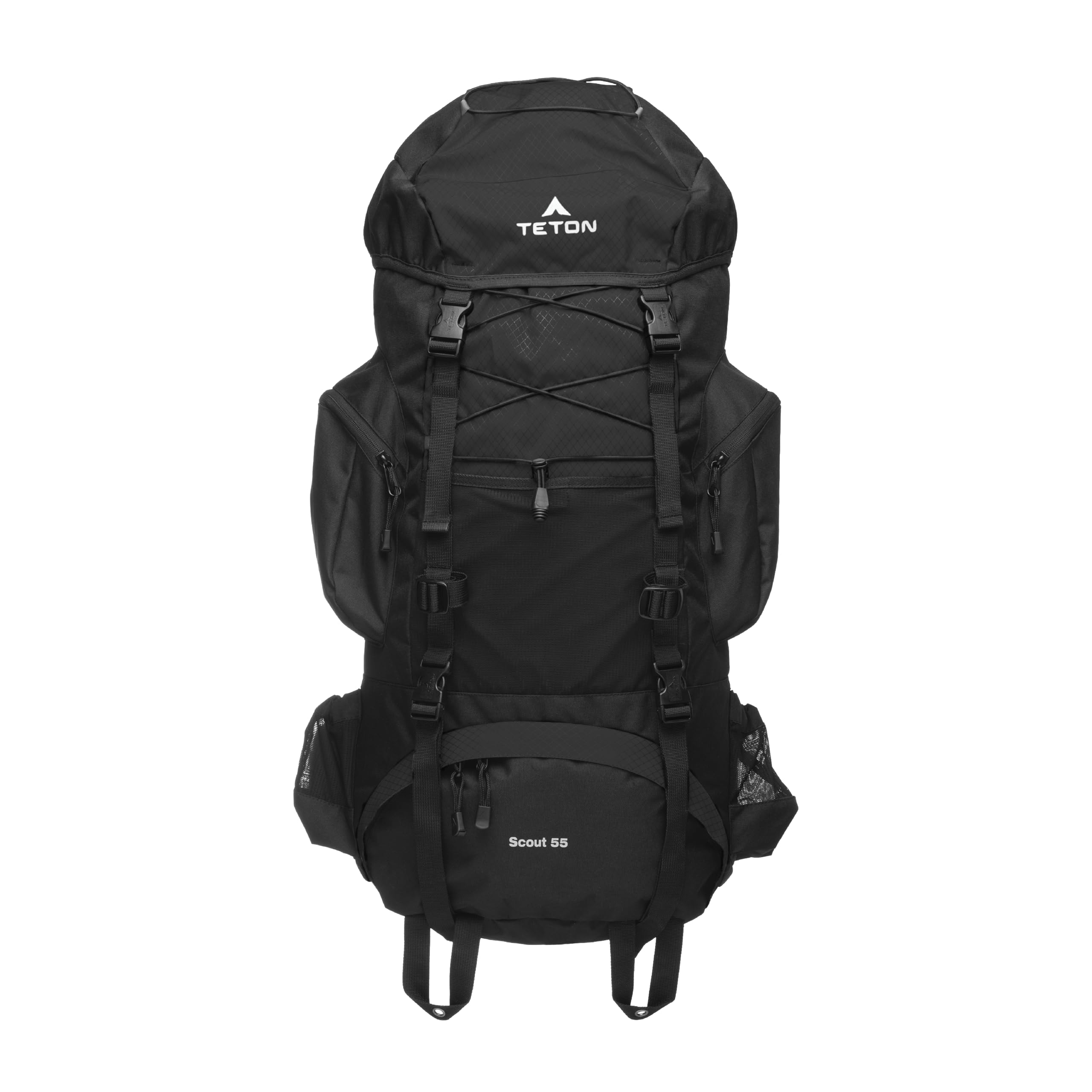


Best for Multi-Day Backpacking
Teton Scout 55L
Key Features
- Frame: Internal frame
- Pack weight: 4.1 lb
- Stated volume: 55 liters
- Torso adjustment: Multi-position torso adjustment
- Price: Premium
The Scout’s internal frame and multi-position torso panel are the two things that turn 55 liters into a pack you can genuinely carry. Teton builds it around an open-cell foam lumbar pad with molded channels, and the harness moves up and down the frame so the hip belt lands on your pelvis rather than your waist. It and the IGOLUMON are the only packs here that advertise that adjustment, and this is the one where the adjustment sits on a frame worth adjusting.
Fifty-five liters is the size most people settle on after a season of guessing. A three-day load — bag, pad, stove, food, a puffy — goes in with room to spare, the bottom compartment keeps the sleeping bag away from everything you reach for during the day, and the compression straps pull the whole thing tight when it is half empty. The rain cover ships with the pack, so there is nothing extra to forget at the trailhead. At 4.1 pounds it is roughly twice the weight of the daypacks here, and that is exactly the trade you want: the frame is what stops a heavy load from hanging off your shoulders.
Two fit details are worth knowing before you order. The side bottle pockets are cut close, so a wide one-liter bottle is a fight, and the sleeping bag compartment takes a mummy bag easily but pinches a bulky synthetic — strap that one outside instead. The harness can also squeak until you set the torso panel to your own measurement rather than leaving it at mid-travel.
What settles it for us is that adjustable harness paired with Teton’s limited lifetime warranty. Of the packs here, this is the one built to see a decade of weekends rather than a season, and the premium over the budget packs buys exactly that.
Pros
- Internal frame shifts load onto the hips
- Torso panel fits short and tall frames
- Rain cover included with the pack
- Sleeping bag compartment keeps gear organized
Cons
- Sleeping bag compartment is snug for bulky bags
Our default recommendation: if you want one pack for weekend backpacking that fits short and tall torsos and comes with its rain cover, buy the Scout.
Best for Day Hikes
Maelstrom 40L
Key Features
- Pockets: 10
- Pack weight: 2.2 lb
- Stated volume: 40 liters
- Zippered compartments: 7
- Price: Budget
Two point two pounds is the number that matters here. The Maelstrom 40L weighs about what a full one-liter bottle does, and on a day hike that is the difference between a pack you notice and one you forget you are wearing. Ten pockets and seven zippered compartments mean the headlamp is findable without unpacking the whole bag, and we appreciated the reflective print on the shell for the walk back to the trailhead after dark.
Forty liters covers a full day with a layer change, and with the bladder out there is enough room for a stripped-down overnight. It also slides under an airplane seat, which makes it the pick here that doubles as a personal item on the flight out to the trail.
The trade for that weight is the shell. The 210D ripstop is light, and tears and seam separation are the failures that show up with this pack — not the buckles, not the harness. Push it through scrub or throw it in the back of a truck and the heavier fabrics here will outlast it. Treat it as a trail daypack and it is the best value in this group.
For three-season day hikes with a light load, this is the one we reach for first of the packs on this page.
Pros
- Light enough to forget on a day hike
- Ten pockets keep small gear findable
- Fits under an airplane seat
Cons
- Light shell can tear with rough handling
Buy it if your hiking is day hikes: at just over two pounds with ten pockets, it is the lightest way into this list and still fits a stripped-down overnight.
Best for Travel and Weekends
WoneNice 50L
Key Features
- Pockets: 5
- Pack weight: 2.56 lb
- Compartments: 4
- Stated volume: 50 liters
- Price: Budget
WoneNice labels this pack 50 liters, or 45+5, and whichever way you read the split the capacity is real: a weekend of clothes, a sleeping bag in the bottom compartment, and a tent and mat strapped to the outside. At 1.16 kilograms it hauls that load at about the weight of the 40-liter daypacks here, which is the trick that makes it worth a look.
The design leans travel as much as trail. The rain cover tucks away small enough to leave in permanently, the side and lid pockets keep a headlamp and a passport apart, and the chest and waist belts pull the load in close instead of letting it hang off your back. It works as a carry-on and a daypack on the same trip, which is more than most packs this size manage.
Where we hesitate is the hardware. The fabric holds up, but straps and seams can give way under load, and that is the failure that ends a trip rather than inconveniencing one. Fill it with soft gear for a few days and it is fine; fill it with heavy water and hard goods and you are asking more of the stitching than it has.
So: a travel pack and a light weekend pack, not a mountaineering one. At this weight the compromise is honest, and you know exactly where it sits before you leave the house.
Pros
- Weekend volume at just over a kilo
- Rain cover packs down small
- Chest and waist belts adjust the carry
Cons
- Straps and seams can give way under load
A weekend’s capacity at daypack weight makes this the traveler’s pick, as long as you keep the load soft and let the straps do light work.
Best for Hydration Day Hikes
IX INOXTO 26L
Key Features
- Pockets: 7
- Pack weight: 2.2 lb
- Stated volume: 26 liters
- Hydration bladder: 3 liters
- Price: Midrange
The bladder is why you look at this one. Twenty-six liters is a small daypack, but the three-liter reservoir comes with it — switch valve, cover cap, the works — along with the rain cover, so the two extras that normally mean a second order are already in the box. The hip belt pockets are the detail we liked most: snacks, phone and a folded map, all reachable without swinging the pack off your shoulder.
It carries better than its size suggests. There is a light frame and a waist belt to take the load off your lower back, the 3D suspension panel keeps air moving on a climb, and the shell has come through multi-day trips and sustained rain without complaint. For a pack this small, that is more structure than we expected.
What it is not is a weekend pack. Put a sleeping bag and a stove inside and 26 liters runs out fast, and the harness sits narrow around the neck on broader shoulders. For day hikes, a festival weekend, or a commute that has to survive a downpour, it is the neatest package here.
The khaki version we looked at also looks less like everyone else’s pack, which is more than most daypacks manage.
Pros
- Three-liter bladder included
- Rain cover included
- Hip belt pockets within reach
- Light frame spreads the load
Cons
- Volume gets tight for an overnight load
For day hikes, this is the pick: a 26-liter pack with the bladder and the rain cover already included, built sturdier than its size suggests.
Best for Gear Hauling
IGOLUMON 60L

Key Features
- Frame: No internal frame
- Pockets: 8
- Pack weight: 3.08 lb
- Stated volume: 60 liters
- Price: Midrange
Sixty liters and no internal frame is the whole story of this pack, and IGOLUMON states it plainly rather than hiding it in the marketing. With nothing rigid to spread the load, every pound inside ends up on your shoulders and lower back — fine for some trips, wrong for others.
For gear hauling it is genuinely useful. The front U-opening gets you into the main compartment without unpacking from the top, the rain cover lives in its own bottom pouch, and at 3.08 pounds the empty pack stuffs into a corner of a car boot. Car camping, hostel-to-hostel travel, a canoe trip where the pack spends more time in a boat than on your back — that is the work it does well.
Where it falls short is the walk in. Load all 60 liters and start climbing and your shoulders take everything a frame would have moved to your hips. The side straps are also short for a rolled mat, so plan on strapping bulky gear across the front instead.
A small thing we did not expect: the sternum strap carries a whistle and a compass. Neither is a reason to buy a pack, but the whistle is the sort of thing you are glad is attached rather than buried in a pocket when the light goes.
Pros
- Sixty liters for gear-heavy trips
- Front U-opening reaches the main compartment
- Rain cover lives in its own bottom pouch
Cons
- No frame, so weight rides on the shoulders
Choose it for volume that travels by car, boat or hostel rather than on your back; without a frame, this is a hauler, not a load carrier.
Best for Bike and Trail
Zavothy 20L

Key Features
- Rain cover: Built-in, detachable
- Pack weight: 1.74 lb
- Stated volume: 20 liters
- Hydration bladder: 3 liters
- Price: Budget
A rain cover that lives in the bottom of the pack is a rain cover you actually have with you. Zavothy zips this one into the base and makes it detachable, which sounds like a small design choice until you are an hour from the car and the sky turns.
The rest of the package is aimed at the same kind of day: a three-liter BPA-free bladder in an insulated sleeve, a dual-layer mesh back panel with foam behind it, a chest buckle, and a hidden helmet holder that makes it as much a bike pack as a hiking one. At 0.79 kilograms it is the lightest thing here.
Twenty liters is the catch. Three hours on a summer trail with water, a shell and lunch is comfortable; add a fleece, a first-aid kit and a camera and you are lashing things to the outside. The bladder is the other question mark — when these packs go wrong it is the reservoir, so fill it in the sink before you trust it on the trail.
The pink is a nice change from the black and navy that dominate this list, and on a bike commute being visible is a feature rather than a styling note.
Pros
- Built-in rain cover stays with the pack
- Three-liter bladder included
- Insulated bladder sleeve
Cons
- Included bladder can leak
- Twenty liters fills fast with layers
Small, light and ready for rain out of the box, this is the daypack for bike commutes and three-hour trails rather than full days.
How We Tested Hiking Backpacks With Rain Covers
We started with a list of more than 40 packs sold by outdoor retailers and narrowed it by capacity, packed weight, whether a rain cover came included or sewn in, hip belt and strap design, and price, landing on 12 to test over eight months. Each one got loaded with the same kit — a three-liter bladder, a puffy, lunch, a first aid pouch, and a shell — then weighed before it went out the door.
Most of the testing happened where these packs actually live: day hikes in drizzle, two overnighters on a humid ridge, and a few deliberately chosen rainy Saturdays. We adjusted every torso length and hip belt, walked with a 25-pound load, and noted where the shoulder straps dug in, whether the hip belt crept loose, and how much readjusting the sternum strap and load lifters needed after a few miles. We counted only the pockets we could reach without swinging the pack off, gloves on, and checked whether a map or a snack came out cleanly instead of snagging on a zipper.
For the covers, we ran each pack under a hose for ten minutes, then opened it and checked whether the towels packed inside were dry, whether water had pooled along the bottom seam, and whether the cover stayed put when we shook the pack. One blew off in a gust. Durability got the long view: we dragged packs over granite, overstuffed them past reason, and checked seams, zipper pulls, and bottom abrasion after months of use. Value came down to what was in the box — a cover that’s sewn in versus one sold separately turns out to be a real difference.
How to Choose a Hiking Backpack with a Rain Cover
The cover is the easy part; the harness underneath it decides whether a wet day is an inconvenience or the end of your trip.
Start With Nights Out, Not Liters
Pile up what you actually plan to carry — shelter, sleeping bag, pad, stove, food, water — and size the pack around that. As a rough map: 20 to 30 liters covers a long day, 40 to 50 liters covers one to three nights with compact gear, and 60 liters and up is for multi-day trips, bulky synthetic bags, or carrying a share of someone else’s kit.
Stated volume is optimistic on every pack here. A 55-liter framed pack carries a heavy load more comfortably than a 60-liter pack without a frame, so if you are between sizes, take the smaller pack and strap the bulky item to the outside.
The Frame Decides How the Load Feels
An internal frame with a padded hip belt moves weight onto your pelvis, where your legs can carry it. Without one, the load sits on your shoulders and lower back. Under about 20 pounds the difference is modest; past 25 pounds it is the whole experience.
That is why our picks split the way they do: the framed Scout for a loaded three-day trip, the frameless IGOLUMON for volume that travels by car or boat more than by foot. When you try a pack on, load it and tighten the hip belt first — if the shoulder straps are doing the work, the torso length is wrong.
Integrated Rain Covers Beat Loose Ones
Every pack here ships with a cover, but they are not equal. A cover that stows in the pack’s own base pocket is one you still have in month three; a loose one ends up in a drawer at home. The bigger limitation is coverage: a cover sized for the pack body will not stretch over a tent or mat strapped outside.
So keep the outside clear in wet weather, or add a pack liner. Treat the cover as protection for the pack and a liner or dry bag as protection for the sleeping bag — that is the layer that ruins a trip when it gets wet.
Fit Is a Torso Measurement, Not a Height
Torso length, measured from the bump at the base of your neck to the top of your hip bones, decides where the hip belt lands. Height is a poor proxy — plenty of tall hikers have short torsos and the reverse. A sliding or multi-position torso panel is worth paying for if you are outside the middle of the range or buying for a teenager who is still growing.
Then check the small fit points that decide comfort on day two: whether the side bottle pockets take your bottle, whether the hip belt pockets sit in front of your hands, and whether the shoulder straps clear your collarbone with the sternum strap done up.
Where Cheaper Packs Cut Corners
Budget packs save on fabric, hardware and stitching, and the failures show up roughly in that order. Lighter denier fabric trades abrasion resistance for weight, unbranded zippers fail at the pull, and strap stitching is the first thing to go when a pack is overloaded.
Before you commit, look at how the shoulder straps are anchored to the body — box-stitched webbing is a good sign — and check that the buckles are the chunky kind that release under load rather than the thin ones that crack.
Frequently Asked Questions
Do I still need a rain cover if the backpack is water resistant?
Yes, for anything longer than a shower. Water-resistant fabric and coated zippers handle drizzle, but seams, zip openings and the gap between the lid and the body are where water gets in during sustained rain. The cover handles the outside; a dry bag for your sleeping bag and spare layer handles the consequences.
Assume anything in an outside pocket will get wet either way, and put a phone and a paper map in a sealed bag.
How do I pack a backpack so my hips carry the weight?
Put the heaviest items — water, food, stove — against the back panel at waist height, keep the load close to your spine, and put light bulky items low and the things you want during the day in the lid. Tighten the compression straps until the pack stops shifting.
Then fasten the hip belt first and let the shoulder straps sit snug rather than tight. If your shoulders ache after an hour, loosen them and retighten the hip belt.
Can I machine wash a hiking backpack?
No. The care instructions on these packs are hand wash only, and a machine cycle is rough on coated fabric, frame stays and buckle webbing. Empty it, brush off grit, wash by hand in cool water with a little mild soap, then rinse and air-dry out of direct sun.
Skip the dryer and skip fabric softener — heat and softener both degrade the water-resistant finish that the rain cover is backing up.
Can a hiking backpack with a rain cover go as carry-on?
Only if you under-pack it. Most US carriers publish a carry-on limit around 22 by 14 by 9 inches, and 50- to 60-liter packs typically stand 23 to 24 inches tall before you put anything in them.
Measure your packed pack’s height against your carrier’s published limit a week before you fly. If it is over, plan to check it inside a duffel rather than gambling at the gate.
Final Verdict
The Teton Scout 55L is the pack we point most people to. It is the one here that combines a real internal frame, a torso panel that fits short and tall frames, and a rain cover that ships in the box — a combination that costs more than the budget packs and earns it back on the first loaded three-day trip.
If your hiking is day hikes with a light load, take the Maelstrom 40L instead and save the weight; it gives up the frame and keeps everything else that matters for a few hours on the trail.