This post contains affiliate links. We may earn a small commission when you buy through our links — at no extra cost to you.
There’s a particular misery that starts around mile six: a hip belt grinding into your hipbone, shoulder straps you’ve re-tightened eleven times, and a water bottle you can’t reach without shucking the pack. A good hiking backpack fixes all three — it puts the load on your hips instead of your shoulders, keeps what you need within reach mid-climb, and rides quiet enough that you forget it’s there.
No pack suits every trip; the trick is matching capacity and frame to the miles you walk, not the ones you daydream about. Capacity numbers are closer to a suggestion than a measurement — a well-shaped 28-liter can swallow a day’s layers that a boxy 32-liter won’t. Over eight months my team and I loaded, wore, and abused 14 packs on day hikes, one muddy overnighter, and a few airport connections, and the ones below got the fundamentals right: honest capacity, pockets in the order you reach for them, a fit that holds on the descent, and seams that don’t flinch in a downpour.


Best for Overnights and Weekends
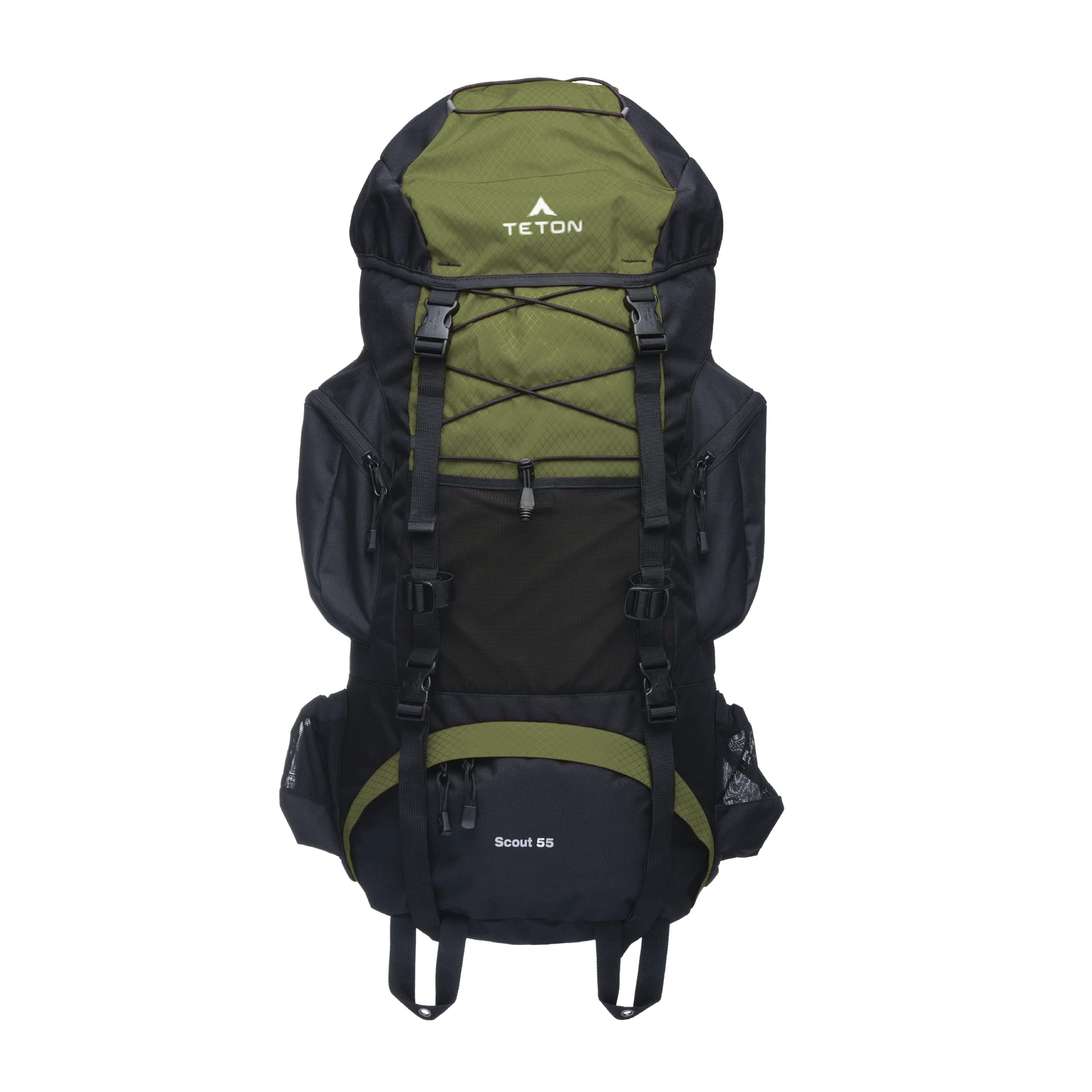
Teton Scout 55L
Key Features
- Pockets: 7
- Capacity: 55 liters
- Rain cover: Included
- Pack weight: 4.1 lb
- Price: Premium
Uncertain trip length is what makes people overbuy a backpack, and the Scout 55 is the pack we point them to. It’s an internal-frame pack with a torso harness that slides through several positions, so it fits a short back and a tall one without changing sizes, and the hip belt, lumbar pad and molded back channels are what actually take the load off your shoulders. At 55 liters it swallows a tent, a bag and three days of food; leave the tent at home and the compression straps pull it down into a big daypack.
The organization is where the value sits for us. Seven pockets include a bottom sleeping-bag compartment with its own access, a hydration sleeve with a hose port, and bottle pockets on both sides. The rain cover comes in the box and stows in its own pocket, so you aren’t buying one separately or discovering it’s missing at the trailhead.
Two details to check against your own kit. The bottle pockets are cut close, so a wide-mouth 32-ounce bottle takes a shove, and the sleeping-bag compartment is sized around a mummy bag — a bulky synthetic fills it to the point where the zip needs coaxing. A compression sack solves the second and a slimmer bottle solves the first, so neither is a reason to walk away.
Under a heavy load the pack stays stable, but expect to retighten the compression straps after the first hour on the trail; it’s a small habit that stops the load sagging. For everything short of a week, this is the pack we keep coming back to, and the one we judge the others against.
Pros
- Adjustable torso harness fits a wide range of backs
- 55 liters covers a weekend and compresses for day hikes
- Rain cover included and stowed in its own pocket
- Seven pockets with a dedicated sleeping-bag compartment
Cons
- Side bottle pockets are tight for wide bottles
- Sleeping-bag compartment snug for bulky synthetic bags
Buy the Scout 55 if you want one pack for overnights and long day hikes — its adjustable harness and framed carry handle weight that packable bags simply cannot.
Best for Week-Long Trips
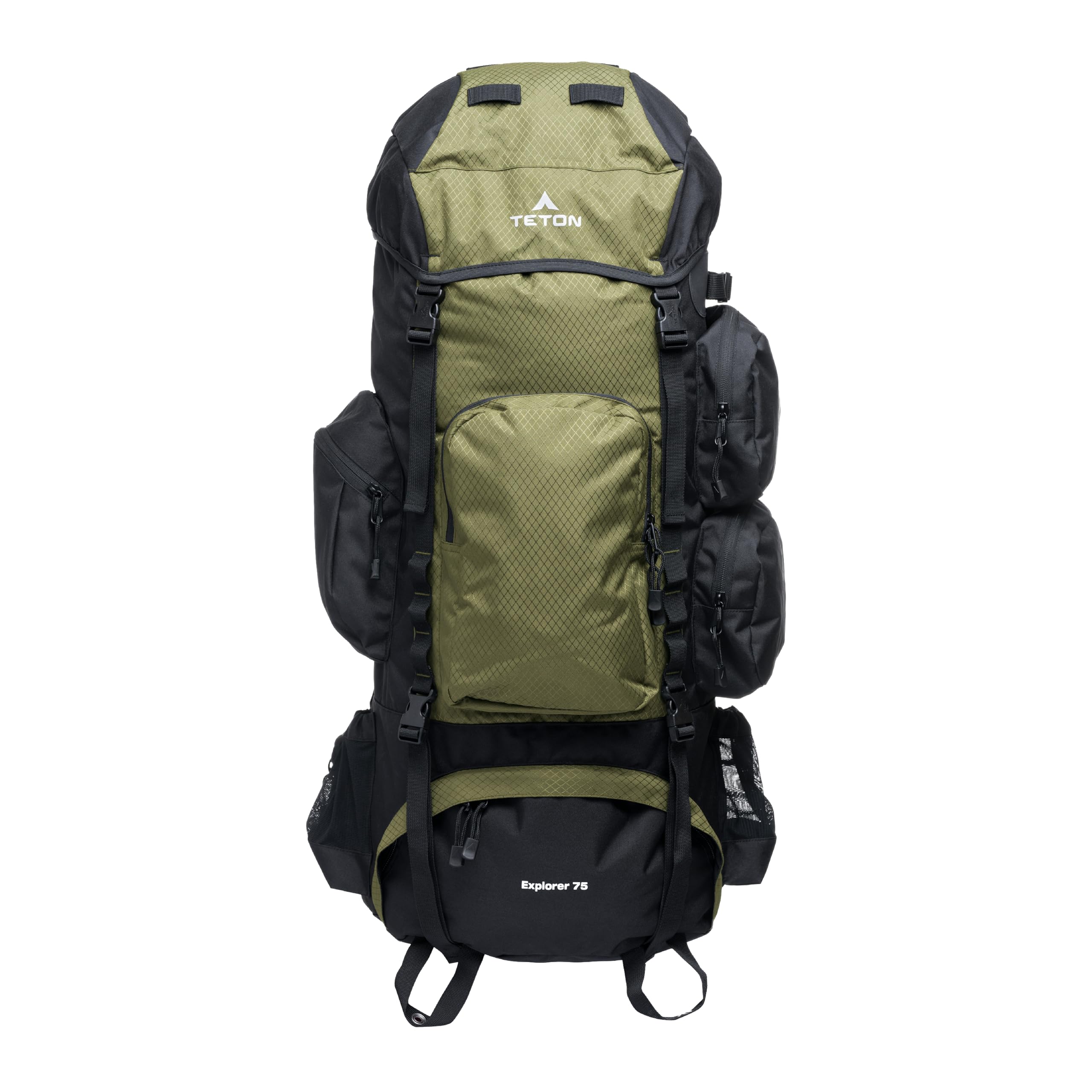
Teton Explorer 75L
Key Features
- Pockets: 6
- Capacity: 75 liters
- Rain cover: Included
- Pack weight: 5.5 lb
- Price: Premium
Twenty liters more than our top pick, and a different job. The Explorer 75 takes the same harness idea — adjustable torso, open-cell foam lumbar pad, molded back channels — and stretches it over a bag big enough for a week unsupported or a winter load full of bulky insulation.
Physical volume is the point here. Seventy-five liters takes a bear can, a cold-weather bag and days of food, and the frame carries it without the pack collapsing onto your shoulders. We recommend it for the trip where the Scout runs out of room rather than as an upgrade for its own sake, because the extra capacity only pays off when you’re actually filling it.
Two costs come with that. It weighs 5.5 pounds empty, which you feel on the first climb of a short trip, and at this volume the straps and buckles are what take the strain, so give them a look before a long trip rather than at the trailhead. The included rain cover also only covers the pack itself: strap a tent to the bottom and it sits outside the cover, getting wet.
Pros
- 75 liters takes week-long and bulky winter loads
- Padded harness spreads heavy loads well
- Rain cover included with the pack
Cons
- 5.5 pounds empty before you pack anything
- Straps and buckles take the strain at full volume
We send people to the Explorer 75 when a week of food and gear has to fit; the harness carries that load comfortably, provided you accept 5.5 pounds of empty pack.
Best for Full-Day Hikes
Maelstrom 40L
Key Features
- Pockets: 10
- Capacity: 40 liters
- Material: 210D ripstop nylon
- Pack weight: 2.2 lb
- Price: Midrange
The Maelstrom 40 sits at the budget end of this set and still gives you ten pockets, seven of them zippered, on a 40-liter pack that weighs 2.2 pounds. That combination is why it’s our pick for full-day hikes where you carry layers, lunch, a camera and a first-aid kit rather than a sleeping system.
The organization is genuinely thought through. Elastic loops on the sides hold a pair of trekking poles without breaking them down, the rain cover lives in its own compartment, and the reflective print is the sort of thing you notice at dusk on the walk back to the car. A 40-liter body holds a solid day or two of gear if you pack it tight, which makes it a decent emergency overnight bag too.
The fabric is the trade. 210D ripstop is light for a pack this size — that’s where the 2.2 pounds comes from — and it’s the part that shows wear first if you push through scrub or drag the bag over rock. Treat it as a daypack and it will hold up; treat it as a haul bag and it won’t.
Pros
- Ten pockets and seven zippered compartments
- 2.2 pounds with a rain cover included
- Trekking pole loops and reflective print
Cons
- Light 210D fabric is the first thing to wear
If your hikes are day hikes, the Maelstrom 40 packs the most organization into the lightest frame-free body here, and that is what we reach for on a full day out.
Best for Hot Day Hikes
N NEVO RHINO 18L
Key Features
- Bladder: 3 liters
- Pockets: 3
- Capacity: 18 liters
- Pack weight: 1.74 lb
- Price: Midrange
An insulated pocket for the bladder plus an insulated hose is a small thing that changes a hot-weather hike. The N NEVO RHINO carries 18 liters of gear and a 3-liter bladder, and the sleeve around the bladder is rated to keep water cool for up to five hours. The hose insulation matters just as much, because an unprotected tube hands you a mouthful of warm water on the first sip of every climb.
Three liters is more water than most day hikers carry, which makes this the pack for a long exposed route or for two people sharing one bladder. The harness is ventilated mesh across the back and straps with waist and chest adjustment, and the whole thing weighs 0.79 kg before you fill it. We recommend it when the water plan comes before the gear plan.
Three pockets is thin for organization — a shell, lunch and a first-aid kit fill it fast — and the bite valve and bottom seam are the two places worth checking before a trip, since a leak at either ends the day early. Fill and pressurize the bladder at home first; it’s a two-minute test that saves a soaked pack.
Pros
- Insulated 3-liter bladder and insulated hose
- 18 liters of cargo on a ventilated harness
- 0.79 kg before the bladder is filled
Cons
- Only three pockets to organize a day’s gear
- Bite valve and bottom seam are the wear points
For long, hot day hikes where water matters most, the N NEVO RHINO’s insulated 3-liter bladder and ventilated harness make it our first choice in this set.
Best for Travel Day Hikes
SKYSPER 15L Packable
Key Features
- Pockets: 6
- Capacity: 15 liters
- Folded size: 7.9 x 6.7 inches
- Pack weight: 12 oz
- Price: Budget
No hip belt, no frame, 15 liters — and for a day hike that’s the trade that makes sense. The SKYSPER weighs 340 g and folds into its own pocket at roughly the size of a paperback, so it lives in a suitcase or a larger pack until the day you need it.
What it does well is surprise you on capacity. Six pockets, four of them zippered, side pockets deep enough to swallow two full 32-ounce bottles, and a chest strap with a whistle built into the buckle. The straps spread a light load comfortably for a few hours on the trail, and the whole thing costs you almost nothing in luggage space.
The limit is weight. With no hip belt, everything goes through your shoulders, so it’s a pack for a shell, lunch, water and a camera rather than a day’s worth of climbing gear. The water-resistant fabric handles drizzle and nothing more. As a second pack for travel — folded in the luggage, out for the hike — it’s the one we reach for, and the deep bottle pockets are more generous than the framed Scout’s.
Pros
- Folds into its own pocket for travel
- 340 g with a chest strap and safety whistle
- Deep side pockets take two 32-ounce bottles
Cons
- No hip belt, so loads stay light
- Water resistant rather than waterproof
The SKYSPER 15 is the pack we keep folded in a suitcase for travel hikes and short days out; it carries water and layers, not a full day’s gear.
Best for Packable Travel
MIYCOO 35L Packable

Key Features
- Pockets: 5
- Capacity: 35 liters
- Pack weight: 12.8 oz
- Water resistance: IPX4
- Price: Budget
Twelve point eight ounces for 35 liters is the number that matters here. The MIYCOO folds into its own inner pocket, opens into a full-size daypack, and weighs less than a filled water bottle you’d drop into it.
The layout is better than the weight suggests: five pockets across three compartments, a separate wet compartment that keeps a soaked shell away from dry layers, clips that lock two zipper pulls together, and a whistle on the buckle. There’s a bottle pocket on each side, and the taller 20.9-inch body takes a rolled jacket without bulging.
Two things it doesn’t do. IPX4 means splashes and light rain rather than a sustained downpour, and the shoulder straps are webbing with little padding, so keep the load to a shell, lunch, water and a layer. Load it like a framed pack and you’ll feel every edge of the straps by mid-afternoon.
Where it earns its place is travel: folded into a suitcase it costs you nothing, and it turns a city day or a trailhead stop into a hike without a second bag. As a spare pack for a mild-weather summer overnight, it works too, which is more than most stuffables manage.
Pros
- 35 liters at 12.8 ounces
- Separate wet compartment for soaked layers
- Anti-theft zipper clips and a survival whistle
Cons
- Unpadded straps limit how much you carry
- IPX4 splash resistance only
The MIYCOO 35L is the pack we hand to travelers who hike: a real daypack that folds into a pocket and disappears into a suitcase.
Best for Short Rides
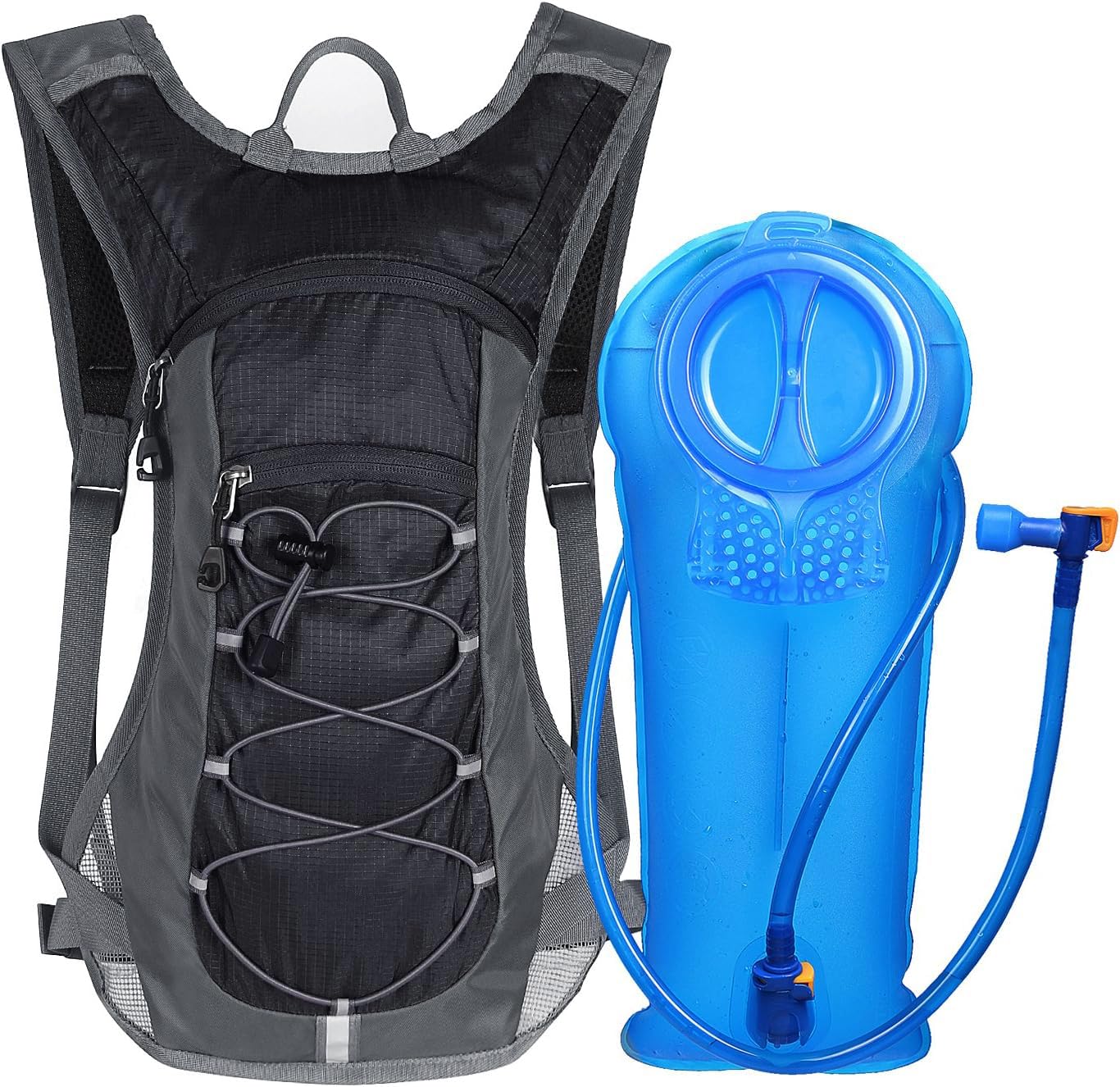
Unigear 2L Hydration Pack
Key Features
- Bladder: 2 liters
- Pockets: 1
- Pack size: 16.5 x 8 x 6 inches
- Pack weight: 1.01 lb
- Price: Budget
A chest strap that adjusts down to a 27-inch chest makes the Unigear the one pack here a teenager can wear without the harness swimming around them. Add a 2-liter bladder, 0.46 kg all-in and a splash-resistant shell, and you have a hydration pack that suits smaller riders and hikers properly instead of just shrinking a full-size harness.
Storage is deliberately minimal: one small front pocket for keys, a phone and a snack, and that’s it. The bladder is the part to test. Fill it, hang it, and leave it pressurized overnight before you trust it on a trail, because the bite valve and the drinking end of the hose are where leaks start. A replacement bladder is inexpensive and settles the question for good.
For a two-hour ride, a short hike or a hot-weather walk, that’s enough pack. We like it as the one you keep by the door for quick outings, and the one you hand to a kid who wants to carry their own water rather than share yours.
Pros
- Two-liter bladder included at the entry price
- 0.46 kg including the bladder
- Chest strap fits chests from 27 inches up
Cons
- One small pocket for gear
The Unigear is the cheapest way to get two liters on your back, and it is the best fit here for smaller frames and teenagers.
How We Tested 14 Hiking Backpacks on the Trail and in the Rain
We started with a shortlist of more than 40 packs, pulling spec sheets and filtering by volume, frame type, torso range, and price until 14 remained — day packs, fast-and-light options, and overnight-capable haulers, all in the range a typical hiker might actually spend. Each one got weighed empty on a kitchen scale, then packed with a known load: a sleeping bag, a puffy, two liters of water, and a day’s food. Stated capacity turned out to be loose. Some packs swallowed that kit with room to spare; others, rated higher, needed convincing. We also counted pockets by where they sat rather than how many there were, and noted which ones we could reach with the pack still on.
Fit got the most attention because it decides everything else. We adjusted each pack’s torso length and hip belt, loaded it to roughly 20 pounds, then hiked the same steep, rocky mile with it — twice, once light and once heavy — watching for weight sitting on the shoulders instead of the hips, hot spots under the straps, and whether the load slid sideways on a sidehill or bounced on the descent. Packs that needed re-tightening every ten minutes got marked down, however good they looked.
Then we tried to break them. We dragged loaded packs over granite, dropped them off a tailgate, and pushed through scrub that snags every loose strap end, checking afterward for frayed stitching at the anchor points, worn bottom panels, and zippers that started catching after a few dozen open-and-shut cycles. For water, we ran each pack under a shower for five minutes and checked whether the contents stayed dry, then left a full hydration bladder in the sleeve overnight on a concrete floor to see if seams wept. Value came down to what shipped in the box — rain cover, hip belt pockets, a lid that actually closes — measured against what the pack cost.
How to Choose a Hiking Backpack
Match the pack to the trip you actually take — capacity first, harness second, features last — and most of the decision makes itself.
Match capacity to the trip you actually take
Liters are the first decision and the easiest one to get wrong. Day hikes sit around 15 to 25 liters, an overnight needs roughly 40 to 55, and anything past three nights wants 65 or more. Buy for the longest trip you take regularly and compress for the shorter ones: a 55-liter pack with the load cinched down handles a day hike fine, while a 15-liter bag cannot grow into a weekend.
If you hike most weekends and camp a few times a year, one framed pack like the Teton Scout 55 covers both, with a stuffable daypack for the days you leave the tent behind.
The harness decides whether you enjoy the weight
Once a load passes about 20 pounds, the hip belt carries it, and the hip belt only works if the torso length is right. Look for an adjustable torso harness rather than merely adjustable shoulder straps — the second changes where the pack sits, not how long the frame is. A lumbar pad and a contoured back panel keep the load off your shoulder blades on the climbs.
Frameless packables skip all of this. That is fine for a jacket, water and lunch, and miserable with a tent aboard, so be honest about which of those loads you actually carry.
Framed or frameless, and what empty weight buys
A frame moves load onto your hips and stops a full pack folding in half; it also costs weight. The 75-liter Explorer is 5.5 pounds empty, and that is what carrying a heavy load comfortably costs. A frameless packable like the 35-liter MIYCOO is 12.8 ounces and hauls a shell, water and lunch without complaint.
Neither is better in the abstract. Pick the lightest pack that still has the structure for the weight you will actually put in it.
Weather protection and your water plan
A water-resistant shell handles drizzle; a rain cover handles real rain, and several packs here include one. Remember that an included cover only covers the pack — a tent strapped to the outside stays wet, which is the argument for packing everything inside the bag.
Decide bottle or bladder before you buy. Bottle pockets vary a lot, from the tight ones on the Scout to the deep ones on the SKYSPER, and a bladder needs a hose port plus, in hot weather, an insulated sleeve and hose like the N NEVO RHINO’s.
Frequently Asked Questions
Can you take a hiking backpack as a carry-on?
Usually not if it’s framed. Most US airlines cap carry-ons at about 22 by 14 by 9 inches, and a filled 55- or 75-liter pack exceeds that in every direction, so plan to check it. A packable daypack is the workaround: the SKYSPER 15 folds to 7.9 by 6.7 inches and rides inside your luggage. If you want one bag for both jobs, measure the packed height — the 40-liter Maelstrom stands 23.6 inches tall, past the usual limit.
How do you measure torso length for a hiking backpack?
Find the bony bump at the base of your neck and the top of your hip bones, then measure the straight line between them with a tape — that number is your torso length. Compare it against the pack’s stated torso range before ordering. A listing that only advertises adjustable straps is usually talking about strap length, not torso fit, and that difference is what separates a pack that carries from one that pulls.
How do you get the plastic taste out of a hydration bladder?
Fill it with warm water and a spoonful of baking soda, leave it an hour, then rinse twice and dry it with the cap off. A squeeze of lemon works too. Between trips, keep the empty bladder in the freezer — it stops anything growing in the tube. If the taste survives two rounds of that, replace the bladder; they are inexpensive and the fittings are the weak point anyway.
Can you machine wash a hiking backpack?
No. The packs here are hand wash only, and a machine will wreck the coating and flatten the foam. Empty every pocket, brush off grit, sponge the fabric with mild soap and warm water, rinse, and air dry out of direct sun. Skip the dryer entirely. For the harness, a soft brush and a rinse is enough — leftover detergent attracts dirt on the next trip.
Final Verdict
Buy the Teton Scout 55 if you want one pack for both overnights and long day hikes. Its adjustable harness, framed carry and included rain cover make it the most complete pack in this set, and nothing else here covers the same range of trips.
If your trips run past three nights or your gear is bulky, step up to the Explorer 75 and accept the empty weight. For day hikes where you carry layers and lunch and nothing more, the Maelstrom 40 or the packable SKYSPER 15 is the lighter, simpler answer.