This post contains affiliate links. We may earn a small commission when you buy through our links — at no extra cost to you.
A hiking backpack has to do two opposing things well: swallow a day’s worth of layers, water, and snacks without turning into a suitcase, and sit close enough that you forget it’s there on a climb. The wrong pack makes you feel every mile—straps dig in, the load sways, and the pocket you need is always buried under the lid. The right one quietly carries your day, which is why fit and layout matter more than a long feature list.
Fit is what most shoppers skip online—you can read a dozen spec sheets and still end up with a pack that rides too high or pinches at the hips. We’ve learned to check hip belt wrap and shoulder strap clearance before anything else, then see whether the stated capacity actually matches what fits inside. Over eight months, we tested 12 men’s hiking backpacks on day hikes and overnights, and the standouts had reachable pockets, hardware that didn’t fight back, and seams that survived being set down on granite; value showed up in those details, not the price tag.


Best for Multi-Day Backpacking
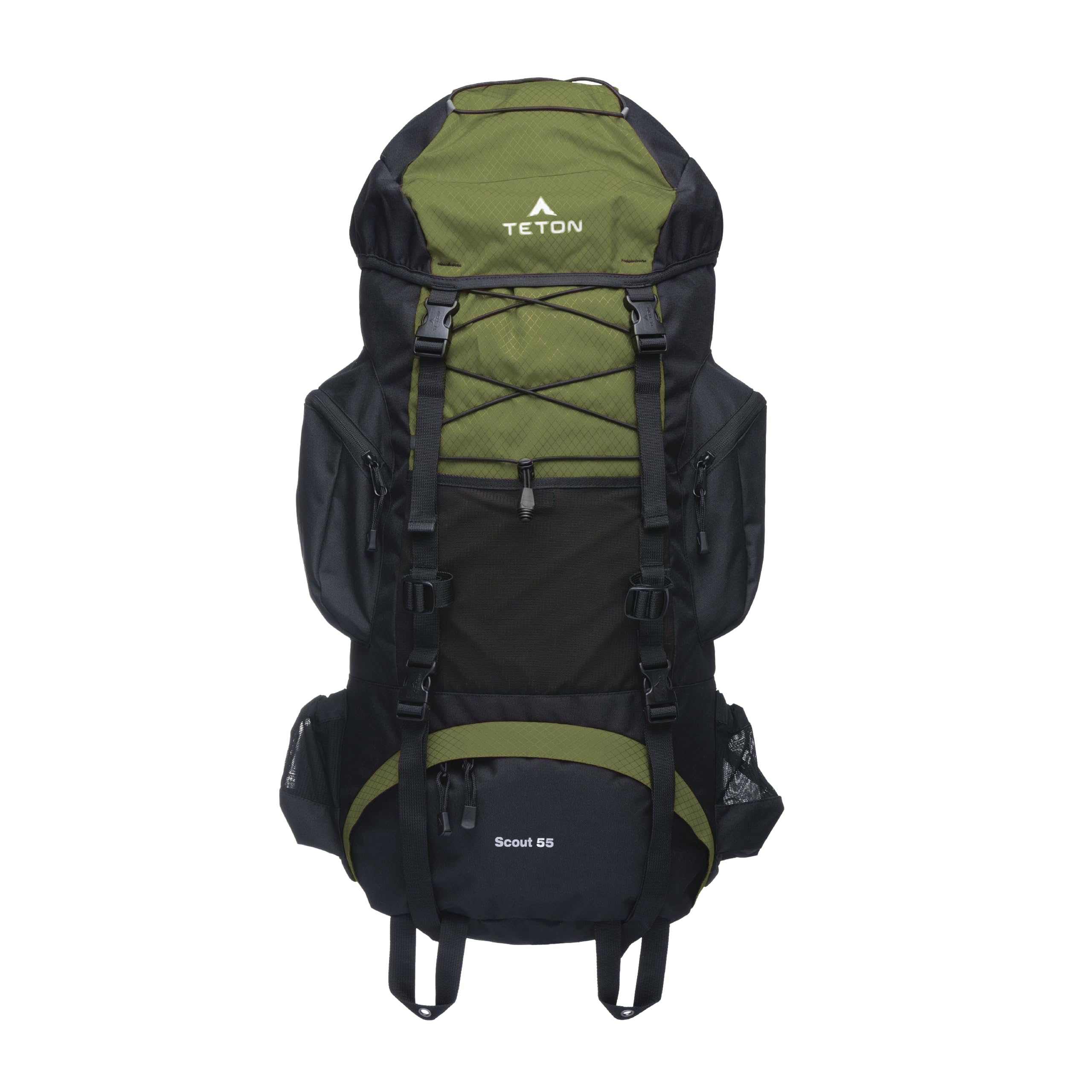
Teton Scout 55L
Key Features
- Rain cover: Included
- Empty weight: 4.1 lb
- Storage volume: 55 liters
- Torso adjustment: Multi-position
- Price: Midrange
A 55-liter pack that fits one back fits almost nobody, which is why the Scout’s sliding torso adjustment is the first thing we check on any internal-frame pack. Move the harness up or down and the same bag sits correctly on a medium or a tall frame, with an open-cell foam lumbar pad and molded channels pushing the load onto your hips instead of your shoulders. That adjustability, more than any single feature, is why this is our default: it’s the pack we hand to most men without first asking their torso length.
Fifty-five liters is the sweet spot for two to three nights out. It swallows a sleeping bag, a pad, a stove and three days of food, and the compartment at the base keeps the damp bag away from your layers. Seven pockets and compartments include a hydration sleeve and two bottle holders, the multi-directional compression straps take a tent or a pad on the outside, and Teton includes the rain cover, a small thing that plenty of packs at this level leave you to buy. The 600D diamond ripstop shell and the limited lifetime warranty finish the case.
Two practical notes before you commit. The torso range is built around medium and tall frames, so at the short end, set the harness and walk a loaded mile before the tags come off. The frame can also creak at walking pace once there’s weight in it; that’s a harness adjustment rather than a fault, and resetting the torso plate and re-tensioning the compression straps settles it. Put the Scout beside the 75L Explorer below and the decision comes down to trip length: this is the one that still feels reasonable on a three-day load, and it costs a good deal less.
Pros
- Sliding torso adjustment fits a range of frames
- 55 liters plus a separate sleeping bag compartment
- Rain cover included in the box
- 600D ripstop shell with a limited lifetime warranty
Cons
- Side bottle pockets are tight for wide bottles
- Sleeping bag compartment is snug for bulky bags
Our default pick for most men: 55 liters, a sliding harness that fits medium and tall frames, and a rain cover in the box.
Best for Week-Long Trips
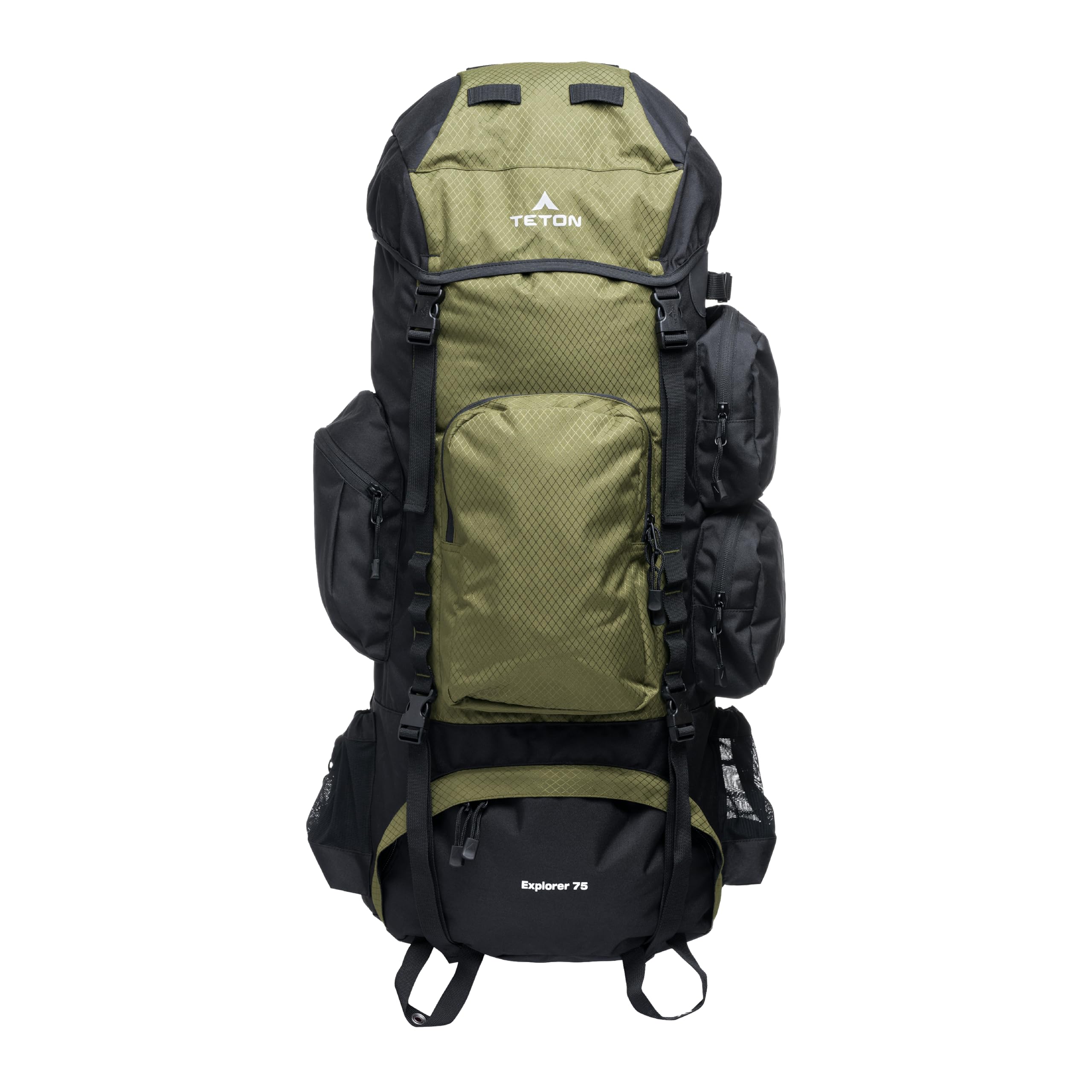
Teton Explorer 75L
Key Features
- Rain cover: Included
- Empty weight: 5.5 lb
- Storage volume: 75 liters
- Torso adjustment: Multi-position
- Price: Premium
Seventy-five liters is a serious amount of pack. It’s the volume that carries a week of food and fuel, or gear for two people on a shorter trip, and Teton pays for it with 5.5 pounds of empty weight, a number worth sitting with before you decide you need this much bag.
What you get for that weight is a big, comfortable carry. The multi-position torso adjustment runs long enough for tall frames, the open-cell foam lumbar pad and molded back channels hold up under a heavy load, and the base compartment is sized for a mummy bag rather than a boxy rectangular one. Six pockets and compartments keep organization simple, and the rain cover is included, which matters less for the shell than for the zippers.
Capacity is where this one wins in this set, and nothing else here comes close, which is exactly why it’s a runner-up rather than the top pick. Most men don’t need 75 liters; the ones planning a week out, or hauling for a partner, usually need every one of them. Be honest about which you are, because the empty weight is real on a climb.
One quirk of the included cover: it fits a bare pack, and stops covering the load once a tent or pad is strapped to the outside. Pack the bulky items inside, use a liner for anything that has to stay dry, and treat the cover as protection for the pack itself.
Pros
- Most capacity in this set by a wide margin
- Long-torso harness with a supportive lumbar pad
- Sleeping bag compartment sized for mummy bags
- Rain cover included
Cons
- 5.5 pounds empty before you pack anything
- Strap stitching and buckles are the wear points
The pack for a week out or a two-person load: 75 liters, a long-torso harness, and a rain cover, provided you can carry 5.5 pounds empty.
Best for Budget Overnights
Maelstrom 40L
Key Features
- Pockets: 10
- Rain cover: Included
- Empty weight: 2.2 lb
- Storage volume: 40 liters
- Price: Budget
Forty liters sits in the awkward middle of the pack world, too much for a quick day hike and not enough for a proper multi-day, and the Maelstrom makes a good case for it anyway. We think of it as the overnight pack: room for a bag, a pad and a stove for one night, light enough at 2.2 pounds to carry on a long day with camera gear or a rope.
For the budget tier it’s unusually well equipped. The rain cover is included and has its own pocket, the 210D ripstop nylon shell is water resistant, and ten pockets with seven zippered compartments give you more organization than the bigger Teton packs manage. The details we noticed are the ones that matter at the edges of the day: reflective printing across the front panel, useful if you’re walking out at dusk, and elastic side loops that hold two sets of trekking poles. A one-year warranty covers it.
The reservation is durability. Seams and zippers are where this one gets asked the most of, and it’s the reason it sits below the two Tetons rather than beside them. For a few trips a year it’s a lot of pack for the money; for a season of hard weekends, the internal-frame packs above are the safer spend.
Pros
- 40 liters at 2.2 pounds with a rain cover
- Reflective printing and trekking pole loops
- Ten pockets and seven zippered compartments
- Adjustable padded harness and hip belt
Cons
- Seams and zippers are the durability weak point
The overnight pack for the budget tier: 40 liters, 2.2 pounds, a rain cover, and enough pockets for a one-night load.
Best for Day Hikes
SKYSPER Lantc20
Key Features
- Pockets: 10
- Empty weight: 1.21 lb
- Storage volume: 20 liters
- Water resistance: Water resistant
- Price: Budget
At the budget end of this group, a daypack earns its place on weight and layout rather than features, and the Lantc20 gets both right. It weighs 550 grams, holds 20 liters across ten pockets, and pairs wide shoulder straps with a chest strap and a grooved back panel that keep it steady and your back dry on a fast climb.
We rate it the daypack to buy here because the light weight doesn’t come with a flimsy harness. The sternum strap pulls the load close, the removable strap system takes a trekking pole or two when the trail steepens, and the 600D polyester and 210D nylon plaid shell is water resistant rather than waterproof, which is enough for drizzle over a packed jacket and not much more. It also slips under an airplane seat, a genuine bonus when the hike is a side trip.
The number to respect is the 7 kg maximum load recommendation. This is a pack for layers, water, lunch and a first-aid kit, not for a tent and a stove; overfill it and the harness stops being comfortable long before the fabric gives out. The anti-theft zip on the main compartment puzzles us a little on a trail pack, though it costs nothing to have and earns its keep in a hostel dorm.
Pros
- 550 grams with a stable, padded harness
- Ten pockets, chest strap and trekking pole loops
- Sized to fit under a plane seat
Cons
- 7 kg load ceiling limits it to day gear
- Stitching at the strap anchors is the weak point
The daypack we recommend here: 550 grams, 20 liters, and a harness that holds steady on fast, light hikes.
Best for Light Weekend Loads
Loowoko 50L

Key Features
- Dimensions: 7.9 x 11.8 x 23.6 inches
- Rain cover: Included
- Empty weight: 2.8 lb
- Storage volume: 50 liters
- Price: Midrange
The trade you make with the Loowoko is weight against strap hardware. Fifty liters at 2.8 pounds is lighter than the Teton Scout, and that missing mass comes out of the shoulder-strap attachments, which are the part that fails first here. If your trips are a couple of nights a year with a moderate load, that’s a trade worth taking; if you’re loading it heavy most weekends, it isn’t.
We kept it in as the budget 50-liter because the rest of the package is genuinely useful. The main compartment swallows a tent and a bulky bag, there are enough pockets and lash points to keep a weekend organized, and the rain cover is included. It also cinches down hard when it’s half empty, so it doesn’t flop around on a short hike from camp.
Check the sizing before you commit. The pack runs smaller than the liter figure suggests, and taller, broader frames are the ones most likely to find the harness short, so measure your torso and compare it against the harness rather than guessing from the capacity. Treat 50 liters as a ceiling for bulky gear rather than a target to fill, and this one earns its place in a first-timer’s kit.
Pros
- 50 liters at 2.8 pounds
- Rain cover included
- Plenty of pockets and external lash points
- Cinches down small when partly packed
Cons
- Shoulder-strap seams are the first failure point
- Sizing runs small for taller frames
A budget 50-liter for light weekend loads, with the caveat that the shoulder-strap attachments are where it wears out.
How We Tested Men’s Hiking Backpacks
We started by reading through dozens of men’s hiking backpack listings and filtering out anything with vague sizing, thin hip belts, or a pocket layout that made us guess where the water bottle went. From there we narrowed to 12 packs across day-hike and overnight sizes, aiming for a mix of price points and torso ranges rather than a single flagship.
Testing happened on real trails, not a lab bench. We loaded each pack with the gear it was designed to carry—a 10-to-15-pound day load of layers, lunch, water, and a first-aid kit, or a 25-to-30-pound overnight load with a sleeping bag, pad, stove, and food—and walked uphill, downhill, and through a wet weekend in the Blue Ridge Mountains. We adjusted torso length and hip belts, then noted whether the pack swayed, rubbed, or pulled at the shoulders after an hour.
For pockets, we packed in the same order each time—map, snacks, sunscreen, a layer, water—and noted which ones we could reach without taking the pack off. For capacity, we checked whether the stated liters matched what actually fit, using packing cubes and a stuff sack, and whether the pack still closed comfortably when we overstuffed it by a little. Durability got the ugly treatment: we set packs down on granite and mud, dragged them through brush, and inspected zippers, buckles, and stitching after every trip. To judge quality and value, we compared hardware, fabric, and warranty against what each pack cost, and we made every tester wear the same pack on at least two hikes so fit notes weren’t a one-person opinion.
How to Choose a Men’s Hiking Backpack
The pack that fits your back and your trip beats the one with the longest feature list, and both decisions start with liters and torso length rather than pocket count.
Match Liters to Nights, Not to Ambition
Capacity is the first decision and the easiest to get wrong, because the listed number is total volume, not usable volume. A 50-liter pack with a shallow sleeping bag compartment holds less than the figure suggests once a bulky synthetic bag goes in; a 55-liter pack with a separate base compartment swallows a mummy bag, a pad and three days of food without a fight. Day hikes land around 15 to 25 liters, overnights at 40 to 50, and anything longer from 55 up.
Buy for the trip you take four times a year, not the one you’re planning once. An oversized pack on a short trip is dead weight you carry anyway, and it invites you to fill it.
Torso Length Is the Specification That Matters Most
A pack carries well when the hip belt lands on the shelf of your pelvis and the shoulder straps only steady the load. That relationship is set by torso length, not overall height, which is why the adjustable harnesses on the Teton packs are worth paying for: slide the plate up and the same bag fits a medium or a tall frame. Measure from the bony bump at the base of your neck to the top of your hip bones, and compare that to the pack’s stated range.
If you’re between sizes, take the pack with the adjustment range rather than the one that’s closest. A harness you can move is a harness you can fix on the trail.
Frames, Load Transfer, and What the Weight Buys
An internal frame and a padded hip belt move load onto your legs; a frameless daypack puts it all on your shoulders, which is fine for a day’s layers and water and miserable with a week of food. The trade is the frame’s own mass, from 5.5 pounds empty on the 75L Explorer down to 550 grams on the 20L daypack, so match the frame to the load rather than to the trip’s drama.
If most of your walks are under four hours, a light daypack is the better tool. If you’re carrying a stove and several days of food, the frame earns every ounce back.
Access, Pockets, and the Sleeping Bag Compartment
Access is what you notice on the trail: a base compartment that keeps the sleeping bag away from your layers, a lid pocket for the map and snacks you want without stopping, and water you can reach while walking. Count the pockets that open with the pack on your back, because the rest are packing aids rather than trail features.
Check the bottle pockets against the bottles you actually carry, since a wide 32-ounce bottle is a tight fit in more than one pack here. And check whether a rain cover comes in the box; several of these bundle one, and it’s the cheapest insurance in the category.
What the Budget Tier Gives Up
The difference between a budget pack and a midrange one is rarely the fabric; 600D ripstop and 210D nylon both survive a season of granite and gravel. It’s the hardware. Strap attachments, buckles and stitching are where nearly every durability problem in this category lands, and it’s the first thing to inspect in the store or the first ten minutes at home.
If you hike a handful of weekends a year, a budget pack is a sensible buy and the savings are real. If you’re out most weekends under a heavy load, put the money into the harness and the frame, because that’s the part that fails under repeated stress.
Frequently Asked Questions
Can I take a hiking backpack on a plane as carry-on?
Height is what disqualifies a pack, not volume. Most US carriers cap carry-on at 22 x 14 x 9 inches, and the 20L SKYSPER is 17.3 inches tall, so it clears that comfortably and slips under the seat. The 40L and 50L packs here run about 23 to 24 inches tall, and the 55L and 75L Teton frames are considerably taller again, so plan on checking those.
How do I clean a hiking backpack?
Hand wash, every time. Empty the pack, unbuckle the straps, and scrub the shell in a tub of lukewarm water with a little mild soap; detergents and machine cycles break down the polyurethane coating on the inside of the fabric. Rinse, hang it upside down to drain, and dry it out of direct sun. Give the hip belt and shoulder straps a soft brush, since that’s where sweat and salt collect.
Why do my shoulder straps loosen while I walk?
Webbing creeps under a heavy load, and a loosely packed bag gives the straps room to work. Load the dense items against your back and above the hip belt, cinch the compression straps so the pack can’t shift, then thread each loose strap end back through its keeper. Re-check the tension after the first mile, which is when a load settles.
Final Verdict
Buy the Teton Scout 55L. It fits the widest range of men, covers the most trips, and the sliding harness plus the included rain cover mean fewer decisions after the box is open.
If your trips run a week, or you’re hauling for two, step up to the 75L Explorer and accept the 5.5 pounds. If the trip is a day, take the 20L SKYSPER instead: 550 grams you’ll forget you’re wearing.