This post contains affiliate links. We may earn a small commission when you buy through our links — at no extra cost to you.
The fantasy is packing everything you need; the reality is feeling every ounce of it by mile four. A women’s hiking backpack is supposed to close that gap, but only if it actually fits your frame. A pack built for a longer torso rides high and yanks at your shoulders no matter how carefully you load it, and a hipbelt sitting above your hip bones takes nothing off your back. What you’re really shopping for is a pack that parks the load on your hips, keeps water and a snack reachable without stopping, and survives being set down on granite a hundred times. We’ve carried 12 of them over the past seven months, and the differences are not subtle.
Here’s the advice I’d give any first-time buyer: liters tell you how much a pack holds, not whether it will fit you. Torso length comes first, then hipbelt shape, then capacity. Women’s-specific designs usually run shorter torso ranges with narrower straps and a hipbelt contoured for wider hips, and a five-liter-smaller pack you can reach into while walking beats a cavernous one you have to stop and unload. The picks below are the ones that earned a place on our hikes.
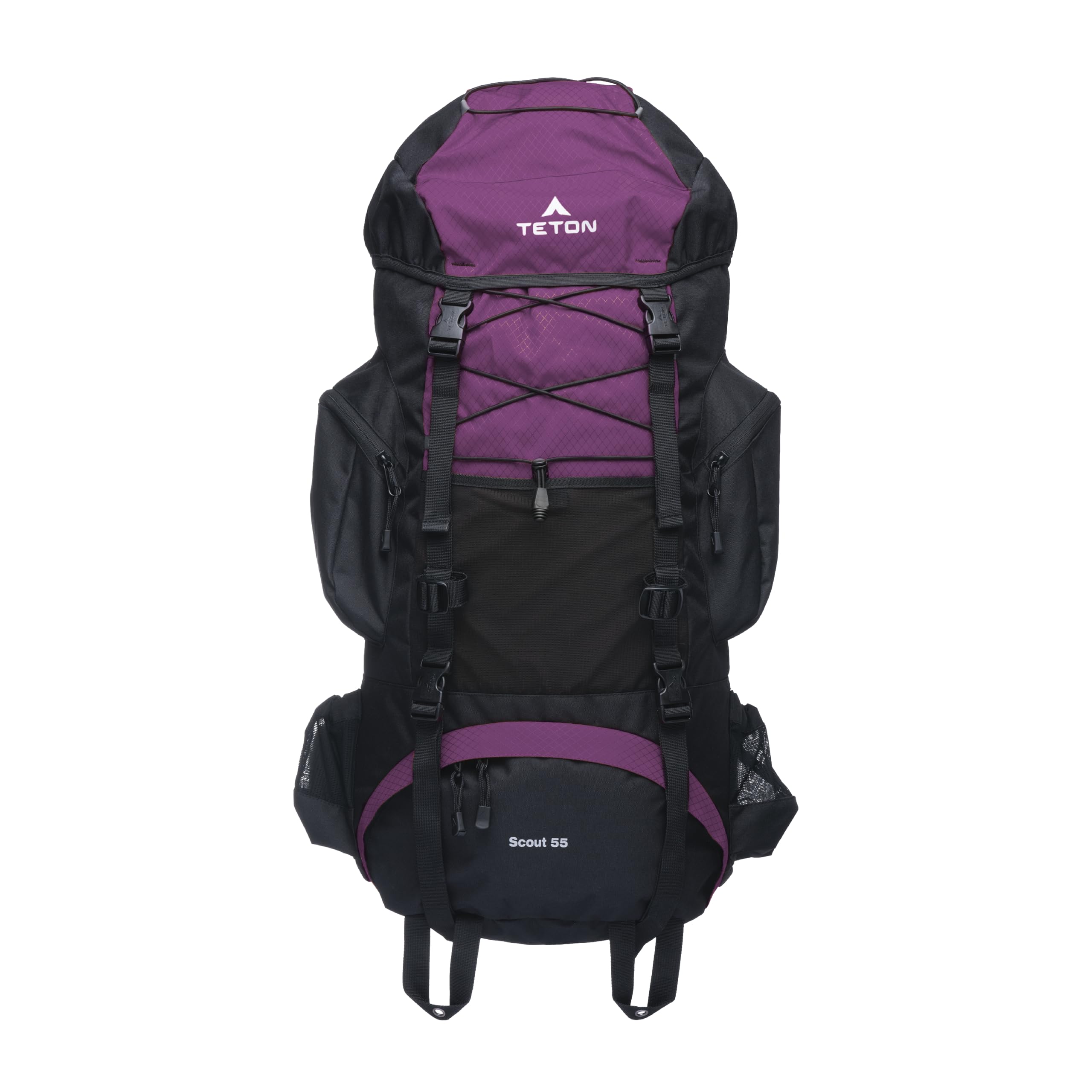


Best for Multi-Day Backpacking
Teton Scout 55L
Key Features
- Pockets: 11
- Capacity: 55 liters
- Torso fit: Multi-position adjustable
- Rain cover: Included
- Price: Premium
Torso length decides whether a backpack works, and the Scout is the pack here that adjusts for it: the harness slides through a multi-position panel, so the same bag fits a short-backed hiker and a taller one. We put that adjustment at the center of this recommendation, because 55 liters of gear carried in the wrong place on your back is worse than 35 liters carried right. Add an open-cell foam lumbar pad with molded ventilation channels and a hip belt that takes real weight, and it’s the pack here that asks the least of your body type.
Fifty-five liters is a lot of pack, and Teton spends it well: a separate sleeping bag compartment at the base, 11 pockets, a hydration sleeve with a hose port, and bottle holders on both sides. The rain cover arrives in the box rather than as an extra purchase two weeks before a trip, and the 600D diamond ripstop shell is the heaviest fabric in this group — you can feel the difference when you haul it out of a car trunk by one strap.
The compromises are in the small dimensions. The side pockets are tight enough that a wide-mouth bottle takes two hands, and the sleeping bag compartment is snug, so a bulky synthetic bag eats into the main body. Neither is a dealbreaker, and both are the kind of thing you discover in the driveway rather than at the trailhead, so pack it once at home before you leave.
This is the pack we hand to a friend buying her first real hiking pack, and the one that covers a day hike and a three-night trip without a second purchase. Measure your torso before you order — the adjustment buys a couple of inches, not a magic fit — and check that the shoulder straps lie flat over your collarbones with the belt sitting on your hip bones rather than your waist.
Pros
- Multi-position harness fits shorter and longer torsos
- 55 liters with a separate sleeping bag compartment
- Rain cover included in the box
- Lumbar pad and ventilated back panel
Cons
- Side bottle pockets are tight on wide bottles
- Sleeping bag compartment is snug for bulky bags
We recommend the Scout to most women shopping for a hiking pack: the adjustable harness suits shorter torsos, and 55 liters covers a long day or a three-night trip.
Best for Long Day Hikes
Maelstrom 40L
Key Features
- Weight: 2.2 lb
- Pockets: 10
- Capacity: 40 liters
- Rain cover: Included
- Price: Budget
Plenty of women shopping for a hiking backpack are really after a daypack, and this is where we start. Forty liters swallows a shell, lunch, a liter of water, a first-aid kit and a camera, and at 2.2 pounds it doesn’t punish you on the climb. It also costs a fraction of the framed packs here, which matters if the pack lives in a closet between weekends.
The details are better than the money suggests. There’s reflective printing across the front for early starts, elastic loops on both sides that hold a pair of trekking poles, a rain cover, and ten pockets, including bottle holders that stretch around a Nalgene instead of fighting it. We noticed the pole loops first, because most budget daypacks make you thread a strap through a buckle and hope.
What you give up is toughness. The shell is light 210D ripstop, and the places that go first are the seams and zippers rather than the fabric itself. Treat 40 liters as a day-and-a-half pack, keep the loads at day-hike weight, and it’s the most sensible money in this list for a season or two of regular hiking.
Pros
- 40 liters at 2.2 pounds
- Trekking pole loops on both sides
- Rain cover included
- Ten pockets with stretch bottle holders
Cons
- Light 210D shell, so seams and zippers go first
Our pick when the hike ends at the trailhead: 40 liters, a rain cover and pole loops, at a price that leaves room for the rest of your kit.
Best for Durability on a Budget
MountainTop 40L
Key Features
- Shell: 400D polyester
- Weight: 2.47 lb
- Zippers: YKK
- Capacity: 40 liters
- Price: Midrange
Four hundred denier polyester and YKK zippers are the two specifications we check first on a budget pack, because that’s where corners usually get cut. The MountainTop lists both, and the shell is noticeably heavier stuff than the 210D nylon on the Maelstrom — the kind of fabric that shrugs off a car trunk and a granite slab without a mark.
The layout is what we keep coming back to. Five pockets plus a hydration sleeve, a lid pocket, and a hip belt pocket that actually swallows a phone — that last one is the detail we miss every time we carry a pack without it. There’s a bungee across the front for a wet shell and compression straps that pull a half-empty load tight instead of letting it slosh, and the padded shoulder straps keep an 18-pound load from cutting in.
Two practical notes. At 1.12 kg it’s the heaviest of the 40-liter packs here, which you feel more on a fast climb than on a steady one. And check the pack over when it arrives: the D-rings and bottom straps shown in the product photos are the first thing to confirm are actually on yours, before you plan a trip around lashing a mat to the base.
Pros
- 400D polyester shell with YKK zippers
- Hip belt pocket that fits a phone
- Hydration sleeve in the main compartment
- Bungee and compression straps for a wet shell
Cons
- Heaviest of the 40-liter packs here
The most solidly built pack here for the money, with 400D fabric and YKK zippers, as long as you don’t mind a little extra weight.
Best for Budget Day Hikes
Bseash 40L
Key Features
- Weight: 1.76 lb
- Capacity: 40 liters
- Max load: 22 lb
- Rain cover: Included
- Price: Budget
If the budget is the deciding factor, this is where we point you. Forty liters, a rain cover, reflective stripes on the shoulder straps and 800 grams — the Bseash undercuts every other full-size pack here on price while still covering what a day hike actually needs.
Eight hundred grams is light for this much volume, and it shows up on the climb: you notice the absence of weight more than anything the pack does. The side pockets are deep enough for a thermos, a rain cover is included, and the main compartment swallows a day of layers with room to spare.
The number to take seriously is the stated 10 kg maximum load, roughly 22 pounds — a full day of gear, or a very light overnight if you’re disciplined. Past that, the light build starts to show at the straps and the stitching, and that’s where the pack gives out first. Stay under the limit, put what you do carry on the hip belt, and this is a lot of pack for the money.
Pros
- Lightest full-size pack here at 800 g
- Rain cover and reflective shoulder stripes
- Deep side pockets that take a thermos
- Lowest-priced 40-liter pack in this group
Cons
- Stated 10 kg load limit caps heavy kit
We point budget shoppers here first: lightest full-size pack in this group, rain cover included, and a 10 kg ceiling to respect.
Best for Fast, Light Hikes
Osprey Daylite Cinch
Key Features
- Shell: Recycled 300D polyester
- Weight: 12 oz
- Closure: Cinch top-loading
- Pockets: 4
- Price: Midrange
There are no water bottle pockets on this pack, and that’s the first thing to know. Osprey built it around a reservoir in the internal sleeve and a flask in the main compartment, so if you’re a bottle person, look at the Maelstrom instead; if you’ve already converted, the reward is a 12-ounce pack that carries closer to your back than anything else here.
What we like is how little it tries to do. No frame, no lid, no hip belt worth the name — just a big top-loading compartment you cinch shut, two daisy chains for a shell or a pair of sandals, and a front slash pocket for the things you want without stopping. On a fast half-day with a liter and a half of water, it disappeared on our backs in a way the bigger packs never do.
Two things temper that. The cinch closure is quick once you’re used to it, but everything you own is behind that drawstring, so a packable rain shell in the front pocket earns its place. And the recycled 300D shell with its PFAS-free DWR handles drizzle, not a downpour. For light and fast days it’s the pack we reach for; for a full day with a stove, it’s the wrong tool.
Pros
- 12 ounces with an internal reservoir sleeve
- Cinch top opens wide for quick access
- Daisy chains for a shell or sandals
- Recycled 300D shell with PFAS-free DWR
Cons
- No water bottle pockets
- Waist strap stabilizes but carries little weight
For fast, light hikes with a reservoir, we think this is the most comfortable small pack here — just don’t expect it to hold a bottle.
Best for Packable Day Hikes
G4Free 10L
Key Features
- Weight: 8.82 oz
- Pockets: 6
- Capacity: 10 liters
- Packed size: Folds into own pocket
- Price: Budget
Stuffed into its own inner pocket, this is a lump the size of a grapefruit that weighs 250 grams. That’s the entire pitch, and it’s a good one: it goes into a duffel for a trip where you might hike, and you don’t think about it again until the day you need it.
Opened up, it’s a proper little daypack. Six pockets, including a front one sized for a 7-inch phone, two mesh bottle holders, and padded mesh shoulder straps that are more comfortable than the money suggests. Ten liters takes a shell, a liter of water, snacks and a camera, which covers a half-day hike or a long afternoon in a city.
Folding it back up is the part that divides people, and we won’t pretend it’s elegant — it takes a couple of tries the first time. We also keep the load light, because thin straps put whatever you carry on your shoulders. As a second pack it earns its place; as the only pack in your closet it doesn’t.
Pros
- Folds into its own pocket at 250 g
- Two mesh bottle holders
- Padded mesh shoulder straps
- Six pockets including a phone pocket
Cons
- Thin straps put the load on your shoulders
- Refolding into the pouch takes practice
We keep this folded in a bigger bag: 10 liters of light daypack for short hikes and town days, and no weight on your back.
Best for First Overnight Trips
Loowoko 50L

Key Features
- Weight: 2.8 lb
- Capacity: 50 liters
- Dimensions: 7.9 x 11.8 x 23.6 inches
- Rain cover: Included
- Price: Midrange
At 2.8 pounds for 50 liters, this is light for what it holds, and capacity is the reason to look. It’s the least expensive way here into genuine multi-day territory, and with a rain cover, real pockets and compression straps, you’re not carrying a sack.
The layout borrows the ideas of a much more expensive pack: a big main compartment, zippered side and front pockets, and plenty of places to lash a mat or a pair of sandals on the outside. It also cinches down well when it’s half empty, which we can’t say for every budget pack. Check that the rain cover is actually in the box when it arrives.
The straps are the part to watch. The shoulder straps and the stitching where they meet the body are where this pack gives out, so check both anchors before the first trip and keep the load reasonable rather than maximal. That’s the trade for the weight and the money, and it’s one a first-timer can live with.
Where it earns its spot: a beginner doing two or three overnights, a partner who hikes twice a year, or a spare pack for a trip where your good one stays home. It isn’t the pack we trust for a decade of hard weekends; it’s the one that gets a first overnight done this season, with money left over for boots.
Pros
- 50 liters with a rain cover at a low price
- Light for its capacity at 2.8 pounds
- Many pockets and external lash points
Cons
- Shoulder strap stitching is the weak point
A 50-liter pack for a first overnight trip or a spare, with the caveat that the shoulder straps are the part to check.
Best for Spare Travel Pack
Waterfly 20L

Key Features
- Weight: 10.2 oz
- Pockets: 4
- Capacity: 20 liters
- Folded size: 8.7 x 6.3 inches
- Price: Budget
Folded, it’s a pouch 8.7 by 6.3 inches; open, it’s a 20-liter daypack that weighs 290 grams. That ratio is the whole reason to own one — it lives in the bottom of a duffel, and it’s there on the day the trip turns into a hike.
The 20 liters are organized into four pockets: a main compartment, two front zips, and mesh side pockets that hold a large bottle. One of the pockets zips out, which is handy when you want your wallet without unpacking, and the recycled nylon has a water-resistant finish that handles a shower.
Where a packable gives ground is the harness. There’s no real padding in the shoulder straps and no hip belt to speak of, so a heavy load cuts in instead of settling on your hips. Keep it to a jacket, water, lunch and a camera and it’s fine.
Twenty liters is also a hard ceiling: this is a day pack in the strictest sense, not something you stretch to an overnight. What it’s good at is being invisible — we’ve carried it folded in a suitcase on trips where a full pack made no sense, and had a decent daypack when the weather turned out better than forecast.
Pros
- Folds to 8.7 x 6.3 inches at 290 g
- 20 liters organized into four pockets
- Mesh side pockets fit large bottles
Cons
- Thin, unpadded shoulder straps
- 20 liters only, so no overnight capacity
We like it as a spare that lives in a suitcase: 20 liters at 290 grams, with thin straps that keep it to light loads.
How We Tested Women’s Hiking Backpacks
We started with a field of more than 60 packs and cut it to 12, filtering on torso range, volume between 20 and 45 liters, hipbelt adjustability, pocket layout, and price. Packs that came only in unisex sizing with no shorter torso option didn’t make the cut. Three testers, ranging from 5-foot-2 to 5-foot-9, then carried each one for seven months.
Each tester measured her torso length and set her pack up from scratch, noting how much strap tail was left over and whether the hipbelt could be snugged onto her hip bones instead of floating at the waist. We weighed every pack empty on a kitchen scale, then loaded each to a consistent 20 pounds and walked the same three-mile loop, watching whether the weight stayed on the hips or crept up to the shoulders by the final mile.
Pockets were judged by what we could reach without stopping: we timed pulling a phone and a snack bar from the hipbelt and side pockets mid-climb, with bare hands and with gloves on. Closure got the same treatment, with buckles, zipper pulls, and top lids opened and closed one-handed in cold rain, and we flagged any buckle that slipped once the pack was under load. Durability was mostly time and abuse, hoisting packs over rock ledges, dropping them on gravel, and pushing through brush, then checking for frayed webbing, popped stitches, worn mesh, and zippers that had started to catch.
Underneath all of it was one question we kept asking about every pack: does this feel like it will still be doing this job in five years? The ones that survived our scrutiny are below.
How to Choose a Hiking Backpack for Women
The pack that works is the one you stop noticing, and that comes down to three things in order: torso length, capacity matched to the trip, and a hip belt that actually takes weight.
Start with torso length, not height
A pack’s frame size is set by the distance from the bony bump at the base of your neck to the top of your hip bones, and that number has nothing to do with how tall you are. Measure it with a tape and a friend, then compare it to the pack’s stated torso range. This is where a women’s-specific pack earns its keep — shorter harness, narrower shoulder straps, a hip belt shaped to sit on the hip rather than dig into it — but a unisex pack with a sliding harness like the Teton Scout’s does the same job for plenty of women and gives you a couple of inches of adjustment either way.
The trap is buying by height or by liter count. A tall woman with a short torso needs the same frame size as a small one, and a pack that is two inches too long puts the hip belt around your waist, which is the wrong place for the weight.
Match liters to the trip you actually take
Twenty liters is a half-day: water, a shell, lunch, a camera. Forty is a long day out with layers and a stove, or one very light night. Fifty and up means a sleeping bag, a pad and a tent, which means a frame and a belt that carries. Where shoppers get caught is trusting the liter figure on its own, because a 40-liter pack that measures small will pack like a 35 once you start loading cubes and a cook kit.
Check the external dimensions against the gear you own. The 40-liter packs here are honest day packs; the Teton’s 55 liters is genuine three-night capacity, and the Loowoko’s 50 gets a beginner through one or two.
The hip belt carries, the shoulder straps steer
A real hip belt wraps the top of your hip bones and takes most of the load; the shoulder straps mostly hold the pack against your back. Test it in the hallway: belt snug, shoulder straps loosened, then bounce. If the pack slides down, the belt isn’t doing its job. A padded, contoured belt with a lumbar pad, like the Scout’s, transfers weight far better than the webbing straps on packable daypacks, which are there for stability and nothing more.
The common mistake is cranking the shoulder straps to stop the pack moving. That puts the weight on your collarbones and lower back instead of your hips, and it’s why a correctly sized pack can still hurt after five miles.
Weigh the pack, then weigh what goes in it
Empty weight matters less than how a pack carries, but it isn’t nothing: the Bseash is 800 grams and the Loowoko 2.8 pounds, and you feel the difference on a climb. More useful is the load ceiling. Only some packs state one — the Bseash lists 10 kg, roughly 22 pounds — and that figure tells you what the design is for rather than what marketing hopes you’ll do with it.
Decide your heaviest realistic load before you decide the pack’s weight. A light pack overloaded behaves worse than a heavier pack loaded properly, and the failure usually shows up at the straps rather than the shell.
Decide how much weather protection you need
A water-resistant shell handles drizzle, and a pack liner handles the rest, but a rain cover is the difference between a damp pack and a soaked sleeping bag. The Teton, Maelstrom, Bseash and Loowoko all include one; the Osprey’s recycled shell has a PFAS-free DWR and no cover.
If you hike in sustained rain, plan for a cover or a liner either way. Coatings wear with use, and a cover only protects the outside of the bag, so a dry bag around your insulation is still the insurance policy that matters.
Frequently Asked Questions
Can I take a hiking backpack as a carry-on?
Often, yes. The 40-liter packs here measure roughly 21 to 24 inches tall, which sits inside most carriers’ carry-on limits; the 50- and 55-liter packs are a different conversation once they’re full. Measure yours packed rather than empty, and use the compression straps to pull the depth in before you reach the gate.
If the pack has an expanding lid, check the height again after loading. A full pack that was compliant at home is the one that gets gate-checked.
Do these packs take a water bladder?
Several do. The Teton has a hydration sleeve with a hose port, the Osprey has an internal reservoir sleeve, and the MountainTop has a dedicated bladder compartment, though the bladder itself is sold separately. If you hike with a reservoir, start from the packs that list a sleeve rather than planning to improvise one.
How should I pack a backpack so it doesn’t hurt my shoulders?
Put the heavy items — water, stove, food — against your spine between your shoulder blades, and keep the sleeping bag and anything bulky low. Tighten the compression straps so nothing shifts, fasten the hip belt first and settle the load on your hips, then snug the shoulder straps and clip the sternum strap.
Repack after the first hour. A load that settles crooked is what makes the last five miles hurt.
How do I clean a hiking backpack?
Empty it, shake out the grit, and wipe it down with mild soap and water — the Teton is hand wash only, and the MountainTop says spot clean and avoid machine washing. Rinse the straps and buckles, then air dry out of direct sun.
Skip the washing machine: a cycle can bend frame stays and strip the water-repellent finish. A soft brush is what gets trail mud out of mesh bottle pockets.
Final Verdict
Across everything we tested, the Teton Scout 55 is the pack we recommend to most women: the adjustable harness is what makes it work on a shorter back, and 55 liters with an included rain cover handles a day hike and a three-night trip with the same bag. If your hikes end at the trailhead, the Maelstrom 40 saves real weight and money and still carries a full day comfortably.
And if you want one pack for fast, light days with a reservoir on your back, the Osprey Daylite Cinch is the one we reach for — as long as you’re happy leaving the water bottles at home.