This post contains affiliate links. We may earn a small commission when you buy through our links — at no extra cost to you.
Every manufacturer promises 35-mile range, but in real wooded or mountainous terrain, even the best FRS radios manage 1–2 miles. That gap between marketing and reality is the first thing to understand before buying. The second is that water resistance, battery life, and durability matter far more than the numbers on the box.
Some radios prioritize waterproofing and long battery life for all-weather reliability. Others trade those for higher power and more channels, useful in open terrain but paired with shorter battery life or splash-only protection. The right choice depends on where you hike and whether you’re willing to carry spare batteries.
This guide focuses on the handful of radios that deliver on the basics that actually matter for hiking: weather sealing that holds up in rain, rechargeable batteries that last a full day, and a rugged build that survives drops. Ignore the mile claims – these picks are proven where the trail actually goes.



Best for All-Weather Hiking
Retevis RB48
Key Features
- Water Resistance: IP67 submersible, floats
- NOAA Alerts: Yes
- Battery Life: 20h Li-ion
- Real-World Range: 1–2 miles
- Durability: MIL-STD-810H, floats
- Price: $$
This radio floats and survives full submersion, which is the rare combination that makes it genuinely useful near water. River crossings, sudden downpours, or a drop into a lake won’t end your trip or ruin the radio — owners routinely report it bobbing back to the surface and continuing to transmit clearly after being fished out. The MIL-STD-810H rating isn’t just a sticker; the IP67 seal holds up to mud, snow, and repeated wet handling.
Battery life matches the claim: a full day of intermittent use and an overnight charge cycle easily covers a multi-day hike. Voice clarity is strong even with wind noise, and the NOAA weather alert function auto-scans for warnings without manual intervention — a welcome safety net in changing conditions. The dual PTT and dedicated SOS button are simple enough to operate with gloves or in low light.
This radio suits hikers, backpackers, and paddlers who need reliable communication in wet or rough terrain and want to skip disposable batteries. The tradeoff is straightforward: like all FRS units, real-world range in forested or hilly areas is typically 1–2 miles, and the display surface may acquire light scratches over time. For those who prioritize waterproofing and battery endurance over maximum reach, the RB48 is the better fit than higher-power GMRS options with shorter battery life.
Pros
- Floats and survives submersion — drop it in a river, fish it out, keep talking.
- 20-hour battery keeps working on multi-day trips without recharging mid-hike.
- VOX and noise filtering maintain clear voice transmission in windy or noisy settings.
- NOAA alerts automatically notify of severe weather without scanning manually.
- USB-C charging and dual PTT simplify operation with gloves or in rain.
Cons
- Display surface may scratch under normal use — a screen protector adds peace of mind.
- In dense forest or hilly terrain, communication range drops to 1–2 miles — typical for FRS radios.
For hikers who need a radio that survives wet and rough conditions without sacrificing battery life, the RB48 is a sensible investment — just add a screen protector and treat it as a reliable short-range tool rather than a long-distance link.
Best for Rugged Job Sites
DEWALT DXFRS800
Key Features
- Water Resistance: IP67 submersible
- NOAA Alerts: No
- Battery Life: 18h Li-Polymer
- Real-World Range: 1–2 miles
- Durability: IP67, drop-resistant
- Price: $$$
The DEWALT DXFRS800 delivers IP67 waterproofing and drop resistance that exceeds most outdoor radios – it can survive immersion and rough handling that would destroy lesser units. Compared to the top pick in this set, you gain a tougher chassis but lose NOAA weather alerts, a significant gap for hiking emergency preparedness.
This radio suits users who work in construction, maintenance, or outdoor roles where the device will get wet, dropped, or dirty. The 2W output penetrates building walls and provides reliable short-to-medium range communication in open areas. Hikers who need weather updates should look at alternatives with NOAA – this DEWALT requires a separate device for storm warnings. At 1.8 pounds per two-pack, it’s not for ultralight backpacking.
Pros
- IP67 waterproofing handles immersion and drops
- 18-hour rechargeable battery with USB charging
- 2W output provides solid range through buildings and open terrain
Cons
- No NOAA weather alerts – requires a separate weather radio for safety
- Belt clip may break under strain and antenna can snap if bent
Best for job sites and harsh conditions where toughness matters more than weather alerts – not the right choice for hikers who prioritize NOAA safety features.
Best for Day Hikes Family
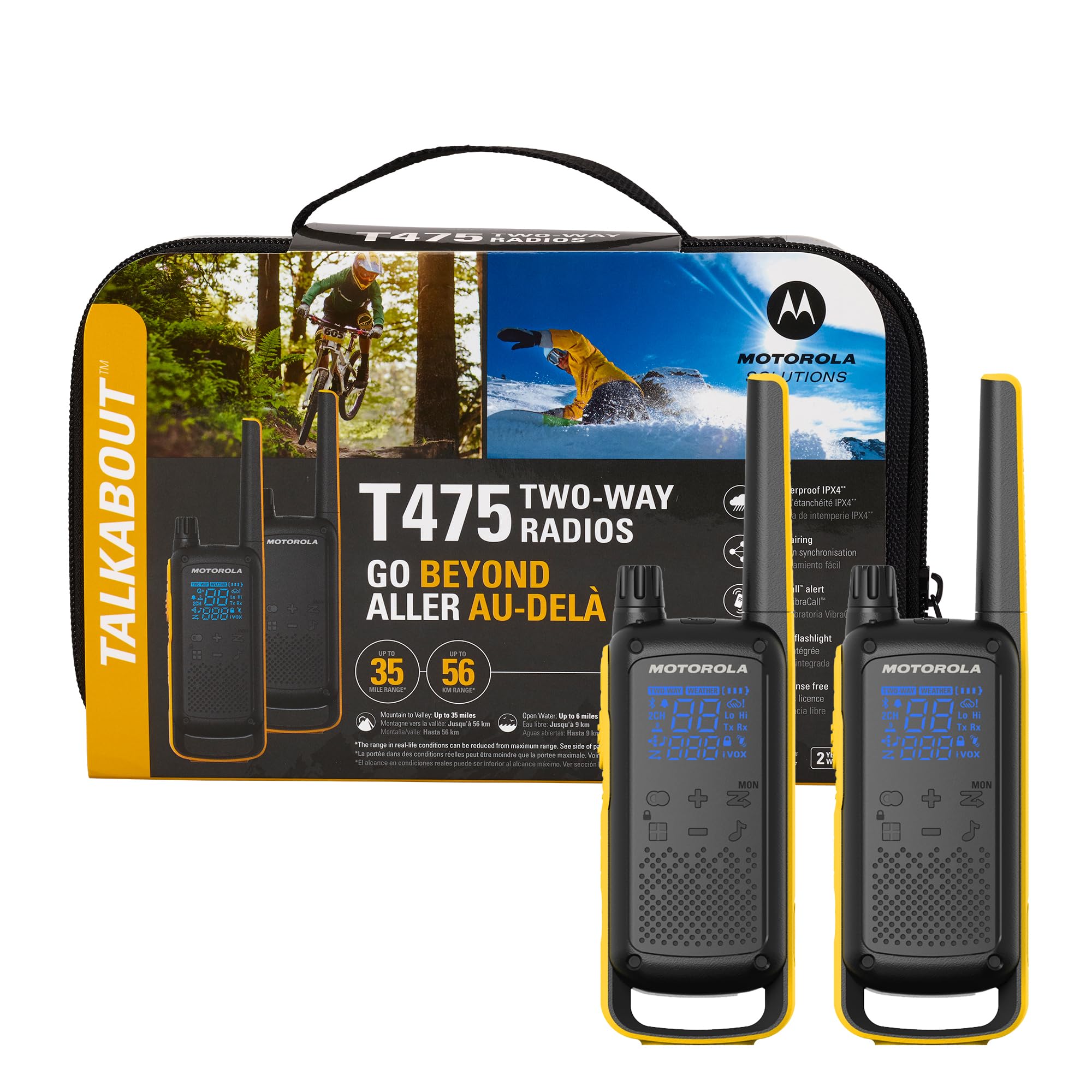
Motorola T475
Key Features
- Water Resistance: IPX4 splash-proof
- NOAA Alerts: Yes
- Battery Life: 12h NiMH
- Real-World Range: <1 mile
- Durability: IPX4, plastic build
- Price: $$
The Motorola T475 includes built-in NOAA weather alerts and rechargeable batteries at a moderate price, making it easier for families to stay informed and avoid disposable batteries. Compared to the top pick, it sacrifices IP67 waterproofing and longer battery life for a lower upfront cost. Real-world range is under a mile in wooded terrain, and battery life can vary – these are fine for short day hikes but not extended trips.
This set suits families who hike on marked trails, want NOAA alerts for sudden weather changes, and prefer rechargeable batteries. The IPX4 splash protection handles light rain but not downpours, and battery life may need a midday charge on longer days – tradeoffs that casual users can work around.
Pros
- NOAA weather alerts built in
- Clear audio with simple controls
- Rechargeable batteries included at this price tier
Cons
- IPX4 splash protection limits use in steady rain
- Battery life can fall short on full-day outings
- Advertised range is unrealistic in typical hiking terrain
A capable set for short family hikes where NOAA alerts and rechargeable batteries are priorities, and you can accept splash-only weather protection and limited range.
Best for Backcountry Skiing
BCA BC Link 2.0
Key Features
- Water Resistance: IP56 jet-proof
- NOAA Alerts: No
- Battery Life: 80h standby
- Real-World Range: 1–2 miles
- Durability: IP56, drop-tested
- Price: $$$$
The BCA BC Link 2.0 separates itself from hiking-focused radios with a remote handset designed for use with bulky gloves in cold, wet conditions. Where the top pick (Retevis RB48) offers NOAA alerts and 20-hour battery life at a mid-range price, this BCA trades those all-rounder features for a rugged IP56 build and a form factor that lets you keep the radio tucked inside a jacket while operating the mic and volume from your chest. Audio clarity in noisy environments like blowing snow or engine hum holds up well enough to keep group coordination easy.
This radio is a strong fit for backcountry skiers and snowmobilers who need reliable communication in cold, wet conditions and don’t mind skipping NOAA alerts. The drop-tested housing and sealed ports handle snow, ice, and rain without issue. The tradeoff comes down to a fragile microphone connection at the port — worth handling carefully — and a premium price that reflects its niche focus rather than a broad feature set. General hikers who want weather safety alerts and lower cost will find better value in the top pick.
Pros
- Glove-friendly remote handset for easy operation in cold conditions
- Rugged IP56 weather resistance and drop-tested for snow and rain
- Clear audio quality in windy or noisy backcountry environments
- Rechargeable Li-ion battery with 80-hour standby for multi-day trips
Cons
- No NOAA weather alerts — a notable gap for users who hike remote trails
- Microphone cable connection at the port can break with repeated stress
- Premium pricing with fewer features than comparably priced hiking radios
The BCA BC Link 2.0 is the right call if your priority is glove-friendly operation and weather sealing for backcountry skiing or snowmobiling — for general hiking with NOAA alerts, the Retevis RB48 covers more ground for less money.
Best for Emergency Kits
Motorola T478

Key Features
- Water Resistance: IP54 splash/dust
- NOAA Alerts: Yes
- Battery Life: 12h NiMH
- Real-World Range: 1–2 miles
- Durability: IP54, emergency focus
- Price: $
The Motorola T478 combines NOAA alerts, a flashlight, and a distress button at a budget-friendly price, making it a practical addition to car camping gear or home emergency kits. Its IP54 splash rating and limited long-term durability data mean it’s best reserved for occasional use in dry conditions rather than regular hiking where heavier rain or rugged handling may occur.
Pros
- Emergency-focused features including NOAA alerts, flashlight, and distress button
- Clear sound quality for communication
- Affordable price point for budget buyers
Cons
- IP54 splash rating limits use in heavy rain or wet conditions
- Long-term durability under regular use is not yet well-documented
For budget-conscious buyers building an emergency kit or needing a NOAA radio for car camping, this is a sensible choice – just keep it dry and treat it gently.
Best for Dry Park Walks
MaxTalker MT10

Key Features
- NOAA Alerts: Yes
- Battery Life: 72h standby
- Real-World Range: <2 miles
- Durability: None (dry only)
- Price: $
The MaxTalker MT10 brings NOAA weather alerts and USB-C rechargeability at a budget price that’s hard to beat. It lacks any water resistance, so rain or splashes will damage it. Range and battery performance can vary between units; expect reliable communication under a mile. This makes it a better fit for neighborhood walks and emergency backup rather than backcountry hiking.
Pros
- Low price with NOAA alerts
- USB-C rechargeable
- Easy to operate
Cons
- No water resistance at all
- Range and battery life can vary between units
A cost-effective NOAA radio for dry-weather family use and emergency kits, but skip it for any hike where rain is possible.
Best for Group Budget Use
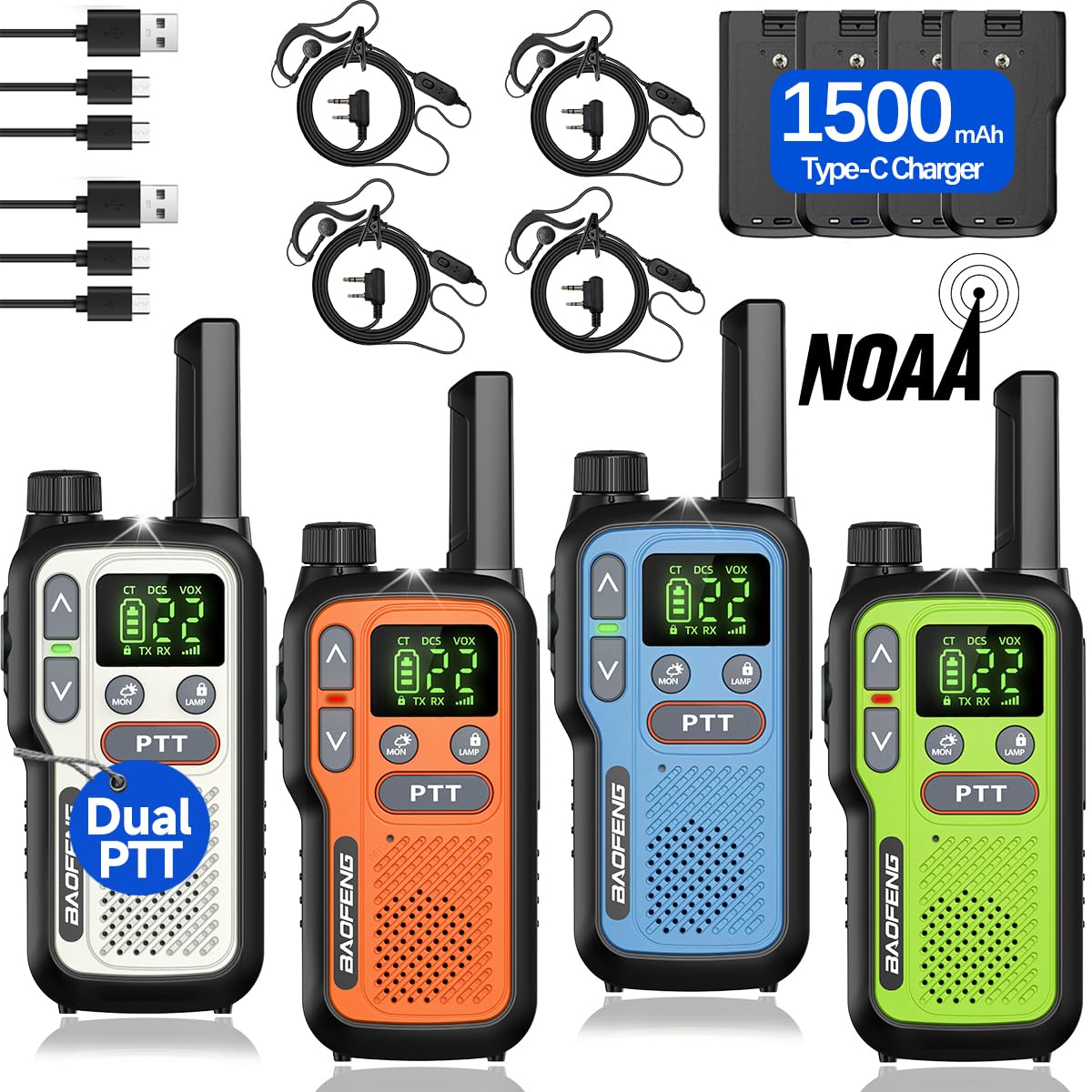
BAOFENG T18
Key Features
- Water Resistance: Not specified
- NOAA Alerts: Yes
- Battery Life: 1500mAh Li-ion
- Real-World Range: 1–2 miles
- Durability: Unknown
- Price: $
The BAOFENG T18 gives you four radios with NOAA alerts and USB-C charging at a price that’s hard to ignore, making it a practical choice for dry-weather group hikes or emergency kit backup. The lack of water resistance keeps it off wet trails, and long-term durability is not yet established – this is best suited for occasional fair-weather use rather than demanding backcountry trips.
Pros
- Four radios with NOAA alerts at a budget-friendly price – ideal for groups.
- USB-C charging eliminates the need for disposable batteries.
- Battery life supports full-day trips based on early reports.
Cons
- No water resistance – not suitable for rain or damp conditions.
- Long-term durability is not yet confirmed for heavy use.
This 4-pack makes sense for large families who stay on dry trails and need NOAA alerts without spending much – but keep it out of the rain.
Best for Emergency Radios
Midland T10

Key Features
- Water Resistance: IP65 water resistant
- NOAA Alerts: Yes
- Battery Life: 3x AAA (not rech.)
- Real-World Range: 1–2 miles
- Durability: IP65, plastic
- Price: $
The Midland T10 combines IP65 water resistance and built-in NOAA weather alerts, making it a capable companion for short dry-weather hikes or emergency kits. However, its reliance on three AAA batteries — not rechargeable — leads to ongoing expense and battery waste, limiting its value for frequent or extended use. The low entry price for a two-pack with these features is a draw, and for emergency preparedness where alkaline shelf life is preferred, this tradeoff is acceptable.
Pros
- IP65 water resistance protects against rain and splashes during outdoor use.
- NOAA weather scan and alert provide real-time storm warnings without a phone.
- Low upfront cost for a two-pack with water resistance and NOAA alerts.
Cons
- Range may be shorter than advertised in wooded or hilly terrain.
- No rechargeable option — requires carrying spare AAA batteries for extended use.
Best kept in an emergency kit or used for short, dry-weather outings where disposable batteries are practical.
Best for Open Terrain Range
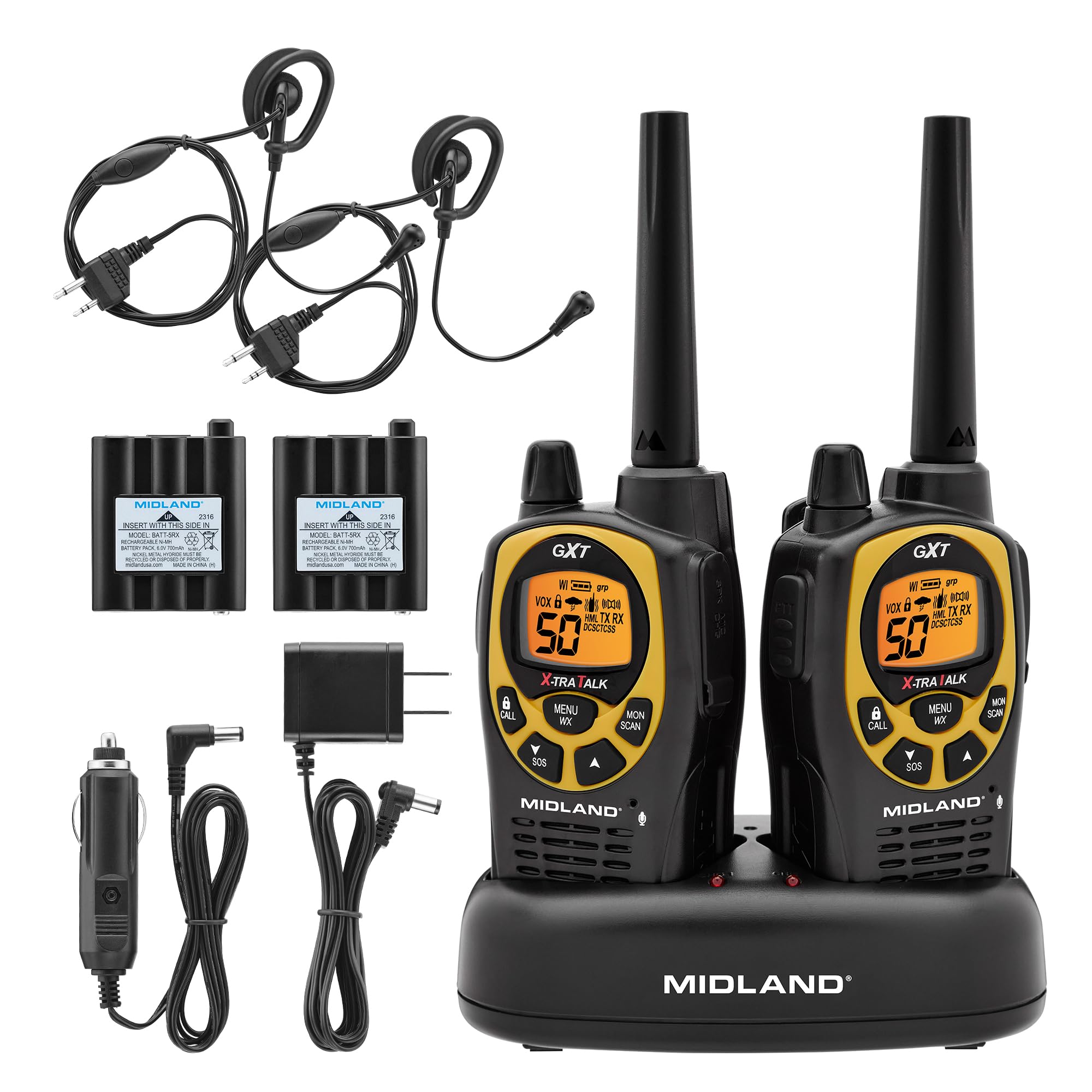
Midland GXT1030VP4
Key Features
- Water Resistance: IPX4 splash-proof
- NOAA Alerts: Yes
- Battery Life: 8h NiMH
- Real-World Range: 2–4 miles open
- Durability: IPX4, proven design
- Price: $$
The Midland GXT1030VP4 pushes 4 watts on GMRS frequencies, giving it the best real-world range in this group for open fields, ridges, and deserts. That power also unlocks 50 channels and 142 privacy codes, reducing interference on crowded trails.
Where the top pick trades GMRS power for water resistance and longer battery life, the Midland prioritizes maximum communication distance. The included NiMH pack provides about eight hours of use – enough for a day trip but not multi-day outings without recharging. Some units have shown screen or water damage over time, so careful handling matters.
This radio suits hikers, off-roaders, and groups who need reliable talk range over a mile in open landscapes and are willing to carry spare batteries. If your adventures involve constant rain or river crossings, the IPX4 splash rating may be insufficient – the top pick offers full IP67 protection. NOAA alerts and SOS provide an extra layer of safety for remote trips.
Pros
- Powerful 4W GMRS range covers miles in open terrain
- NOAA weather alerts and SOS function keep you informed in the backcountry
- Sturdy construction that holds up to rough outdoor handling
Cons
- The NiMH rechargeable pack drains within a day on active use – carrying AA backup is recommended for longer trips
- IPX4 splash resistance means the radios are not safe for submersion; some units may develop display issues after moisture exposure
If your priority is communication range over open ground, the Midland GXT1030VP4 is the right call – just plan for its limited battery life and splash-only weather protection.
How to Choose
The single most important buying insight is that advertised range is meaningless – real-world performance depends on terrain, power, antenna height, and weather, not the 35-mile claim on the box.
Water Resistance (IP Rating)
IP67 means the radio can be submerged in 1 meter of water for 30 minutes – essential for hiking in rain or near streams. IPX4 only handles splashes; a heavy downpour can seep through seals and kill the radio. Budget radios often omit any rating, making them unusable in wet conditions.
For hiking, IP67 is the benchmark. If you hike in dry climates only, IPX4 may suffice, but any encounter with a river crossing or sudden storm becomes a gamble.
NOAA Weather Alerts
A radio that receives NOAA broadcasts can automatically alert you to severe weather warnings even when you’re out of cell range. This is a live-saving feature for backcountry trips – without it, you rely entirely on your own observations.
If you hike in areas prone to sudden storms or flash floods, NOAA alerts are a must-have. Radios that lack them (like the DEWALT DXFRS800) force you to carry a separate weather radio or smartphone that may not have signal.
Battery Type and Life
Rechargeable lithium-ion batteries with USB-C charging are the most convenient for hiking – you can top up from a power bank. NiMH batteries lose charge faster and often require a dedicated charger. AAA-powered radios seem cheap initially, but battery costs add up quickly and alkaline cells leak if left in the radio.
Look for at least 12–20 hours of real-world use per charge. The Retevis RB48 delivers 20 hours, while the Midland GXT1030VP4 struggles at 8 hours. For multi-day trips, a radio that accepts AA backup batteries (like the Midland LXT600) provides flexibility.
Real-World Range
Ignore the mile numbers on the packaging. In forested or hilly terrain, FRS radios (2W) typically reach 1–2 miles. GMRS radios (up to 4W, license required) can stretch to 2–4 miles in open areas. Antenna length and line of sight matter more than raw wattage.
If you need to communicate across ridges or deep valleys, consider a GMRS radio like the Midland GXT1030VP4, but remember you need an FCC license (easily obtained online). For most hiking groups, 1–2 miles is sufficient – the real challenge is staying within that range.
Durability (Drop and Clip Strength)
A radio that breaks after a single drop is useless on the trail. Look for military-standard drop resistance (MIL-STD-810H) and a belt clip that won’t snap under light pressure. The DEWALT and Retevis models pass these tests; many budget radios fail within weeks.
The belt clip is the most common failure point – if it breaks, you lose the radio. Some models (like the Retevis RB48) include a lanyard hole as backup. If you frequently bushwhack, a radio with a reinforced clip or aftermarket holster is a smart addition.
FAQ
Why don’t my walkie talkies reach the advertised range in the mountains?
Advertised ranges are measured in ideal conditions – flat open ground with no obstacles. In wooded or mountainous terrain, trees, ridges, and valleys block the signal. FRS radios (2W) typically achieve 1–2 miles in such conditions. GMRS radios with 4W and a longer antenna can reach 2–4 miles in open areas, but still far less than the 30–40 mile claims. Always evaluate range based on real user reports for your specific terrain type.
Is it worth getting a walkie talkie with NOAA weather alerts for hiking?
Absolutely. NOAA weather alerts provide automatic warnings for severe storms, flash floods, and other hazards, even in areas without cell service. For backcountry hiking where weather can change rapidly, this feature can give you critical minutes to seek shelter. Radios without NOAA alerts (like the DEWALT DXFRS800) require you to monitor the weather yourself. The added cost is minimal – many budget models include it. For hiking, it’s a must-have safety feature.
What does IP67 mean for a two way radio, and do I need it for hiking?
IP67 means the radio is dust-tight and can survive immersion in 1 meter of water for 30 minutes. For hiking, this rating gives you confidence to use the radio in heavy rain, near streams, or if it accidentally falls into water. Lower ratings like IPX4 only resist splashes – a soaking rain can still damage the radio. IP67 is ideal for hikers who encounter wet conditions; if you always hike in dry weather, IPX4 or even no rating may be acceptable. But for backcountry trips, IP67 provides peace of mind.
Can I use a GMRS radio without a license for emergency communication?
In the US, GMRS radios require an FCC license that costs $35 and covers your immediate family for 10 years. However, in a genuine emergency, anyone can use any radio on any frequency to call for help – the FCC allows that. But for day-to-day hiking communication, you must have the license to transmit on GMRS channels. FRS radios are license-free and sufficient for most hiking groups. If you purchase a GMRS radio, get the license – it’s quick and avoids legal issues.