This post contains affiliate links. We may earn a small commission when you buy through our links — at no extra cost to you.
Most portable solar panels claim impressive wattage numbers, but on a shady trail or under passing clouds, real output often drops to half. A 30W panel that only delivers 15W leaves you with a dead phone and a heavier pack.
The difference between a panel that works and one that doesn’t comes down to how it handles partial shade, how efficiently it converts sunlight, and whether its USB ports actually deliver power. This guide focuses on those factors, prioritizing panels that maintain usable output when you need it.
We’ve also flagged panels with inflated specs or overheating risks, so you can avoid wasting money on gear that fails mid-trip.


Best for Open Sun Camping
BigBlue 28W Ammeter
Key Features
- Real-world Power: ~25-28W
- Weight & Size: 1.47 lbs, folds small
- Port Types: USB-A, USB-C 5V/4A
- Weather Rating: IP44
- Price: $$
Charging performance holds up across a wide range of conditions — cloudy days, through windows, even in Norwegian spring light — making it a consistent partner for backpackers who camp under open skies. The integrated digital ammeter is the standout feature: it shows current output in real time, so you can tilt and rotate the panel until the number peaks. That feedback loop turns guesswork into a deliberate, repeatable process for getting the most out of available sun.
That real-time ammeter is especially useful because this panel, like most folded solar panels, delivers its best output only in direct, unobstructed sunlight. Performance drops sharply in partial shade or when angled even slightly off. The ammeter lets you confirm you’ve found the sweet spot rather than assuming. It’s a practical tool for anyone who wants to squeeze every watt from a sunny afternoon.
This panel suits backpackers who camp in consistently sunny, open locations and want a durable, mid-weight option for topping off phones, power banks, or small electronics. At 1.47 lbs it’s not ultralight, but it folds compactly and the build quality feels solid for regular trips. The ammeter screen can scratch during transport if not protected, and occasional durability issues — such as the screen lifting or internal connection looseness — have been noted after extended use. Keeping the screen covered when stored minimizes that risk.
Pros
- Built-in ammeter shows live current output for precise angle optimization
- Charges consistently in cloudy conditions and through windows, not just full sun
- Folds to a compact size that fits in a backpack side pocket
- Build quality feels durable enough for regular backpacking use
Cons
- Ammeter screen is prone to scratching during transport or handling
- Output drops significantly in partial shade, requiring full-sun placement
- Some units have shown internal connection or screen issues after a few months of use
For backpackers who want a reliable, mid-weight solar panel and value the ability to dial in maximum power with live feedback, this is a smart pick that earns its place in the pack.
Best for Ultralight Hikers
BigBlue 25W Ultra-Light
Key Features
- Real-world Power: ~20W
- Weight & Size: 0.84 lbs, pocket-size
- Port Types: USB-A 2.4A, USB-C 3A
- Weather Rating: IP68
- Price: $$
Weighing just 0.84 lbs and folding to a pocket-size shape, this BigBlue panel delivers the best weight-to-watt ratio among portable 25W models. The IP68 waterproof rating means it can handle rain or splashes without worry, and the foldable design packs neatly into a daypack or even a jacket pocket for ultralight trips.
This panel suits ultralight backpackers and day hikers who need a pocketable solution for topping off phones or power banks during short outings. For longer multi-week trips or use in variable weather, the chance of early USB port or panel failure and inconsistent charging in shifting light becomes a real limitation — the ammeter-equipped top pick offers more consistent real-world output for those conditions.
Build quality feels solid for its weight, with a foldable fabric exterior that holds up to regular packing and unpacking. The USB-C port outputs up to 3A, enough for a fast top-up on modern smartphones in direct sunlight.
Pros
- Extremely lightweight and compact for a 25W panel
- Solid build with a thoughtful foldable design
- Full IP68 waterproof rating for wet conditions
Cons
- USB port or panel failure has occurred in some units within the first few months
- In fluctuating sunlight, the panel may draw power from rather than charge a connected device
For ultralight backpackers who prioritize weight above all else and accept some variability in charging reliability, this is the most portable 25W panel available.
Best for Proven Track Record
BigBlue 28W
Key Features
- Real-world Power: ~25W
- Weight & Size: 1.5 lbs, magazine-size
- Port Types: Dual USB-C, USB-A
- Weather Rating: IP44
- Price: $$$
The BigBlue 28W has accumulated a large body of user feedback over years on the trail, indicating steady phone and power bank charging in direct sunlight. Unlike the top pick with its built-in ammeter, this version requires you to manually angle the panel for best results. It folds to roughly magazine size and weighs under 1.5 pounds, making it easy to pack for multi-day trips.
Charging speed matches a wall adapter when the panel is positioned directly under the sun with no shade. The dual USB-C and USB-A ports allow simultaneous charging of a phone and a power bank. Partial shade from tree cover or clouds drops output significantly — the panel uses series-connected cells, so even one shaded cell can cut power in half.
This panel suits backpackers who camp in open, sunny environments and can take time to position it for optimal sunlight. Durability is a point of attention: the charge controller may overheat if left in direct sun without a device attached, and some units have shown wear after extended use. Those who need a panel for heavily shaded trails or unpredictable weather should consider other options.
Pros
- Consistent charging for phones and power banks in direct sunlight.
- Folds to roughly magazine size and weighs 1.5 lbs, easy to stow in a backpack.
- Charges phones at speeds comparable to a wall charger in direct sun.
Cons
- Partial shade from clouds or tree cover reduces charging output drastically.
- Charge controller can overheat if left in direct sun without a load; unit durability may vary.
A straightforward panel for backpackers who prioritize proven full-sun performance and can accept occasional unit variance. If you want real-time angle feedback or work in partial shade, the top pick with its ammeter is a better match.
Best for Phone Top-Ups
FlexSolar 15W
Key Features
- Real-world Power: ~12-15W
- Weight & Size: 0.99 lbs, compact
- Port Types: USB-A 5V/3A
- Weather Rating: IP67
- Price: $
The FlexSolar 15W trades the built-in ammeter and extra wattage of our top pick for a lighter carry and a lower price. Its 0.99-pound weight and folded pocket size make it one of the most packable options in this roundup, and the ETFE front sheet with IP67 sealing handles light rain and dust without complaint. For a backpacker whose only charging need is keeping a phone topped off during a day hike, this panel delivers measured output in direct sun.
This panel is best for ultralight backpackers who carry a single phone and a small power bank. On clear days, it can add meaningful charge to an iPhone or a 10,000mAh bank within a few hours. However, the 15W rating means it will struggle under cloud cover or when charging larger devices like tablets. If your trips often involve overcast skies or you need to power a camera battery pack, a higher-wattage panel like the BigBlue 28W Ammeter will be more dependable.
Build quality can vary; occasional units arrive with loose USB ports or do not charge at all. Testing the panel before a trip is advisable to avoid a non-functional panel when you need it most.
Pros
- Lightweight and portable — 0.99 lbs folds small for backpacking
- Charges phones and small power banks in strong sunlight
- Cost-effective entry point for solo ultralight trips
Cons
- 15W limit means it charges slowly under cloud cover and cannot power tablets or larger power banks
- Inconsistent build quality can result in a panel that does not charge out of the box
For ultralight backpackers who need a cheap, lightweight way to top off a phone on sunny day hikes, the FlexSolar 15W delivers. Skip it if you need more power or expect cloudy conditions.
Best for Power Station Backup
MARBERO 21W
Key Features
- Real-world Power: ~10-15W
- Weight & Size: 1.32 lbs, folds compact
- Port Types: USB-A, USB-C, DC 18V
- Weather Rating: IP65
- Price: $
The MARBERO stands out for its low price and direct DC 18V output, letting it charge small power stations like the Jackery without an extra adapter. Unlike the top pick’s ammeter for angle optimization, this panel prioritizes cost savings and broad compatibility over consistent high-wattage performance.
In full sun, output can fall short of the rated 21W – occasional reports show 10W or less even in ideal conditions. That still tops off a smartphone or trickle-charges a power bank, but expect slower refueling than higher-rated panels.
It suits budget-conscious backpackers who own a small power station and are prepared for the possibility that the panel may not hold up beyond a few trips. Durability is a noted limitation – some units have had cords detach or stopped producing power entirely. This is a viable short-trip or emergency backup rather than a long-term companion.
Pros
- Excellent value for money with good build quality
- Portable and easy to store in a laptop bag
- Wide compatibility via DC 18V output for small power stations
Cons
- Power output can be well below the rated 21W in ideal sun
- Some units may stop producing power after weeks of use
If your budget is tight and you’re prepared to inspect and test the panel before each trip, the MARBERO offers functional DC charging at a rock-bottom price.
Best for Harsh Conditions
SunJack 25W
Key Features
- Real-world Power: ~20-22W
- Weight & Size: 1.7 lbs, sturdy
- Port Types: USB-A, USB-C 5V/3A
- Weather Rating: IP67
- Price: $$$
The SunJack 25W stands apart with its IP67 waterproof rating and ETFE-coated cells, allowing it to handle rain and dust that would damage standard panels. This ruggedness comes at the cost of portability and value, making it a niche product for specific use cases.
This panel is best for campers who expect wet conditions or need a panel that can survive vehicle travel. Backpackers seeking ultralight gear will find lighter alternatives more practical — the SunJack prioritizes durability over pack weight and price.
When the sun is out, charging performance is solid: devices charge at speeds comparable to a wall outlet, and some users report useful output even under light overcast. The dual USB-A and USB-C ports (5V/3A each) handle phones and power banks without fuss.
Pros
- Durable and weather-resistant build with IP67 rating – withstands rain and dust
- Charges devices quickly in direct sun, even in overcast conditions
Cons
- At 1.7 lbs, this panel is noticeably heavier than many 25W competitors – a drawback for backpackers counting every ounce
- The premium price sits above many comparably performing panels, making it a harder value proposition
A rugged, weatherproof panel that charges well in sun — ideal for vehicle-based trips and emergency kits, but not the best choice for ultralight backpacking.
Best for Car Camping
FlexSolar 40W

Key Features
- Real-world Power: ~30W
- Weight & Size: 1.76 lbs, larger fold
- Port Types: USB-C PD, USB-A, DC
- Weather Rating: IP67
- Price: $$
This panel delivers steady charging in strong sunlight and folds into a compact shape that stows easily in a car trunk or base camp bin. Build quality is solid for its price tier. The catch: real-world output typically lands around 30W, and charging can pause intermittently. At 1.76 lbs, it adds noticeable weight for anyone carrying a pack all day. Those limitations make it a poor match for backpacking, but a capable addition to an emergency kit or camp setup where extra wattage matters more than pounds.
Pros
- Charges consistently in full sun, performing well in desert or strong sunlight.
- Build quality holds up during trips, and it folds to a compact size for day packs.
Cons
- At 1.76 lbs, it adds weight that backpackers will want to avoid.
- Real-world output may peak near 30W and charging can pause, falling short of the 40W label.
For car campers or emergency kits needing higher wattage, this panel delivers dependable charging in full sun — just don’t expect it to match the 40W claim or fit in a backpacking pack.
Best for Wet Environments
BigBlue 35W
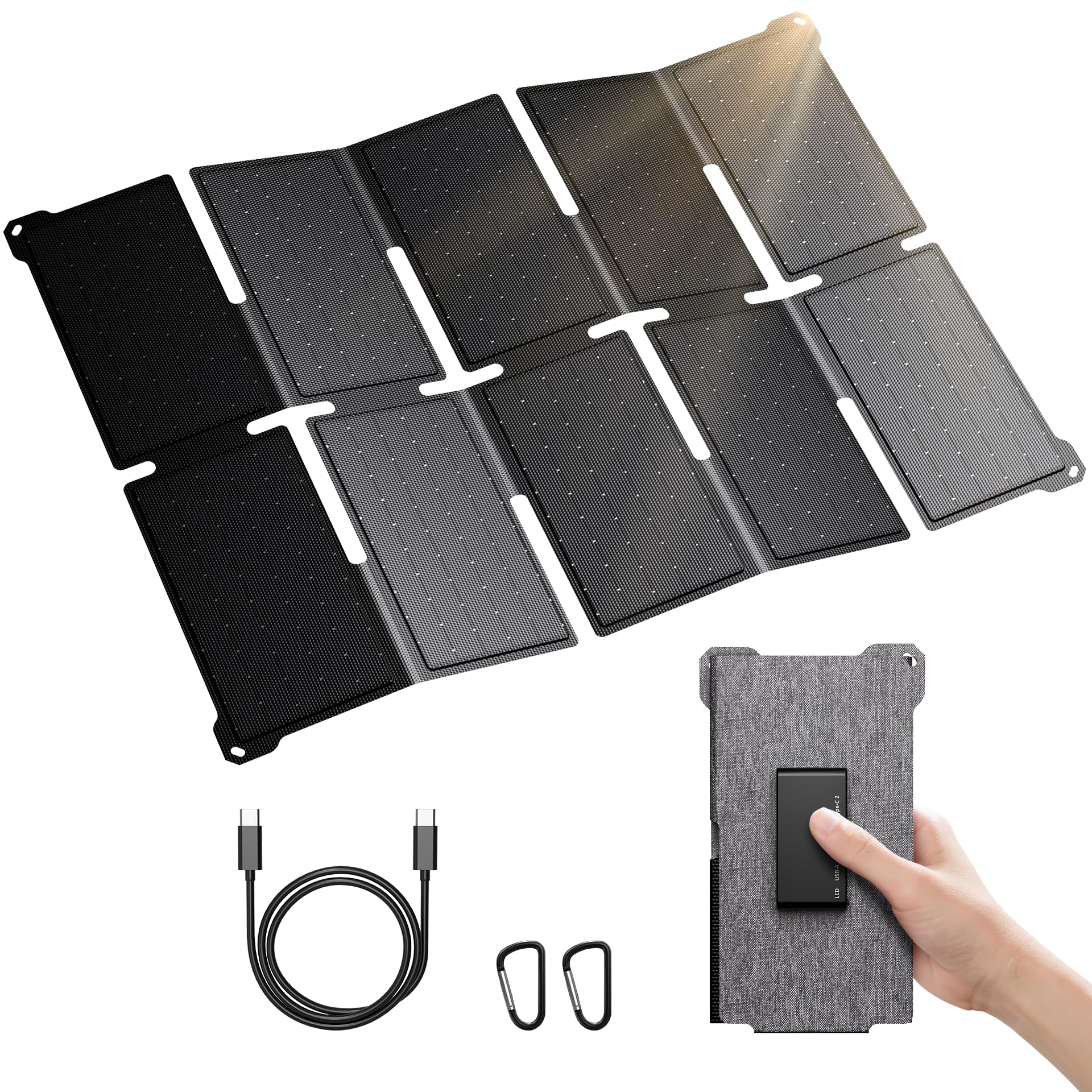
Key Features
- Real-world Power: ~25W
- Weight & Size: 1.54 lbs, rugged
- Port Types: USB-C PD 25W, USB-A QC
- Weather Rating: IP68
- Price: $$$
The BigBlue 35W stands out with its fast USB-C PD 25W output and full IP68 waterproofing, making it a solid choice for travelers who regularly face wet conditions or need to quickly charge modern devices. However, for backpackers prioritizing weight, the 1.54 lb panel is heavier than most 30W options, and real-world output typically settles around 25W despite the 35W claim — a gap that becomes noticeable on cloudy days. This makes it better suited for car camping or base camp use than ultralight trips.
Pros
- Fast USB-C PD 25W output for quick device charging
- IP68 waterproof rating handles rain and splashes
- Compact foldable design stows easily in a pack
Cons
- Under full sun, output may not reach the rated 35W; in cloudy conditions, charging slows considerably
- At 1.54 lbs, it can add noticeable bulk for a 35W panel
This panel works well for car campers or travelers who need fast USB-C PD charging and waterproofing, but backpackers prioritizing weight and consistent output should look to lighter panels.
Best for Car Camping
SOLUPUP 30W
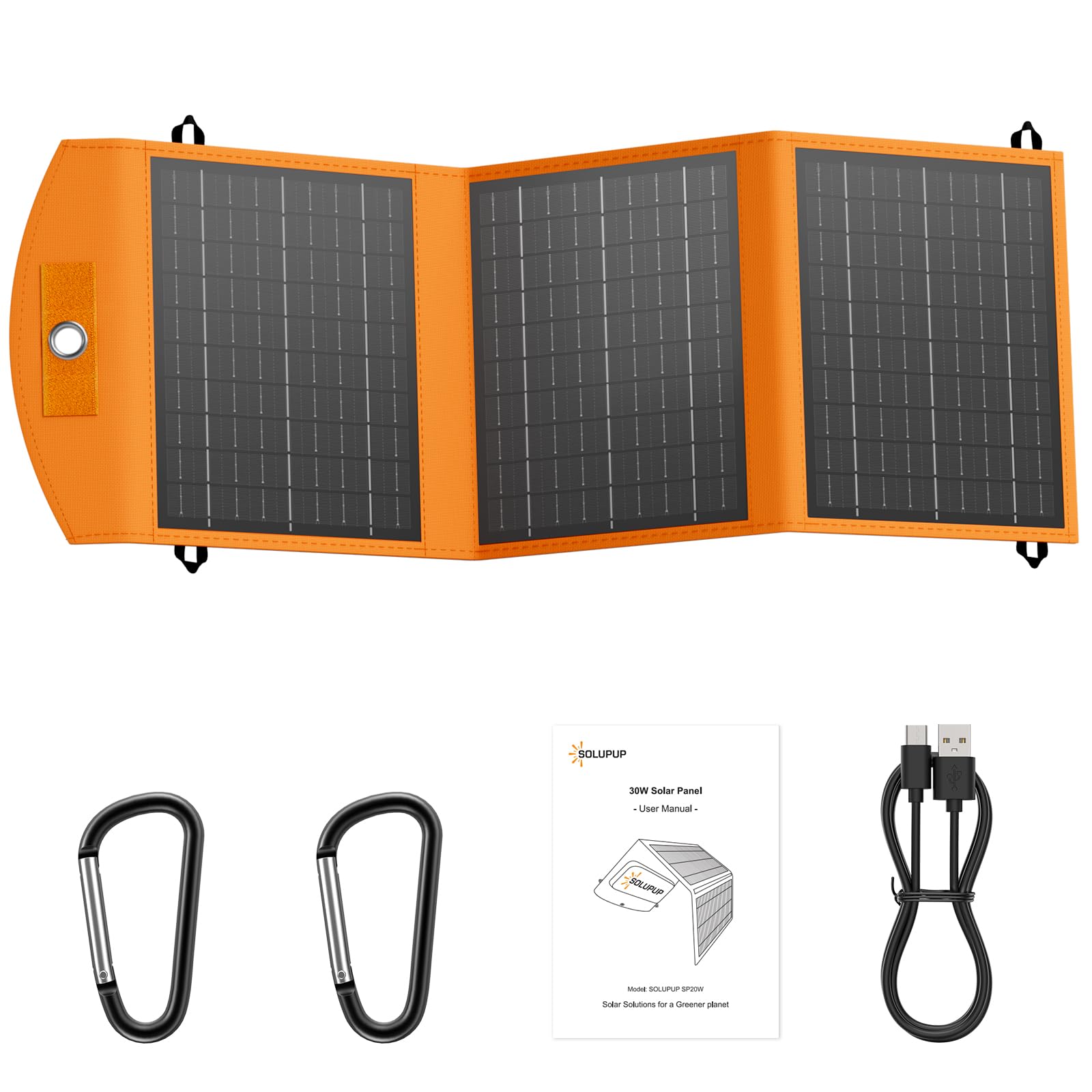
Key Features
- Real-world Power: ~15-20W
- Weight & Size: 2.4 lbs, bulky
- Port Types: USB-A, USB-C 5V/3A
- Weather Rating: IPX5
- Price: $
The SOLUPUP 30W offers a solid build and a handy built-in kickstand for easy sun alignment, making it practical for base camp or car camping setups where weight isn’t critical. However, at 2.4 pounds it’s too heavy for backpacking, and real-world charging output can fall well below 20W even in full sun – a known limitation that makes it a poor fit for the lightweight, fast-charging needs of a backpacker.
Pros
- Good value and overall quality for a budget panel
- Integrated kickstand helps angle panels toward the sun for better performance
- IPX5 waterproof rating protects against rain and splashes
Cons
- At 2.4 lbs it is noticeably heavier than most panels in this wattage range, limiting its use to car camping or stationary setups
- Charging output in real-world conditions can be significantly slower than the rated 30W, sometimes below 20W even in full sun
A decent budget panel for car campers or emergency kits who can accept the weight and slower charging, but not for backpacking trips where every ounce and watt counts.
Best for Day Trips
Anker Solix PS30

Key Features
- Real-world Power: ~15W
- Weight & Size: 2.2 lbs, compact fold
- Port Types: USB-A, USB-C (no PD)
- Weather Rating: IP65
- Price: $$$
The Anker Solix PS30 folds down to a compact shape and feels solidly constructed, which fits the brand’s usual build quality. However, real-world charging performance falls well short of its 30W rating — some devices charge slowly or even lose power in anything less than full, direct sun. At 2.2 lbs, it also carries a weight penalty that makes it noticeable on longer trails. These limitations confine it to short day trips where weight and charging speed aren’t critical, and where staying within the Anker ecosystem matters more than outright performance.
Pros
- Solid build quality typical of Anker products
- Folds into a compact shape for easy packing
Cons
- At 2.2 lbs, weight can be excessive for backpacking trips — better suited to car camping or short walks
- Charging output can fall far below the rated 30W; some devices may not charge at all in partial shade
This panel works for Anker loyalists on short day trips where weight and charging speed aren’t priorities — but backpackers should look to options with better real-world output and lighter carry.
Best for Design-Focused Users
ELECOM NESTOUT 28W

Key Features
- Real-world Power: 14W max
- Weight & Size: 1.18 lbs, storage pouch
- Port Types: Dual USB-A 5V/4.8A
- Weather Rating: Water-resistant
- Price: $$$
The ELECOM NESTOUT wins an IF Gold Award for its innovative storage pouch and durable ripstop nylon construction. The panel folds into its own case with a zippered compartment for a power bank, a thoughtful design. However, the 28W claim on the title conflicts with product details listing 14W max, creating confusion about its true output. Charging devices inside the pouch can lead to overheating in warm conditions, which may stop charging. This panel is best suited for design-conscious buyers on short trips in cooler climates, not as a reliable backpacking power source.
Pros
- Outstanding build quality and storage pouch design
- Folds into its own case with zippered compartment for power bank
- Fast charging for phones in direct sun
Cons
- Product page lists 14W max while title claims 28W – a serious spec inconsistency
- Charging devices inside the pouch may overheat in direct sun, causing the panel to stop charging
Buy this only if design and storage are your top priorities and you’ll use it in mild, short-duration conditions where overheating is unlikely.
Best for Emergency Backup
FlexSolar 20W

Key Features
- Real-world Power: ~10-15W
- Weight & Size: 0.99 lbs, compact
- Port Types: USB-A, USB-C 5V/3A
- Weather Rating: IP67
- Price: $
At 0.99 lbs with IP67 waterproofing and ETFE coating, the FlexSolar 20W folds small enough for a side pocket and holds up in damp conditions. It’s one of the lightest panels at its rated wattage, making it easy to justify adding to a pack for its potential value.
That potential comes with a caveat: real-world charging output varies widely. Some users find it barely tops off a phone, while others get usable power in strong sun. A few units have stopped working entirely after limited use. This panel suits an emergency kit or a day hike where a slow top-up is acceptable, but not for reliable daily charging on trail.
Pros
- Lightweight and compact at 0.99 lbs — easy to pack for hiking.
- IP67 weather resistance adds durability in wet or dusty environments.
- USB-A and USB-C ports let you charge small devices directly.
Cons
- Charging speed can be unpredictable — some units struggle to maintain a useful rate even in full sun.
- Long-term reliability is uncertain; individual panels may stop functioning after limited use.
Best as a backup panel for emergency kits or short day hikes where a slow, variable charge is acceptable.
Best for Ecosystem Use
Goal Zero Nomad 10

Key Features
- Real-world Power: 10W
- Weight & Size: 1.12 lbs, compact
- Port Types: USB-A
- Weather Rating: Not rated
- Price: $$$$
The Nomad 10 delivers the solid build and portability you’d expect from Goal Zero — stitched panels, reinforced corners, and a 1.12 lb weight that tucks easily into a pack. For ultralight trips where every ounce counts, it feels reassuringly tough. The tradeoff is power: 10W output charges a modern phone at a glacial pace, often taking multiple hours for a partial top-up, and the per-watt price is far higher than competing 20W panels. This works best as a trickle charger for a small power bank like the Goal Zero Flip series, or as a backup in an emergency kit where time isn’t critical.
Pros
- Build quality feels robust for outdoor use, with durable fabric and stitching.
- Lightweight and folds compactly for backpacking or travel.
Cons
- For backpackers needing to charge modern phones, the 10W output can be painfully slow.
- Premium-priced per watt compared to cheaper 20W panels from other brands.
A good pick only if you already own Goal Zero gear and need a lightweight backup for very slow trickle charging, not a primary power source for a backpacking trip.
Best for Ultralight Small Devices
Goal Zero Nomad 5

Key Features
- Real-world Power: 5W
- Weight & Size: 0.79 lbs, tiny
- Port Types: USB-A 5V/1A
- Weather Rating: Not rated
- Price: $$
The Goal Zero Nomad 5 is exceptionally lightweight and well-built, making it easy to carry on any trip. Its 5W output, however, cannot meaningfully charge a modern smartphone in reasonable time — it is strictly for maintaining low-power devices like headlamps or fitness trackers. At this price, other panels offer three to four times the wattage, so its value is limited to ultra-minimalist emergencies or dedicated use within the Goal Zero ecosystem.
Pros
- Weighs only 0.79 lbs — trivial to pack in any backpack.
- Build quality is solid, with durable stitching and materials.
- Works as a dedicated trickle charger for low-drain devices like headlamps.
Cons
- Per-watt cost is high compared to many 10-20W panels available at similar prices.
- 5W output can only slowly charge small devices; a phone may take all day to gain a partial charge.
Only consider this panel if your goal is to keep a single low-drain device alive on ultralight trips, and you already own other Goal Zero gear. Otherwise, a budget 10-15W panel offers far more practical charging for comparable weight.
How to Choose
The wattage printed on a solar panel is rarely what you get on the trail; real-world output typically runs 60-80% of the rating, making verified performance more important than headline numbers.
Real-World Power Output
A panel’s rated wattage is measured under perfect lab conditions with the sun directly overhead. On a trail with variable angles, clouds, or tree cover, output drops. Look for user reports of consistent, repeatable charging rather than peak claims. Panels that maintain 70% or more of their rating in partial shade are rare and worth the premium.
The best panels use parallel-connected cells to keep charging alive when part of the panel is shaded. If you hike through alternating sun and shade, a panel with dual-string circuitry will outperform a standard series design.
Weight and Packed Size
Every ounce matters when you’re carrying a panel for days. Aim for a weight-to-watt ratio under 2 ounces per watt. For a 25W panel, that means under 3.1 lbs total. The lightest options around 1 lb offer enough power for phone and small power bank charging without adding noticeable pack weight.
Packed size is equally important. Panels that fold to the size of an iPad or smaller fit easily in a daypack or side pocket. Larger panels require external lashing and can snag on branches.
Port Types
USB-C Power Delivery (PD) is the most efficient way to charge modern phones and power banks. Panels with PD 25W or higher can refill a phone at wall-charger speeds. Standard USB-A ports are slower and may not support fast charging for newer devices.
Check if the panel supports simultaneous charging on both ports – many split the total output, reducing speed when both ports are used. A panel that can deliver at least 15W per port is ideal for charging two devices at once.
Weather Resistance
IP ratings tell you how well the panel handles water and dust. IP67 means it can survive brief submersion and is dust-tight – ideal for rain or river crossings. IP44 offers splash resistance but not submersion. Panels without a rating should be kept dry, as moisture can damage the electronics and fold seams.
High IP ratings often add weight and stiffness. If you hike in dry climates, a lower rating is acceptable. For wet or humid environments, prioritize at least IP65.
Durability and Connectors
The folding seam is the weakest point on any solar panel. Look for reinforced stitching and rubberized edges that prevent fraying. USB ports should have protective flaps or be recessed to avoid snagging. Panels with detachable cables let you replace a worn cord without replacing the whole panel.
Heat buildup is another hidden issue. Panels left in direct sun for hours can reach temperatures that degrade internal components. Good panels have thermal protection that pauses charging when too hot, but this also stops power delivery on hot days.
FAQ
Do foldable solar panels charge phones as fast as a wall charger?
In direct, unobstructed sun, a 20W+ panel with USB-C PD can match a standard 15W wall charger. But real-world conditions – clouds, angle, temperature – often cut that speed in half. Plan for longer charging times and consider using a power bank as a buffer.
Why does my solar panel stop charging when a cloud passes?
Most foldable panels use series-connected cells. When one cell is shaded, the whole circuit’s current drops to near zero. Panels with parallel strings or bypass diodes keep the unshaded cells working, maintaining partial output. If you hike in variable light, choose a panel with that feature.
Can a 20W solar panel keep a phone and power bank charged on a multi-day backpacking trip?
Yes, but only with consistent direct sun for 3-4 hours per day and minimal device use. A 20W panel can top off a 10,000mAh power bank and one phone each day in ideal conditions. In cloudy weather or shorter daylight, you’ll need a 30W panel or longer charging stops.
How important is USB-C Power Delivery (PD) in a backpacking solar panel?
Very important. USB-C PD delivers higher wattage to compatible devices, cutting charge time by half compared to standard USB-A. Without PD, newer phones and power banks often charge at 10W or less. Look for panels with PD 20W or higher for efficient trail charging.