This post contains affiliate links. We may earn a small commission when you buy through our links — at no extra cost to you.
Most camping emergency radios promise solar charging and enough battery to top off your phone. In practice, the tiny solar panels barely trickle, and the phone output often stops at a few percent. You end up with a radio that can’t do what you bought it for.
The real workhorses in this category are hand cranks and USB-C ports. Solar is a nice extra but rarely a primary charger. Battery capacity also varies wildly: a 2000mAh pack might run the radio for a day but won’t bring a dead smartphone back to life.
This guide cuts through the marketing and highlights the radios that actually hold a charge, tune in NOAA alerts, and keep your devices running. Whether you prioritize battery size, digital tuning, or a trusted brand, the trade-offs are clear.


Best for Battery & Phone Charging
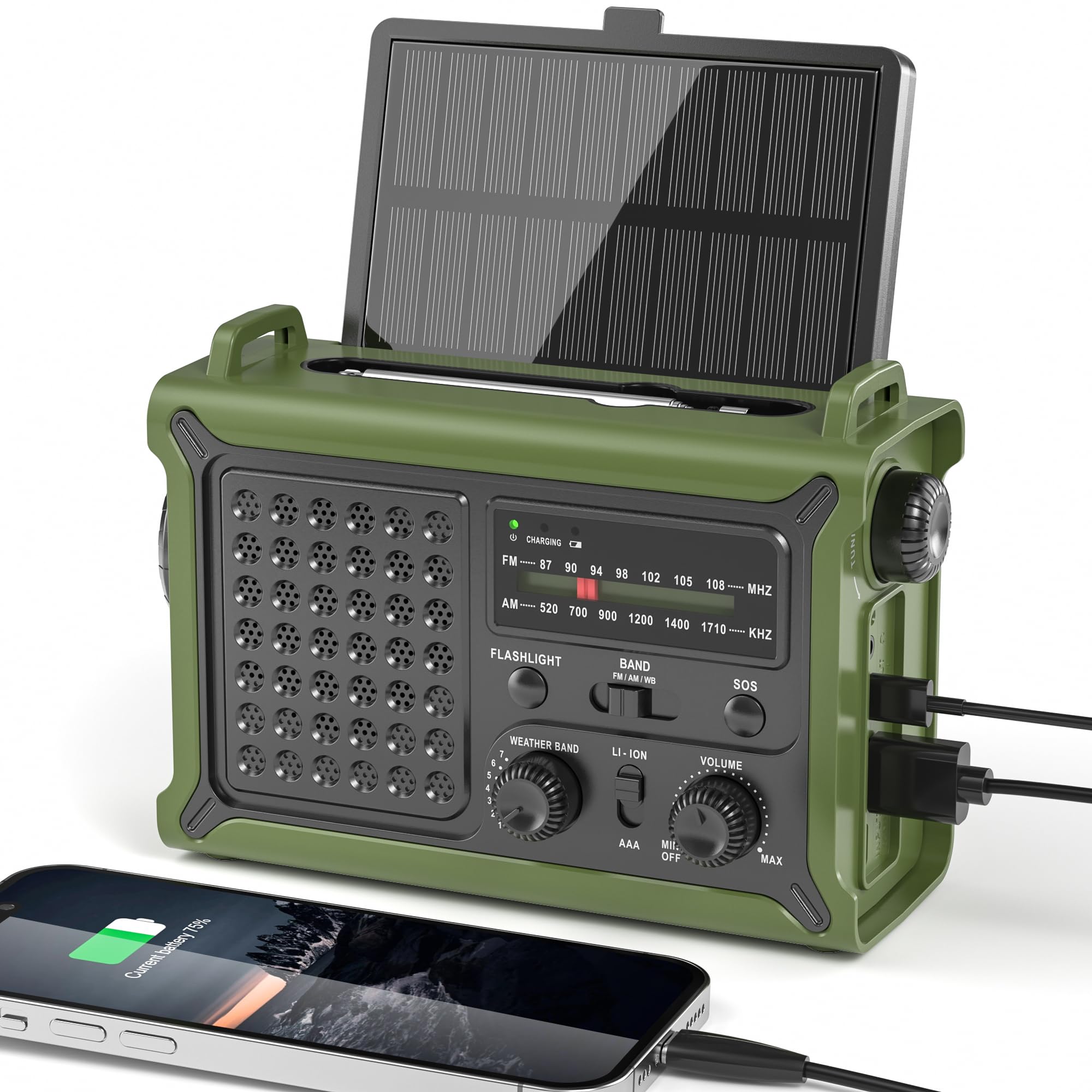
Mesqool CR1030 12000mAh
Key Features
- Battery: 12000mAh Li-ion
- Power Sources: Solar, Crank, USB-C, AAA
- NOAA Alert: Manual tune
- Water Resistance: Water resistant (no IP)
- Display: Analog
- Price: $$
The Mesqool CR1030 delivers a genuine 12000mAh lithium battery that charges a smartphone from empty to full more than once — a capability many competing radios claim but few deliver. The large 8500mm² monocrystalline solar panel helps top off the battery during daylight, while USB-C and hand crank provide backup without relying on wall power.
NOAA weather reception comes through clearly, and the SOS alarm is loud enough to be heard over moderate wind or rain. AM/FM tuning is analog, which means you need to slowly dial in stations — it works fine once locked, but the lack of a backlight makes it tricky in darkness.
Two lighting modes separate this from single-flashlight designs: a focused LED flashlight for walking and a reading lamp with adjustable brightness for inside a tent. The SOS strobe is triggered by a dedicated button and flashes brightly enough to signal from a distance.
This radio is best for campers and emergency kit builders who prioritize long off-grid power over tuning convenience. The small antenna tab can be frustrating for larger fingers — a tool or fingernail helps — and analog tuning requires a steady hand in low light. If you need digital presets or auto-scan NOAA, the Midland ER310 is a better fit, but it cannot match the CR1030’s battery capacity or phone-charging output.
Pros
- Genuine 12000mAh battery charges a phone multiple times
- Clear AM/FM/NOAA reception with loud, distinctive SOS alarm
- Two-mode flashlight and adjustable reading lamp cover camp and emergency lighting
- Large solar panel and multiple input options reduce reliance on disposable batteries
Cons
- Antenna tab is small and may need a tool to pull out
- Analog tuner requires careful adjustment in dim lighting conditions
If your emergency kit or camping gear needs a radio that can actually recharge your phone multiple times without grid power, the Mesqool CR1030 is the clear pick.
Best for Brand & Noaa Alerts
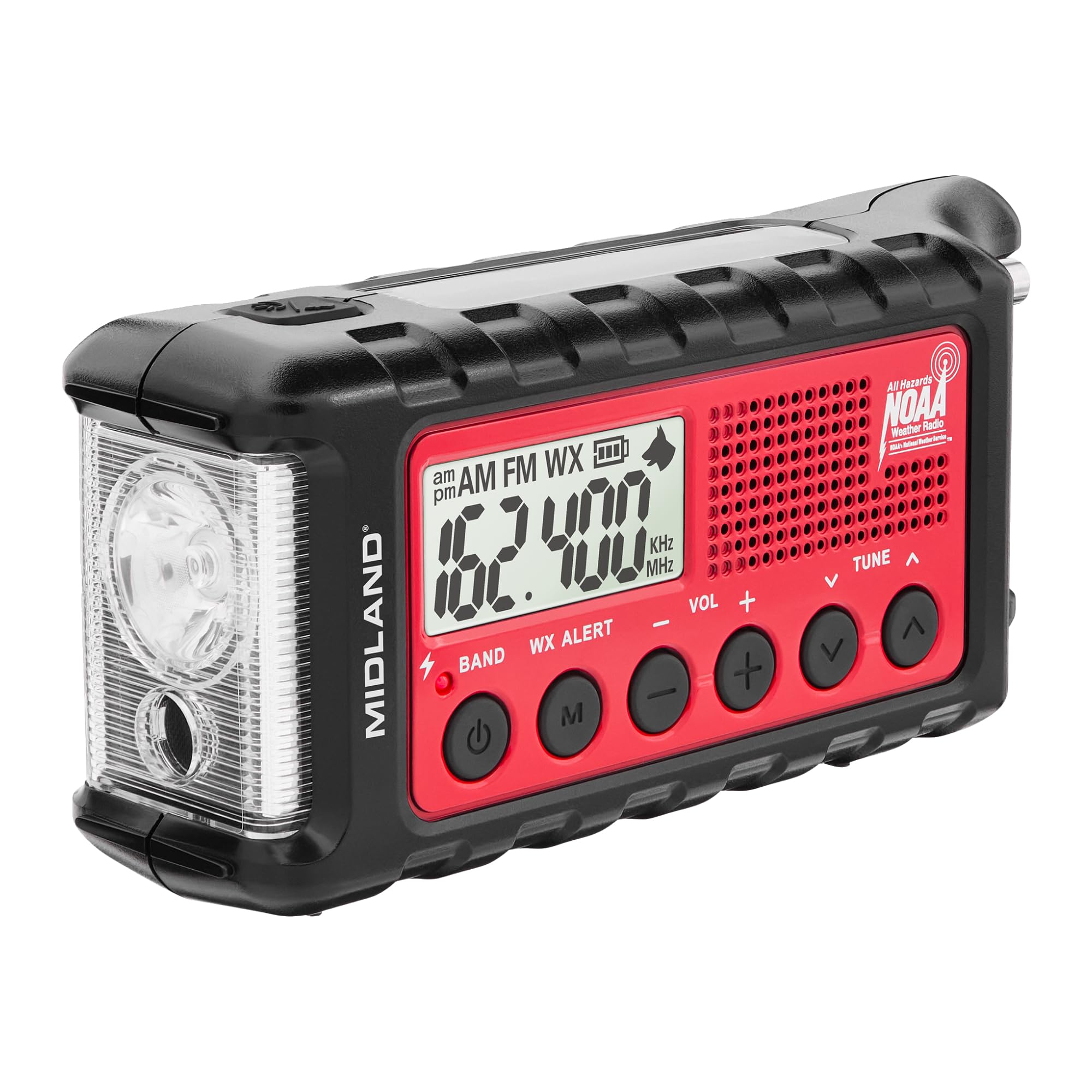
Midland ER310
Key Features
- Battery: 2600mAh + 6×AA
- Power Sources: Solar, Crank, USB, AC
- NOAA Alert: Auto-scan + alarm
- Display: Analog
- Price: $$$
The Midland ER310 automates NOAA channel scanning, saving time during severe weather, and includes a unique ultrasonic dog whistle to help rescuers locate you. While the top pick in this category offers a larger battery for phone charging, the ER310 prioritizes consistent weather alerts and search features. The audio is clear with a loud alert tone, and multiple power sources (hand crank, solar, USB, AC) provide flexible charging options.
This radio suits those who value automated NOAA scanning and brand reputation over extended battery life. Battery charging consistency can vary between units; some may not hold a full charge, so test before a trip. The solar panel works best as a backup source, not a primary charger. Reception may be weak in some areas, so verify coverage for your camping location. The ultrasonic whistle adds a distinctive aid for emergency scenarios.
Pros
- Automatic NOAA scan and alert keep you updated on weather threats without manual tuning.
- Clear audio quality with a loud alert tone for warnings.
- Multiple power sources (hand crank, solar, USB, AC) offer flexible charging options.
- Built-in ultrasonic dog whistle can aid search and rescue efforts.
Cons
- Solar panel provides limited power; best used as a supplement to hand cranking or USB.
- AM/FM/NOAA reception can be weak in certain locations.
- Battery charging consistency varies between units; some may not reach full charge.
If automated NOAA scanning and a search-assist whistle are your priorities, the ER310 delivers, but plan to test battery performance and reception before relying on it in the backcountry.
Best for Digital & Shortwave
Raynic CR1009Pro
Key Features
- Battery: 5000mAh (18500mWh)
- Power Sources: Solar, Crank, USB, AC, AAA
- NOAA Alert: Auto-scan
- Water Resistance: IPX3
- Display: LCD digital
- Price: $$
The Raynic CR1009Pro stands out from the top pick with its LCD digital display, shortwave bands, and automatic NOAA scanning. Where the leading Mesqool CR1030 relies on an analog tuner with a small antenna tab, the Raynic gives you a clear readout and one-button access to weather alerts. That makes it a better fit for campers who prefer frequency accuracy over raw battery capacity.
This radio targets hikers and backpackers who want shortwave reception for international broadcasts or emergency nets, plus the convenience of auto-scan NOAA alerts without fiddling with a dial. The IPX3 water resistance handles light rain, and the compact size slides into a pack pocket easily. That said, reception quality can vary with terrain and atmospheric conditions — some locations may get weaker AM/FM signals compared to a dedicated outdoor antenna setup. The internal battery may also lose charge over a week of storage, so it helps to top it off before heading out.
Pros
- Digital LCD with auto-scan NOAA and shortwave bands for precise tuning and alert access.
- Good value considering the feature set at a mid-range price.
- Compact and lightweight design fits easily in hiking packs or glove compartments.
- Emergency alert siren and SOS function are loud enough to be heard in outdoor settings.
Cons
- Reception quality may be weak in areas with dense tree cover or distant transmitters.
- Battery can drain when stored unused for a week, requiring a recharge before use.
- Analog tuning dial is offset by about 1.5 units, so the digital display is needed for accurate frequency selection.
For backpackers who prioritize digital tuning and shortwave reception over battery longevity, the Raynic CR1009Pro brings useful features at a fair price — just keep a USB power bank handy for longer trips.
Best for Preppers & Shortwave
Kaito KA500
Key Features
- Battery: NiMH (replaceable) + 3×AA
- Power Sources: Solar, Crank, USB, AC, AA
- NOAA Alert: Manual tune
- Display: Analog
- Price: $$
The Kaito KA500 stands out with a user-replaceable NiMH battery pack and standard AA backup, allowing you to keep the radio functional for years without sending it to a repair shop. Its two shortwave bands open up international broadcasts and emergency frequencies that many camping radios omit.
This radio suits campers and preppers who store their gear for seasons at a time and want the ability to swap in fresh batteries when the internal pack eventually loses capacity. That said, the NiMH battery can degrade over years of shelf storage, and reception may be weaker in certain locations compared to units with digital signal processing. Keeping a set of AA batteries on hand mitigates the first issue, while the telescopic antenna helps with the second.
Solar and crank charging work as advertised, with the solar panel providing a steady top-up during daylight use. The analog tuning dial is deliberate and dependable once you get used to it, though it requires a steady hand in low light.
Pros
- Replaceable battery pack and AA backup extend service life beyond sealed alternatives.
- Two shortwave bands for international and emergency broadcasts.
- Durable build with clear sound quality suitable for outdoor use.
- Multiple power sources – solar, dynamo crank, USB, AC, and AA – offer charging flexibility.
Cons
- In areas with weak signal, reception may require extended antenna placement or relocation.
- Plastic body may not feel as robust as metal alternatives in rough handling.
For campers and preppers who prioritize long-term storage and self-maintenance over digital features or phone charging, the KA500 delivers where sealed-battery radios fall short.
Best for Bright Lights
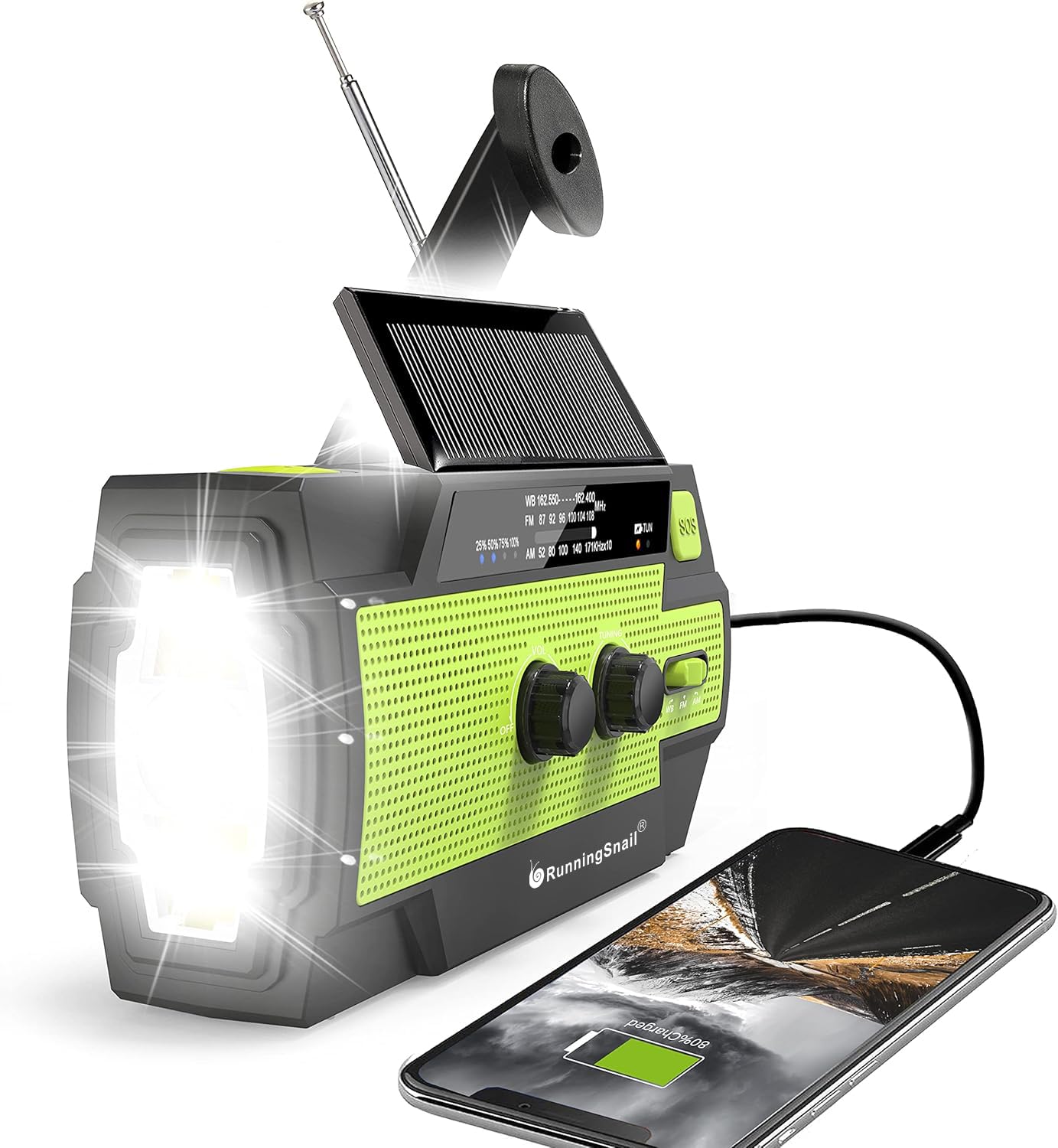
RunningSnail MD-090P
Key Features
- Battery: 4000mAh (14800mWh)
- Power Sources: Solar, Crank, USB, AC
- NOAA Alert: Manual tune
- Display: Analog
- Price: $
The MD-090P’s standout feature is its lighting array — a 1W three-mode flashlight that produces a strong beam and a motion-sensor reading lamp that activates automatically. This is unusually bright for a budget radio, and the compact size (6.2 x 2.5 inches) fits easily into a backpack or emergency kit.
This radio suits campers and emergency kit builders who want a bright, portable light source without spending much. The AM/FM/NOAA bands provide essential weather alerts, and the SOS function adds peace of mind. However, the solar panel is essentially non-functional for charging — treat it as a design element. The internal battery may not reach full charge or hold it over time, so hand cranking or USB input are the only dependable ways to keep it powered. Phone charging via USB should be considered a backup; the battery is best reserved for radio and lights.
Where the MD-090P excels is in core emergency functions: clear AM/FM/NOAA reception, a genuinely bright flashlight, and a thoughtful motion-sensor reading lamp for hands-free use. For buyers whose primary need is a loud, bright warning light and dependable radio reception, this radio delivers — just don’t count on solar or the battery for extended off-grid stays.
Pros
- Exceptionally bright flashlight and motion-sensor reading lamp
- Compact and portable design fits emergency kits
- Great value for money with dual light sources
Cons
- Solar panel is virtually non-functional for charging
- Battery may not charge to full capacity or hold charge over time
- Individual unit quality can vary; some have been observed to stop operating after a short period
If your primary need is a bright, affordable emergency light with radio, the RunningSnail MD-090P fits the bill — just keep the hand crank handy.
Best for Budget Radio
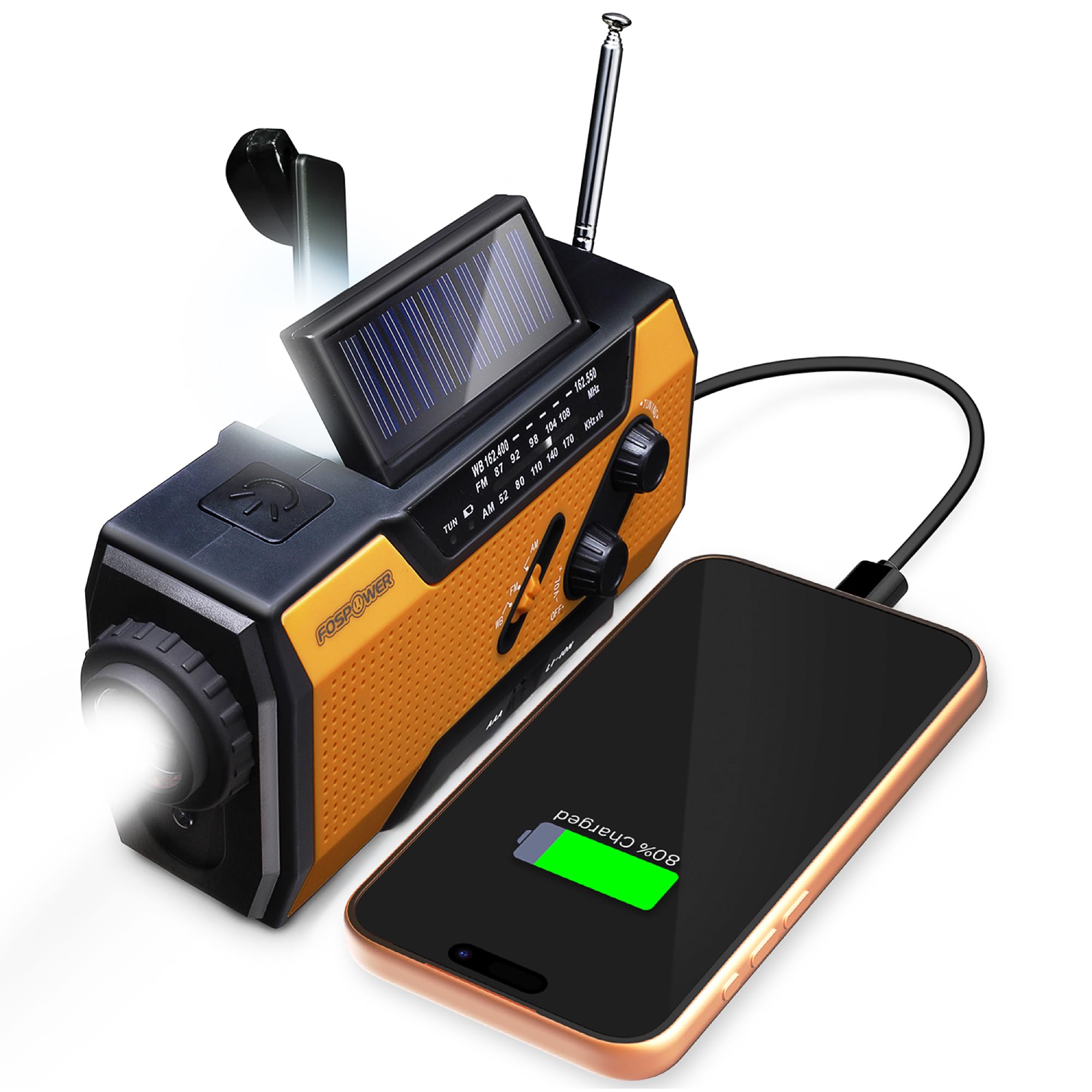
FosPower A1
Key Features
- Battery: 2000mAh (7400mWh)
- Power Sources: Solar, Crank, AAA, USB
- NOAA Alert: Manual tune
- Water Resistance: Water resistant (no IP)
- Display: Analog
- Price: $
The FosPower A1 is a popular entry-level emergency radio that combines compact size with AM/FM/NOAA reception and a basic flashlight. Its low price and wide availability make it an easy addition to emergency kits. However, the phone charging output is limited — it may not fully charge a smartphone. The solar panel and hand crank provide only a trickle of power, and the build quality (battery door, clips) can be inconsistent. For users who primarily need a reliable radio and light source without expecting dependable device charging, this remains a cost-effective choice.
Pros
- Compact and portable for easy storage
- Good value for money
- Works well for emergencies and camping
Cons
- Build quality (battery door, clips) can be inconsistent
- Phone charging output may not be sufficient for a full charge
Best suited as a dedicated radio and flashlight for emergency kits where phone charging is not a priority.
Best for Waterproof & Battery
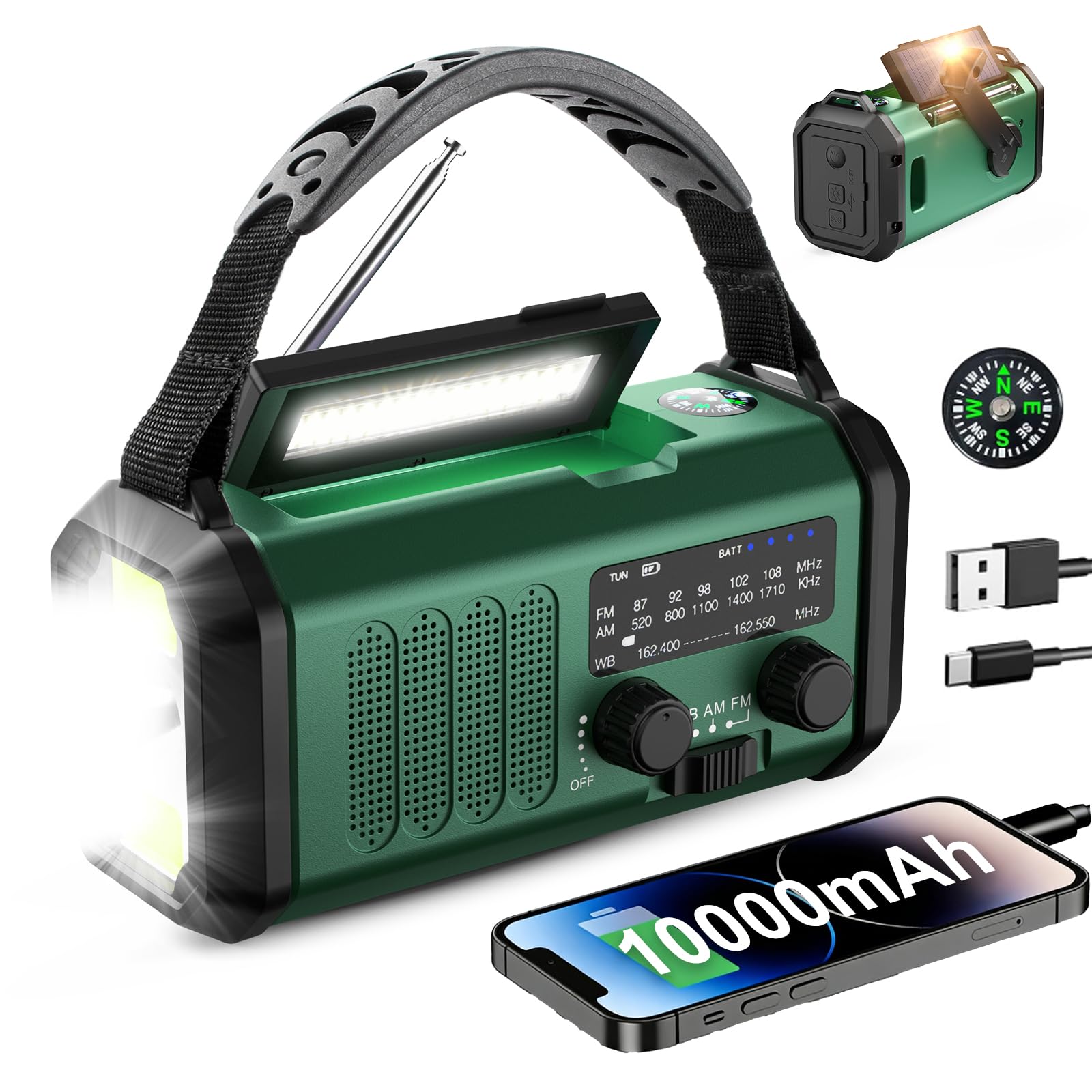
Leaton XSY-330
Key Features
- Battery: 10000mAh Li-poly
- Power Sources: Solar, Crank, USB-C, AAA
- NOAA Alert: Manual tune
- Water Resistance: IPX6
- Display: Analog
- Price: $
The Leaton XSY-330 brings IPX6 waterproofing and a 10000mAh battery to the budget segment, making it a sensible option for campers who need a rugged radio with extended runtime. However, the battery charging circuit can be unreliable — some units may not hold a charge as expected. The plastic housing also feels less substantial than pricier alternatives, and the analog tuner is tricky to use in low light. These quality control concerns keep it from a stronger recommendation.
Pros
- Massive 10000mAh battery provides extended runtime for radio and device charging.
- IPX6 waterproof rating and durable build withstand rain and drops during outdoor use.
Cons
- Plastic construction may feel less premium to some users.
- Battery charging circuit can be inconsistent; some units may not charge properly.
Best for campers on a tight budget who prioritize waterproofing and battery capacity over charging reliability — and are willing to test the unit promptly.
Best for Waterproof & Specs
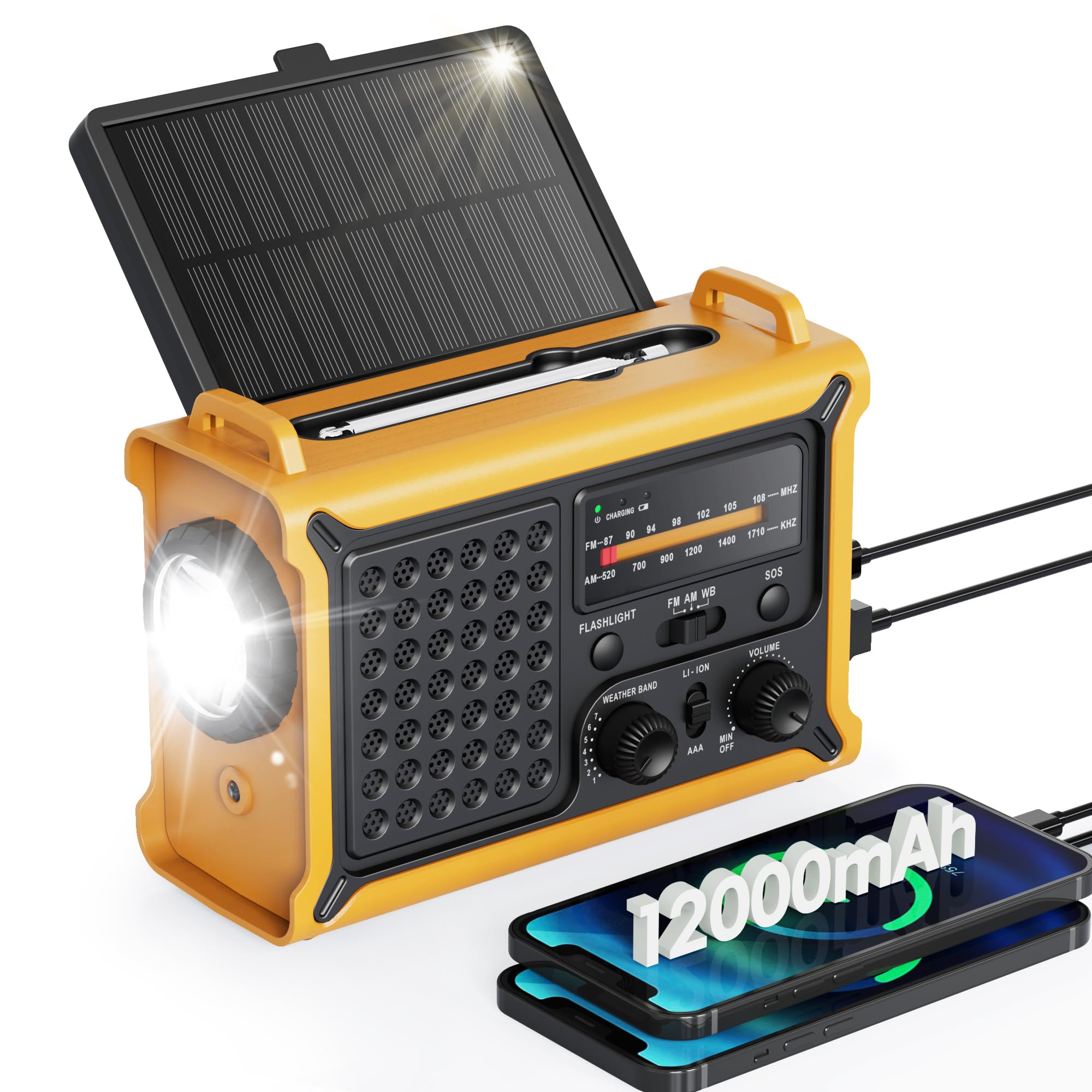
Roxicosly CR1030
Key Features
- Battery: 12000mAh Li-ion
- Power Sources: Solar, Crank, USB-C, AAA
- NOAA Alert: Manual tune
- Water Resistance: IPX6
- Display: Analog
- Price: $$
The Roxicosly CR1030 packs a large 12000mAh battery and IPX6 waterproofing into a mid-range emergency radio. Clear AM/FM/NOAA reception and multiple charging options (USB-C, hand crank, AAA) make it useful for camping and blackouts. However, the solar panel is designed only to maintain battery charge, not fully replenish it — a discrepancy from promotional materials. Phone charging via USB can also vary between units. These limitations make it a riskier pick than similarly priced radios with proven solar performance.
Pros
- Large 12000mAh battery with USB-C, hand crank, and AAA charging options
- Clear AM/FM/NOAA reception for weather alerts and news
- IPX6-rated waterproofing for outdoor use
Cons
- Phone charging may not work consistently across all units
- Solar panel only maintains battery charge, not fully charges it despite marketing claims
Worth considering if you prioritize battery capacity and waterproofing and can rely on USB-C or hand crank charging over solar.
Best for Budget Radio
Nitigo Emergency Radio

Key Features
- Battery: 4000mAh (14800mWh)
- Power Sources: Solar, Crank, USB
- NOAA Alert: Manual tune
- Water Resistance: Waterproof (no IP)
- Display: Analog
- Price: $
The Nitigo Emergency Radio offers clear AM/FM/NOAA reception and bright lights in a compact, budget-friendly package. Build quality is solid for the price. However, the battery and phone charging systems can be inconsistent – some units may not hold a charge or deliver usable power to a smartphone. This limitation makes the Nitigo best suited for short-duration emergency kits where radio and illumination are the primary needs, rather than as a dependable power bank for devices.
Pros
- Solid build quality for emergency use
- Bright LED flashlight and reading lamp
- Multiple charging options (solar, hand crank, USB)
Cons
- Phone charging may not work as expected; battery can fail to hold a charge over time
- Compact size may feel too small for users with larger hands
A solid budget option for those who need a basic emergency radio with good sound and light, as long as phone charging is not required and the unit is tested upon arrival.
How to Choose
The single most important buying insight is that hand cranking and USB charging are far more reliable than solar for topping off a radio battery in an emergency.
Battery Capacity
Battery capacity determines how long the radio runs and whether it can charge your phone. A 2000mAh pack may power the radio for a day but won’t fully recharge a modern smartphone. Look for 5000mAh or higher if you need device charging.
Keep in mind that advertised capacity is often optimistic. The actual usable charge can be lower due to voltage conversion losses when outputting to a phone. Radios with 10000mAh or more give you a meaningful reserve for multiple charges.
Power Sources
Most emergency radios offer solar, hand crank, USB, and battery backup. Solar panels on these radios are small: they can maintain a charge in direct sun but rarely recharge a depleted battery from zero. Hand cranking is more predictable but requires physical effort.
USB-C input is the fastest way to pre-charge the radio at home or from a power bank. Having a backup of standard AA or AAA batteries is critical if the internal battery dies and the crank fails. Prioritize radios with at least three distinct power methods.
NOAA Weather Alert
NOAA weather alert can be manual (you tune to the station) or auto-scan (the radio sweeps for the strongest signal and locks on). Auto-scan is far more convenient during a storm when you need the alert immediately.
Many budget radios only offer manual tuning, which means you have to know the frequency for your area. Auto-scan models like the Midland ER310 automatically find the nearest NOAA transmitter and sound an alarm when a warning is issued.
Water Resistance
Water resistance protects the radio from rain, splashes, or drops in a wet tent. IPX3 withstands light rain; IPX6 handles heavy spray and brief submersion. Radios without an IP rating may survive a light drizzle but not a downpour.
If you camp in rainy climates or near water, IPX6 is worth the extra cost. For car camping or dry conditions, a water-resistant shell without certification is sufficient. Check the manual for actual limits.
Display Type
Analog tuners use a dial and needle to select frequencies. They are simple but imprecise, especially in low light. Digital LCD displays show the exact frequency, battery level, and often an auto-scan function.
In an emergency at night, digital tuning is much easier: you can set a station quickly without fumbling with a small dial. If you plan to use the radio during power outages, a backlit LCD is a significant advantage over analog.
FAQ
Why won’t my emergency radio charge my phone?
Most emergency radios have small batteries (2000-4000mAh) and low-output USB ports. They are designed for a quick emergency top-up, not a full charge. A 2000mAh battery can only deliver about 60% of that to a phone due to conversion losses. For reliable phone charging, choose a radio with at least 5000mAh internal battery.
Does solar charging actually work on emergency radios?
Solar panels on these radios are small and produce only a few hundred milliamps. They can maintain a charged battery in full sun but rarely recharge a dead battery from zero. Solar is best used as a maintenance trickle charge, not a primary charging method. Hand crank or USB are far more dependable.
How long do you need to hand crank an emergency radio to charge a phone?
Hand cranking at 120-150 RPM typically generates 0.5-1 watt. To charge a phone (about 10 watt-hours), you would need to crank for 10-20 minutes straight. Most radios require even longer because internal charging circuits are inefficient. The crank is useful for a few minutes of radio time, not a full phone charge.
Is digital or analog tuning better for a camping emergency radio?
Digital tuning with an LCD display is substantially easier to use in the dark, especially during stress. It shows the exact frequency and can auto-scan for NOAA alerts. Analog dials are simpler mechanically but require good light and steady fingers to dial in a station. For camping, digital is the more practical choice.