This post contains affiliate links. We may earn a small commission when you buy through our links — at no extra cost to you.
You read the BTU rating, imagine fast boiling, then discover the stove can’t simmer a sauce and the wind snuffs the flame. That’s the gap between marketing and real camp cooking, and it’s surprisingly common. The best car camping stove doesn’t just blast heat – it controls it.
This guide cuts through the numbers to highlight stoves that actually combine high heat output with reliable flame control and wind resistance. These picks hold a low flame and stay lit even when a breeze picks up – a rarity among camp stoves.
The trade-off between power and precision is real, but you don’t have to sacrifice one for the other. The options here hit the sweet spot most car campers need: enough heat to boil water quickly, plus the control to simmer gently. No single stove is perfect, but the right one makes cooking at camp a pleasure.


Best for Family Car Camping
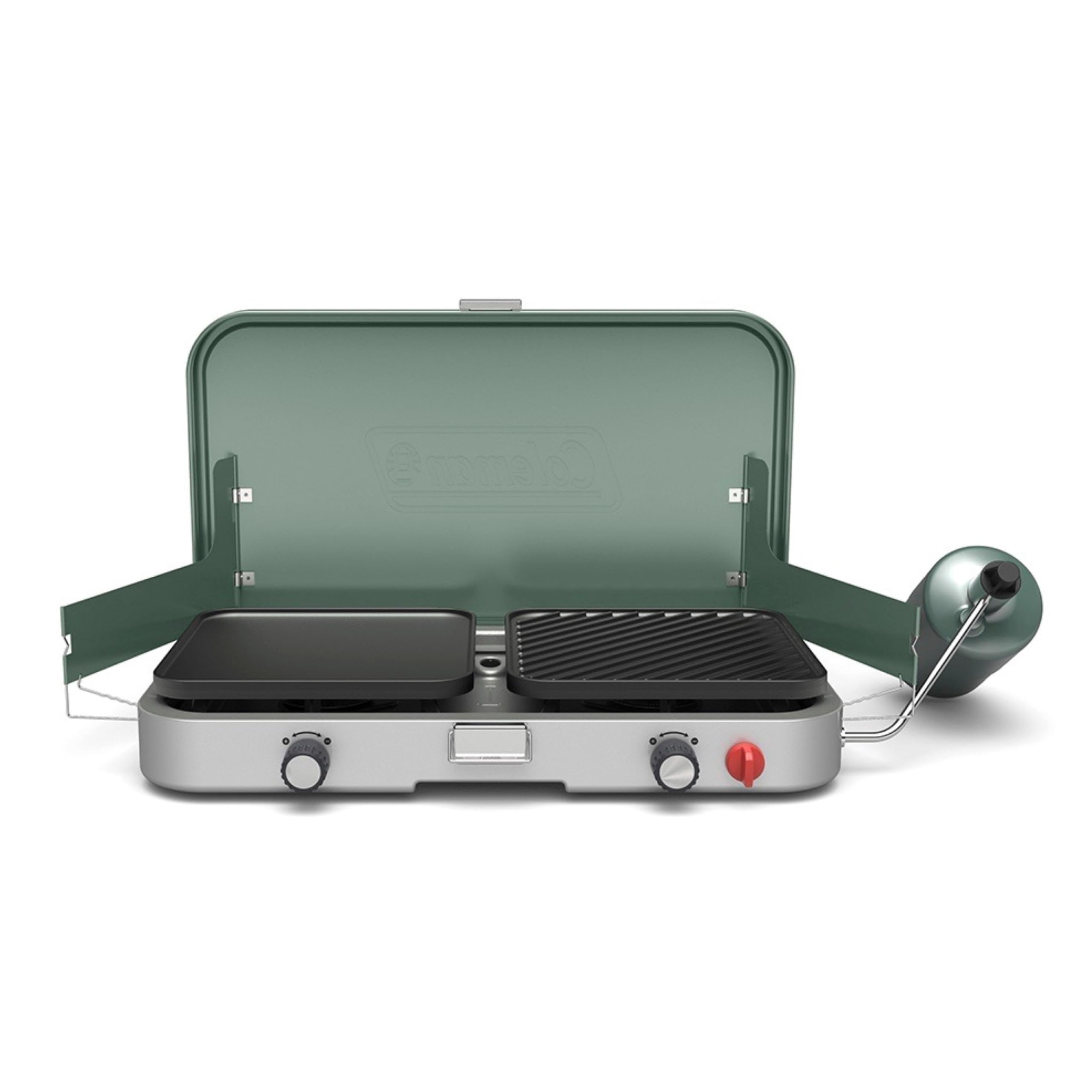
Coleman Triton 2-Burner
Key Features
- BTU Output: 22,000 total
- Burners & Pan Fit: 2 adjustable, 12-in & 10-in pans
- Ignition: Manual (match required)
- Weight & Size: 5 lbs
- Price: Mid-Range
The Triton delivers 22,000 total BTUs across two adjustable burners, enough to boil water quickly and hold a steady simmer for sauces. Ignition requires a match or lighter – a deliberate choice that eliminates a common failure point. The built-in wind shields offer modest protection; in breezy conditions, a separate windscreen improves consistency.
The stove folds up with a built-in handle for straightforward transport and storage, weighing about 5 pounds. It fits 12-inch and 10-inch pans without wobbling. Some units have arrived with minor scratches or dents from shipping – worth inspecting on arrival, but these don’t affect function.
This stove suits car campers who want a straightforward dual-burner cooktop without extras like piezo ignition. It works best in calm conditions or with a windscreen. If you prefer a built-in igniter, the Triton’s manual lighting adds a small step. For most family camping trips, it delivers consistent results without surprises.
Pros
- Even heat across both burners with fast boiling and capable simmer
- Simple setup and operation right out of the box
- Compact fold and built-in handle for easy carrying and storage
- Strong value for the price compared to similar dual-burner stoves
Cons
- Some units show cosmetic shipping damage like scratches or dents
- Wind shields are adequate for light breezes but not strong gusts
For car campers who want a stove that heats evenly, packs easily, and skips unnecessary extras, this model fits the need without overpaying.
Best for High-Heat Cooking
Camp Chef Everest 2X
Key Features
- BTU Output: 40,000 total
- Burners & Pan Fit: 2, 215 sq in cooking area
- Ignition: Matchless (piezo)
- Weight & Size: 15 lbs
- Price: Premium
For campers who need more heat than the standard two-burner stove, the Everest 2X delivers 40,000 BTUs and flame adjustment that holds a steady low simmer. The high output boils water fast and sears meat with authority, while the low end lets you cook delicate sauces without scorching.
The stove lights reliably in breezy conditions and maintains even heat across the cooking surface. Its 15-pound frame and large footprint mean it stays planted, but that same size limits where you can set it up.
This stove suits car campers who cook elaborate meals at a base camp and can accommodate its weight and dimensions. It is not a backpacking stove and will feel cramped on small picnic tables. The matchless ignition saves fumbling with lighters, though individual units have had the igniter stop working over time.
Pros
- Boils water quickly and sears meat effectively with high heat output.
- Precise flame adjustment for delicate simmering without scorching.
- Sturdy construction that handles heavy cookware and rough camp use.
Cons
- At 15 pounds, this stove is best left in the car for base camp use rather than carried any distance.
- The wide footprint may not fit standard picnic table surfaces or small camping tables.
The Everest 2X is the right choice for car campers who cook ambitious meals and value heat output and control over weight and size.
Best for Backup or Emergency
Gas One Butane Stove
Key Features
- BTU Output: 7,650
- Burners & Pan Fit: 1
- Ignition: Piezo electric
- Weight & Size: 3.1 lbs
- Price: Budget
The Gas One delivers cooking power comparable to pricier single burners at a fraction of the cost. Its piezo ignition lights consistently, and the 7,650 BTU output handles boiling water or quick meals without fuss.
This is a warm-weather companion. Butane fuel loses pressure below 50°F, so cold-weather campers should stick with propane options. The plastic hinge on the carrying case may break under rough handling — treat it like the budget tool it is. That makes it best for occasional use as a secondary stove or emergency gear.
For car campers who already have a primary dual-burner stove, this unit tucks into a corner for backup cooking or coffee. It is not built for heavy daily use, but for the price, it holds up fine for weekend trips in mild weather.
Pros
- Extremely portable and affordable for camping or emergencies.
- Simple operation with consistent piezo ignition.
- Heats food quickly for a single-burner design.
Cons
- Plastic hinge on the case can break if handled roughly.
- Butane pressure drops noticeably below 50°F, reducing flame output.
If you need a cheap, single-burner stove for warm-weather camping or emergency prep, the Gas One does the job without overspending.
Best for Van Life Solo
Coleman BottleTop
Key Features
- BTU Output: 10,000
- Burners & Pan Fit: 1, fits 8-in pan
- Ignition: Manual (lighter required)
- Weight & Size: Attaches to bottle
- Price: Budget
The Coleman BottleTop Propane Stove stakes its claim as the most portable propane option by screwing directly onto a standard canister. No hose, no regulator, no extra parts to lose – just twist it on, open the valve, and light. While ultra-light butane stoves like the Fire-Maple FMS-116T are even lighter, they require a separate fuel canister and performance drops in cold. The BottleTop uses ubiquitous green propane cylinders and delivers consistent heat regardless of temperature.
This stove best suits car campers who need a compact backup for boiling coffee or heating a single pot of soup, or van dwellers with minimal counter space who want a stove that stows in a cubby. The tradeoffs are clear: the burner only fits 8-inch pans, the flame control at low settings is coarse, and the top-heavy setup can tip if bumped. These constraints are manageable for small, quick meals but rule out elaborate camp cooking or delicate simmering.
Heat output is sufficient to boil water in about 4 minutes – enough for a quick coffee or ramen. The burner ring distributes heat evenly for its size, and the stove feels solid when attached to a full propane bottle on a level table. Because the stove sits atop the canister, placing it away from traffic and on a stable surface avoids accidental knocks.
Pros
- Screws directly onto any standard propane bottle – no hose, regulator, or extra assembly needed.
- Sturdy four-point connection to the canister keeps the stove stable on flat ground.
- Generates enough heat to boil water in minutes and handle basic camp cooking.
Cons
- Flame adjustment at the low end is coarse – achieving a true simmer requires patience.
- Top-heavy design can tip if the stove is bumped or placed on uneven ground – better suited for careful placement.
- Accommodates only 8-inch pans or smaller – not suitable for larger cookware.
A compact propane stove that excels as a backup or space-saving option – but only if you work within its pan-size and simmer limitations.
Best for All-In-One Cooking
Coleman Cascade 3-in-1
Key Features
- BTU Output: 24,000 total
- Burners & Pan Fit: 2 plus grill/griddle
- Ignition: Rotary (piezo)
- Weight & Size: 15.8 lbs
- Price: Premium
The Coleman Cascade 3-in-1 combines a two-burner stove with a cast-iron grill and griddle, allowing you to switch between pancakes, burgers, and a pot of chili without additional cookware. With 24,000 total BTUs, it has enough heat for most camp meals.
This setup is best for car campers who prioritize cooking variety over portability. The 15.8-pound weight means it stays in the trunk, not on a trail. Occasional igniter issues are possible — a backup lighter solves that — but the cast-iron grates hold heat well and clean up with minimal effort.
The included grill and griddle distribute heat evenly, making it possible to cook a full breakfast or sear meat at the same time. The sturdy construction handles repeated use, though the accessories are heavy and require some scrubbing after greasy meals.
Pros
- Versatile cooking options with included grill and griddle
- Solid build quality with durable cast-iron grates
- Easy to use and clean with simple setup
Cons
- At 15.8 pounds, this stove is best left in the car — not for carrying to a campsite
- The rotary igniter can occasionally need a backup lighter to spark the flame
If you drive to camp and want one appliance that handles grilling, griddling, and boiling, the Cascade delivers versatility that separate stoves can’t match — just don’t plan to carry it far.
Best for Budget Dual-Burner
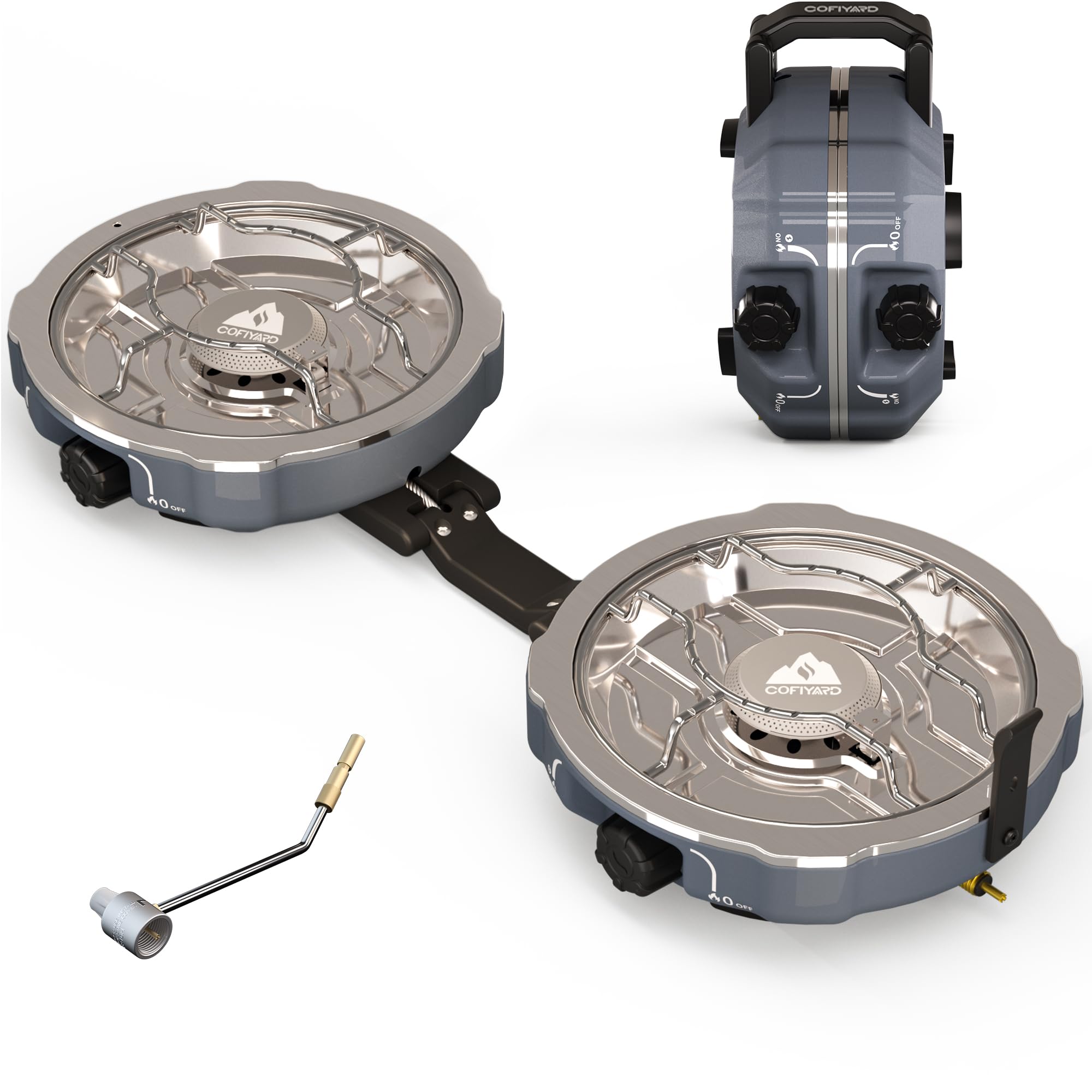
Cofiyard 2-Burner
Key Features
- BTU Output: 20,000 total
- Burners & Pan Fit: 2
- Ignition: Built-in piezo
- Weight & Size: 4.5 lbs
- Price: Mid-Range
The Cofiyard delivers a similar dual-burner experience to the Coleman Triton at a noticeably lower price, with rapid boiling and a folded size that stows easily in a car trunk. The 20,000 BTUs handle typical camp meals without issue, and the included carry bag adds convenience.
This stove suits budget-conscious car campers and first-time buyers who want a low-risk entry to two-burner cooking. The steel body can feel thin and the piezo igniter sits near the flame, which may shorten its lifespan, but these tradeoffs are manageable for those who prioritize cost and portability over premium materials.
Water boils quickly on high, and the burners respond well to adjustment for simmering. The igniter is convenient for initial use, but keeping a backup lighter handy is a sensible precaution if the piezo degrades from repeated flame exposure. The lightweight build means it won’t withstand heavy abuse, but it holds up fine for regular car camping trips.
Pros
- Low price for a dual-burner with strong heating and compact storage.
- Folds small for easy transport and includes a carry bag.
- Powerful 20,000 BTUs boil water fast.
Cons
- Piezo igniter located near flame may degrade sooner than expected.
- Build feels flimsy; thin metal and rattling can occur.
For budget-focused car campers who want fast heat and easy portability without paying a premium, this stove offers solid performance at a price that leaves room for other gear.
Best for Matchless Ignition
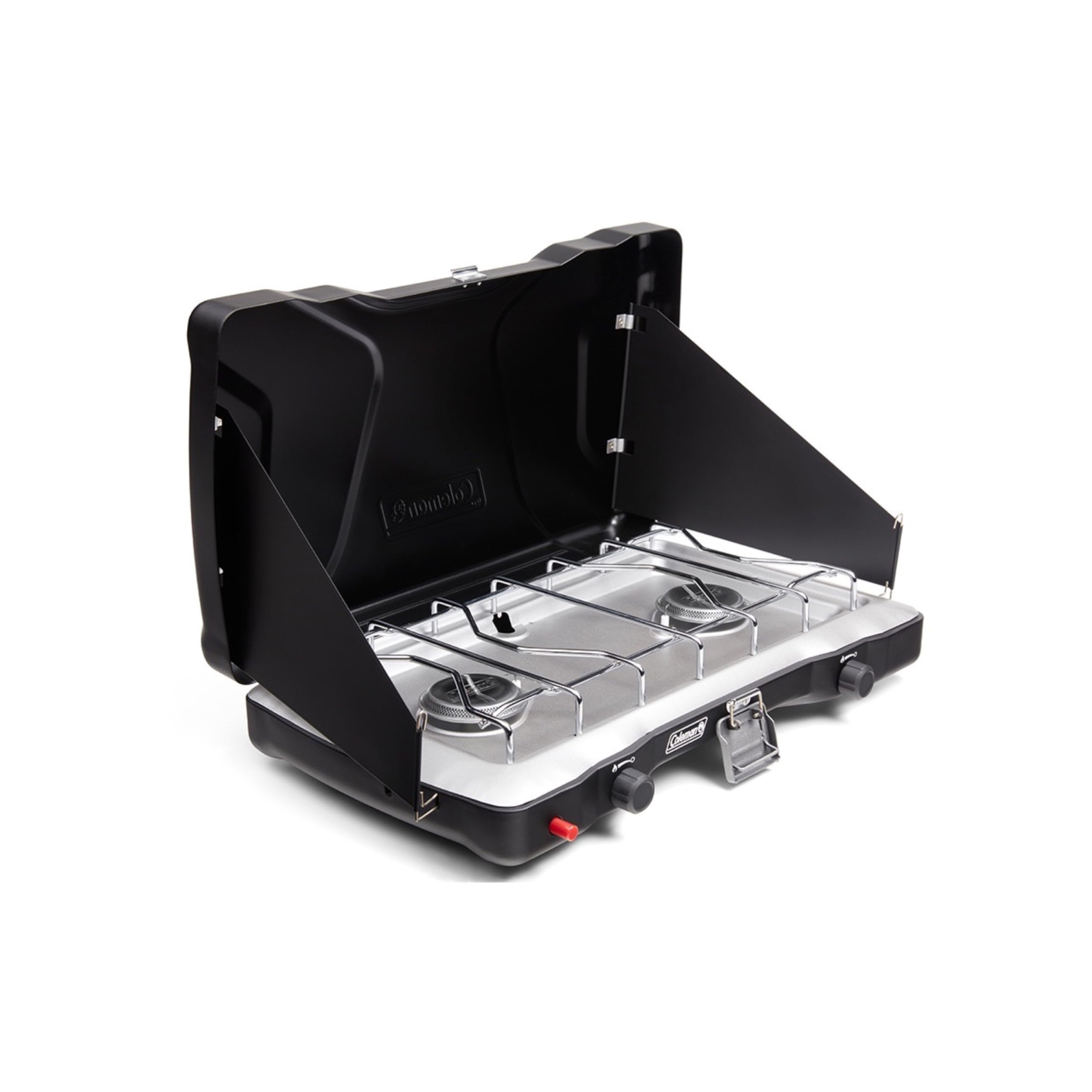
Coleman Triton+ 2-Burner
Key Features
- BTU Output: 22,000 total
- Burners & Pan Fit: 2 adjustable, 12-in & 10-in pans
- Ignition: InstaStart push-button
- Weight & Size: 16 lbs
- Price: Mid-Range
The Triton+ lights burners with a push-button starter that works on the first press, and its burners heat cast iron quickly. The compact fold-up design fits easily in a car trunk. The trade-off is cost: the standard Triton (manual ignition) offers identical heat output and portability at a lower price. The integrated igniter is convenient, though occasional electrode misalignment may require a simple adjustment.
Pros
- Push-button ignition lights burners consistently on first press.
- Heats cast iron cookware quickly with 22,000 total BTUs.
- Folds up compactly for easy car camping transport.
Cons
- Igniter electrode may need occasional bending to maintain contact.
- Costs more than the base Triton without meaningful performance gains.
Best for car campers who dislike using a lighter and are willing to pay a small premium for push-button ignition.
Best for Lightweight Secondary
Coleman Classic Butane

Key Features
- BTU Output: 7,650
- Burners & Pan Fit: 1
- Ignition: InstaStart
- Weight & Size: 0.55 lbs
- Price: Budget
The Coleman Classic Butane stove delivers on its promise of ultralight portability. At just over half a pound, it packs easily for car camping, picnics, or as a backup. Its InstaStart ignition and steady 7,650 BTU output handle boiling water or heating a small pan without fuss. However, butane’s pressure drops below 50°F, making this a warm-weather only tool. The plastic carry case can also crack under rough handling. It is not a primary stove for cooking for more than one or two people, but as a lightweight addition for quick meals, it serves well.
Pros
- Ultra-light at 0.55 lbs, packs easily for any trip
- Simple ignition with reliable InstaStart, no matches needed
- Good heat output for its size, boils water quickly
Cons
- Carry case may crack with rough handling or packing
- Butane performance drops below 50°F, limiting use to warm weather
Best used as a warm-weather backup for coffee or hot water when weight savings matter more than all-weather reliability.
Best for Stable Large-Pan
Coleman PowerPack

Key Features
- BTU Output: 7,500
- Burners & Pan Fit: 1, fits 12-in pan
- Ignition: Manual (lighter required)
- Weight & Size: Attaches to bottle
- Price: Budget
This single-burner propane stove screws onto a canister and provides a wide, stable platform for large pots – ideal for boiling water or one-pot meals at car campsites. Heat output is fast and consistent. The tradeoffs are clear: the temperature knob offers little precision for low-heat simmering, and lighting requires a separate lighter or matches. For campers who prioritize stability over simmer control and don’t mind carrying an igniter, it’s a budget-friendly workhorse.
Pros
- Wide, stable base supports 12-inch pots without tipping
- Compact design attaches directly to propane canister – minimal setup
- Heats water quickly with 7,500 BTUs of consistent output
Cons
- Coarse flame adjustment makes low-heat simmering difficult
- No piezo igniter requires matches or a lighter for each use
A stable, no-fuss burner for boiling and basic camp cooking – skip it if you need fine temperature control.
Best for Budget with Extras
ODSD 2-Burner

Key Features
- BTU Output: 20,000 total
- Burners & Pan Fit: 2
- Ignition: Built-in piezo
- Weight & Size: 8.66 lbs
- Price: Mid-Range
This stove delivers good value for the price with the included accessories, making it a convenient option for occasional car camping. The piezo igniters can be inconsistent, and the plastic coffee stand may not hold up over time. These durability concerns make it less suited for frequent trips or heavy use, but for light, infrequent cooking it gets the job done without a big investment.
Pros
- Includes frying pan, coffee stand, and carry bag for added convenience
- Folds compactly and packs inside the included carry bag
- Quick assembly with self-contained design
Cons
- Piezo igniters may need multiple attempts to light
- Plastic coffee holder can crack with repeated use
Best for budget-conscious car campers who want a complete setup for occasional weekend trips and are willing to accept occasional ignition hassle.
Best for Emergency Kit Only
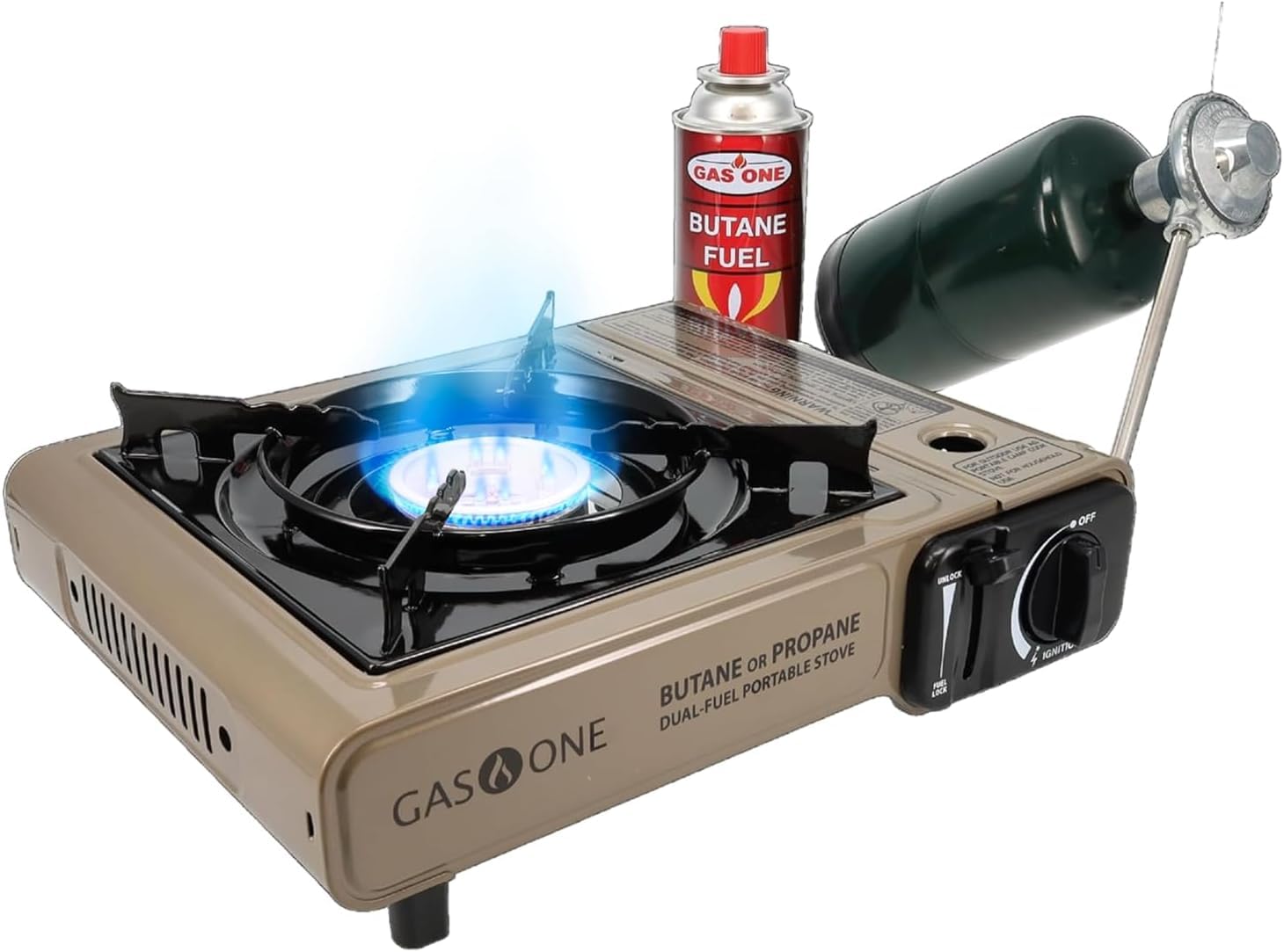
Gas One GS-3400P
Key Features
- BTU Output: ~7,500-10,000
- Burners & Pan Fit: 1
- Ignition: Piezo electric
- Weight & Size: 3.1 lbs
- Price: Budget
The Gas One GS-3400P accepts both butane and propane canisters, giving flexibility in fuel choice without requiring adapters. Its compact size and piezo ignition make setup quick. However, this stove is not built for sustained high-heat cooking; the burner area and plastic components can overheat and melt if used at high output for long periods. That makes it suitable only for emergency kits, light camping meals, or as a backup stove where heat is kept low and cooking times are short.
Pros
- Accepts both butane and propane canisters without adapters.
- Compact and lightweight, easy to store in a car trunk or emergency kit.
Cons
- Thin metal body may warp with repeated use.
Best reserved for occasional, low-heat tasks where weight and price matter more than durability.
How to Choose
Most car camping stoves advertise high BTUs but lack the flame control and wind resistance that actually matter for camp cooking.
Total Heat Output (BTU)
BTU is the raw power rating – higher numbers mean faster boiling and more heat for searing. For car camping, 20,000 total BTUs is a good baseline for a dual-burner, enough to boil a pot of water in under 5 minutes on high.
But raw BTUs don’t tell you how well the stove simmers. A burner that only runs at full blast or drops to a weak flame forces you to juggle pan position. Look for a stove with a separate low flame adjustment, not just a high-low dial that jumps between extremes.
Burners and Pan Size
A dual-burner stove lets you cook two dishes at once, essential for family meals. Check the grate spacing – a stove that fits a 12-inch pan on each burner is ideal for cast iron skillets and larger pots.
Single-burner models are more compact but limit you to one pot at a time. If you often cook for more than two people, a dual-burner is worth the extra space in the car.
Wind Protection
Wind is the biggest enemy of camping stoves. Built-in windshields or folding panels help redirect air away from the burners, keeping the flame stable. Without them, even a light breeze can blow out the flame or waste fuel.
Many stoves have minimal shields – you can add a separate folding windscreen for $10-20. If you camp in open, exposed areas, prioritize models with taller or wrap-around shields over those with small flaps.
Ignition Type
Piezo or push-button igniters offer one-click lighting, but they can fail after repeated use from debris or mechanical wear. A stove with a replaceable igniter or a backup manual system is more reliable over time.
Manual stoves (match or lighter required) never suffer igniter failure, and a cheap lighter works every time. For peace of mind, carry a backup lighter regardless of the ignition type.
Weight and Portability
Car camping doesn’t require ultralight gear, but a heavy stove is still a burden when loading and unloading. Dual-burner stoves range from 5 to 16 pounds. Under 10 pounds is manageable; over that, you’ll notice the weight.
Foldable legs and a built-in handle make transport easier. If trunk space is tight, measure the folded dimensions – some stoves fold to the size of a shoebox, while others are bulky.
FAQ
Can I use a 20lb propane tank with a portable camping stove?
Yes, with an adapter hose (sold separately). Most portable stoves come with a 1lb propane canister connection, but a 20lb tank is more economical for extended car camping. Make sure the stove’s regulator is compatible – some stoves require an intermediate regulator if the hose is long. Using a 20lb tank saves money and reduces canister waste.
Why does my camping stove flame keep going out in the wind?
Inadequate wind protection is the culprit. Most portable stoves have minimal windshields that only block low-angle breezes. For gusty conditions, use a foldable windscreen or position the stove behind a natural barrier like a cooler or vehicle. If your stove lacks any shielding, expect flames to flicker or extinguish in strong winds.
How many BTUs do I actually need for a car camping stove?
For a dual-burner stove, 20,000 total BTUs (10,000 per burner) is the sweet spot. It boils water quickly and provides enough heat for typical camp meals without excessive fuel consumption. Stoves with 7,000–10,000 BTUs per burner are fine for single-burner use but slower for large pots.
What’s the best stove for simmering while camping?
Look for stoves with a separate low-flame adjustment and a regulator that maintains consistent gas flow at low settings. The Camp Chef Everest 2X and Coleman Triton both receive praise for their simmer control. Avoid stoves that only have a coarse high-low dial – they tend to jump from high to a nearly-off flame.