This post contains affiliate links. We may earn a small commission when you buy through our links — at no extra cost to you.
Camping lantern specs are often inflated. Advertised runtimes can fall 20-30% short, and a claimed 1000 lumens might be too harsh for a small tent. The real challenge is matching the light to how you actually camp — not just chasing numbers.
That means choosing between battery-powered simplicity with multi-packs for the whole family, or rechargeable models with power-bank backups for longer stays. Collapsible designs are easy to store but rarely offer fine brightness control. This guide cuts through the hype to spotlight lanterns that deliver honest performance for camping, emergencies, and everyday use.
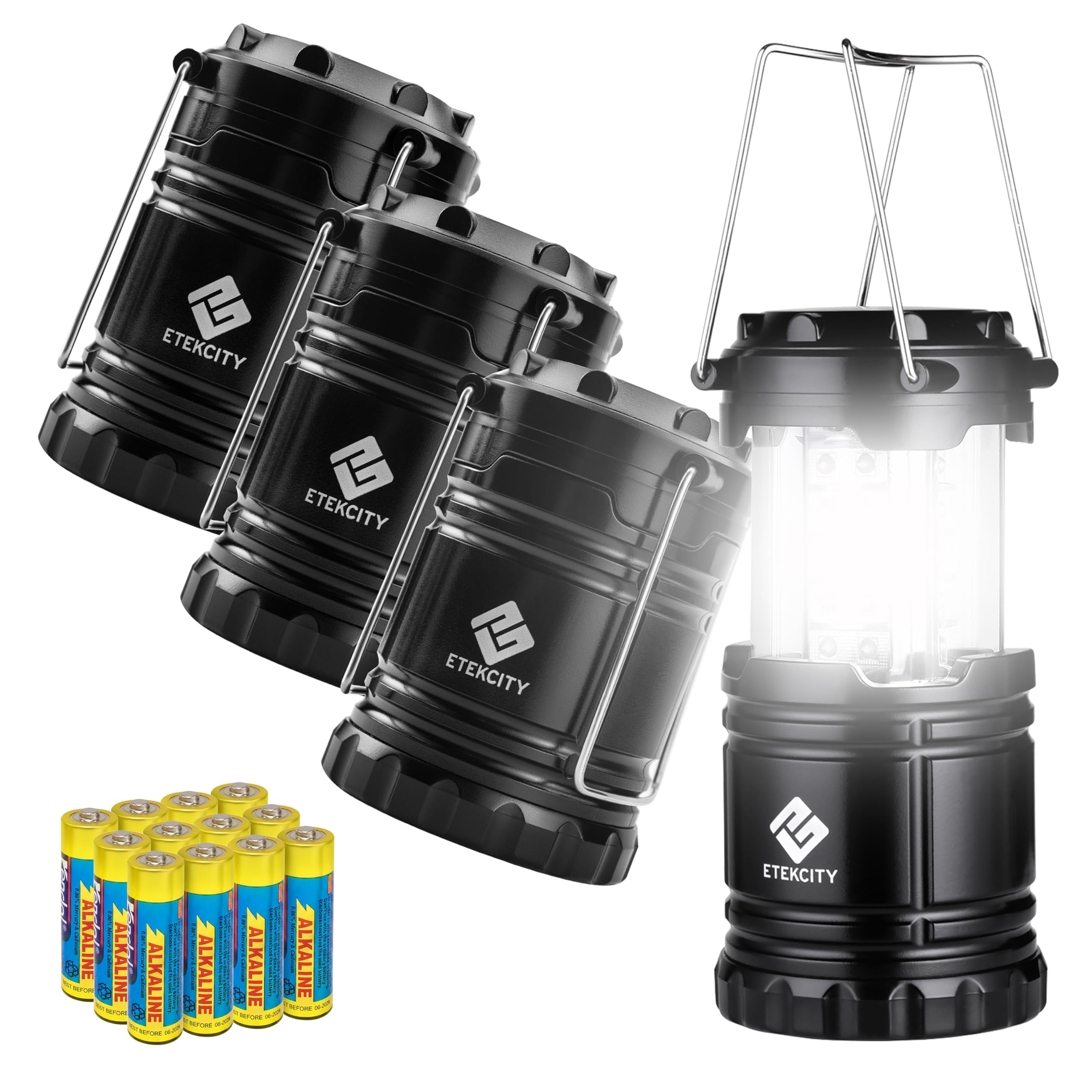


Best for Budget & Family
Etekcity 4 Pack
Key Features
- Brightness: 154 lumens
- Power: 3 AA batteries
- Pack Size: 4
- Water Resistance: Water resistant
- Special Features: Pull-up operation
- Price: $
Each lantern delivers 154 lumens of 360-degree light from a compact body that collapses to palm-size. The pull-up operation requires no switches — extend the housing to turn on, collapse to turn off. With 50 hours of battery life from three AAs, this is the kind of straightforward design that works every time without menu-diving or charging cables.
This set suits campers and preppers who need multiple lights for tents, power outages, or emergency kits. The cool white beam is bright for utility use — reading, cooking, walking — but not for ambient relaxation. Brightness is adjusted only by how far you pull the housing, so fine control is limited. For those who want a warm, dimmable glow, this isn’t the fit. But for reliable task lighting at a price that undercuts single-lantern competitors, it’s hard to beat.
Pros
- Incredible value for a 4-pack with batteries included
- Bright 154-lumen output with full 360-degree coverage
- Simple pull-up mechanism, easy for all ages to operate
Cons
- Brightness adjustment is limited to pulling the housing — not as precise as a switch
- Cool white light may feel harsh during extended use
If you need a bundle of no-fuss lanterns for camping, outages, or prep kits, the Etekcity 4 Pack delivers proven performance at a price that leaves room for other gear.
Best for Campers & Emergency
EZORKAS 2 Pack
Key Features
- Brightness: COB LED ~200-300
- Power: Rechargeable + AA backup
- Pack Size: 2
- Water Resistance: Water resistant
- Special Features: Magnetic, SOS, flashlight
- Price: $
EZORKAS 2 Pack adds USB rechargeability and AA battery backup – a flexible solution for campers who want to avoid relying solely on disposables. The magnetic base and red SOS mode expand its usefulness beyond basic lighting. However, there is no brightness level adjustment, and runtime on high brightness is around 5-6 hours. This makes it best for budget-minded campers and emergency kit builders who prioritize rechargeable convenience with a backup option over fine-tuned brightness control.
Pros
- Rechargeable with AA battery backup ensures continuous light even when the built-in battery dies.
- Bright COB LED with multiple modes including flashlight and red strobe.
- Magnetic base and hanging hook enable hands-free positioning on metal surfaces or from a tent ceiling.
Cons
- No dimming control – only mode changes without fine brightness adjustment.
- On high brightness, the rechargeable battery lasts about 5-6 hours before needing a charge.
A practical choice for campers and preppers who value rechargeable backup over brightness control, as long as runtime on high isn’t a dealbreaker.
Best for Rugged, Marine, Preppers
Streamlight Siege
Key Features
- Brightness: 540 lumens
- Power: 3 D-cell batteries
- Pack Size: 1
- Water Resistance: IPX7
- Special Features: SOS, removable globe
- Price: $$$
The Streamlight Siege is IPX7 waterproof and floats, a rare combination that makes it ideal for marine or wet conditions. Battery life on low mode stretches 295 hours, covering multi-week trips without battery swaps. The tradeoff is weight: D-cell batteries and rugged construction make it bulky, so it’s not for ultralight backpackers. This is a lantern for vehicle campers, emergency kits, and RV storage where durability matters more than ounces.
Pros
- IPX7 waterproof and floats — won’t sink if dropped overboard
- 295-hour runtime on low mode — set it and forget it for weeks
- 360° diffused light with even coverage and no hot spots
Cons
- For backpackers, the D-cell weight (approx. 2 lbs with batteries) makes it impractical for hiking
- If used nightly on high mode, buying D-cell replacements becomes a recurring expense
Best for campers who drive to the site and emergency preppers who want a light that won’t quit in a flood. Skip it if every ounce counts.
Best for Large Areas, Car Camping
Lepro 1000LM
Key Features
- Brightness: 1000 lumens
- Power: 4400mAh rechargeable
- Pack Size: 1
- Water Resistance: IPX4
- Special Features: Power bank, dimmable
- Price: $$
The Lepro delivers 1000 lumens of adjustable warm-to-cool light — far brighter than the top pick. Its USB-C power bank can charge a phone in a pinch, making it a functional multi-tool for the campsite. For car camping where weight and bulk aren’t a concern, this is an appealing choice. But it’s not for backpackers.
The tradeoff is that high mode drains the battery in about 4-5 hours, and some units may experience charging failures over time. This makes it best for campers who want maximum brightness and a backup phone charger, and who can work around the runtime limitation.
Pros
- Bright 1000-lumen output with adjustable brightness and color temperature
- USB-C rechargeable with power bank function for charging phones
- Compact size considering the high lumen output
Cons
- Charging port or battery may stop working in some units
If you need a bright lantern with a built-in phone charger for car camping, the Lepro delivers — just plan around the shorter battery life on high and the possibility of charging port issues.
Best for Mechanics, Car Campers
GearLight 2 Pack
Key Features
- Brightness: 600 lumens
- Power: 3 AA per lantern
- Pack Size: 2
- Water Resistance: Water resistant
- Special Features: Magnetic base, collapsible
- Price: $$
Each lantern’s magnetic base attaches securely to car hoods, tool chests, or tent poles, providing bright, shadow-free light exactly where needed. At 600 lumens, they easily illuminate a campsite or engine bay, and the included AA batteries mean immediate use. The listed 2-hour battery life is misleading — in practice, runtime extends far longer, but the discrepancy can cause initial distrust. These suit car campers, mechanics, and DIYers who value a magnetic mount over rechargeable convenience. Backpackers may find the weight (three AA batteries plus lantern) a bit much.
Pros
- Bright 360-degree light with a strong magnetic base for hands-free use in tight spaces.
- Batteries included and ready to use right out of the package.
Cons
- Claimed 2-hour runtime is inaccurate; actual performance is much longer but the spec causes initial confusion.
- Some units may arrive with missing batteries or minor assembly inconsistencies.
A capable hands-free lighting option for car campers and mechanics who value a magnetic mount over rechargeable features — just be aware the battery spec isn’t what’s printed on the box.
Best for Compact, Car Camping
LE 410LM
Key Features
- Brightness: 410 lumens
- Power: Rechargeable Li-Po
- Pack Size: 1
- Water Resistance: IPX4
- Special Features: Power bank, magnetic, 5 modes
- Price: $
The LE 410LM delivers impressive brightness from a compact frame, with a magnetic base and dual hooks for hands-free mounting. It doesn’t match the output of bulkier models, but its size makes it ideal for minimalist packing. Best for car campers and emergency kits who value portability and the convenience of a backup phone charger. That said, some units may stop holding a charge after a few months – a known quality-control variance worth considering if long-term reliability is critical.
Pros
- Compact size delivers 410 lumens – bright enough for a tent or campsite.
- Magnetic base and hooks allow hands-free attachment to metal surfaces or hanging.
- Rechargeable with 12-hour runtime and USB power bank for phone charging.
Cons
- Some units may develop charging problems after months of use – acceptable for occasional camping, less so for daily reliance.
- Side buttons are harder to press when the lantern is magnetically attached – a minor ergonomic quirk.
For campers who prioritize a compact, multi-functional lantern and accept minor quality variance, this is a cost-effective choice.
Best for Budget & Emergency
Lichamp 4 Pack

Key Features
- Brightness: 350 lumens
- Power: 3 AA batteries
- Pack Size: 4
- Water Resistance: Water resistant
- Special Features: Collapsible
- Price: $
Each lantern pumps out 350 lumens from three AAs, making this 4-pack a cost-effective way to light a tent or outage. The collapsible design stores flat. The battery cap can be stiff to thread and some units arrive non-functional – worth checking before a trip. For low-cost bulk lighting, it delivers.
Pros
- Puts out 350 lumens from three AA batteries – bright enough for a tent or room.
- Collapses flat for storage in emergency kits or camping gear.
Cons
- The battery compartment cap can be difficult to thread, especially in low light or with cold fingers.
Best for budget-conscious buyers who need multiple lanterns for occasional camping or home emergency kits and are willing to inspect each unit upon arrival.
Best for Families, Kids, Budget
MalloMe 4 Pack

Key Features
- Brightness: 146 lumens
- Power: 3 AA per lantern
- Pack Size: 4
- Water Resistance: Not water resistant
- Special Features: Multicolor, pull-up
- Price: $
These lanterns offer vibrant color options and a simple pull-up design that children can handle easily. The 4-pack provides excellent value for family camping or budget emergency kits. At 146 lumens, brightness is modest, and some units may arrive non-functional out of the box, so it is worth testing each one immediately.
Pros
- Fun color options appeal to families and kids
- Compact and lightweight, easy for children to handle
Cons
- Not water resistant; best for dry camping or indoor use only
Best for families seeking colorful, easy-to-use lanterns for dry conditions; test each unit upon arrival.
Best for Tent Campers, Emergency
Lepro 4 Pack 190LM

Key Features
- Brightness: 190 lumens
- Power: 3 AA per lantern
- Pack Size: 4
- Water Resistance: IPX4
- Special Features: Collapsible
- Price: $
These Lepro lanterns offer 190 lumens per unit in a collapsible design with IPX4 water resistance, making them practical for tent lighting in damp conditions. The 4-pack provides good coverage for multiple rooms or emergency kits. Brightness is adequate for close-up use but insufficient for large areas – the top pick delivers more light for a similar price.
Pros
- Four water-resistant lanterns at a budget price cover multiple spaces
- Simple pull-to-on operation and 14-hour battery life minimize fuss
Cons
- New units may have a plastic smell that dissipates after airing out
Best for budget-conscious campers who need multiple lights for enclosed spaces and don’t require high brightness for outdoor gatherings.
Best for Emergency, Dry Campers
Eveready 3 Pack

Key Features
- Brightness: 350 lumens
- Power: 3 AA per lantern
- Pack Size: 3
- Water Resistance: Not water resistant
- Special Features: Flashlight, magnets, SOS
- Price: $
Eveready’s 3-pack provides 350 lumens per lantern with a flashlight mode and magnetic base. Batteries are included for immediate use. The plastic build feels lightweight, and there’s no water resistance—rain or damp conditions are out. It works well for dry camping or emergency prep, but misses the all-weather utility of the top pick.
Pros
- Good brightness (350 lumens) with directional flashlight mode.
- Batteries included, ready out of the box.
Cons
- In rain or damp environments, the absence of water resistance limits its use.
Best for dry camping, emergency kits, or as a gift for non-outdoorsy types where water exposure is not a concern.
Best for Large Areas, Car Camping
AYL 1800LM 2 Pack

Key Features
- Brightness: 1800 lumens
- Power: 4400mAh + AAA backup
- Pack Size: 2
- Water Resistance: IP44
- Special Features: Power bank, 4 modes
- Price: $$
Delivers an impressive 1800 lumens and doubles as a power bank, ideal for lighting up large campsites. However, charging reliability can be inconsistent, and the plastic housing may crack over time, so these suit car campers who prioritize brightness above all else and are comfortable with potential unit variance.
Pros
- Extremely bright 1800 lumens with multiple light modes for large-area illumination.
- Rechargeable battery with power bank capability to charge devices on the go.
Cons
- Charging reliability can be inconsistent, and the plastic housing may crack under extended use.
Best for car campers who need extreme brightness and don’t mind occasional unit variance.
Best for Preppers, Occasional
XTAUTO Solar 4 Pack

Key Features
- Power: 1600mAh + solar
- Pack Size: 4
- Water Resistance: Waterproof (claimed)
- Special Features: Solar, USB, flashlight
- Price: $
Off-grid campers will appreciate the dual solar and USB charging that keeps four lanterns topped up without wall outlets. The collapsible design is easy to pack. Brightness is modest — suitable for tent use rather than lighting a large area. Occasional charging hiccups mean this works best as a backup option for emergency kits where solar is a key requirement.
Pros
- Solar and USB charging keep four lanterns running without wall power.
- Lightweight collapsible design packs easily into a backpack or emergency kit.
Cons
- Plastic housing may crack after drops or rough handling during transport.
Worth picking up if solar charging is a must-have and you can accept occasional charging inconsistencies.
Best for Ultra-Budget, Kids
FLY2SKY 4 Pack

Key Features
- Brightness: 150 lumens
- Power: 3 AAA per lamp
- Pack Size: 4
- Water Resistance: IPX8
- Special Features: Clip hook, 3 modes
- Price: $
Under $12 for a 4-pack of IPX8, lightweight clip-on lights with 150 lumens each makes this an unbeatable deal for one-time events. But the plastic clips can break under pressure, each light needs three AAA batteries (ongoing cost), and occasional units may arrive non-functional — so these are best as throwaway spares for kids or emergencies, not for frequent camping use.
Pros
- Extremely low price for a 4-pack
- Lightweight with clip for easy hanging
Cons
- Plastic clips can break under pressure; each light needs three AAA batteries, adding to running cost.
Buy this four-pack if you need cheap lights for a single weekend event or as emergency spares where loss is likely.
How to Choose
Lumen and runtime claims on packaging often don’t match real-world use — focus on user-verified performance and your actual camping style.
Brightness (Lumens)
Lumens measure total light output, but how that light spreads matters more. A 360-degree lantern disperses light evenly, so 150 lumens suffices for a two-person tent. A 1000-lumen lantern in the same space can be blinding and annoy nearby campers.
Look at real-world reviews to see if a lantern’s brightness works for its intended setting. For cooking or group areas, 300-600 lumens is comfortable. For tent reading, 100-200 lumens with a dimmer is ideal.
Power Source
Battery-powered models are simple and cheap but require constant battery purchases. Rechargeable lanterns with USB-C and backup AA slots offer flexibility: you can charge at home and fall back to disposables on long trips.
Built-in lithium batteries degrade over time and may fail after a year or two. If you camp infrequently, battery-powered units with long shelf life (like Streamlight’s 295-hour low mode) dodge that risk.
Number of Units
One lantern per tent corner or room transforms a campsite. Multi-packs (2-4 units) let you light different areas without moving a single light. However, more units mean more batteries to carry and replace.
For car camping or base camp, a 4-pack covers cooking, sleeping, and bathroom trips. For backpacking, a single compact rechargeable saves weight.
Water Resistance
IPX4 handles splashes and light rain – fine for tent use. IPX7 means the lantern can be submerged briefly, critical for boaters or rainy climates. Non-rated models should stay dry.
A waterproof lantern also resists condensation inside a tent. But higher IP ratings often add weight and cost. Match the rating to your typical weather exposure.
Special Features
Magnetic bases free your hands for car repairs or tent setup. Power bank ports let you charge a phone in an emergency. Red SOS mode preserves night vision and signals for help.
These features add convenience but eat into battery life. Prioritize the ones you’ll actually use on each trip rather than paying for a laundry list you won’t touch.
FAQ
Why does my camping lantern battery die faster than the manual says?
Manufacturers often test battery life on the lowest brightness setting with continuous use. Real-world usage — higher brightness, multiple modes, or cold temperatures — can cut runtime by 20-30%. For a more accurate estimate, double the advertised runtime if you plan to use medium to high settings.
Can I use rechargeable AA batteries in my camping lantern?
Yes, most AA-powered lanterns accept NiMH rechargeables. They deliver consistent voltage and can be recharged hundreds of times, saving money over disposables. Just note that their capacity (mAh) is typically lower than alkaline, so runtime may be slightly shorter, especially in cold weather.
How many lumens do I actually need for tent camping?
For a small two-person tent, 100-200 lumens with 360-degree coverage is plenty for reading and moving around. For larger tents or group cooking areas, 300-600 lumens works better. Above 600 lumens is usually overkill inside a tent and may create harsh shadows.
Is a magnetic base useful on a camping lantern?
Very, if you often need hands-free lighting. Stick the lantern to a car hood, metal tent pole, or RV frame to illuminate a work area without a stand. For backpacking where weight matters, magnetic bases add bulk. Car campers and mechanics benefit most from this feature.