This post contains affiliate links. We may earn a small commission when you buy through our links — at no extra cost to you.
Most camping axes under $20 arrive with an edge that wouldn’t cut butter. Spending twenty minutes with a sharpening stone is practically a rite of passage for budget buyers.
But a good camp axe shouldn’t require pre-trip maintenance. The best designs balance weight, blade geometry, and steel quality to deliver a usable edge from the factory.
This guide focuses on axes that work on day one—and keep working season after season.



Best for All-Around Camping
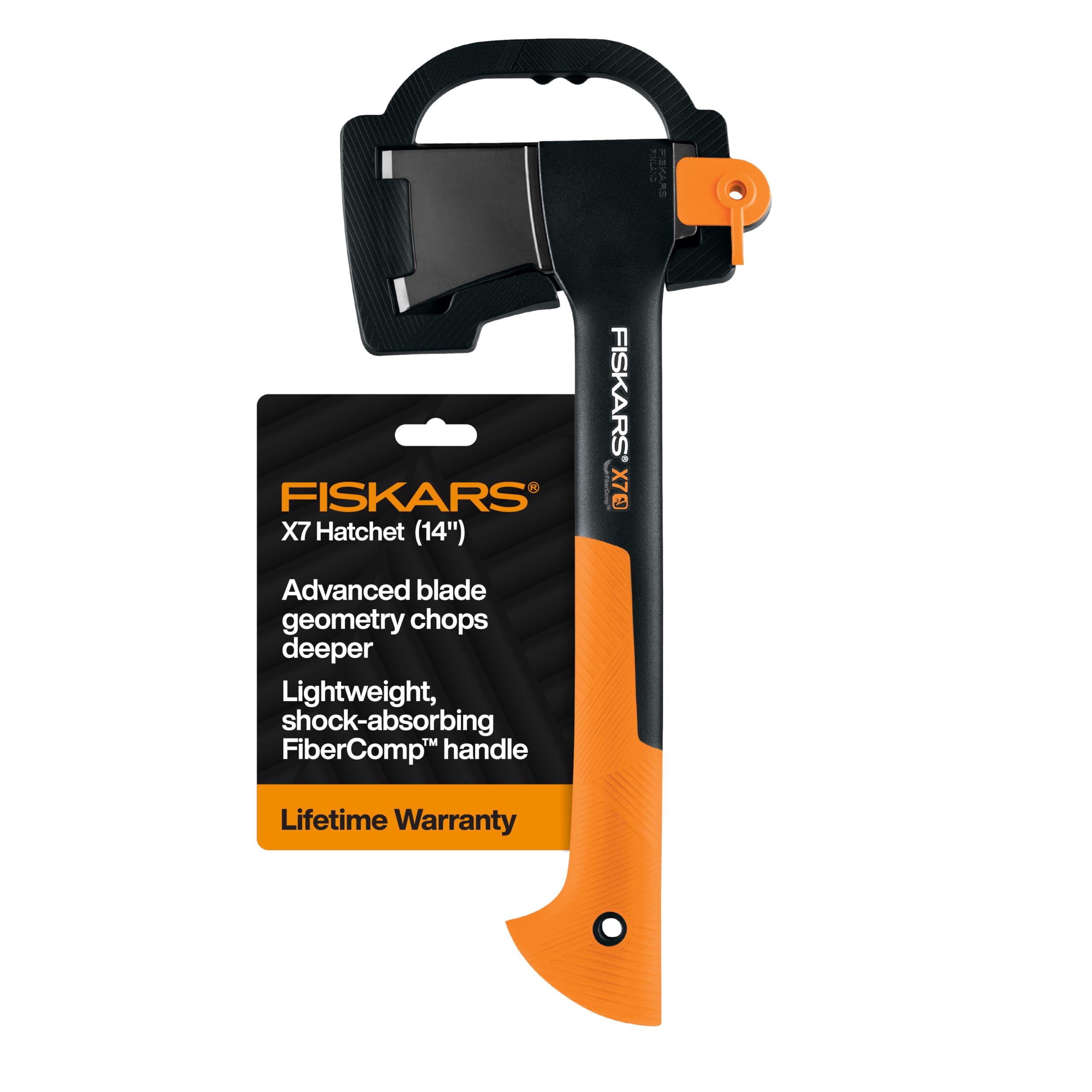
Fiskars X7 Hatchet
Key Features
- Weight & Balance: 1.4 lbs, well-balanced
- Edge & Sharpness: Forged steel, sharp out of box
- Handle & Grip: FiberComp shock-absorbing
- Length & Portability: 14 in, highly portable
- Sheath Quality: Included, durable
- Price: $
At 1.4 pounds with a shock-absorbing FiberComp handle, the Fiskars X7 feels balanced and easy to swing for extended sessions. The forged steel blade arrives ground sharp and cuts through softwoods and kindling without extra work. Over 12,000 reviews back its reputation for getting the job done on trail and at campsite.
The tradeoff: the lightweight head lacks the momentum to split large hardwood rounds, and the edge can dull faster if you hammer repeatedly into dense wood. This hatchet suits campers and backpackers who need a portable tool for fire prep and small logs, not for processing full firewood piles. First-time buyers get a proven design at a budget-friendly price.
Pros
- Arrives sharp and holds its edge during normal camp use
- Lightweight and well-balanced for fatigue-free swinging
- Compact and portable, ideal for backpacking
Cons
- Lacks the momentum to split larger rounds of hardwood
- Edge can dull more quickly when used on hard wood or with heavy impact
The Fiskars X7 is the go-to hatchet for campers and backpackers who need a lightweight, affordable tool that works right out of the box. It’s not a heavy splitter, but for kindling and small logs it’s hard to beat.
Best for Traditional Camping
Estwing Sportsman’s Axe
Key Features
- Weight & Balance: 1.8 lbs, solid feel
- Edge & Sharpness: Alloy steel, good retention
- Handle & Grip: Stacked leather, lacquered
- Length & Portability: 14 in, moderate portability
- Sheath Quality: Ballistic nylon, tight fit
- Price: $$
The Estwing Sportsman’s Axe is built like a tank — one-piece forged steel from head to heel, with a stacked leather grip that looks right at home in a vintage gear collection. This design sacrifices minimal weight for near-indestructibility. It’s the hatchet for campers who prioritize durability and American-made craftsmanship over portability, and who don’t mind a few quirks: the leather handle gets slippery in wet weather, and the stock sheath can be annoying to reholster. For ultralight backpackers or those who want a grab-and-go tool, the Fiskars X7 is the lighter, slicker alternative.
Pros
- Forged one-piece steel construction delivers durability that can last for generations.
- Genuine leather grip provides comfortable control and a classic appearance.
- Holds its edge exceptionally well, requiring minimal maintenance over years of use.
Cons
- Leather handle becomes slippery when wet; gloves are advisable in rain or sweaty conditions.
- The included sheath can be tight, making it tricky to reinsert the blade after use.
A solid choice for campers who value heirloom-quality construction and traditional materials, but the Fiskars X7 is lighter and more practical for those prioritizing weight and convenience.
Best for Ultralight Backpacking
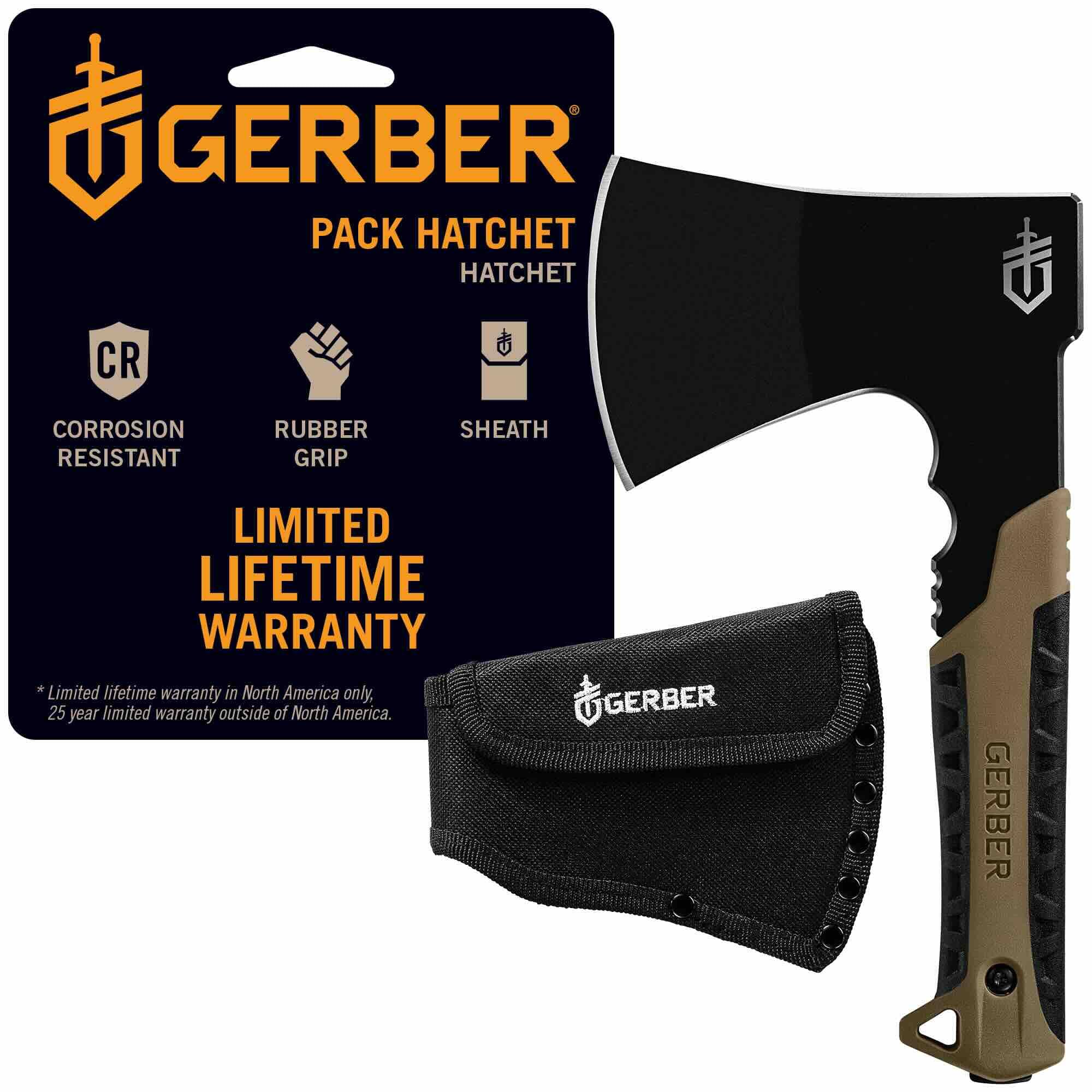
Gerber Pack Hatchet
Key Features
- Weight & Balance: 1.3 lbs, compact
- Edge & Sharpness: Stainless steel, sharp out of box
- Handle & Grip: Rubber over molded nylon
- Length & Portability: 9.46 in, ultralight
- Sheath Quality: MOLLE-compatible, poor design
- Price: $$
At just over 1.3 pounds and less than 10 inches long, the Gerber Pack Hatchet slips into a daypack or bug-out bag without protest. The full-tang stainless blade arrives sharp and holds an edge well for its size, and the rubberized grip stays secure in wet or gloved hands. That tiny head, however, bounces off larger branches rather than biting in, making this a tool for splitting kindling and cutting small limbs — not felling or heavy splitting. The nylon sheath is tight enough to frustrate quick draws and doesn’t attach easily to pack straps. For backpackers who need an emergency fire-prep tool and value every ounce, this hatchet fills a specific niche. Anyone expecting a general-purpose camp axe will find the reach and mass inadequate.
Pros
- Extremely compact and lightweight, fits in most packs without adding noticeable bulk
- Sharp out of the box with reliable edge retention for light tasks
- Ergonomic rubber grip stays comfortable and secure during use
Cons
- Sheath is tight, hard to insert and remove, and awkward to attach to packs
- Lightweight head may bounce off larger wood rather than cutting cleanly
This ultra-portable hatchet suits backpackers who need a backup fire-prep tool and have modest chopping expectations. For heavier camp work, the Fiskars X7 delivers more bite per ounce.
Best for Bushcraft Felling
Gränsfors Small Forest Axe
Key Features
- Weight & Balance: 2.0 lbs, balanced
- Edge & Sharpness: Reclaimed stainless, razor edge
- Handle & Grip: Hickory wood, ergonomic
- Length & Portability: 19 in, moderate portability
- Sheath Quality: Vegetable-tanned leather
- Price: $$$$
Hand-forged Swedish craftsmanship gives the Gränsfors Small Forest Axe a razor edge straight from the box, and its 19-inch handle provides the reach to fell small trees and limb with control. The blade holds its sharpness well, and the leather sheath protects the edge between uses. This axe targets backcountry hunters and bushcrafters who value precision and tradition over budget. The price is high, and the hickory handle can crack or the wedge loosen under repeated heavy strikes — a tradeoff that demands careful technique and maintenance. For those who understand these boundaries, it delivers outstanding performance.
Pros
- Sharp blade out of the box with good edge retention
- Effective for felling small trees and limbing at 19 inches
- Hand-forged Swedish design with high-quality appearance
Cons
- Premium price limits the audience to serious users only
- Hickory handle can crack or wedge loosen under repeated heavy strikes — a safety concern
The Small Forest Axe rewards those who prioritize Swedish craftsmanship and precision work, but its durability boundaries and cost make it a specialist tool rather than a general camp axe.
Best for Budget Kindling
DESHIL 15" Hatchet
Key Features
- Weight & Balance: 1.32 lbs, good balance
- Edge & Sharpness: 45 Carbon steel, variable sharpness
- Handle & Grip: Fiberglass with rubberized grip
- Length & Portability: 15 in, portable
- Sheath Quality: Locking blade cover
- Price: $
DESHIL’s 15-inch hatchet pairs a hammer back with a comfortable rubberized grip at a budget-friendly price. It undercuts the top pick in cost, but the blade arrives dull and needs sharpening — a trade-off that suits campers who prioritize value over out-of-box convenience.
This hatchet is for budget-conscious campers who want a functional tool for splitting kindling at a car-camp site. The fiberglass handle and 1.32-pound weight make it easy to swing without fatigue. If you’re willing to sharpen before your first trip, it delivers solid performance for the price.
Pros
- Well-balanced swing with a comfortable grip for its size
- Hammer back adds utility for light striking tasks
- Cost-effective for splitting kindling without breaking the bank
Cons
- Edge may arrive dull and require sharpening before first use
- Blade can lose its edge relatively quickly with regular splitting
If you don’t mind a few minutes with a sharpening stone, this is the best value hatchet under $20 for car-camping kindling duty.
Best for Larger Fiskars
Fiskars X10 Axe

Key Features
- Weight & Balance: 2.2 lbs, heavier
- Edge & Sharpness: Hardened steel, non-stick coating
- Handle & Grip: Fiberglass reinforced plastic
- Length & Portability: 17.5 in, less portable
- Sheath Quality: Included storage case
- Price: $$
The Fiskars X10 extends the handle to 17.5 inches for a longer swing arc, and the included storage case keeps the blade protected during transport. It uses the same fiberglass-reinforced handle and hardened steel blade as the smaller X7, but the price climbs much higher without a proportional gain in cutting performance for typical camp tasks. Long-term durability is less documented due to limited user feedback, making this a better fit for those who value extra reach over cost savings.
Pros
- Fiberglass-reinforced handle with textured grip stays secure in wet conditions.
- Included storage case protects the blade and aids safe transport.
Cons
- Costs much more than the compact Fiskars model while offering similar results for most camping chores.
Worth considering if you prioritize extra reach over cost and are comfortable with less documented long-term performance.
Best for Full-Size Chopping
Estwing Camper’s Axe

Key Features
- Weight & Balance: 3.5 lbs, heavy
- Edge & Sharpness: Forged steel, sharpness varies
- Handle & Grip: Steel tubing with shock-reducing grip
- Length & Portability: 26 in, bulky
- Sheath Quality: Ballistic nylon
- Price: $$
A full-size camp axe built for limbing and driving stakes, with a durable one-piece steel head and shock-reducing grip. Its blade geometry is not designed for splitting logs — it can stick or bounce — and at 3.5 lbs it’s too heavy for backpacking. Some units may require sharpening out of the box.
Pros
- Great for limbing and felling small trees with leverage from the 26-inch handle.
- Shock reduction grip reduces vibration during extended use.
Cons
- Heavier than most camp axes at 3.5 lbs, limiting portability for hiking.
Best for car campers who prioritize durability and limbing over portability or splitting performance.
Best for Budget Backup
KSEIBI Camp Hatchet

Key Features
- Weight & Balance: 1.3 lbs, lightweight
- Edge & Sharpness: Forged steel, often dull
- Handle & Grip: Fiberglass with anti-slip grip
- Length & Portability: 14 in, portable
- Sheath Quality: Rubber blade guard
- Price: $
The KSEIBI hatchet offers a lightweight, well-balanced feel for occasional camp tasks, and the fiberglass handle is comfortable. However, the blade arrives dull and requires immediate sharpening. Handle failure has been noted in some cases, so inspect before heavy use. It’s a workable option for budget shoppers who don’t mind extra prep, but the similar DESHIL hatchet costs less.
Pros
- Sturdy build quality and solid feel for the price
- Lightweight and well-balanced for comfortable extended use
Cons
- Blade arrives dull and needs sharpening before first use
A reasonable pick for occasional camp use if you’re comfortable sharpening it and can accept the possibility of handle issues — but the lower-priced DESHIL may suit the same buyer better.
Best for Extreme Budget
Coleman Camp Axe

Key Features
- Weight & Balance: 2 lbs, head-heavy
- Edge & Sharpness: Alloy steel, very dull
- Handle & Grip: Steel with rubber grip
- Length & Portability: 13 in, short
- Price: $
This budget-friendly hatchet offers a steel head and rubber grip for an exceptionally low price. However, the blade arrives dull and requires sharpening before any real chopping, and the head-heavy balance reduces efficiency for regular camp tasks.
Pros
- Extremely affordable; ideal as a backup hatchet or first axe.
- Durable steel head handles abuse and light splitting tasks.
Cons
- Blade arrives dull; sharpening is required before any use.
Only worth buying if you have a sharpening stone and need an axe for rare use, like an emergency car tool.
Best for Compact Premium
Gränsfors Wildlife Hatchet

Key Features
- Weight & Balance: 1.3 lbs, light
- Edge & Sharpness: Reclaimed stainless, razor sharp
- Handle & Grip: Hickory wood, ergonomic
- Length & Portability: 13.5 in, compact
- Sheath Quality: Vegetable-tanned leather
- Price: $$$
The Gränsfors Wildlife Hatchet delivers exquisite hand-forged Swedish quality and a razor edge that slices through kindling with ease. Its premium price and lighter head make it a better fit for collectors and bushcraft enthusiasts who appreciate craftsmanship over raw splitting power – campers needing to fell or split larger wood will find better value in mid-range alternatives.
Pros
- Exquisite hand-forged Swedish craftsmanship with heirloom-quality finish.
- Razor sharp out of the box and maintains an edge with basic care.
Cons
- High price compared to mid-range hatchets; value depends on appreciation for handcrafted tools.
Best for collectors and bushcraft enthusiasts who value artistry over cost; campers needing a workhorse should look to the Fiskars X7 or Estwing for similar performance at a fraction of the price.
Best for 2-In-1 Design
Agawa ADK26

Key Features
- Weight & Balance: Not specified
- Edge & Sharpness: 5160 Carbon steel
- Handle & Grip: Long-fiber nylon, wood-grain
- Length & Portability: 14/26 in, convertible
- Sheath Quality: Cordura
- Price: $$$
The ADK26’s 2-in-1 design uses a compression joint to switch between hatchet and full-size axe, with 5160 carbon steel blade and a wood-grain textured nylon handle. However, customer reviews on this listing are from a folding saw, not the axe itself, so actual chopping performance is unverified. At a premium price, this is a gamble for anyone needing a proven camp axe.
Pros
- Innovative mechanism lets one tool serve as both hatchet and full-size axe.
- Materials include 5160 carbon steel and a compression joint for structural stability.
Cons
- User feedback is missing for the axe function — reviews reference a different product (folding saw), so real-world performance is unknown.
Worth considering only if you’re an early adopter willing to test an unproven design and can accept the uncertainty.
How to Choose
The right camping axe balances weight, blade quality, handle comfort, length, and sheath design to match your specific camping style.
Weight & Balance
A lighter axe (under 1.5 lbs) is easier to swing all day and carry in a pack. But that light head transfers less momentum, so it will bounce off larger rounds rather than split them. Heavier axes (over 2 lbs) deliver more chopping power but fatigue your arm faster and take up more space. Balance matters too: a head-heavy tool feels clumsy and wastes energy. Look for a hatchet where the handle and head feel neutral in your grip.
Edge & Sharpness
Factory edges vary wildly. Many budget axes are ground with a coarse finish that barely cuts. You can fix that with a sharpening stone, but it adds time and frustration. Higher-end brands like Fiskars and Gränsfors use harder steel and precision grinding to deliver a usable edge out of the box. Edge retention depends on steel hardness: softer steels dull faster but are easier to sharpen in the field; harder steels hold an edge longer but are tougher to touch up without a stone.
Handle & Grip
Handle material affects both comfort and reliability. Wood handles (hickory) absorb shock well but can crack if stored wet. Composite handles (FiberComp, fiberglass) are weather-resistant and nearly indestructible, but some transmit more vibration. Leather grips look classic but become slippery when wet; rubberized or textured handles stay secure in rain. A handle that flares or twists in your hand can cause blisters or loss of control, especially during repetitive swings.
Length & Portability
Length determines leverage and swing arc. A 14-inch hatchet is short enough to pack inside a backpack but requires more effort to split large wood. A 19- to 26-inch axe provides more reach and force, but it must be strapped to the outside of a pack or left in the car. For backpacking, 14 inches is the sweet spot. For car camping or basecamp use, a longer handle lets you tackle bigger logs without as much effort.
Sheath Quality
A good sheath protects the blade from rust and your gear from cuts. Cheap sheaths are often tight, making it hard to reinsert the axe, or loose enough that the blade falls out. Look for a sheath that snaps or locks securely, with a belt loop or MOLLE attachment for easy carry. Some budget axes skip the sheath entirely, which means you need to buy one separately or risk damaging your pack.
FAQ
Why does my camping axe handle keep coming loose?
Wood handles shrink when dry, causing the head to loosen. If your axe has a wood handle, soak the head in water for 15 minutes to swell the wood, then tap the wedge back in. Composite handles rarely loosen, but if they do, check for cracks. A loose handle is dangerous—stop using it immediately.
Is a 14-inch hatchet enough for splitting firewood?
Yes for kindling and small logs (under 4 inches thick). For larger rounds, a 14-inch hatchet lacks the momentum to split through. Use a splitting wedge or a longer axe for bigger firewood. The 14-inch size is ideal for backpacking where weight matters most.
Can I use a hatchet to fell small trees for trail clearing?
A hatchet can fell saplings up to 3 inches in diameter with a sharp edge and proper technique. For larger trees, switch to a full-size axe (19 inches or longer) to generate enough force. Always wear eye protection and check for overhanging branches before cutting.
How often should I sharpen a camping axe?
Touch up the edge after every heavy use session. If the axe fails to bite into wood, it needs sharpening. A diamond stone or sharpening puck works in the field. For axes that arrive dull, a 15-minute initial sharpening is common. Premium axes like Gränsfors hold an edge for a full season of moderate use.