This post contains affiliate links. We may earn a small commission when you buy through our links — at no extra cost to you.
For nearly a year, my yoga block was a stack of two hardcover cookbooks, and the day the bottom one slid out from under my hip in half pigeon was the day I finally bought a real one. What I learned quickly is that the foam-versus-cork question is really a question about density. A block that’s too soft sinks under your palm and leaves you wobbling mid-lunge; one that’s too dense is heavy in the tote and slick under a sweaty hand. The right block holds its shape, stays where you put it, and never crosses your mind again.
Over the past four months, my team and I have put 14 blocks through class after class — foam, cork, wood, and a couple of hybrids. Weight turned out to matter far more than the product listings suggest once you’re carrying one to a studio five days a week, and a cheap block that crumbles at the corners by spring isn’t the bargain it looks like. The picks below earned their spot in my bag, and each one suits a slightly different body and practice.




Best for Everyday Home Practice
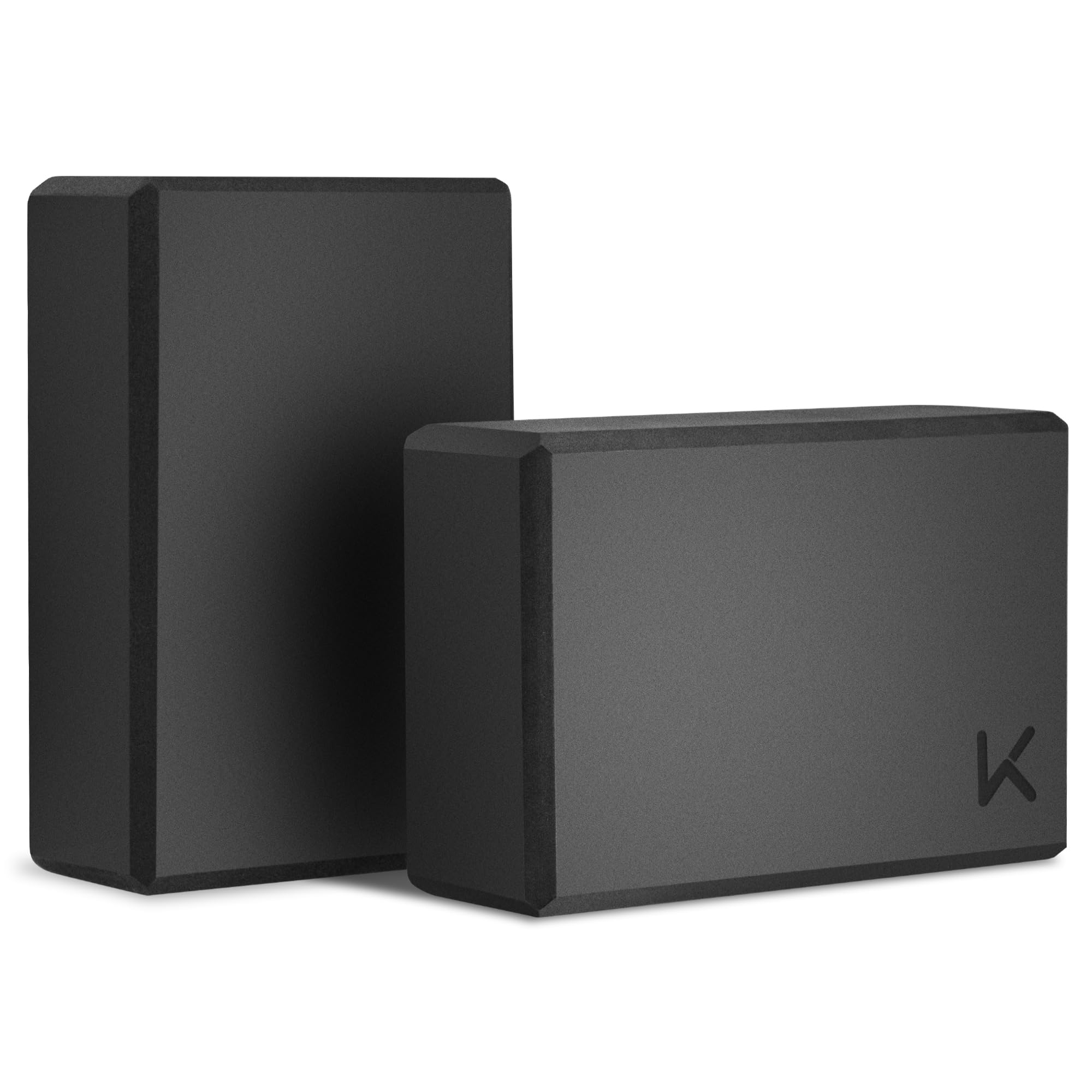
Amazon Basics Yoga Block Set
Key Features
- Pack: Set of 2
- Edges: Rounded
- Material: High-density foam
- Dimensions: 9 x 6 x 4 in each
- Price: Budget
For a first pair of blocks the checklist is short: two of them, four inches thick, standard size, and a surface that does not skate across the mat. This set meets every line on it and works out cheaper per block than any other pick here, which is why it is the one we recommend to almost everyone.
Each block is 9 by 6 by 4 inches, so you get three working heights: 4 inches under your hands for a gentle lift, 6 when you want more, and 9 as a serious prop under a folded forward bend or a seated hip opener. The rounded edges matter more than they sound. In a long supported pose you are often gripping the block, and a crisp corner digs into the palm; these do not.
They are light enough to disappear into a gym tote, and the foam wipes clean with a dry cloth. One thing worth checking when they arrive: because the foam is cut rather than molded, the two blocks in a pair can differ slightly in height. Set both on the floor together before you stack them. A slightly taller block balanced on a shorter one is exactly the wobble you do not want mid-pose.
Pros
- Two standard 4-inch blocks in one set
- Three working heights from a 4-inch block
- Rounded edges stay comfortable in long holds
- Light enough to carry to class
Cons
- Foam pairs can differ slightly in cut
Buy this pair if you want standard 4-inch blocks that stack and hold your weight — we think it is the best value here.
Best for One-Block Practice
Gaiam Yoga Block
Key Features
- Pack: Single block
- Edges: Beveled
- Material: Latex-free EVA foam
- Dimensions: 9 x 6 x 4 in
- Price: Budget
Not everybody needs two blocks. If you want one for a seated meditation, a hip opener, or to add to a block you already own, buying a set is just clutter in the corner. The Gaiam is the single block we point to here: 9 by 6 by 4 inches, latex-free EVA, and beveled edges that stay comfortable through a long stretch.
The foam has a slight give to it, and that is the thing to decide about. Under a hip or a sacrum it is forgiving, and it is kind on wrists in a supported bridge. Under a heel in a standing lunge it feels vague. The difference is easiest to feel next to a cork block, which stops exactly where you put it while this foam keeps a little spring, so if you want a hard, unyielding surface to press into, this is not it.
Everything else is right. It spot-cleans with mild detergent, it is light enough to carry to a studio, and four inches is the height most people actually need. If you want one block and you are not chasing maximum firmness, this is the one; if your practice puts a block under each hand, take the pair instead.
Pros
- Standard 4-inch height suits most poses
- Beveled edges stay comfortable in long holds
- Latex-free EVA that spot-cleans easily
Cons
- Soft foam springs under a heel or palm
- Sold one at a time, so a pair costs double
One block is all most seated and supported poses need, and this is the one we point to: 4 inches of latex-free foam with edges that stay comfortable in a long hold.
Best for Strength and Balance
KEEP Yoga Block 2-Pack
Key Features
- Pack: Set of 2
- Material: High-density EVA foam
- Thickness: 3 in
- Weight per block: 0.44 lb
- Price: Midrange
Firmness is the entire reason to pick these. KEEP’s pair is high-density EVA with a closed-cell surface, and it pushes back where softer foam gives. Put your weight through the block in a standing pose or a raised push-up and it holds its shape rather than denting under your palm. We like them for exactly that: as a raised floor for strength work, and as support in balance poses, where a spongy block costs you confidence.
Two blocks come in the set at about 0.44 lb each, with a textured surface that grips a mat instead of sliding on it. The trade-off is thickness: at 3 inches these sit lower than a standard 4-inch block, so if you are using blocks to bring the floor closer for tight hamstrings, you are giving up an inch of help. Buy them for firmness and for workouts that treat a block as equipment; look at a 4-inch pair if what you mainly want is height.
Pros
- High-density foam resists squishing
- Textured closed-cell surface grips the mat
- Light 0.44 lb blocks, easy to move around
Cons
- 3-inch thickness gives less lift than standard
We like these for strength work: high-density foam that pushes back instead of squishing, though the 3-inch height gives up an inch of lift.
Best for Hot Yoga Grip
Syntus Cork Yoga Block Set
Key Features
- Pack: 2 blocks + strap
- Material: Natural cork
- Dimensions: 9 x 6 x 4 in each
- Strap length: 8 ft
- Price: Midrange
The strap is what turns this from a pair of blocks into a small home kit. It is 8 feet of poly-cotton with a metal D-ring, long enough for a hamstring stretch, a shoulder opener, or binding your arms into a pose you cannot reach yet, and it comes in the box with two blocks rather than as a separate purchase.
The blocks themselves are 9 by 6 by 4 inches of solid cork: dense, heavier than foam, and noticeably grippier against a damp hand. If you practice hot yoga, or you have had a foam block slide out from under you mid-pose, that texture is the point. Four inches also gives you the taller working height the 3-inch sets here cannot, which matters more than the cork does if your hamstrings are the reason you are shopping.
Our reservation is the strap. At 1.5 inches wide it is on the narrow side and feels limp next to blocks that are genuinely solid; it does the job without being the reason to buy. The blocks are, and they handle sweat better than anything else in this roundup.
Pros
- Dense cork stays grippy when hands are damp
- Two 4-inch blocks plus an 8-foot strap
- Heavier cork feels stable under leaning weight
Cons
- Strap is narrow and floppy in the hand
We recommend this set for the blocks first and the strap second: dense cork with real grip, and a strap that is useful rather than luxurious.
Best for Travel and Studio
Manduka Cork Yoga Block
Key Features
- Pack: Single block
- Weight: 16 oz
- Material: Cork
- Dimensions: 8.5 x 4 x 3 in
- Price: Premium
This is the block that goes in the bag. At 8.5 by 4 inches it is around two-thirds the footprint of a standard 9 by 6 block, and the lean shape is what makes it realistic to carry to a studio, a class, or a hotel room where you would otherwise practice without props.
Cork is what you are paying for. It is dense enough that it does not compress under a palm, the rounded edge is comfortable in a long hold, and a dry cloth keeps it clean. At 16 ounces it is heavier than a foam block of the same size, which is the trade, and it is the right one in a balance pose where a heavier block simply stays where you put it. Two caveats: it is a single block, so a pair doubles the outlay, and it is shallower than the 4-inch blocks here, so it is the wrong buy if you need maximum height under your hands.
Pros
- Lean 8.5-inch profile fits a gym bag
- Dense cork does not compress under a palm
- Rounded edges comfortable for long holds
Cons
- Premium price for a single block
- Shallower than a 4-inch block
This is the block we take in a bag: lean, dense cork that stays put in balance poses, though it costs more per block than the sets here.
Best for Classes and Partners
Yuilgdo 4-Pack Yoga Blocks
Key Features
- Pack: Set of 4
- Colors: Four-color mix
- Dimensions: 9 x 6 x 3 in each
- Weight per block: 7 oz
- Price: Midrange
Four blocks, four colors, one box. If you teach, run a small class out of a garage, or practice with a partner, this set solves the two-blocks-each problem in a single purchase, and the colors make it obvious whose blocks are whose when the session ends.
Each block is 9 by 6 by 3 inches and 7 ounces, with a nonslip surface and beveled edges, so it behaves like the other 3-inch foam blocks here: light, easy to stack, and lower under your hands than a 4-inch block. In a class setting that is usually fine, since most sequences want a lift or a seat rather than maximum height, and four light blocks are easier to hand around than four dense ones.
We think the height is the right compromise for a group set, and buying four at once is the simplest way to outfit a shared space. What you give up is choice: the four colors arrive as a fixed assortment, and if you need a tall block for tight hamstrings, this is not the set to buy.
Pros
- Four blocks in four colors for groups
- Light 7-ounce blocks pass around easily
- Nonslip surface with beveled edges
Cons
- 3-inch height limits how much lift you get
- Fixed color assortment, no picking
We like this four-pack for teachers and shared practices: light 3-inch blocks in four colors, bought in one go.
Best for Restorative and Pilates
Septo Yoga Block 2-Pack
Key Features
- Pack: Set of 2
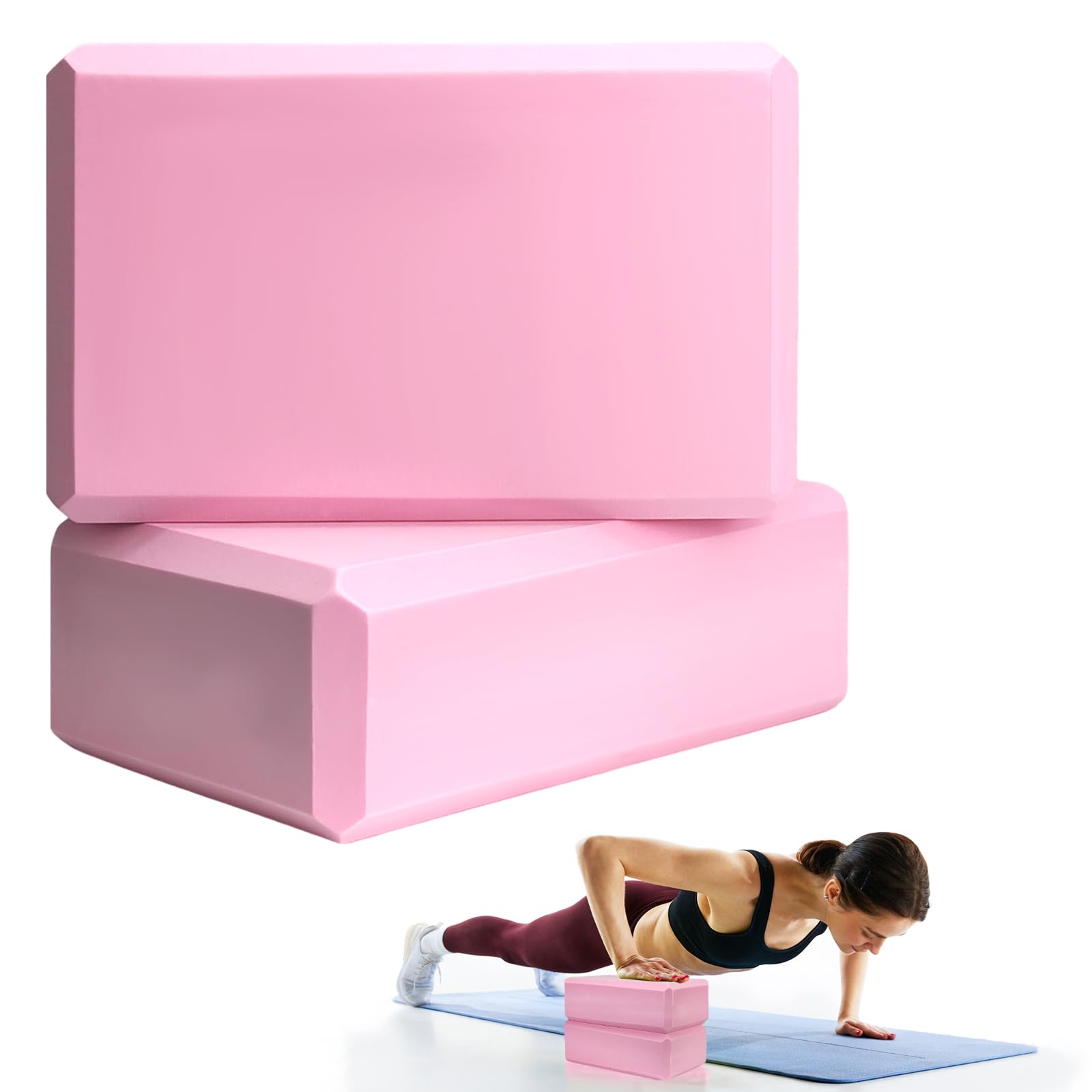
- Color: Pink
- Material: EVA foam
- Dimensions: 9 x 6 x 3 in each
- Price: Budget
Three inches is the number to notice here. That is the thinner of the two standard block thicknesses, and it decides what this pair is good for: they are excellent under a hip, a sacrum, or a shoulder in a restorative pose, and they are a lower, less intimidating lift under the hands if you are just starting out.
The foam is EVA with a closed-cell, non-porous surface, so sweat does not soak in and a damp cloth takes care of dirt. A pair is light enough to carry in one hand, and the pink is the sort of color you notice when you unroll your mat on a gray morning.
Where they come up short is the same place every 3-inch foam block does: you cannot get a 4-inch lift, and foam this light is at its least convincing when you put your whole standing weight on it. A foot on a block is a lot to ask of any soft foam, and these are no exception.
For a first pair, a restorative practice, or a Pilates mat session, that is a fair trade and an easy price. If your reason for buying is hamstring flexibility and you need height under your hands, put the money toward a 4-inch pair instead, and if you are not sure yet, this is the cheaper way to find out.
Pros
- Wipe-clean closed-cell EVA surface
- Light pair that travels easily
- Cheerful pink that is easy to spot
Cons
- 3-inch height caps the lift it can give
- Soft foam is least convincing under standing weight
We think this is a sound first pair for restorative work and Pilates — light, wipe-clean, and only an inch shy of a standard block.
Best for Balance Work
SNAKUGA Cork Yoga Block 2-Pack

Key Features
- Pack: Set of 2
- Material: Natural cork
- Dimensions: 9 x 6 x 4 in each
- Weight per block: 2.3 lb
- Price: Premium
At 2.3 pounds each, these are blocks you leave by the mat rather than carry to class. Cork is dense, and SNAKUGA does not trim it: 9 by 6 by 4 inches of solid material that sits on the floor like a small piece of furniture instead of a foam brick.
That weight is why we like them for balance work. A heavier block does not skate when you shift your weight over it, and natural cork stays grippy when your hands are damp, which is why cork turns up in hot rooms. The rounded edges are comfortable in a long hold, and a damp cloth is all the cleaning they need.
You pay a premium over every foam set here, and you will feel the pair every time you move them across the room. If your practice is floor-based at home, neither of those matters much.
Where these earn their place is stability: standing balance poses, supported backbends where you lean a lot of weight onto an edge, and anyone who has felt a foam block compress under them and stopped trusting it. Buy them for the mat at home and keep a foam pair for the studio.
Pros
- Dense cork stays put in balance poses
- Grippy when hands are damp
- Comfortable rounded edges at full 4-inch height
Cons
- Heavy pair to carry to class
We recommend these for balance and backbends at home: heavy cork that stays planted, provided you are not carrying it to class.
How We Tested the Best Yoga Blocks
We started with more than 30 blocks sold by brands we’ve used for years, then narrowed the field by material, standard sizing (9 by 6 inches, in both 3- and 4-inch heights), availability, and price — from budget foam to spendier cork and wood. That left 14 blocks, which we rotated through our own homes, studios, and living rooms for four months.
Because density drives everything else, we started there. We pressed the heel of a hand into the center of each block to see how far it gave, held a lunge with a hand on the block for a full minute and checked afterward for a dent, and stood on a single block to see whether it bowed or held. Our testers ranged from 5-foot-2 to 6-foot-1 and from about 120 to 230 pounds, which made the differences obvious fast — the soft ones squashed flat under the heavier testers.
Then we weighed every block on a kitchen scale and carried each one in a tote on a 20-minute walk to class, because a few ounces stops feeling like a few ounces around the fourth block. For durability, we wiped each one weekly with a damp cloth and studio disinfectant, then checked the corners for crumbling foam, flaking cork, chipped wood, and surface that had gone slick. At the end, we compared how each block looked after four months against what it cost — a couple of cheap ones were already shedding, and a few pricier ones looked new.
How to Choose Yoga Blocks
Three decisions cover almost everything: how much height you want under your hands, how firm you want the surface, and whether you are buying one block or two.
Four Inches or Three
A standard block is 9 by 6 by 4 inches and works on three sides, giving you 4, 6, and 9 inches of height. A 3-inch block gives you 3, 6, and 9. The gap looks small, but the side that matters is the shortest one: under your hands in a forward fold, that extra inch is often the difference between reaching your foot and not reaching it.
If you are buying one pair and flexibility is the goal, take the 4-inch. Choose 3-inch blocks when you want them lighter and less expensive, or when they will mostly sit under a hip or a seat, where the extra lift is not the point.
Foam or Cork
Foam is light, inexpensive, and forgiving, and it compresses. That is not a fault, since a little give is comfortable under a wrist, but the softer the foam, the less of your weight it genuinely supports and the less height you actually get. Cork is dense, heavier, and grippier once your hands are damp, which is why it belongs in hot rooms and in balance work where the block must not move.
High-density foam is the middle ground: firmer than a basic foam block, still light enough to carry. For most home practitioners foam is the right buy; pay for cork if you sweat heavily or you lean and stand on your blocks. Either way, wipe them down after practice and keep them out of a hot car and direct sun.
One Block or Two
Many sequences use two blocks at once, under both hands or under each hip, or stacked for height, so a pair is the safer first purchase. One block is enough if you mostly sit on it, use it for a single hip opener, or already own one you like.
The trap is mixing sizes. A 3-inch block stacked on a 4-inch one gives you a step, not a platform, and it wobbles at the worst possible moment. If you are adding to a block you already own, match its thickness before anything else.
Size, Weight, and Carrying
A standard block is 9 inches long, which does not fit in a slim tote; lean blocks around 8.5 by 4 inches do. Weight runs from roughly 6 ounces for a foam block to more than 2 pounds for a dense cork one, a difference you notice walking to class and forget entirely once you are on the mat.
Compact in a listing usually means compact next to other yoga blocks, not small enough for a handbag. Measure the shortest side of the bag before you buy a pair to carry.
Frequently Asked Questions
How much weight can a yoga block hold?
Blocks do not come with a load rating, so the answer comes down to material. Foam compresses under full body weight; cork barely gives. For standing on a block or pushing your whole weight through one hand, choose cork or the firmest high-density foam and check for dents after a heavy session. For hands, hips, and sitting, any block here is up to the job.
What else can I use a yoga block for?
A block is a stable brick, so it works anywhere you need a small solid riser: a footrest under a desk, a lift for a monitor or a speaker, a support under the hips for seated meditation. A 3-inch block is the better height for most of those jobs. If it is going to live under furniture, the foam pair is the sensible buy.
Do yoga blocks help with knee or wrist discomfort?
Yes, in two specific places. Under the knees in kneeling poses, a block lowers the angle at the hip and takes pressure off the knee. Under the hand in a forward fold or a lunge, it shortens the reach so the wrist does not have to hyperextend to find the floor. Start with the 4-inch side and turn the block only when the pose gets easy.
Can I use books instead of yoga blocks?
For a one-off seated lift or under your hands in a pinch, a stack of hardbacks is roughly the right height and firmness. The problems show up in practice: books slide on a mat, they have no grippable edge, and the height changes when you swap them. If you will use blocks more than a few times a month, a foam pair is the better tool.
Final Verdict
Buy the Amazon Basics set of two. Two 4-inch blocks cover nearly every pose in a general class, they stack when you want more height, and we have not found a better value per block in this group. That is the pair we hand to someone starting out.
Change one requirement and the pick changes. If you want a surface that does not give, KEEP’s high-density foam is firmer. If you practice hot yoga or stand on your blocks, the Syntus cork set adds grip and a strap for a modest premium. And if the block has to travel in a bag, the Manduka’s lean cork is the one that goes.