This post contains affiliate links. We may earn a small commission when you buy through our links — at no extra cost to you.
A match is a small thing to bet a cold night on, right up until it’s the only thing you have. I’ve hunched over a damp fire pit striking matches that snapped or flared and died before the kindling caught, and every camper I know has a version of that story. Waterproof matches are supposed to end it: a head that still lights after a dunking, a striker that bites when your hands are wet, and a flame that holds long enough to get real wood going instead of just a puff.
My team and I spent four months working through 14 boxes and tins, and the thing that surprised me most is that the match head is rarely what fails — the striker strip is. A match that survives a river crossing does you no good if the box it lives in has turned to pulp. The sets worth carrying all lit on the first strike in lousy conditions and stayed small enough to disappear into a jacket pocket, and those are the ones in the list below.


Best for First Camp Kit
UCO Stormproof Match Case Kit
Key Features
- Case: Waterproof plastic
- Striker: Built into case exterior
- Burn Time: About 15 seconds
- Match Count: 25
- Price: Budget
The striker sits on the outside of the case, and that single decision explains why this is our top pick. You scrape a match without opening the lid, so the twenty-four you have not used yet never see the rain. In a wet camp that is the whole game: the match rarely fails, the second match does, after the box has been standing open.
Inside, the case holds 25 matches of about 15 seconds each plus spare strikers, and UCO rates them to burn in wind and rain and to keep going under water. Fifteen seconds is shorter than the Zippo’s 30 and the Titan’s 25, and we noticed the difference when the kindling was wet — you get one good push at the fire rather than two. With dry shavings it is plenty.
The case is refillable with boxed UCO stormproof matches, which is what separates a kit from a disposable purchase: buy it once and top it up instead of buying another case every season. At 3 by 2 inches it drops into a jacket pocket or a pack lid, and it is cheap enough that a second one for the car is not a splurge.
Pros
- Striker on the case exterior keeps the rest dry
- Sealed case holds matches and spare strikers
- Matches burn in wind and after a soaking
- Case refills from boxed UCO matches
Cons
- Only 25 matches; refills are a separate buy
- About 15 seconds of burn, short against the longest here
The one we hand someone building a first fire kit: a sealed case, a striker you can reach without opening it, and spare strikers inside.
Best for Worst-Weather Fires
Zippo Typhoon Match Kit
Key Features
- Case: Floats, O-ring sealed
- Burn Time: Up to 30 seconds
- Match Count: 15
- Match Length: 4 in
Thirty seconds is a long time to hold a flame against wet kindling. Zippo rates the Typhoon matches at up to 30 seconds, double what the UCO case kit gives you, and the matches are four inches long — long enough to keep your hand clear and still reach into a stack of damp twigs.
What we did not expect to care about is the case. The strike pad lives in its own sealed compartment rather than loose with the matches, so a wet hand or a wet match head cannot ruin the surface you need, and the whole thing feels built to be thrown in a pack. It floats, it has a lanyard point, and the O-ring under the lid does the work a cardboard box never will.
It is also the biggest kit here at 4.8 inches tall and just under five ounces, so it is a pack item rather than a pocket one. For a cold, wet trip where the evening fire has to happen, that size buys the most forgiving match in this set; for a day hike, the UCO case is easier to carry.
Pros
- Up to 30 seconds of burn, the longest here
- Strike pad sealed in its own compartment
- Case floats, with a lanyard point
Cons
- Bulky at 4.8 inches for pocket carry
- Only 15 matches in the kit
The longest burn in this set, in a case that floats and keeps its strike pad in a separate dry compartment.
Best for Long Matches
UCO Titan Stormproof Matches
Key Features
- Extras: Spare strikers included
- Burn Time: Up to 25 seconds
- Match Count: 25
- Match Length: 4.125 in
- Price: Midrange
At 4.125 inches, a Titan match is nearly twice the length of a kitchen match, and the length is the point. You can push the head deep into a fire lay while your knuckles stay well back, and you can hold one in cold, stiff hands without feeling heat come up the stick.
They burn for up to 25 seconds, second only to the Zippo kit here, and UCO rates them to stay lit in gale-force wind and under water. Twenty-five arrive in a box with extra strikers. What does not arrive is a case.
That is why we rank these behind the case kit rather than in front of it: loose matches need somewhere dry, and at four inches they are too long for a standard pocket match case, so plan on a longer container or a zip bag. If you already have a case that swallows them, or your fire kit lives in a stuff sack, the extra length and the extra burn are worth the fuss.
Pros
- 4.125-inch matches keep fingers out of the flame
- Up to 25 seconds of burn, second only to the Zippo
- Rated to stay lit in gale-force wind and underwater
Cons
- No case included — the matches arrive loose
- Too long for standard pocket match cases
For readers refilling a case or reaching into a fire lay, these four-inch matches put real distance between your fingers and the flame.
Best for Visibility in Packs
LKTdesign Stormproof Matches

Key Features
- Case: Water-resistant, floats
- Weight: 1.9 oz
- Burn Time: 20 seconds
- Case Color: Bright orange
- Price: Midrange
The case is what sold us: bright orange, water-resistant, and light enough at 1.9 ounces that you forget it is in the pack until you need it. It floats, which matters more than it sounds — a match case dropped at the edge of a lake is one you can still fish out. Dark cases get left behind; this one does not.
The matches themselves are rated at 20 seconds of burn and will relight after a dunking, which puts them ahead of the UCO case kit on paper. Striking is the weak spot: some catch on the first scrape and some take several tries, and the sticks are thin enough to snap if you lean on them.
For a backup in a boat bag or a pack pocket where you want to find it fast, that is an acceptable trade. For the match you will rely on in a storm, we would rather spend the extra on the UCO or the Zippo. Strike firmly, once, and keep the case lid closed between lights.
Pros
- Floating orange case is easy to find
- 20-second burn beats the top pick’s 15
- Matches relight after being submerged
Cons
- Some matches fail to catch on the striker
- Thin sticks can snap while striking
Buy these for the floating orange case that is easy to find in a dark pack; the striking is less consistent than our top picks.
Best for Bulk Stashing
Coghlan’s Waterproof Matches 4-Pack

Key Features
- Packaging: Four cardboard boxes
- Match Type: Wood safety matches
- Match Count: 160 (4 boxes of 40)
- Waterproofing: Coated match heads
Four boxes of 40 is 160 matches, more than any kit here, and that is the entire pitch. It is what you buy when you want a set of matches in the car, the shed, the pack, the kitchen drawer and the boat, without thinking hard about any single one of them.
What you are buying is a coated wooden safety match, not a stormproof head. The coating sheds a splash and lights in damp air, which is what most campers actually need for a stove or a lantern; it will not do what a UCO or Zippo match does after a real soaking. We think that is a fair trade at a bulk-box price, as long as you know which one you are getting.
The box is cardboard, though, and cardboard is not a waterproof container. Once the box itself takes on water the coating is all that stands between you and a soggy match, and a damp box is exactly when the strike strip quits. Repack them into a zip bag or a hard case before they go in a pack and most of that problem disappears.
So the honest read is that this is the stash-everywhere box, not the one to stake a cold night on. If a fire has to happen, twenty-five in the UCO case are the better twenty-five; if you want matches in every bag you own, this is the simplest way to do it.
Pros
- 160 matches across four boxes
- Standard match size fits any holder
- Lights in damp air, not only dry
Cons
- Some matches fail to light once damp
The box to buy when you want matches in the car, the shed and every pack — with a coating, not a stormproof head, doing the work.
Best for Stove Lighting
Coleman Waterproof Matches 4-Pack

Key Features
- Boxes: 4
- Match Heads: Extra large
- Strike Surface: Waterproof
- Price: Midrange
Coleman prints two things on these boxes that matter: extra-large match heads and a waterproof striking surface. The big heads are the part we believe — they catch on the first stroke and throw a flame big enough to light a camp stove or a lantern without holding the match in the burner. The strike surface is the part to watch, because it is printed on a cardboard box, and a box that gets damp takes the strip with it. Keep each box inside a zip bag and the strip stays usable.
Four boxes to a pack means one for the car, one for the stove kit and two in the cupboard, and large heads are genuinely easier to strike with cold hands. These are coated safety matches rather than stormproof ones, so do not expect one to survive a dunking the way a UCO will. For everyday fire lighting at a campsite, this is a reasonable place to save.
Pros
- Extra-large heads catch on the first stroke
- Four boxes to spread across kits
- Big flame for stoves and lanterns
Cons
- Coated heads, not stormproof ones
Big heads that catch easily and throw a flame for stove lighting, sold as four boxes to scatter through your gear.
Best for Filling Many Kits
Weshaso Waterproof Match Kit

Key Features
- Case: Waterproof plastic box
- Striker: Striking paper included
- Match Count: 100
- Price: Budget
The listing argues with itself about quantity: the title mentions 20 pieces, 100 pieces and 5 pieces, while the product details settle on 100 pieces. Check the count on the variant you order before you plan a stockpile around it.
What is not in doubt is the shape of the thing: a hard plastic box with striking paper inside, at the lowest cost per match of anything in this roundup. That makes it the box to buy when you are filling four or five kits at once — one for each vehicle, one for the boat, one for the hall cupboard.
Treat it as stock rather than as your primary fire kit. Strike two or three at home before a trip so you know how they behave, and keep a UCO case or a Zippo kit for the night the fire has to work. As cheap insurance in the glovebox, we are glad to have one.
Pros
- Lowest cost per match here
- Hard plastic box protects the heads
- Striking paper included in the box
Cons
- Listing contradicts itself on the match count
The cheapest way to put a lot of matches in a lot of places, as long as you treat it as stock rather than your only fire kit.
Best for Splitting Between Bags
eGreen Windproof Match Cases
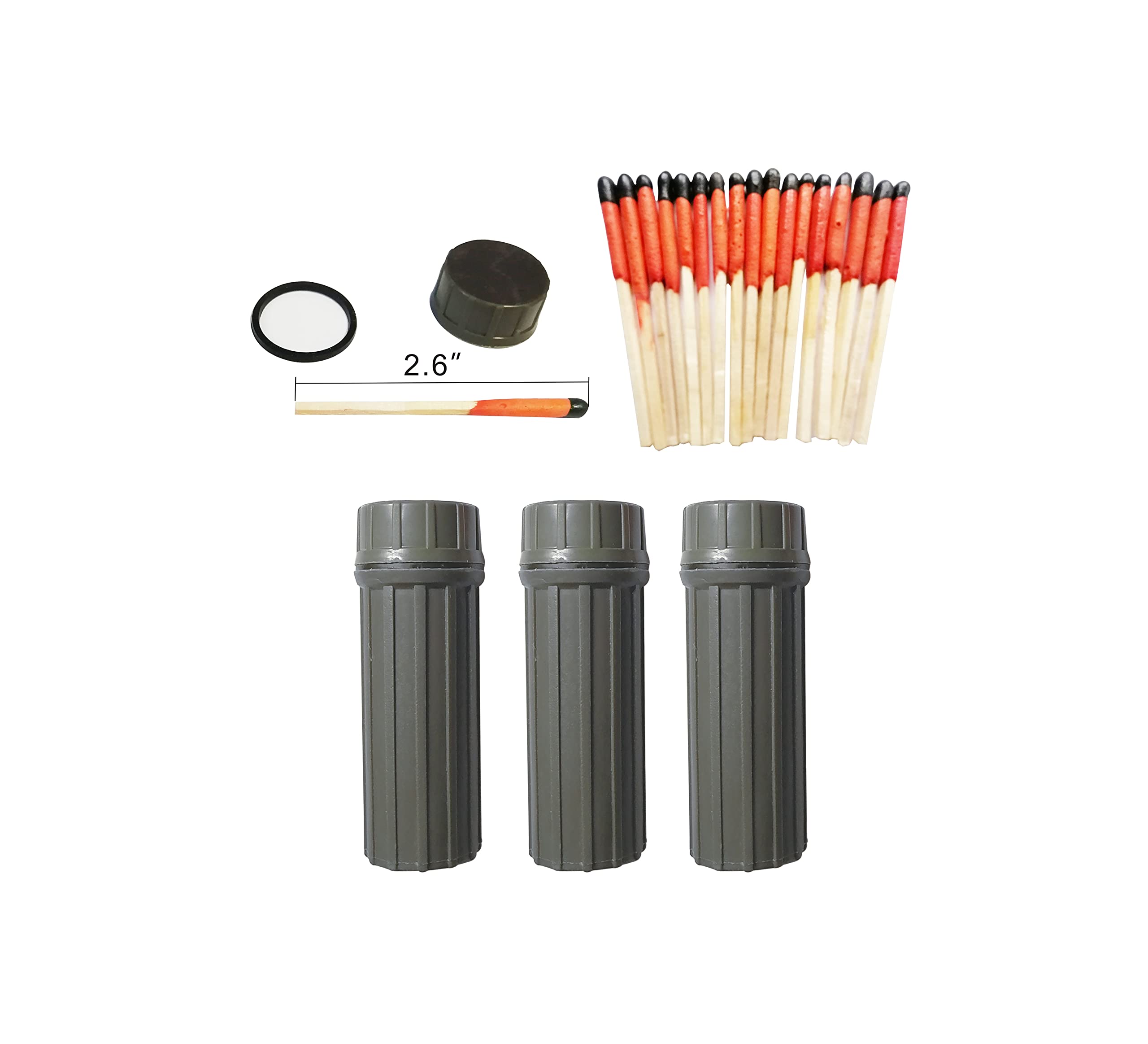
Key Features
- Seal: Rubber O-ring caps
- Cases: 3
- Burn Time: 5 to 10 seconds
- Match Length: 2.6 in
- Price: Premium
Five to ten seconds is the shortest burn in this roundup, and the listing is upfront about it: these are rated to hold a flame for at least five seconds in strong wind. Against the Zippo’s thirty that is not much of a window, and it means your tinder needs to be ready and dry before you strike.
Where the eGreen earns attention is the packaging. Three small cases, each with a rubber O-ring under the cap, each holding about 20 matches just 2.6 inches long. Split them between a pack, a car and a kitchen drawer and you have covered three places a fire might be needed without buying three separate kits.
The catch is what that costs. This is the priciest pick here for three small cases, and the matches inside are shorter and shorter-burning than the ones in kits that cost less.
We think the three-case format is the honest reason to buy them, and only if you always carry decent tinder. Want a sealed case in every bag? These do that neatly. Want one kit that can nurse a wet fire into life? We point people to the UCO case kit instead.
Pros
- Three sealed cases to split between bags
- O-ring caps keep the contents dry
- Small enough for a glovebox or pocket
Cons
- Shortest listed burn time here
- Priciest pick for what is in the box
Three small sealed cases are the reason to buy these, not the matches, which burn for the shortest time here.
How We Tested Waterproof Matches in Rain, Wind, and Cold
We narrowed a long list of strike-anywhere and strike-on-box matches, wax-coated and dipped heads, down to 14 boxes and tins, filtering for count per box, price per match, whether the container resealed, and whether the whole thing was small enough to carry without noticing it. Each set then went through the same four months of use.
Water resistance got the harshest treatment. Every set was submerged in a bowl of water for a full minute, pulled out dripping, and struck; we also left boxes on a picnic table through two overnight rainstorms and soaked the striker strips directly. We watched whether the coating shed, whether the heads went soft, and whether the strip turned to mush or still scraped.
Then the matches went to work: lighting a backyard fire pit on a windy, forty-degree evening, firing a camp stove, and coaxing damp kindling back to life after two days of rain, first with bare wet hands and then with gloves on. We timed how long each lit match actually burned, noted whether the head crumbled mid-flame or the stick charred through before the wood caught, and counted the broken heads in each box to see what we were really paying per usable light.
A few boxes lived in a truck glovebox and a backpack emergency kit for the duration, and others rode in packs for weeks at a stretch to check that the containers didn’t crush, leak, or rattle open. At the end of four months we re-lit every set to see whether damp pack time had changed anything.
How to Choose Waterproof Matches for Camping
The word waterproof on a match box can mean two very different things, and knowing which one you are buying decides whether your fire kit survives a soaking.
Waterproof coating or stormproof head?
A coated wooden match is an ordinary safety match dipped in wax or lacquer. It shrugs off a splash, damp air and a wet pocket, and the moment that coating is breached it is just a wet match. A stormproof match, the kind in the UCO and Zippo kits, carries a head that keeps burning in wind and even under water.
Buy a coated box for lighting a stove or a lantern at a dry campsite; buy a stormproof kit if the fire has to happen in bad weather. Watch the packaging claim, too: waterproof usually describes the match, not the container, and a cardboard box is not a waterproof case no matter what is printed on it.
Burn time and match length decide what fire you can build
A match is a one-shot tool, so burn time is really the size of the window you get to build the fire. Fifteen seconds covers a stove or prepared shavings. Twenty-five to 30 seconds, which is where the UCO Titan and the Zippo Typhoon sit, lets you nurse damp twigs into a flame.
Length works the same way. A four-inch match keeps your knuckles out of the fire lay and handles better in cold, wet hands; a 2.6-inch match needs the tinder closer. If you build fires from scratch in the rain, pay for long and slow-burning.
The striker fails before the match does
The strike pad is the part of a match kit that quietly gives up. It wears smooth, and a damp pad will not light anything however good the match is. That is why case design matters as much as match chemistry: the Zippo keeps its pad in a sealed compartment, and the UCO case mounts one on the outside so you never open the lid to strike.
Whatever you carry, put a spare striker in with the matches, keep it dry, and do not scrape the same line until it is gone. A kit with three matches left and a dead striker is an empty kit.
Cases, counts, and what you are really paying for
Twenty-five matches in a sealed case outfits a weekend. A hundred and sixty in four cardboard boxes outfits a decade of gloveboxes. The kit is the better first buy because the case is the part that keeps working, and UCO sells boxes of matches that refill its case, so the container outlives the contents.
Buy bulk boxes to top up a case or to leave matches somewhere you will forget about them, and buy a kit for the pack you actually carry. Matches left at home are worth nothing.
Frequently Asked Questions
Why carry matches instead of a lighter?
A lighter is faster when it works, and we still carry one. Matches earn their place as the backup that does not depend on fuel or a spark wheel, and a stormproof match will still take a flame with wet hands beside wet wood.
Carry both, and keep the matches sealed so the backup is actually usable when the lighter quits.
How many waterproof matches should I take camping?
A 25-match case covers a weekend of evening fires with room to spare, because a campfire usually costs one or two matches when the tinder is dry and three or four in the rain.
Budget two or three matches for practice strikes at home before the trip, and add a refill box rather than a second case for anything longer than a week.
How do you put out a stormproof match?
Not by blowing. These heads are built to keep burning in wind and water, so a puff of breath does nothing useful and scattering a live head into dry grass is how trips go wrong.
Lay it on bare ground, a flat rock or a metal pot lid and let it burn out, or dunk it in a cup of water. Check that the head is cold before it goes back in the case.
Final Verdict
The UCO Stormproof Match Case Kit is what we hand someone building a first fire kit: a sealed case, a striker you can reach without opening it, spare strikers inside, and matches that still light after a soaking, in one pocketable kit.
Step up to the Zippo Typhoon when you expect the worst weather and want the longest burn in this set. Take the UCO Titan instead if you would rather have four-inch matches and already own a case that fits them.