This post contains affiliate links. We may earn a small commission when you buy through our links — at no extra cost to you.
A self-inflating pad is open-cell foam sealed inside an airtight shell: unscrew the valve, the foam springs back, and air gets pulled in behind it. Simple — except the gap between a pad that does this well and one that only half does it is the gap between sleeping through the night and wrestling a floppy rectangle at 11 p.m. I’ve slept on quarter-inch foam mats and plush four-inch pads alike, and the pattern holds: thickness buys comfort, foam density buys support, and one cheap little valve decides whether any of it matters.
We spent eight months with 12 pads — tent floors, a guest-room floor, the back of a hatchback, a memorably lumpy campsite — and the ones that lasted share a few things. A spec sheet won’t tell you how a pad feels at 2 a.m.; a valve that whistles air back in while you roll up, or foam that packs out in a month, will. Weight only matters if you’re the one carrying it, and a pad that won’t go back in its sack stays home. The picks below are the ones worth the money, sorted by how you’ll actually use them.



Best for Three-Season Backpacking
Gear Doctors Oxylus
Key Features
- R-value: 4.3
- Weight limit: 250 lb
- Inflated size: 72 x 22 x 1.5 in
- Packed weight: 2.2 lb
- Price: Budget
Open the valve, unroll it, and go pitch the tent — that’s the routine this pad rewards. By the time the stakes were in, the foam had drawn most of its own air and a couple of breaths brought the rest up to firm. A 4.3 R-value is a genuine three-season number, and the waterproof-coated polyester shell handled damp ground without a footprint underneath it.
The figure that decides it, though, is 2.2 pounds. That’s the only weight in this guide that goes into a backpack without an argument, and the memory-foam pads here weigh roughly three times as much. Warmth, weight and price rarely line up this neatly in one pad, and that’s why this is the one we recommend first rather than one of the plusher mattresses.
Foam is what insulates here, and foam takes a few minutes to draw its air rather than a few seconds. Give it that time while camp goes up and you’ll never think about it again. We were also pleased to find a repair patch in the bag: a pinhole is the difference between a good night and a cold one, and a patch you already own beats improvising at midnight.
Pros
- 4.3 R-value covers three-season camping
- 2.2 pounds, light enough for a pack
- Needs only a few breaths to finish
- Repair patch and carry bag included
Cons
- Only 1.5 inches thick, the thinnest here
- Modest 250-pound weight limit
This is the pad we point most campers to: 4.3 R-value warmth, 2.2 pounds of carry weight, and an inflation routine that costs a valve and a couple of breaths.
Best for Winter Camping
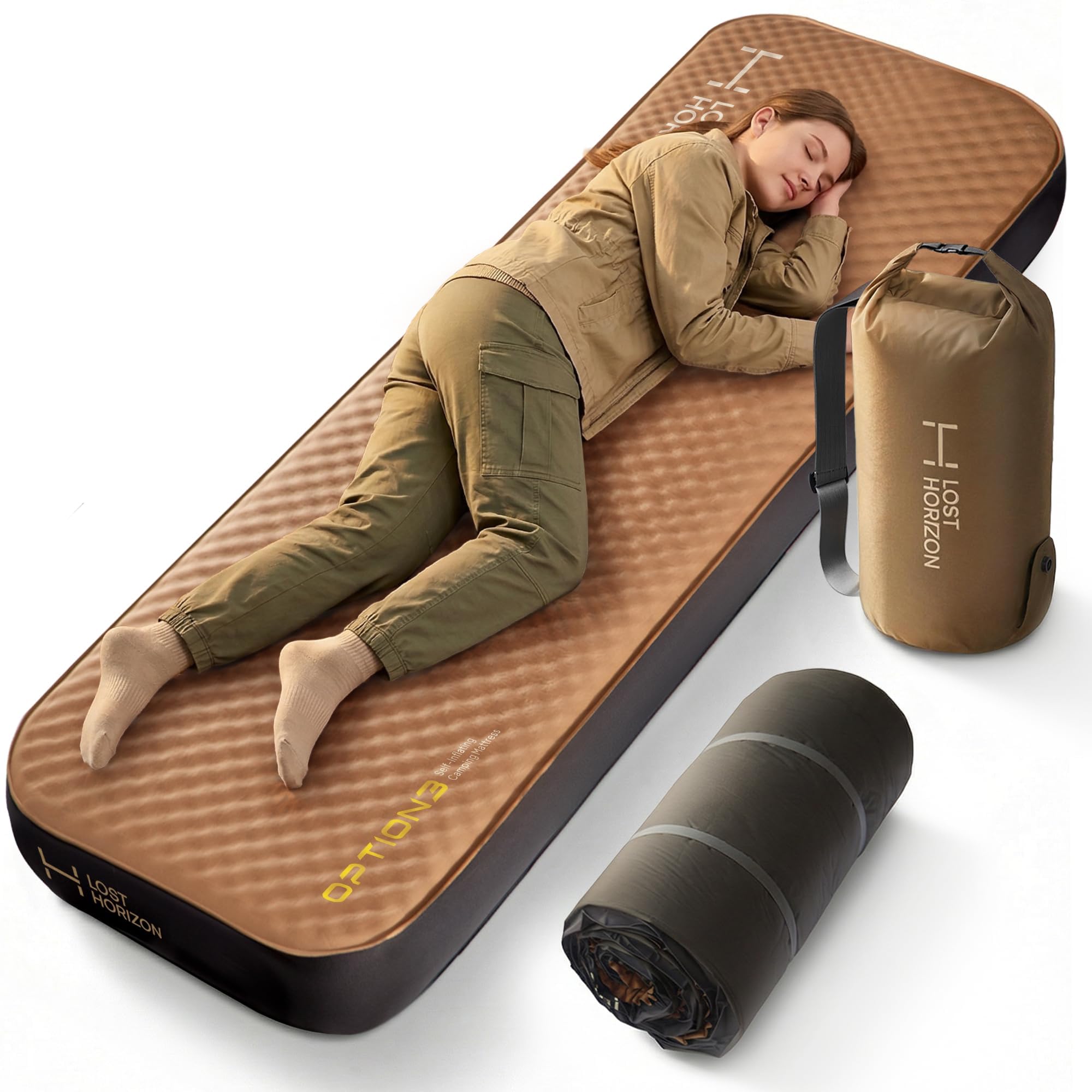
Lost Horizon Option3
Key Features
- R-value: 13
- Thickness: 4.5 in
- Weight limit: 220 lb
- Packed weight: 7.8 lb
- Price: Premium
Lost Horizon rates this pad at R-13, and nothing else in this guide comes close — the next warmest sits at 9.5 — with 4.5 inches of foam and air behind the number. That combination is why it’s the pad we reach for when the forecast turns, and why the rest of this group gets measured against it for real winter use.
Everything else about it is a compromise with that warmth. It weighs 3.54 kg, it’s bulky even deflated, and getting it back into its bag is the least pleasant job here — deflating takes patience and the foam doesn’t surrender quickly. This is a pad you carry from the car to the tent, not one you carry up a hill.
Two practical notes. The shell isn’t rated water-resistant, so put a footprint or a tent floor you trust under it on wet ground. And pressure is the thing worth checking before a freezing trip: inflate it at home, leave it a full night, and see whether it’s still firm in the morning — the valve is where that shows first.
Pros
- R-13 is the warmest rating in this group
- 4.5 inches of foam and air under you
- Firmness adjustable at the valve
Cons
- 220-pound weight limit, the lowest here
Our winter pick: an R-13, 4.5-inch pad that keeps real cold out, as long as the campsite is a short walk from the car.
Best for Car Camping Comfort
Elegear Memory Foam Pad
Key Features
- R-value: 9.5
- Inflated size: 77 x 27 x 3.15 in
- Packed weight: 8.1 lb
- Built-in pillow: Yes
- Price: Midrange
Twenty-seven inches wide, 3.15 inches thick, and the only pad in this guide with a pillow molded into the head end — the Elegear is less a sleeping pad than a mattress that happens to roll up. We noticed the width first: there’s room to turn over without finding the tent wall or a partner’s elbow.
Its R-9.5 rating is level with the Wevelel and behind only the Lost Horizon’s 13, and the 26D memory foam under the knit cover is the softest surface in the group. That pairing is what makes it a shoulder-season car-camping pad rather than a summer one, and it’s the one we suggest for cold-weather weekends where the car is doing the carrying.
The foam is also why the first inflation takes longer than you expect. Memory foam that has spent months compressed in a warehouse needs time to find its loft, so open both valves at home and let it sit a full day before your first trip. After that it fills quickly, and adjusting firmness is a matter of a few breaths.
The Wevelel further down this list claims the same R-value in a lighter, less expensive pad; if a built-in pillow isn’t worth 1.6 pounds to you, that’s the better buy. If it is — and on a cold night with no spare jacket to fold under your head, it might be — this is the plushest thing here.
Pros
- 27-inch width leaves room to roll over
- Pillow built into the head end
- R-9.5 insulation for cold nights
Cons
- 8.1 pounds packed, so it stays near the car
We rate it the most comfortable night here — 27-inch memory foam with a built-in pillow and R-9.5 warmth — for anyone who never carries it far.
Best for Value Cold-Weather Pad
Wevelel Memory Sleeping Pad
Key Features
- Foam: 50D memory foam
- R-value: 9.5
- Inflated size: 77 x 26.98 x 3.1 in
- Packed weight: 6.5 lb
- Price: Budget
Nine and a half, 77 inches long, 27 wide, and 6.5 pounds. The Wevelel claims the same R-value and the same footprint as the Elegear while carrying 1.6 pounds less and costing less — which is the kind of arithmetic that usually means something has been given up somewhere.
What hasn’t been given up is the sleeping surface. A 50D memory-foam core under a 50D stretch knit cover reads as mattress topper rather than camping pad under a sleeping bag, and the three valves let the foam expand quickly; most of the work happens while you’re sorting out the rest of your kit. The 3.1-inch stack is enough to keep a hip off a root.
Where it earns its place in this guide is warmth for the money. Nothing else here gets you an R-9.5 rating for less, and the weight saving over the Elegear tells the next morning when you’re hauling gear from the trunk in one trip instead of three. If the padded head end isn’t something you need, this is the warm pad we’d…
Pros
- R-9.5 warmth at the lowest price here
- 1.6 pounds lighter than the Elegear
Cons
- Can lose firmness overnight
- No built-in pillow at the head end
If you want warm sleeping without the weight or the price, this is the one we choose: R-9.5, a mattress-like cover and 6.5 pounds.
Best for Budget Side Sleepers
Coleman Silver Springs

Key Features
- Shell: PVC-coated 75D polyester
- R-value: 5+
- Inflated size: 72 x 20 x 3 in
- Packed weight: 4 lb
- Price: Midrange
Three inches thick, four pounds, R-5, 20 inches wide — the Silver Springs sits in the middle of this group on every count, and for a lot of camping that middle is the sensible place to be. There’s enough foam to soften stony ground and enough insulation for a frosty spring night, in a pad that still fits behind a car seat.
Self-inflation is a starting point rather than a finished job here. Open the valve and the foam does most of the work, but the last of the firmness usually comes from your own breath — a dozen puffs and you’re there, so plan for it rather than being annoyed by it. The valve is a straightforward twist design and the PVC coating on the 75D polyester gives it the toughest-feeling shell in this guide, which is what you want on gravel and roots.
Pros
- Three inches of foam for rough ground
- R-5+ insulation for cold nights
- Abrasion-resistant PVC-coated shell
Cons
- Narrow 20-inch sleeping surface
- Roll-up straps are the flimsiest part
We see the Silver Springs as a dependable middle: three inches of foam, R-5 warmth and a tough shell for car campers who want to sleep off stony ground.
How We Tested and Chose the Best Self-Inflating Sleeping Pads
We started with the pads sold by the established outdoor brands plus a handful of budget names, then cut the list by reading spec sheets: packed size, claimed weight, thickness, R-value, and whether the foam ran the full length of the pad or stopped short of the corners. Pads too heavy for backpacking, too long for a two-person tent, or priced well above what their materials suggested were set aside. That left 12 pads, which we used for eight months.
The first thing we did with each one was open the valve in a living room and time how long the foam took to pull itself back to full thickness, counting how many extra breaths it needed to feel firm. We rolled every pad back up and timed that too, then compared the finished roll to its stuff sack — a pad that only fits back in its bag if you kneel on it is a pad that gets left at home. Each one was weighed on a kitchen scale and carried in a daypack on a three-mile walk with a sleeping bag.
For comfort, testers slept on their back and on their side, and we slid a hand under a hip to see whether the pad bottomed out at the pressure the manufacturer recommended. Air retention got its own check: pads were inflated and left for three days, then measured with a tape for sag, and we slept on them in a cold car overnight to see how much firmness the foam lost. Durability was largely accidental — camp chairs, a dog’s nails, gravel under the tent floor — and we noted scuffs, soft spots, and seams that started to lift.
How to Choose a Self-Inflating Sleeping Pad
The thing to understand before comparing these pads is that self-inflating describes a head start, not a finished job.
Self-inflation is a head start, not a pump
Every pad here works the same way: open-cell foam compressed flat springs back when you open the valve and pulls air in behind it. None of them reaches the firmness you actually want on its own. The foam gets you most of the way, a few breaths finish it, and what separates one pad from another is how much of that last stretch you have to supply.
Calibrate at home — open the valves, unroll the pad on a flat floor and see how long it takes to reach shape. Foam that has been compressed for months is slow the first time and quicker afterwards. Watch for the trap, too: a mat with a built-in foot pump or a battery pump isn’t self-inflating at all, and it sleeps colder at the same thickness.
Match the R-value to the ground, not the forecast
R-value measures resistance to heat loss, and on a sleeping pad it’s the number that decides whether you’re cold at three in the morning. The pads here run from 4.3 to 13. For summer and mild shoulder-season camping, 4 to 5 is enough; for nights below freezing, look at 9 and up.
It tells you nothing about comfort, noise or thickness, so treat it as one filter rather than the whole decision. And the ground pulls heat faster than the air does, which is why an R-5 pad that’s fine in September can feel thin on frozen ground in November.
Weight and bulk decide whether the pad leaves the car
A 2.2-pound pad goes into a pack. A 6.5- to 8-pound memory-foam mattress stays in the trunk, whatever the marketing says about portability. If you backpack even occasionally, weight comes first and everything else follows it.
Compact is a relative word. A foam-core pad never packs down to the size of an air pad, because the foam is the entire point, so compare the rolled size against the volume you actually have rather than against the last pad you owned.
Thickness, width and the body sleeping on it
Thickness buys forgiveness on rough ground: 1.5 inches is fine on grass or a smooth tent floor, while 3 inches and up handles roots and stones. Width matters more than most shoppers expect — 20 inches is narrow for a broad-shouldered adult, and 25 to 27 inches lets you turn over without rolling off.
Check the weight limit too. These pads are rated from 220 to 800 pounds, and a limit close to your own weight is not one to test on a sharp rock.
Plan for the pack-up, not just the sleep
Deflating is the daily chore with a foam pad, and it decides whether you resent the thing by day three. Open the valve, fold the pad in thirds toward the valve so the air has one route out, then roll and kneel on it as you go. Closing the valve only at the end stops air sneaking back in.
Expect it to take more room on the way home than it did on the way out. Foam that has been slept on holds a little more air than factory-flat foam, and forcing it only stresses the seams.
Frequently Asked Questions
Should I store a self-inflating pad rolled up or flat?
Flat with the valves open, if you have the room — under a bed or on a shelf. Foam that stays compressed for months takes a set, and a pad with a set inflates slowly and sleeps thinner. If space is tight, roll it loosely and leave the valve open rather than strapping it down tight.
Why is my pad softer in the morning than when I went to sleep?
Cold air contracts, so a pad that was firm at bedtime often feels softer at three in the morning. Top it up right before you turn in and expect to add a little more on a freezing night. If it’s genuinely flat rather than merely soft, it’s a leak: fill it, coat the seams and valve with soapy water, and watch for bubbles.
Is a self-inflating pad better than an air pad?
For cold weather, usually yes. The foam adds insulation that a plain air chamber doesn’t have, and there’s no pump or inflation bag to carry or lose. Air pads still win on packed size, since a foam core never compresses as small — so if you’re counting grams and camping in summer, an air pad is the lighter answer.
Final Verdict
The Gear Doctors Oxylus is the pad most people should buy. It carries like a backpacking pad, insulates like a three-season one, and the inflation routine is a valve and a couple of breaths rather than a pump or a bag full of air.
Change the requirement and the answer changes. Camping in genuine cold and driving to the pitch? The Lost Horizon’s R-13 and 4.5 inches are in a different class, and its bulk stops mattering once the car is parked. Want a mattress rather than a pad? The Elegear’s 27-inch width and built-in pillow are the reason to take the extra weight.