This post contains affiliate links. We may earn a small commission when you buy through our links — at no extra cost to you.
A camping heater earns its keep the moment the fire dies and the temperature keeps dropping—but only if it lights, stays upright, and throws enough heat without turning your tent into a hazard. The right model takes the sting out of a cold morning and makes a long evening outside feel comfortable; the wrong one flickers out, tips on uneven ground, or leaves you fumbling with a propane tank in the dark. I want a heater that starts reliably, holds steady warmth, and feels safe in a tent.
I’ve learned that heat-output numbers on the box don’t tell you much until a gust hits camp. Over the past six months, my team and I have lived with nine propane camping heaters—car camping, tailgating, and working in a cold garage—and the differences come down to ignition, stability, and the safety shutoff. We also tracked battery life on fan-assisted models and whether setup felt intuitive after a long drive. The picks below are the ones I’d trust on a cold night, whether you’re tent camping or heating a screened porch.



Best for All-Round Camping
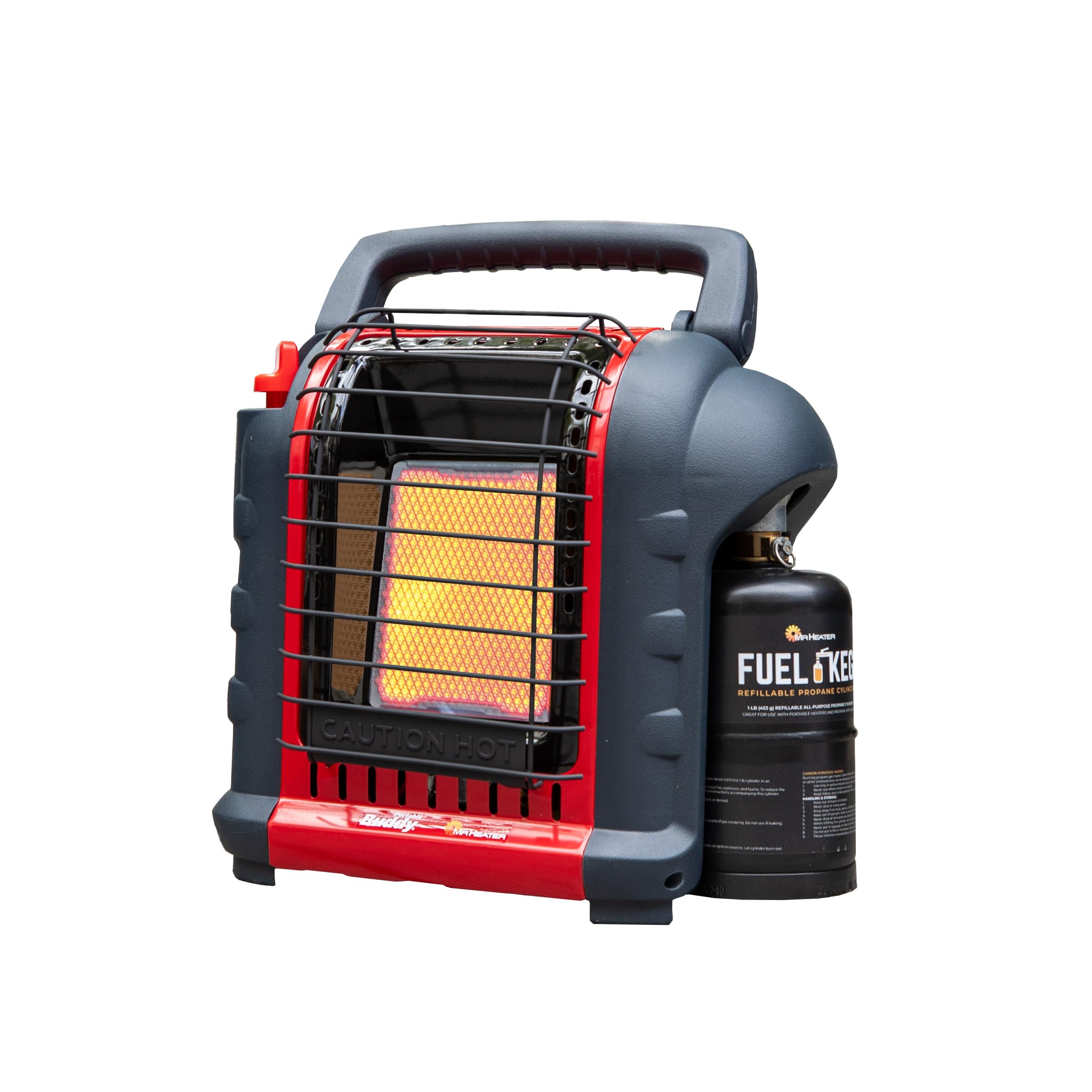
Mr. Heater Portable Buddy
Key Features
- Weight: 7.1 lb
- Coverage: 225 sq ft
- Heat output: 9,000 BTU
- Heat settings: 2
- Price: Midrange
Read the rating line before the BTU number: this is one of only two heaters in this roundup cleared for both indoor and outdoor use, and the low-oxygen sensor behind that rating is why it takes the top spot. In a small tent with a vent cracked, the flame cuts out when the air turns thin instead of quietly burning through what’s left. That safety net, wrapped in a 7.1-pound body, is a combination nothing else here offers.
Heat runs 4,000 BTU on low and 9,000 on high, spread across a claimed 225 square feet. Because it’s radiant, it warms what it faces rather than the air in the room, so how far you sit from it matters more than the square footage. In a two- or three-person tent, low is the setting you’ll live on and high is for the first ten cold minutes. Two settings and no thermostat is the honest trade: there’s one knob, and you learn where it belongs.
What tempers our enthusiasm is age. The sparker and the gas valve are the parts that go, and a heater that spends eleven months a year in a garage is the one most likely to be stubborn on the first cold night of a trip. We’ve made a habit of a trial light in the driveway before packing it. For a tent, a hunting blind and the odd power cut, this is still the one we hand people.
Pros
- Indoor and outdoor rated with a low-oxygen shutoff
- 9,000 BTU across a claimed 225 sq ft
- 7.1 pounds with a small floor footprint
- Piezo ignition, no matches needed
Cons
- Only two settings and no thermostat
- Ignition and valve can fail with age
This is the one we point to for tent camping: an indoor rating, a low-oxygen shutoff and 9,000 BTU you can carry in one hand.
Best for Large Tents
Mr. Heater Big Buddy
Key Features
- Fan: Built-in
- Coverage: 450 sq ft
- Heat output: 18,000 BTU
- Heat settings: 3 (4,000/9,000/18,000 BTU)
- Price: Premium
Think of this as our top pick after a growth spurt. Same shape, same indoor/outdoor rating, same low-oxygen shutoff, but 18,000 BTU against a claimed 450 square feet and 14.1 pounds to hoist out of the truck. For a cabin tent with cots, gear and a dog, that bigger burner is the difference between warm and almost warm.
The built-in fan is the part we value most. A radiant heater warms the people in front of it; the fan pushes that heat into the corners of a larger space, which is the only reason a tent this size evens out. Three settings — 4,000, 9,000 and 18,000 BTU — let you start strong and drop to low once the edge comes off the cold, so you’re not choosing between freezing and roasting.
The bill arrives in two places. Four D batteries run the fan and drain over a season, so pack rechargeables, and the fan is the assembly that ages first; a unit whose fan quits still heats, just without the circulation that justified the upgrade. For a two-person hike-in tent, our top pick does the same job at half the carry.
Pros
- 18,000 BTU with a low setting that still works
- Built-in fan spreads heat into corners
- Same indoor/outdoor rating as our top pick
Cons
- 14.1 pounds before you add fuel
- Fan runs on four D batteries
For a four-person cabin tent you drive to, the Big Buddy’s extra output and fan are worth the fourteen pounds it costs you.
Best for Group Campsites
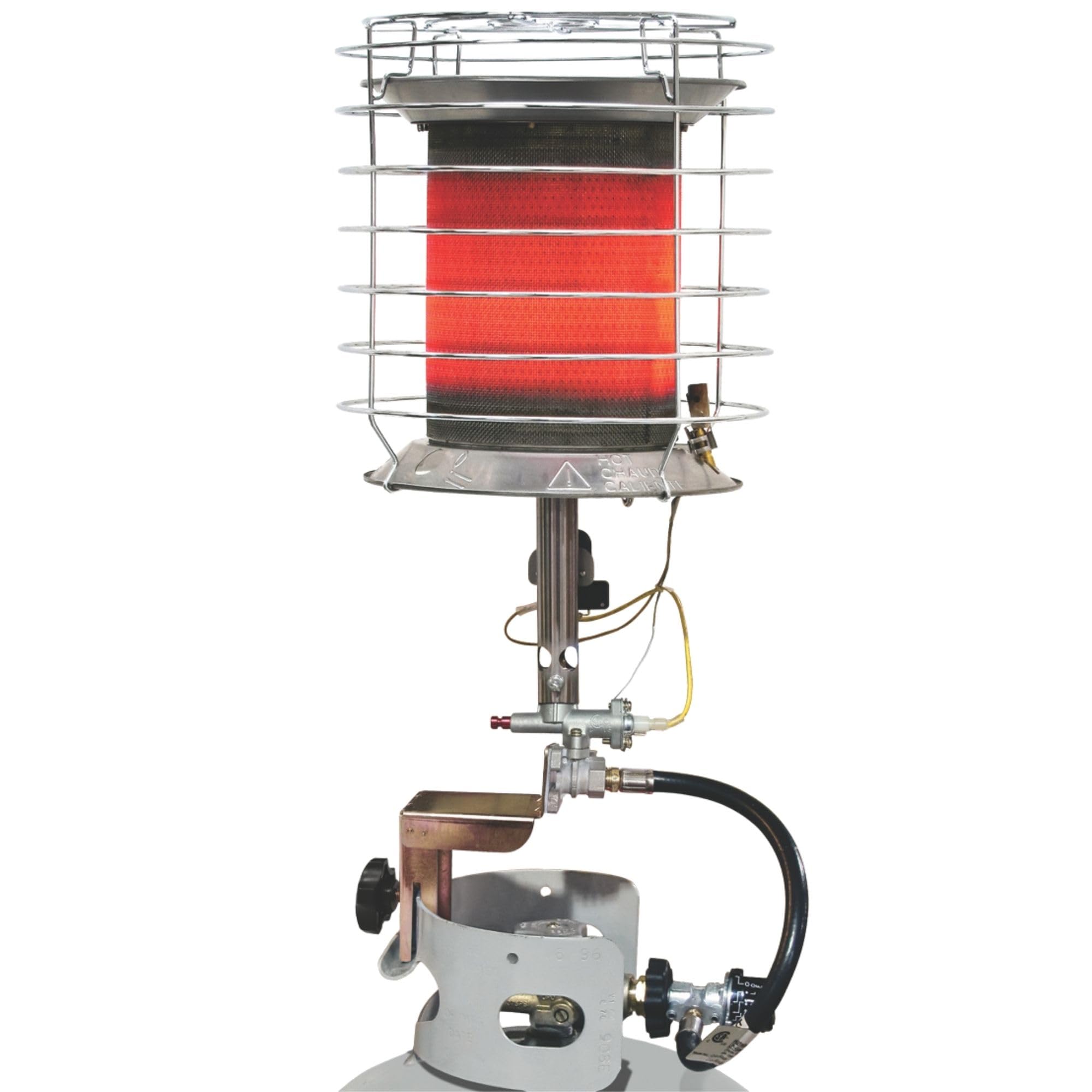
Dura Heat TT-360
Key Features
- Use: Outdoor only
- Burner: 360-degree
- Coverage: 1,000 sq ft
- Heat output: 40,000 BTU
- Price: Midrange
Picture the outdoor half of camping: a ring of chairs, something cold in a cup, and a 20-pound tank standing between them with a chrome dish bolted on top. The TT-360 is built for exactly that, throwing heat through a full circle so nobody has to claim the good seat.
It’s rated at 40,000 BTU across a claimed 1,000 square feet, which is a different order of output from the tent heaters here. Three settings take it down to something bearable on a merely cool evening, and the 5.5-pound head mounts straight to the tank valve with the regulator and hose in the box. The chrome wind guard and stainless reflector are there for the breeze that flattens a bare burner.
It is an outdoor heater in the strict sense: no indoor rating, no low-oxygen sensor, match lit rather than push-button, and happiest standing level where it can’t go over. None of that is a flaw in the design — it is the design. You buy this to heat open air around people dressed for it, not to make a tent livable.
We like it best for a group basecamp or a cold tailgate, where the tank doubles as the stand and everyone shares the same wash of heat. Budget for propane honestly, because 40,000 BTU empties a tank over a long evening, and expect to fiddle with the match and the valve when the temperature drops.
Pros
- 360-degree heat for a whole circle
- 40,000 BTU on a 5.5-pound head
- Regulator and hose included, no assembly
Cons
- Outdoor use only, and match lit
- Wants a 20-pound tank and level ground
Buy the TT-360 to heat the people standing around the tank, not the tent behind them: 40,000 BTU of outdoor-only, 360-degree warmth.
Best for Two-Zone Heat
XtremepowerUS Tank Top
Key Features
- Use: Outdoor only
- Burners: Two, independently lit
- Coverage: 750 sq ft
- Heat output: 30,000 BTU
- Price: Budget
Two burners that light independently are the reason this one earns a place. Light one side to warm a couple of chairs, light both when the crew turns up or the wind gets serious, and you spend propane in proportion to the company instead of blasting 30,000 BTU at four people.
It’s a tank-top unit: 30,000 BTU total across a claimed 750 square feet, three heat settings, a rustproof chrome guard over the emitter, and a tip-over switch that cuts the gas if it goes over. Nothing needs assembling — you thread it onto a 20-pound cylinder and you’re done, which makes it the quickest thing here to set up at a campsite after dark.
The limits are the ones that come with the format. It’s for outdoor use, it rides on top of a tank you then have to keep upright and level, and 750 square feet is an open-air number that assumes still air. We treat it as the two-zone heater for a basecamp: one burner for the picnic table, one for the chairs, and the tank parked where nobody kicks it.
Pros
- Two burners that light separately
- 30,000 BTU across a claimed 750 sq ft
- Tip-over shutoff and a chrome guard
- Mounts to a tank with no assembly
Cons
- Outdoor use only
- Rides on the tank, so level ground matters
Best when your campsite has two zones to heat: light one burner for the table, both for the whole circle.
Best for Small Shelters
Gasfargo 9,000 BTU
Key Features
- Fuel: Butane or propane
- Hose: 8 ft included
- Coverage: 200 sq ft
- Heat output: 9,000 BTU
- Price: Budget
The eight-foot hose is what sets this one apart. Screw it to a 20-pound tank and the tank stays outside the shelter or behind the tailgate while the heater sits where you actually want the warmth — a small thing on paper, and the difference between warm boots and cold ones at the end of an evening.
Output is modest and deliberate: 9,000 BTU across a claimed 200 square feet, self-ignition, tip-over and low-oxygen shutoffs, and a body small enough to tuck between two camp chairs. It runs on butane canisters as well as propane, which is handy when that’s what the camp store stocks. We see it as the heater for one or two people in a small, ventilated space — a screen house, an ice shanty, a van with a window cracked — rather than a family tent.
Two things to know before you order. It’s listed for outdoor use, so it doesn’t belong in a sealed tent with people sleeping in it. And it needs a flat, stable perch; the body is light and wants to lean on soft ground. Set it on a board or a firm patch, and 9,000 BTU will take the ache out of a cold evening without ever heating a big tent.
Pros
- Included 8-foot hose keeps the tank away
- Self-ignition with tip-over and low-oxygen shutoffs
- Small body that runs on butane or propane
Cons
- Listed for outdoor use only
- Wants a flat, stable base
A good fit for one or two campers in a small ventilated shelter, where a hose keeps the tank out of the way.
Best for Backup Heat
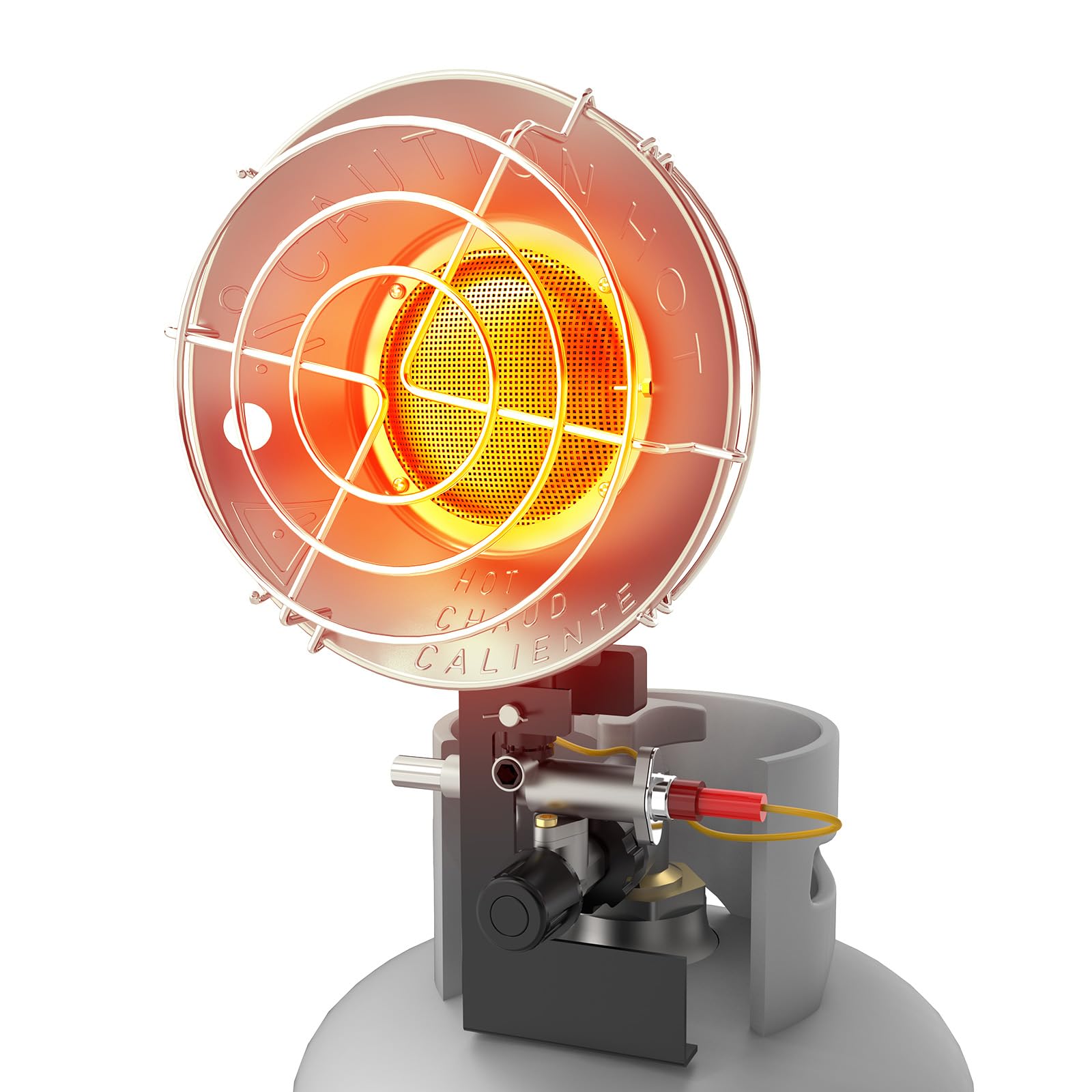
SISUPASSIE 15,000 BTU
Key Features
- Dimensions: 12"D x 10"W x 6"H
- Heat output: 15,000 BTU
- Heat settings: 3
- Price: Budget
This is the cheapest way into propane heat in this group, and it’s honest about it: 15,000 BTU, three settings and a body roughly a foot across. If you want a second heater for the garage or something that lives behind the truck seat for a cold night, it’s the first one to look at.
It heats quickly for its size, and the three modes give you something to work with — a wide burner on high is more than a small space needs, and low is usable when you’re sitting close. Tip-over and overheat protection are both there, which is more than the position on the price ladder suggests, and it’s rated for outdoor use only, same as the tank-tops.
The caveat is the hardware around the burner. The control knob and the mounting bracket are the two spots to inspect when it arrives, and a heater that rattles loose in a truck bed is asking for trouble with either. Buy it as a compact second heater or a spare for the shed, not as the one thing standing between you and a cold night.
Pros
- 15,000 BTU with three settings
- Compact 12 by 10 inch body
- Tip-over and overheat protection
Cons
- Listed for outdoor use only
Worth it as a spare or a shed heater at the lowest price here, not as the main heat for a family tent.
Best for Big Outdoor Areas
Buyplus 30,000 BTU

Key Features
- Burners: Two, 30-degree rotating
- Coverage: 800 sq ft
- Heat output: 30,000 BTU
- Price: Midrange
Two heads on a single tank, each one swiveling about 30 degrees, so you can point one at the picnic table and the other at the chairs without moving the propane. Output steps through 22,000, 26,000 and 30,000 BTU, and the dish-and-guard build is aimed at open ground rather than a tent floor.
On paper it covers a claimed 800 square feet, the same kind of open-air figure every tank-top here quotes: useful for judging relative size, not a promise about a windy field. The safety mesh over the emitter and the tip-over switch are the two features we care about most on a unit that sits at knee height with people walking around it.
Where it earns its spot is a campsite laid out across two areas — a table under a canopy and a fire ring ten feet away. It’s outdoor only, it mounts once and stays put for the weekend, and the swivel heads are the part to handle carefully when you pack it up. If your group sits in one circle, the XtremepowerUS does the same job with simpler hardware.
Pros
- Two heads rotate about 30 degrees each
- 30,000 BTU in three steps
- Safety mesh and tip-over shutoff
Cons
- Outdoor use only
The pick for a wide campsite with two clusters of chairs, where the swiveling heads do the work of two heaters.
How We Tested Propane Camping Heaters
We started by pulling together the propane heaters sold for camping rather than patio use, then filtered the list by BTU rating, footprint, ignition type, tank compatibility, and safety features like tip-over shutoffs and oxygen-depletion sensors. We also looked at what came in the box—regulator, hose, carry handle—because a heater that needs a separate fitting is a different value proposition.
Nine models made the cut, and we tested them over six months at campsites, tailgates, and in a cold garage. We lit each one from cold and in wind, timed how long it took to reach a steady flame, and repeated the start after a night in the car to judge reliability and ease of lighting. We set them on gravel, a slight slope, and a tailgate, then nudged each to see whether the tip-over switch cut the fuel.
For heat output, we sat at three and six feet away and noted whether we felt warmth at our hands, face, and feet or only within a tight circle. Fan models ran on high until the batteries died, which gave us a rough battery-life figure; we also logged fan noise and whether the controls worked with gloves on. We packed and unpacked every heater for each trip, checking for loose knobs, bent grates, and rust, and compared included accessories against price.
Safety and installation got their own pass: we attached and removed each tank repeatedly, checked that connections seated without tools, and kept clearances from tent walls and gear. The heaters that scored best were the ones that lit without drama, stayed planted, and kept putting out steady heat after months of use—not just the ones with the biggest BTU number.
How to Choose a Propane Heater for Camping
The first decision isn’t how many BTUs you need; it’s whether the heater is rated for the space you sleep in, because only a couple of camping heaters are.
Start With the Rating, Not the BTU
A propane flame doesn’t know the difference between a tent and a patio; the rating does. Heaters cleared for indoor use carry a low-oxygen sensor that shuts the burner down when the air in a small space thins out, and that sensor is why the Mr. Heater Buddy models can go inside a tent while every tank-top here belongs outside it. Read the indoor/outdoor line before anything else on the box.
Then treat the rating as a floor rather than permission. Unvented propane gives off water vapor and carbon monoxide, so crack a vent, keep a carbon monoxide alarm in anything you sleep in, and leave clearance between the heater and tent walls or sleeping bags.
Size the Output to the Space, Then Run It Low
Output across these picks runs from 9,000 to 40,000 BTU, and the gap matters more than the numbers suggest. Two or three people in a tent are comfortable at 4,000 to 9,000 BTU; a cabin tent with cots and gear wants 12,000 to 18,000; the 30,000-plus units are for open air around standing people. Coverage figures assume still air, which a campsite rarely provides, so use them to compare size rather than to predict a temperature.
The practical move is buying more settings instead of more firepower. A three-position unit lets you start on high to take the edge off and drop to low for the evening; a single-setting heater gives you one answer to every night, and it’s usually too much.
Bottles, Tanks and the Hose Question
One-pound disposable bottles are what makes a camping heater portable, and they’re the most expensive way to buy propane. A small radiant unit runs for hours on a bottle, not a full night, so a cold trip means a spare in the pack or a hose feeding from a 20-pound tank. The hose route is cheaper per hour and keeps the tank outside the shelter; some heaters, like the Gasfargo, include one, while others need the right accessory.
Match the fuel to the trip. For a handful of weekends, bottles plus one spare are simpler than hauling steel. For a basecamp, a hunting cabin or a whole season of cold starts, a 20-pound tank and a hose pay for themselves quickly — as long as you have room to stand the tank upright and level.
Weight, Footprint and Where It Stands
Where the heater sits decides almost as much as what it produces. Tank-top units bolt to the cylinder, which makes them top-heavy and dependent on flat ground; a tipped unit shuts itself off and you’re relighting in the dark. Floor-standing Buddy models are steadier but eat tent floor you may not have. Account for the fuel too: a 20-pound steel tank is a two-handed lift, a one-pound bottle is not.
Check the packed shape against your vehicle and your tent before you commit, and give the heater its own clear square of ground. A flat board under a tank-top is the cheapest fix at a sloping site.
Frequently Asked Questions
Does a propane heater make a tent feel damp?
Yes, and the heater is the reason. Burning propane produces water vapor as well as heat, so an evening of warmth in a sealed tent leaves the walls and the tops of sleeping bags clammy even when the outside air is dry. Leave a vent or a window cracked a couple of inches and keep bedding off the fabric that touches the outside.
A heater rated for indoor use still adds moisture; that rating covers oxygen, not humidity. Dry wet gear somewhere other than the space you’re heating.
Why does my propane heater keep shutting off?
Three usual suspects. The tip-over switch is doing its job on soft or sloped ground, so set the unit on something flat and solid. In a small sealed space, a low-oxygen sensor cuts the flame and keeps cutting it until air moves.
The third is the bottle. A one-pound canister loses pressure as it chills, which makes the burner falter; swap in a fresh one, or warm the old one inside your jacket before reconnecting it. Never warm a canister over a flame.
Do camping propane heaters need maintenance?
Less than you’d guess, but not nothing. Over the off-season, dust and spider webs collect in the venturi tube behind the burner, and a partly blocked tube burns yellow and lazy. Blow it out and look over the emitter before your first cold trip of the year.
Store the heater indoors and upright with the bottle disconnected, and don’t leave a one-pound canister screwed on between trips.
Final Verdict
If you’re sleeping in a tent, buy the Mr. Heater Portable Buddy. It’s one of only two heaters here rated for indoor use, the low-oxygen shutoff is the feature that matters when a small tent gets stuffy, and 9,000 BTU in a 7-pound body is enough for two or three people on the low setting.
Go up to the Big Buddy when your tent has room for four cots and you can drive to the site. If your heat is only for the circle of chairs outside, skip both and take the Dura Heat TT-360 or the XtremepowerUS — more firepower, no tent duty, and no pretending otherwise.