This post contains affiliate links. We may earn a small commission when you buy through our links — at no extra cost to you.
The fastest way to end a family hike is a kid with soggy socks and a hot spot. Kids hiking shoes need real grip on wet rock and loose gravel, a fit that leaves room for wiggly toes without causing trips, and closures a child can manage at the trailhead. The right pair fixes the small miseries that cut a walk short: cold, wet feet, a blister forming, and a child who wants to turn back before the view.
Appearance matters more than parents expect — if the shoes feel clunky or babyish, they stay by the door. I judge a pair by the end of the day, not the first five minutes: are the socks dry, are the laces still tied or the straps still snug, and are there red marks where the shoe rubs? We’ve spent eight months with 12 pairs on local trails, muddy backyards, and school drop-off, watching how the soles, seams, and toe caps held up and whether each pair earned its price. A kids hiking shoe is an investment in a much better walk.




Best for Everyday Trail Shoe
Merrell Trail Chaser
Key Features
- Style: Low-cut hiking shoe
- Closure: Elastic lace
- Department: Boys
- Price: Budget
The cheapest shoe in this guide is also the one we recommend most often, and there’s no contradiction in that. The Trail Chaser is built like a trail shoe rather than a sneaker with a hiking label: a low, flexible profile, a sole with real bite, and an upper that shrugs off scuffs, kicks and toe-dragging. For a family that gets out a dozen weekends a year, it’s the pair that makes the most sense.
What sold us is how little shoe there is. Kids still growing into their balance do better close to the ground, and this one lets them feel the trail instead of clomping over it. On wet roots, loose gravel and the sloped rock that turns up on almost every local trail, the outsole held where we were braced for a slip.
Fit is the one thing to think about. This model can run narrow, and a wide-footed kid will feel the squeeze across the toes before complaining about anything else. If that sounds like yours, start with the LeIsfIt or one of the KEENs instead; if not, order the usual size and check the heel at the trailhead.
Two practical notes. The elastic lacing is the part that ages first, and it can let go while the sole still has plenty of tread on it, so glance at it before a long walk. And Merrell doesn’t claim waterproofing on this model, so a stream crossing means wet socks. Neither is a reason to skip it at this price; both are reasons to know what you’re buying.
Pros
- Trail outsole bites on wet roots and gravel
- Low, flexible profile suits younger hikers
- Costs less than any other pick here
- Upper stands up to scuffing and kicking
Cons
- Elastic laces can snap before the tread wears out
The one we hand to most families: a genuine trail shoe with real grip and a low, forgiving profile, at a price that makes the next growth spurt painless.
Best for Rough, Rocky Trails
Merrell Chameleon
Key Features
- Style: Mid hiking boot
- Department: Unisex child
- Ankle coverage: Mid-cut
- Price: Premium
Rock, roots and a steep, uneven descent: that’s the ground the Chameleon is built for. It’s a proper mid-cut boot, with a collar that comes up over the ankle and enough structure that the foot doesn’t slide sideways inside the shoe on a sidehill.
That ankle coverage is the reason to buy it, and we think it’s the right call for a kid carrying a small pack or covering ground where a stumble means a scraped shin. Grip is confident on wet rock and packed snow, and the boot stays light enough that it doesn’t turn a two-mile walk into a chore.
Comfort is immediate — no break-in, no complaints on the first long day. Sizing is where it gets fiddly: this model can run small and narrow, so try them on with the socks your child will actually hike in and go up a size if the toes are anywhere near the end.
Water is the surprise, and not a good one. For a boot that looks this serious, standing water is where it gives up: puddles and shallow crossings get through, and once the footbed is wet it stays wet for the rest of the day.
Pros
- Mid-cut ankle coverage on rocky ground
- Confident grip on wet rock and snow
- Comfortable from the first wear
- Well built for the money
Cons
- Standing water soaks through
Buy this one for the ankle coverage: a proper mid boot that steadies a kid on rock and scree, as long as your trails are drier than a creek bed.
Best for Cold, Wet Days
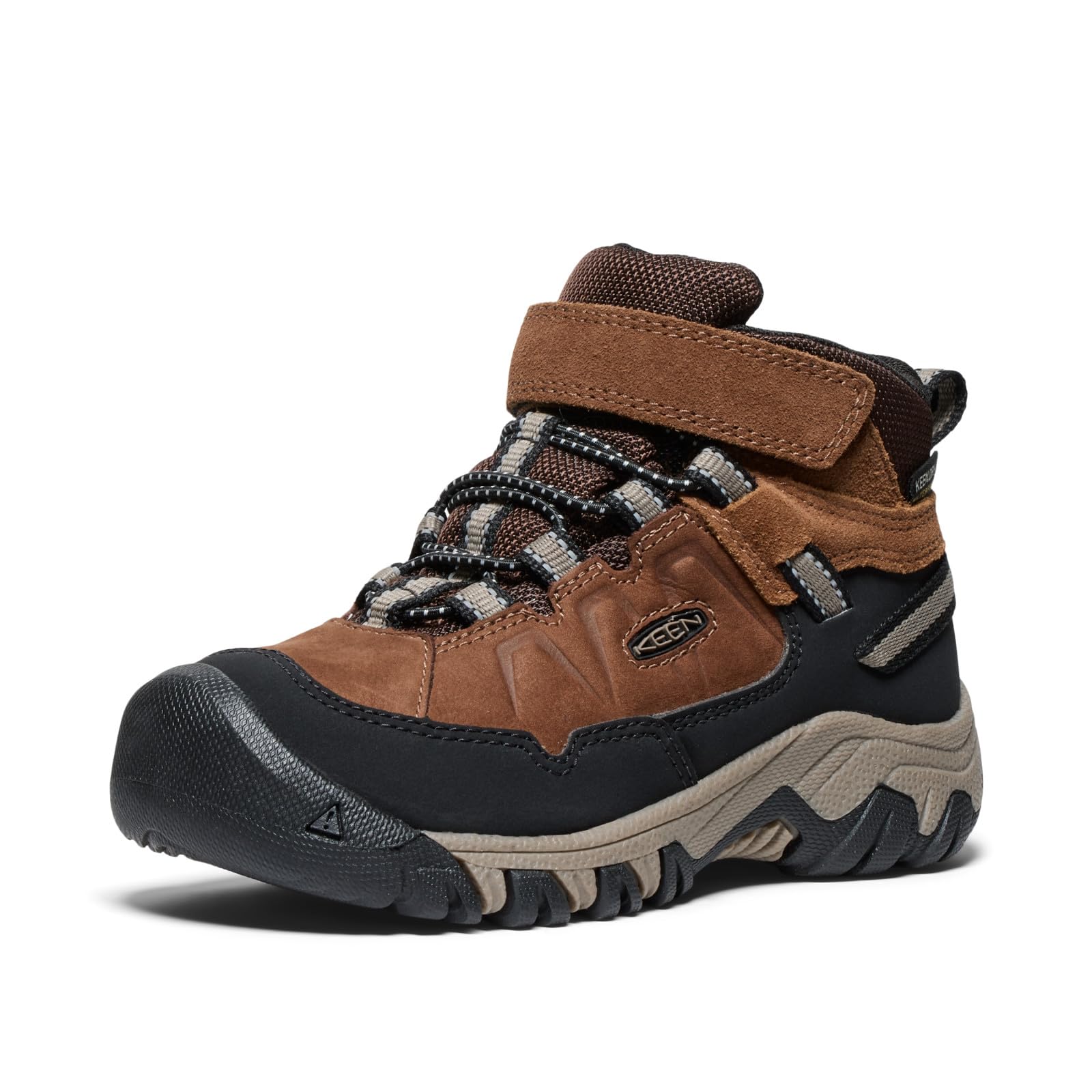
KEEN Targhee 4 Mid
Key Features
- Style: Mid hiking boot
- Closure: Bungee cinch
- Waterproofing: Waterproof
- Price: Premium
No laces to tie and no double knots to pick apart with cold fingers: the Targhee 4 Mid uses a bungee cinch, and a kid can pull it tight and loosen it alone. At a trailhead with gloves on, that’s worth more than it sounds.
Underneath the convenience is a real waterproof boot. The upper handles wet grass, slush and shallow puddles, and it runs warm — this is the pair we reach for in late fall and early spring rather than July.
It’s the most expensive boot here, and we think it earns that in cold, wet weather, which is exactly where cheap boots give up first. It’s also a lot of boot for a dry summer trail, where a low shoe is cooler and more fun to walk in.
The bungee also means no lace bites and nothing to retie halfway up a climb, which matters more than any specification once a kid is tired and wants to be done.
Pros
- Waterproof upper handles wet grass and slush
- Bungee cinch means no laces to tie
- Warm enough for cold-weather hikes
Cons
- Run about half a size large
The cold-and-wet-weather boot we reach for: waterproof, warm, and cinched with a bungee so a kid never has to tie anything.
Best for Fast Wet Hikes
KEEN Hightrail Low
Key Features
- Style: Low-cut hiking shoe
- Department: Unisex child
- Waterproofing: Waterproof
- Price: Premium
If you want waterproofing without a boot, this is the pair. The Hightrail Low is a low-cut shoe with a waterproof upper, and it’s the pick for wet, mild-weather hikes where a mid boot is more shoe than the day requires.
Water beads and rolls off the upper instead of soaking in, and the shoe stays light enough that kids keep it on in the car and around town afterwards. We noticed it most on a drizzly walk where everyone else’s feet were getting cold and soggy.
What you give up is support and, partly, value. There’s no collar to brace an ankle, and it costs close to what the boots here do, which is the awkward part — you’re paying for the waterproofing and the lighter weight, not for more shoe. For a kid who hikes fast, hates bulk and complains about every boot, that’s the right trade.
Pros
- Waterproof upper sheds drizzle and wet grass
- Light enough to wear all day
- Comfortable on long days out of the box
Cons
- Costs nearly as much as a boot
Waterproofing without the boot: the pair for wet, mild-weather hikes when a mid-cut is more shoe than the day calls for.
Best for Comfort on a Budget
Mishansha Kids Hiking Boots
Key Features
- Style: Mid hiking boot
- Weight: 10.58 oz packaged
- Department: Boys
- Price: Midrange
The price lands between the budget shoes and the KEEN boots, and what you get for it is comfort: a soft, roomy interior and a footbed kids don’t complain about, even after a full day out. That’s not a small thing with a five-year-old.
Grip is better than the price suggests. The outsole held on rocky paths and steep dirt, and the boots go on and come off without a fight, which is the difference between a kid who puts their own shoes on and one who stands at the door waiting.
Where it stops is water. Wet grass and puddles get through sooner than the boot suggests, so this isn’t the pair for a rainy weekend. Keep it for dry-to-damp trails and it does everything you want at the price.
For short family walks and a kid who wants a boot rather than a shoe, the comfort and the grip make this an easy recommendation. It’s the best value among the boots here, as long as those walks stay on the drier side.
Pros
- Soft, roomy interior kids don’t complain about
- Grip holds on rocky paths and steep dirt
- Kids can pull them on unaided
- Costs less than the premium boots here
Cons
- Seams and lower rubber can separate with hard use
The comfort-and-grip boot we hand to families on short, drier walks — soft inside, easy to pull on, and not built for a rainy weekend.
Best for Wide Feet
LeIsfIt Barefoot Shoes

Key Features
- Style: Low-cut barefoot shoe
- Closure: Hook-and-loop strap
- Department: Unisex child
- Price: Budget
The toe box is the whole point. This is a barefoot-shaped shoe — wide across the toes, flat inside, flexible enough that the foot does the work instead of the sole. For a kid with wide feet who fights every closed shoe, it’s a small revelation.
It’s also not a hiking shoe in the way the others here are. There’s no waterproofing, the sole is thin, and the upper is mesh: brilliant on a dry forest path or the playground, out of its depth on wet rock, loose scree or a cold morning. It’s the everyday-and-easy-trails pick, not the mountain one.
The hook-and-loop strap is easy for small hands, the shoe is light enough to forget about, and ours survived school days and after-school running about without a split seam. Sizing runs true, which is more than several picks here can say.
Pros
- Wide, foot-shaped toe box
- Light, flexible and breathable
- Easy for kids to put on alone
Cons
- No waterproofing and a thin sole
For wide-footed kids who fight every closed shoe, this flexible barefoot pick works beautifully — as long as the trails stay dry and gentle.
Best for Short Wet Hikes
EQW Kids Waterproof Hiking Shoe

Key Features
- Style: Low-cut hiking shoe
- Department: Boys
- Waterproofing: Waterproof
- Price: Midrange
This is the least expensive waterproof shoe in the guide, and that’s the reason it’s here. It’s a lightweight low-cut trail shoe with a waterproof upper — the kind of thing you leave in the car for the unplanned muddy walk.
On a short, wet trail it behaves. The upper keeps splashes out, the sole grips, and it’s light enough that a kid forgets about it. We liked that it needed no breaking in at all.
Where it sits is as a second pair. As a spare, a school-trip shoe, or a first hiking shoe for a kid who might not take to the hills, it does the job at a price that makes the decision easy.
Pros
- Waterproof upper at the lowest price here
- Light and comfortable from the first wear
- Grip holds on short wet trails
Cons
- Waterproofing suits splashes, not sustained rain
A sensible spare pair: waterproof, light and cheap enough that keeping a muddy-trail backup in the car stops being a decision.
How We Tested Kids Hiking Shoes
We began by shortlisting more than 40 kids hiking shoes from established shoe and outdoor brands, then narrowed the group by available sizes, price, and whether the outsole and upper looked suited to dirt, roots, and wet grass rather than pavement. Twelve pairs made the cut, and we tested them for eight months.
Each pair went into the same rotation: weekend day hikes of two to three miles, after-school playground time, muddy backyard rambles, and a few deliberate puddle-and-wet-grass walks. For fit, we checked heel slip, toe room, and whether the shoe pinched across the top of the foot after an hour; kids reported hot spots and we noted whether they wanted to take the shoes off early. We also watched them put the shoes on themselves, marking whether laces stayed tied, Velcro straps stayed snug, and any loose ends became a tripping hazard.
On the trail, we watched where feet slipped on gravel, wet rock, and roots, and whether the tread cleared mud or packed it in. Back home, we inspected toe caps, seams, and soles for scuffs, separation, and worn tread, and checked socks after wet walks for damp spots. We noted whether the shoes still looked presentable after a wash, and compared price against how much wear each pair shrugged off — because a cheap shoe that falls apart in one season is not a value.
How to Choose Kids Hiking Shoes
The most useful thing we can tell you is that most kids under ten are better served by a low, flexible shoe than a tall boot — and that the word waterproof deserves a closer look than the label suggests.
What Waterproof Really Buys You
Waterproofing comes two ways: a membrane built into the shoe, or a coating sprayed on the outside. A membrane keeps water out only up to the top of the collar, which is why a low shoe and an ankle-deep puddle don’t mix however the label reads. Coatings wear off with abrasion and need refreshing.
The other half of the trade is breathability. A waterproof shoe runs warmer, and in July that matters more than a dry sock. Buy waterproofing for wet grass, mud and cold weather; skip it for summer trails and save the weight.
Fit Comes Before Everything Else
Buy the size that fits today. A shoe bought big enough to grow into slips at the heel, rubs on the climb and turns a confident kid into a tripping one. Measure at the end of the day when feet are widest, and check the toes with a thumb’s width of room while your child stands.
Sizing numbers are not comparable across these brands — the KEEN Targhee 4 runs large while the Merrell models can run narrow — so treat the size on the box as a starting point rather than an answer.
Grip: The Part You Can’t Fix Later
Traction lives in the outsole: deeper lugs for mud and loose dirt, softer rubber for wet rock, and a wrapped toe for kids who drag their feet. You can’t add grip to a worn sole, so smooth tread is the moment to retire a pair, whatever the upper still looks like.
Among these picks, the Merrell outsoles are the ones we trust on wet roots and sloped rock; the barefoot-shaped LeIsfIt has a thin sole that suits dry paths only.
Low Shoe or Mid Boot
This decision changes the most. A mid boot adds ankle coverage and protection on rock and scree, and it earns its place in cold, wet weather or on a child carrying a pack. A low shoe is lighter, cooler, cheaper and easier to run in — better for most day hikes with younger kids, who spend more time moving than plodding.
Match the boot to the terrain and the season, not to how serious it looks in the photo.
Closures Your Kid Can Work Alone
A closure a child can manage beats a perfect fit on paper, because it decides whether they dress themselves at the trailhead or wait to be helped. Elastic and bungee systems are quick and independent but are also the first thing to wear out; hook-and-loop straps are easy but offer less fine-tuning; laces give the best fit on older kids.
Whatever the system, check that the tongue stays put when it’s tightened — a gap at the top lets in water and grit.
Frequently Asked Questions
Do kids really need hiking shoes instead of sneakers?
On a flat, dry path, sneakers are fine. The difference shows on wet roots, loose gravel and long descents, where a trail outsole holds and a running sole slides, and where a rubber toe bumper saves a toenail. If you hike more than a handful of times a season, a dedicated pair earns its keep; if not, spend the money on good socks instead.
How do I know when my kid has outgrown their hiking shoes?
Check at the end of the day, standing, in the socks they hike in. There should be about a thumb’s width between the longest toe and the front of the shoe, and the heel should stay put when they walk. Feet grow in bursts, so recheck before each season rather than trusting the size you bought in spring.
Can I wash kids’ hiking shoes in the washing machine?
Mesh and synthetic low shoes usually survive a cold, gentle cycle in a pillowcase with the insoles out. Leather boots and anything with a waterproof membrane should be brushed, rinsed and air-dried instead. Stuff them with newspaper to pull moisture out, keep them away from radiators, and never use the dryer — heat is what kills the adhesives and the membrane.
Final Verdict
Our pick for most families is the Merrell Trail Chaser. It grips, it’s light, and it costs less than anything else here, which makes replacing it when the next growth spurt lands much easier to swallow.
If your trails are wet and cold, step up to the KEEN Targhee 4 Mid — the waterproofing and ankle coverage are worth the extra money in that weather. And if your kid has wide feet that fight every shoe, start with the LeIsfIt, as long as the trails stay dry.