This post contains affiliate links. We may earn a small commission when you buy through our links — at no extra cost to you.
The first sleepover invitation arrives, and suddenly you’re standing in the aisle of a store wondering why every kids sleeping bag looks either like a cartoon character or a tiny mummy case. A good one does more than keep a child warm for a night — it makes unfamiliar floors and tents feel like an adventure, so they sleep. The wrong one leaves them tangled in a thin polyester sack, fussing with a zipper that jams at 2 a.m., and you get the phone call. We kept that in mind while testing.
Over the past six months, my team and I put 12 kids sleeping bags through the wringer — backyard campouts, living room sleepovers, a few actual camping trips, and one long weekend at Grandma’s. We watched how kids climbed in and out, whether they stayed covered, and how each bag held up after being dragged across grass and stuffed into its sack. The differences in comfort, size, durability, and value were obvious — and appearance mattered more than I expected, since kids gravitated to certain colors and patterns.


Best for Family Camping
Coleman Kids 45°F Sleeping Bag
Key Features
- Weight: 2.9 lb
- Dimensions: 60"L x 26"W
- Fits heights up to: 5 ft 5 in
- Temperature rating: 45°F
- Price: Midrange
A five-year limited warranty is not the sort of detail that usually sells a kids sleeping bag, but it is the first thing that made us take the Coleman seriously. This is the one we recommend first for most families: the ZipPlow zipper is designed to keep fabric out of the teeth, the Roll Control system helps the bag stay straight while you roll it, and Coleman backs it for five years. Those are small conveniences until you are packing up a damp tent with a tired child, and then they are the whole morning.
The 45°F rating puts it in the cool-weather family camping lane, not the deep-winter one. For spring-through-fall trips, scout camps, and sleepovers on a cold floor, that is a sensible range, and the polyester shell is easy to wipe down. We also appreciate the Comfort Cuff around the face; it is a soft edge rather than a bare zipper, which matters when a child burrows in. The bag measures 60 by 26 inches and Coleman sizes it for children up to 5 ft 5 in. Those two numbers do not quite line up for a tall child, so measure before you commit; for most younger campers the length is fine.
What seals it for us is the combination of a snag-resistant zipper and a warranty that covers five years. A zipper failure is the quickest way to turn a children’s bag into a frustrating hand-me-down, and Coleman has clearly designed around that. It is not the warmest bag here, and it does not have the flannel softness of the KingCamp. But for ordinary family camping, it is the bag we reach for when the packing is already chaotic.
Pros
- Snag-resistant ZipPlow zipper
- Roll Control keeps the bag straight while packing
- Five-year limited warranty
- Comfort Cuff softens the face opening
Cons
- 45°F rating is not for freezing nights
We recommend the Coleman first for cool-weather family camping: its snag-resistant zipper, easy rolling, and five-year warranty make it the most reassuring bag here.
Best for Cold-Weather Camping
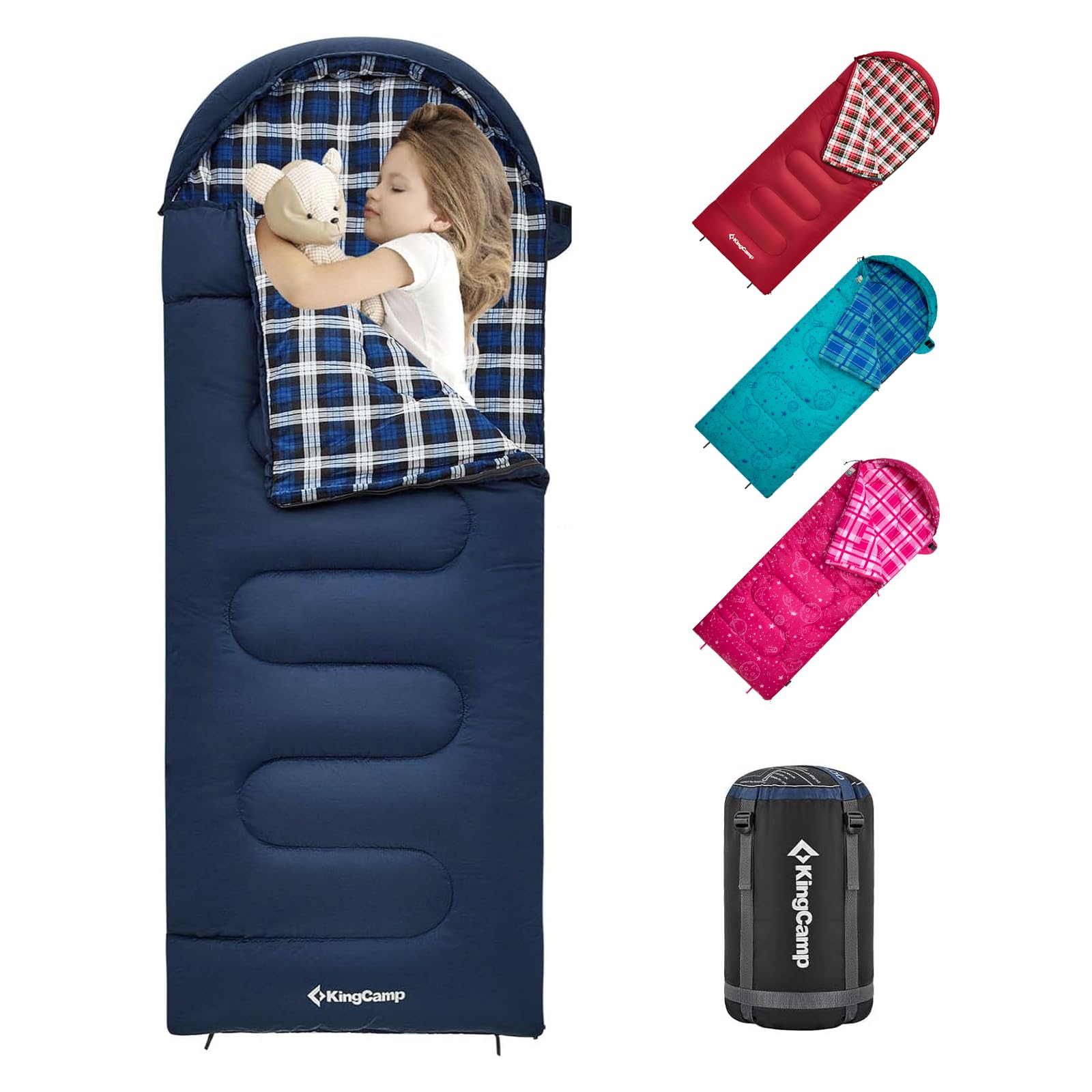
KingCamp Kids Flannel Sleeping Bag
Key Features
- Lining: 100% cotton flannel
- Weight: 3 lb
- Dimensions: 66.9"L x 27.5"W
- Temperature rating: 1 to 5 degrees Celsius
- Price: Midrange
The inside of the KingCamp is the part that stands out: 100% cotton flannel, with a quiet, brushed feel that is closer to a blanket than to a slick camping sack. The 300 g/m² hollow-fiber fill gives it some loft, and the semi-rectangular shape leaves more room around the knees and feet than a mummy bag. It is 66.9 inches long and 27.5 inches wide, so it has more sprawl room than the Coleman or the Wake In Cloud.
That makes it our cold-weather comfort pick. The bag is rated for 1 to 5°C, and the flannel lining plus the thicker fill is the combination we reach for when the forecast is cool rather than merely mild. It packs into its included sack and works well for car camping, cabin trips, and a sleepover on a chilly floor. The width is the detail bigger kids will notice; there is room to turn over without wrestling the shell.
The catch is the hardware. The zipper works smoothly when it is aligned, but it is the point where this bag asks for patience, and the shell and strap are not as confidence-inspiring as the Coleman’s. The height guidance is also muddled: one part of the product description gives under 4 ft 7 in, while the specifications allow up to 5 ft. Measure your child before ordering rather than assuming the 10-12 label in the title means a tall 12-year-old. For a cozy, cold-night bag, though, it earns its place.
Pros
- Flannel lining feels soft and quiet
- Colder-weather rating and thicker fill
- Wide 27.5-inch interior gives room to turn
- Included carry sack
Cons
- At 3 pounds, it is heavy for small children to carry
We reach for the KingCamp on cold nights when comfort matters more than packing: the flannel lining is soft, the bag is wide, and the warmth is serious for this group.
Best for Younger Kids
Wake In Cloud Kids Sleeping Bag
Key Features
- Weight: 3.42 lb
- Carry sack: Backpack-style
- Dimensions: 61"L x 26"W
- Temperature rating: 45°F – 77°F
- Price: Budget
The Wake In Cloud arrives as a small, tidy bundle with a backpack-style sack, and that is the point of it. A 61-by-26-inch bag that a young child can carry changes the math on sleepovers and short family trips; it is one less thing for a parent to haul. The unicorn, rainbow, and star print is clearly designed to make the bag feel like the child’s own gear rather than borrowed camping equipment.
We like it best as the lightweight choice for younger kids and mild nights. The temperature range runs from 45°F to 77°F, which makes it a three-season bag for summer camp, sleepovers, and cool-but-not-cold weather. The polyester shell is water-repellent and the lining is soft enough that it does not feel like a plastic sack. For a first bag that a child can manage, that combination is more useful than a warmer bag they cannot carry.
The trade-off is depth. This is not the bag for frosty nights, and the 1.55 kg weight is still enough that a very small child will feel it on a longer walk. But it is easy to roll, easy to carry, and the print does half the work of getting a reluctant sleeper into bed. For a younger camper who wants to carry their own bag, this is an easy one to say yes to.
Pros
- Backpack-style sack for a child to carry
- Three-season 45°F to 77°F range
- Water-repellent polyester shell
- Playful unicorn print
Cons
We like the Wake In Cloud for younger kids who want to carry their own bag: it is compact, cheerful, and rated for mild-to-cool nights rather than winter.
Best for Indoor Sleepovers
Jay Franco Monster Jam Slumber Set

Key Features
- Care: Spot clean only
- Season: Summer
- Included: 17" x 11" pillow
- Dimensions: 54"L x 27"W
- Price: Budget
The Jay Franco set is less a camping bag than a sleepover kit: a 54-by-27-inch slumber bag, a small pillow, and a Monster Jam print that does most of the persuading before a child has even unrolled it. The two pieces are soft and light, and the set opens flat like a blanket, which makes it useful for movie nights, daycare naps, and grandparents’ spare-room sleepovers.
Where it earns its keep is convenience. The bag is a summer-weight polyester layer, not an insulated camping bag, and the pillow is sized for a child rather than an adult. It opens flat like a blanket, so it works for movie nights, daycare naps, and grandparents’ spare-room sleepovers. We see it as a gift for a child who wants the character more than a technical sleeping bag; the fun is the point.
For actual camping, we leave it at home. The shell is not built for damp ground or cold nights, and the thin fill will not keep a child warm in a tent. What it does well is make a sleepover feel like an event, and that is a real job. If you need one bag for both the backyard and the tent, choose the Coleman or the KingCamp; if the guest room is the destination, this set is charming and easy to live with.
Pros
- Monster Jam print and pillow make it a gift
- Soft, light, and opens flat like a blanket
- Good for sleepovers and naps
Cons
- Spot clean only; not machine washable
We see the Jay Franco set as an indoor sleepover gift, not camping gear: it is soft, fun, and easy to live with, as long as the destination is a carpeted floor.
How We Tested the Best Kids Sleeping Bags
We started by scanning the market for sleeping bags sized for kids roughly ages 4 to 12, then narrowed the field to 12 models that represented a range of materials, shapes, and price points. We skipped oversized adult bags that swallow small sleepers and tiny infant sacks that kids outgrow in a season. Each bag went home with a family on our team and was used for six months — not just in the backyard, but on living room floors, in tents, and on overnight visits to relatives.
Comfort and thickness were the first things kids noticed. We asked them whether they could feel the floor through the padding, and we checked how much loft each bag had after a night of tossing and turning. To test zipper quality, we had kids open and close the bags themselves — we noted snags, jams, and whether the zipper was easy to reach from inside. Size mattered too: we compared how each bag fit a 5-year-old versus a 10-year-old, and whether there was room to grow without leaving gaps at the shoulders.
Durability got a workout: bags were dragged across grass, stuffed into stuff sacks by kids rather than adults, and washed according to the care labels. After each wash, we inspected seams and fabric for quality and wear. Appearance and enjoyment went hand in hand — we let kids choose which bag they wanted for each sleepover and watched which ones they reached for without prompting. Finally, we weighed value: did the bag feel worth its price after six months of use, or did it show wear that made us doubt it would last a second season?
How to Choose a Kids Sleeping Bag
Start with the night your child will actually sleep through, not the lowest temperature a label claims.
Match the rating to the trip, not the season name
A 45°F bag like the Coleman is a cool-weather family camping bag, not a deep-winter one; the KingCamp’s 1 to 5°C rating is aimed at colder nights. Treat the number as a starting point. Dry pajamas, a hat, and a warm layer do as much for comfort as another inch of fill. We prefer to match the bag to the trips you actually take: a 45°F bag is the easier default for spring-to-fall car camping, while a lower rating and more loft make sense for shoulder-season cold.
Fit the bag to the child, then leave room to grow
Height matters more than age on the label. A bag that is too long leaves a cold pocket at the feet; one that is too short puts pressure on the toes and wakes a child up. Coleman sizes its bag for children up to 5 ft 5 in, KingCamp gives a 5 ft maximum, and the Wake In Cloud is a 61-inch bag aimed at younger kids. Measure your child before ordering, and if they are between sizes, choose the shorter bag for warmth rather than the longest one for years of use.
Put the zipper high on your list
A sleeping bag is only as good as its closure. A snaggy zipper lets cold air in, wakes everyone up, and can fail before the rest of the bag wears out. We look for a zipper that runs smoothly around the footbox, has a backing behind the teeth, and is easy enough for a child to work alone. The Coleman’s ZipPlow is the most convincing snag-resistant design here; on any bag, have your child practice opening and closing it before the trip.
Decide who carries it and how far
Packed weight matters differently for a car-camping family and a child walking to a sleepover. A 3-pound bag is fine from the trunk to the tent but heavy for a small child on a longer walk; the Wake In Cloud’s backpack-style sack is aimed at the child who wants to carry their own gear. Look at the sack as well as the bag: a simple stuff sack protects the bag, while a backpack sack is easier for little shoulders. If the bag will live in the car, prioritize warmth and room over the last few ounces.
Don’t ask an indoor slumber bag to be a camping bag
Themed slumber bags like the Jay Franco set are built for sleepovers, movie nights, and naps. They are usually thinner, may be spot-clean only, and often have a polyester shell that is not meant for damp ground. That is not a flaw if the destination is a carpeted floor. It becomes a problem when a child is shivering in a tent. If you want one bag for both, choose a camping bag with a temperature rating and a washable shell; keep the themed set as the fun indoor option.
Frequently Asked Questions
Does my child need a sleeping pad under a kids sleeping bag?
Yes for camping. The ground pulls heat away from the bag, and a child who is warm in a bed can be cold on bare tent floor. A closed-cell foam pad or a small inflatable pad is enough for most family trips. For sleepovers on a carpet, a pad is not necessary. Put the pad under the bag, not inside it.
How do I clean a kids sleeping bag?
Check the care label first. A camping bag with polyester fill can usually go in a front-loading machine on a gentle cycle, then tumble on low or air-dry; a top-loader’s agitator can strain seams. Spot-clean a themed slumber bag with a damp cloth and mild soap. Never dry-clean a synthetic bag unless the label says so.
Can two kids sleeping bags be zipped together?
Only if both bags are designed for it and the zippers have opposite sides, one left-hand and one right-hand. Many children’s bags have a single-sided zipper, and two of the same side will not mate. Check the closure details before buying, and test the join on a flat floor before a trip. If the bag’s description does not state that the bags zip together, assume they do not.
Final Verdict
For most families, we recommend the Coleman Kids 45°F first. Its snag-resistant zipper, roll-control packing, and five-year warranty address the parts of kids’ camping that tend to go wrong, and it is the easiest bag here to live with on a normal weekend. Choose the KingCamp when cold-weather comfort matters more than easy packing and you can live with a finicky zipper; choose the Wake In Cloud for a younger child who wants to carry their own bag. The Jay Franco set is for sleepovers, not the tent.