This post contains affiliate links. We may earn a small commission when you buy through our links — at no extra cost to you.
A kids’ hiking boot has to survive more than a trail. It has to get through the muddy puddle on the walk to school, the gravel pile at the playground, and the one rock every kid insists on scrambling over. The trouble is that children don’t break boots in politely: they run, scuff, stomp, and grow. A good pair fixes the daily friction—wet socks, sore heels, laces that come undone halfway up the path—without turning every outing into a negotiation.
I’ve watched my own kids reject stiff boots after one block and treat a too-roomy pair like clown shoes. Over eight months, we tested 12 pairs on neighborhood walks, muddy park loops, and easy weekend trails, paying attention to comfort, traction, water resistance, fit, durability, laces, ease of use, appearance, quality, and value. The lesson: buy for the foot your child has now, with a thumb’s width at the toe, not the foot you hope they’ll grow into. The picks below are the pairs that earned repeat wear.


Best for All-Around Trail Use
Merrell Chameleon
Key Features
- Boot type: Hiking boot
- Department: Unisex child
- Model number: MK162178
- Price: Midrange
Give a kid a boot that slips on wet rock and the whole hike turns into a slow shuffle behind a nervous parent. The Chameleon is the boot in this group that doesn’t do that. The tread bites into loose gravel and wet mud, and it holds on the tilted, root-crossed ground where a small foot usually starts rolling sideways. The ankle collar rises high enough to steady that foot without turning the boot into a cast, and our pair went from the box to a long day out with no break-in and no blisters.
What makes it our top pick is balance rather than one headline feature. It’s supportive without feeling heavy, tough without feeling like a brick, and it sits in the middle of this group’s prices rather than at either end. Set against the rest of these boots, the combination of grip, ankle support and all-day comfort is the most complete on the page, and that is the standard we hold a kids’ trail boot to.
The thing to accept is water. Merrell doesn’t sell the Chameleon as a waterproof boot, and that matches what we found: wet grass and a shallow puddle are fine, but a couple of inches of standing water soaks a sock through. If your trails are boggy, or your kid finds every stream, the KEEN is the better buy. For three-season hiking in ordinary conditions, this is the boot we pack.
Pros
- Grip that holds on wet rock and mud
- Ankle support without a heavy feel
- No break-in period
- Comfortable through full-day hikes
Cons
- Sizing runs small for some kids
The most complete kids’ trail boot we tested: real grip, steady ankle support and no break-in, with water resistance the one real compromise.
Best for Wet, Rough Trails
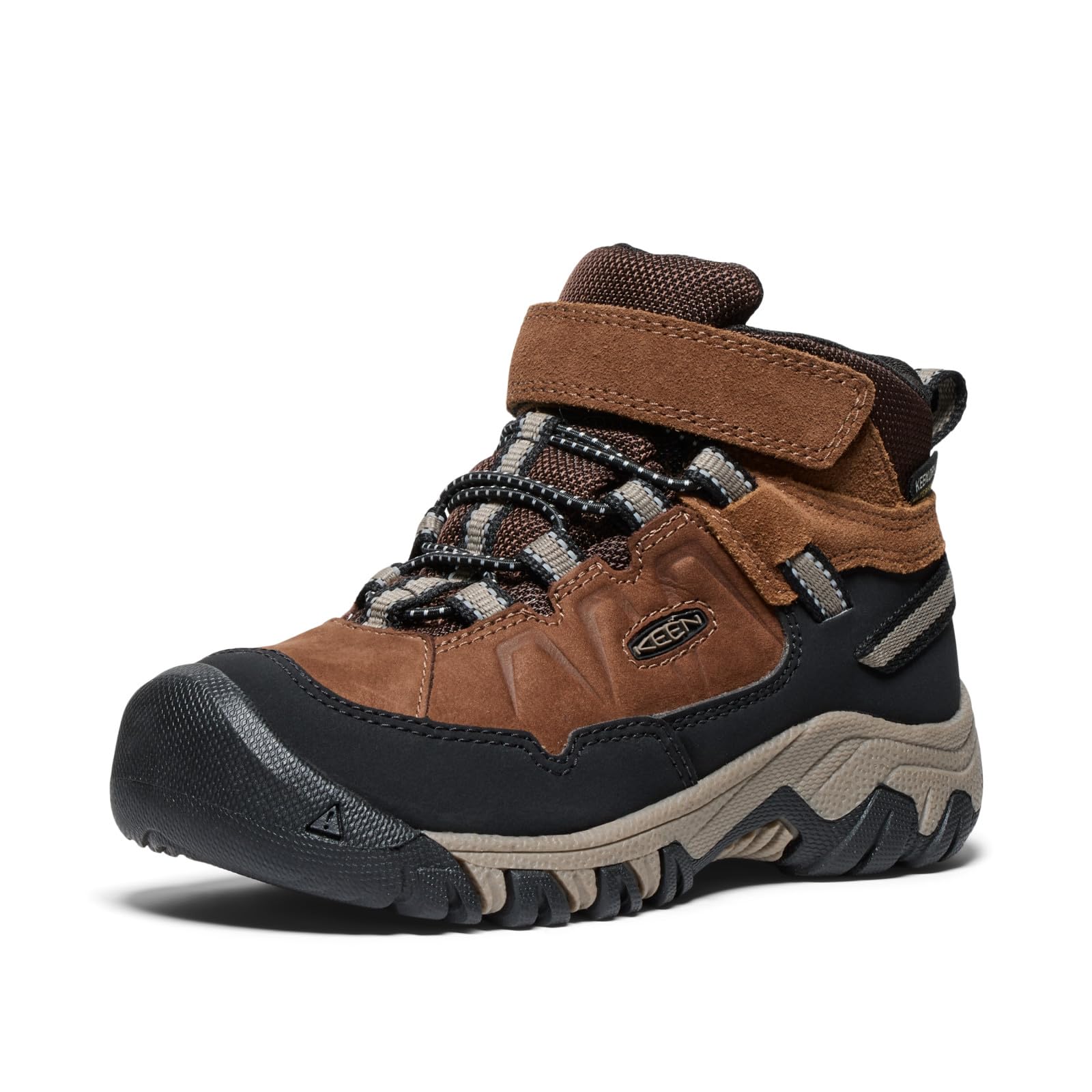
KEEN Targhee 4 Mid
Key Features
- Closure: Bungee cord
- Boot type: Mid hiking boot
- Department: Unisex child
- Waterproofing: Waterproof
- Price: Premium
Start with the pull toggle. Instead of laces, the Targhee 4 uses a bungee cord with a sliding adjuster, so a six-year-old can loosen it, push a foot in and tighten it again without an adult kneeling in the mud. That sounds like a small thing until you have done it forty times on one walk. It’s what makes this the most independent boot here for a child who wants to dress themselves, and it’s why we reach for it on cold mornings when nobody wants to be crouching on a doorstep.
Build is where the extra money goes. This is the most structured, protective boot we put a child in for a real trail: a firm sole, a padded collar, and an upper that takes scuffs rather than tearing. KEEN sells it as waterproof, and a membrane is worth more than the water-resistant treatment on a lighter boot, though nothing stays dry once water comes over the collar. It also feels like the stiffest boot in this group — exactly what you want on rough ground, and exactly what a fidgety kid notices on a flat path.
That makes it the pick for wet, rocky country and for the child who destroys footwear faster than they outgrow it. It’s the most expensive boot here that we genuinely hike in, and a family out most weekends gets that back over a couple of seasons. For three walks a summer, the Merrell does the same job for less and in a lighter package.
Pros
- Pull-cord lacing kids can manage alone
- Waterproof construction for wet trails
- Structured, protective build
Cons
- Runs about a half size large
For wet, rocky trails and a kid who is hard on boots, the Targhee 4 is the most protective pick here, and its pull cord is the easiest closure in this group to work alone.
Best for Light Everyday Trails
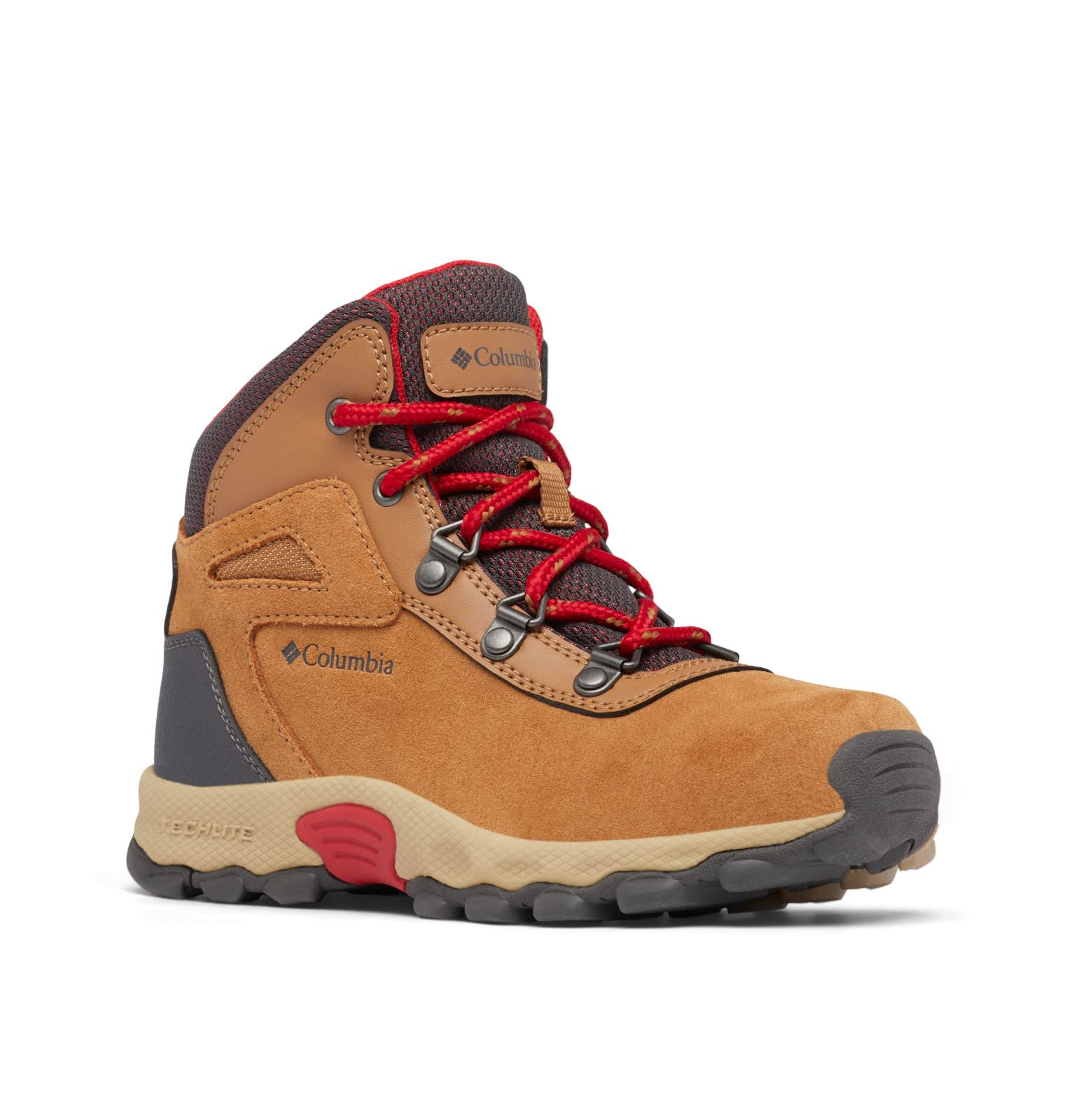
Columbia Newton Ridge
Key Features
- Boot type: Hiking boot
- Department: Boys
- Water resistance: Water-resistant
- Price: Midrange
The throat of this boot is tight. Some kids get a foot through the arch without a second thought; others need a parent hauling on the pull loop every morning. It’s the one thing to know before you order.
Once they’re on, the Newton Ridge is the closest thing here to a sneaker. It’s soft from the first wear with no break-in and no rubbing at the ankle, light enough that a child forgets they’re in boots, and it kept feet dry through heavy rain. The upper wipes clean and doesn’t hold mud or stain, which matters more than it sounds when the boots live by the back door. On rocks, roots and wet leaves the sole grips well enough that it never crossed our minds mid-walk, and the price lands in the middle of this group.
Where it stops is rough ground. There’s less boot here than in the KEEN or the Merrell, and the light build that makes it so easy to live with is the same reason it isn’t our first choice for scree or a long day with a pack. For school runs, weekend paths and the kind of walking most families actually do, it’s the pair we hand over with the least fuss.
Pros
- Light enough to forget you’re wearing boots
- Dry in heavy rain, easy to clean
- Comfortable from the first wear
Cons
The boot to hand a kid who hates boots: light, soft from the first wear, dry in heavy rain, and easy to live with on the trails most families walk.
Best for Budget-Conscious Families
Northside Kids’ Hiking Boot
Key Features
- Upper: Synthetic suede and rip-stop
- Insole: Cushioned EVA
- Outsole: TPR traction outsole
- Department: Boys
- Price: Budget
This is the value pick of the group, and we mean value in a specific sense: a boot with a real trail sole, a cushioned insole and a reinforced upper that undercuts the Merrell and the KEEN. Synthetic suede and rip-stop over a TPR traction outsole is honest, functional construction rather than a fashion exercise, and it’s the combination we point a family at when the budget is fixed and the hiking isn’t.
On the trail it behaves like a much more expensive boot. The upper shrugs off mud, the toe box leaves room for thicker socks, and the cushioned EVA insole takes the sting out of packed gravel and long descents. Fit comes up true for most kids, which is more than we can say for a couple of the boots here.
The catch is hardware. The metal lace hooks are the weak point, and one can snap off, taking the lace with it. If your kid hauls boots off by the heel with the laces still tied, that’s a real risk; if they sit down and undo them, this is a lot of boot for the money. It’s the pick for a family that wants trail-capable boots without paying for a badge.
Pros
- Trail-ready outsole and cushioned insole at a value price
- True-to-size fit with toe room
- Handles mud and everyday abuse
Cons
- Metal lace hooks can snap off
The best value in this group: real trail construction, a cushioned insole and a true-to-size fit for a family that hikes often but spends carefully.
Best for First Trail Boots
Mishansha Kids Hiking Boots

Key Features
- Boot type: Hiking boot
- Department: Boys
- Model number: TrekkingKidShoesXZC
- Price: Budget
It’s the least expensive way into a proper kids’ hiking boot, and on the first wear it doesn’t feel like it. The lining is soft, there’s room for thick socks, the sole grips well on rocky paths, and kids get them on and off without help — the single biggest quality-of-life difference in this category. For a family that hikes a handful of times a year, that covers most of what you want.
Where it gets shaky is over time. Stitching and the rubber toe cap can give way within a season, so this is a boot to buy for one child and one summer rather than one to hand down. Fit is the other variable: plenty of kids wear their usual size comfortably and plenty find it narrow, so try them on with the hiking socks before you commit. Buy them knowing that, and the comfort and the grip are a genuinely good deal.
Pros
- Soft, comfortable interior
- Strong grip for the money
- Kids can put them on themselves
Cons
- Stitching and toe caps can fail within a season
The budget pick worth considering if the boots only need to last one season — comfortable, grippy and easy for kids to manage, with build quality that won’t survive hand-me-downs.
Best for Camp and School
Deer Stags Drew Hiker

Key Features
- Boot type: Hiker boot
- Department: Boys
- Model number: DREW – K
- Price: Premium
Some boots earn their keep at camp rather than on a mountain, and the Drew is one of them. It looks like proper hiking kit, there’s plenty of room across the toe for a growing foot, and it’s comfortable enough for a long day out without rubbing or blisters. As a first pair for a scouting trip, a summer camp or a school shoe that has to survive a field, it does the job.
It handles wet ground better than most of the boots here. Puddles and wet grass don’t get through, and it cleans up well enough to wear to school on Monday. The roomy toe box is the other thing worth calling out: kids with wider feet who struggle to get into narrower boots get on with this one, and the collar doesn’t dig into the ankle.
Then there’s the hardware. The top metal lace hook is the failure point — one can snap within a month, and once it goes the boot is awkward to lace properly. At the top of this group’s price range, that’s hard to swallow, and it’s why the Drew sits in our also-consider list: a comfortable, good-looking boot for camp and everyday wear, not the one we choose for rocky trails or for passing down.
Pros
- Roomy toe box suits wider feet
- Keeps feet dry in puddles and wet grass
- Comfortable for long days without blisters
Cons
- Top lace hooks can snap within weeks
A comfortable, good-looking boot for camp, school and easy trails, with a roomy toe box and decent water resistance — just don’t expect the hardware to survive a rough kid.
How We Tested Kids Hiking Boots
To build the shortlist, I read through size charts, closure systems, waterproof claims, and parent reviews, then narrowed the field by available sizes, replacement policies, and price relative to construction. We ended with 12 pairs and put them on kids ages 4 to 10 for eight months, rotating them through school runs, backyard play, muddy park loops, and easy weekend trails.
On the trail, we watched how each boot handled wet roots, loose gravel, and slick boardwalks, noting slips and saves rather than just calling traction good. For water resistance, kids stepped into shallow creeks and wet grass; we checked socks immediately after and again at the car. Fit got checked with the thick socks they actually wear, looking for heel lift, toe room, and whether the widest part of the foot lined up with the widest part of the boot.
Comfort showed up in complaints—or the lack of them—after a full afternoon, and in whether kids asked for the same pair again. We had them put boots on and take them off without help, and we watched laces on the move to see which stayed tied and which needed double knots. After each outing, we inspected toe caps, seams, and soles for scuffs and separation; by the end, we compared wear against what each pair cost. We also let kids choose between colorways, because a boot they refuse to wear is no bargain.
How to Choose Kids Hiking Boots
The right kids’ hiking boot is the one that keeps a child steady on the ground your family actually walks on; the rest is detail.
Grip and Ankle Support Come First
A trail boot earns the name at the outsole. Deep, widely spaced lugs shed mud instead of packing it, and softer rubber bites on wet rock where a harder compound skates. Ankle height is the other half: a collar that rises above the ankle gives a growing foot something to lean against when the ground tilts, which is exactly when a child goes down. Press the heel counter with your thumb before you buy — if it folds over easily, it won’t steady much.
We care far more about these two things than about colour, brand or the number of straps. The Merrell and the KEEN are the two boots here we trust on genuinely uneven ground; the lighter boots are excellent on paths, packed dirt and park tracks, which is where most family walking happens anyway.
Waterproofing: Know What the Word Covers
A waterproof membrane keeps water out until it comes over the collar, and nothing keeps it out after that. Water-resistant treatments handle dew, wet grass and a shallow puddle, then give up. The trap is that both words appear on boots that look identical in a photo, so buy for your terrain: stream crossings and bog justify a membrane, while damp paths and the odd shower are served by a treated upper that weighs less.
The KEEN is the one boot in this guide sold as waterproof. Treat the others as dry-weather boots and your kids’ socks stay drier than if you assume otherwise.
Fit for the Foot They Have Now
Buying a size up so the boots last two seasons is the most common mistake in this category. An oversized boot lets the heel lift with every step, which rubs blisters and, worse, cancels out the ankle support you just paid for. Measure the foot at the end of the day when it’s largest, and leave roughly a thumb’s width at the toe — enough for a wool sock and a few months of growth without the heel sliding.
Sizing is inconsistent across this group: one of our picks runs about half a size large and another runs small for plenty of kids. Start from a measurement rather than the size of their school shoes, and bring the socks they’ll actually hike in.
Closures and the Parts That Break First
Laces give the most adjustability and take the longest to learn. A bungee cord with a pull toggle gets a child out the door unaided, which is worth a great deal on a cold morning, and hook-and-loop sits between the two — quick, but less precise over the instep. Whichever you pick, look at the hardware rather than the lacing style.
Metal speed hooks and thin round laces are what fail on kids’ boots, usually at the top hook where all the pulling happens; fabric loops or covered eyelets last longer in rough hands. Check the toe cap too. Kids drag their toes, and a rubber bumper is the difference between a scuff and a hole.
Frequently Asked Questions
Are kids’ hiking boots worth it for easy, flat trails?
For a gravel path, a park loop or a farm track, a well-fitting sneaker with a grippy sole is fine and lighter on the feet. Boots earn their keep on roots, rock, mud and anything that tilts. If your family walks most weekends, buy the boot; if it’s twice a summer, put the money into fit and grip rather than features you’ll never use.
Can my kid wear hiking boots to school every day?
Yes, if they’re comfortable — several boots here are soft enough from the first wear. Expect faster wear, though: concrete and asphalt grind a trail sole flat, and scuffing at the school gate is harder on the upper than mud is. Rotating them with a pair of sneakers is the simplest way to get a full season out of them.
Will kids’ hiking boots keep feet warm in winter?
Treat a trail boot as three-season footwear. Unless the boot is sold with a lining, it adds no warmth, and the ankle padding that makes it comfortable does nothing for cold. For cold-weather walks, pair a trail boot with a wool sock and make sure there’s room to wiggle toes — a tight boot is a cold boot. Once the ground is frozen and snowy, switch to a winter boot.
Final Verdict
Buy the Merrell Chameleon. It’s the most complete kids’ trail boot in this group — grip that holds on wet rock, an ankle collar that steadies a small foot, and no break-in — and it does that at a mid-range price rather than a premium one.
If your trails are genuinely wet and rocky, or your kid is hard on footwear, the KEEN Targhee 4 is the upgrade: waterproof, more protective, and closed with a pull cord a child can work alone. On a tight budget, the Northside still gives you a real trail sole and a cushioned insole for a lot less.