This post contains affiliate links. We may earn a small commission when you buy through our links — at no extra cost to you.
A cotton T-shirt feels fine for the first mile. Then the climb starts, sweat soaks through, and you’re wearing a wet sponge that clings to your back, chafes under pack straps, and stays damp for hours. A good hiking shirt moves that moisture off your skin, dries fast, and blocks the sun without turning into a sauna.
My team and I have spent the past six months hiking in 12 of them — day hikes, a couple of overnights, and plenty of sweaty lunch-break walks — and the pattern was clear: fabric technology matters far less than fit. A shirt that rides up under a hipbelt or bunches at the shoulders will ruin a long day no matter what the hangtag promises. Sizing tripped up more of our testers than anything else, and sleeve length varied wildly between a true long sleeve and something closer to a baseball tee. The ones below stayed comfortable from the trailhead to the car.




Best for Long Days Out
Columbia PFG Tamiami
Key Features
- Style: Button-down
- Sleeve: Long sleeve
- Department: Men’s
- Price: Premium
The detail that earns this shirt its place is the sleeve. Columbia puts a tab above each elbow, so the long sleeves roll up and stay rolled when a climb turns hot, then drop back down for the exposed ridge above treeline. The back is vented, the collar buttons up to shade your neck, and the fabric dries quickly enough that a sweaty hour does not leave it clammy for the rest of the day.
That adjustability is why it is our overall pick. In our testing the venting did real work on climbs where the other long sleeves here turned into a damp second skin, and the shirt came out of a stuffed pack looking presentable rather than creased. It is the closest thing here to one shirt that handles a cold start, a hot climb and a breezy summit without a change.
Two things to know before you buy. It runs large, with a generous cut through the body, and most hikers will want to size down. And it costs several times what the sun shirts in this guide do, which is the real trade: you are paying for the venting and the collar. What keeps it in our pack, though, is that collar and button front. It is the only shirt here that looks right at the trailhead, in the car and at a table afterward, so it doubles as the evening shirt you would otherwise pack separately.
Pros
- Roll-up sleeves with tabs adapt as you climb
- Vented back keeps air moving on hot climbs
- Dries fast and travels without creasing
- Collar and long sleeves cover neck and arms
Cons
- Runs large; size down for a trail fit
- Premium price against the rest of this set
Our overall pick: vented, sun-blocking and fast to dry, with sleeves you can roll and tab on the climb. Size down and it handles a full day out.
Best for Full Sun Exposure
baleaf UPF 50+ Long Sleeve
Key Features
- Sleeve: Long sleeve
- Department: Men’s
- Sun protection: UPF 50+
- Price: Budget
Coverage per dollar is the whole argument here. UPF 50+, sleeves down to the wrist and a price among the lowest in this guide make the baleaf the shirt we hand someone heading out on an exposed, shadeless trail where the sun is the main hazard rather than the climb.
It wears like a thin rash guard: smooth, close enough to stay put under a pack but not compressive, and cool in still heat where a heavier knit goes sticky. It also dries about as fast as anything here, so a river soak or a sweaty hour is a non-event. The trade for that thinness is a shirt with no structure at all: no collar, no pockets, nothing to hold a sunglasses case.
Sizing is the part to slow down for. The same labeled size comes up trim on some colorways and roomy on others, so try it on before you cut the tags and keep the packaging handy for an exchange. Get the fit right and it is a superb sun layer, and it doubles as a swim shirt, which is worth knowing if your hike ends at water.
Pros
- UPF 50+ with full arm and shoulder coverage
- Dries fast after sweat or a soaking
- Cool in still heat without clinging
- A fraction of the price of the button-down
Cons
- No collar or pockets
The best sun coverage for the money here: UPF 50+, full sleeves and a thin fabric that dries fast. Try it on before you commit.
Best for Multi-Day Trips
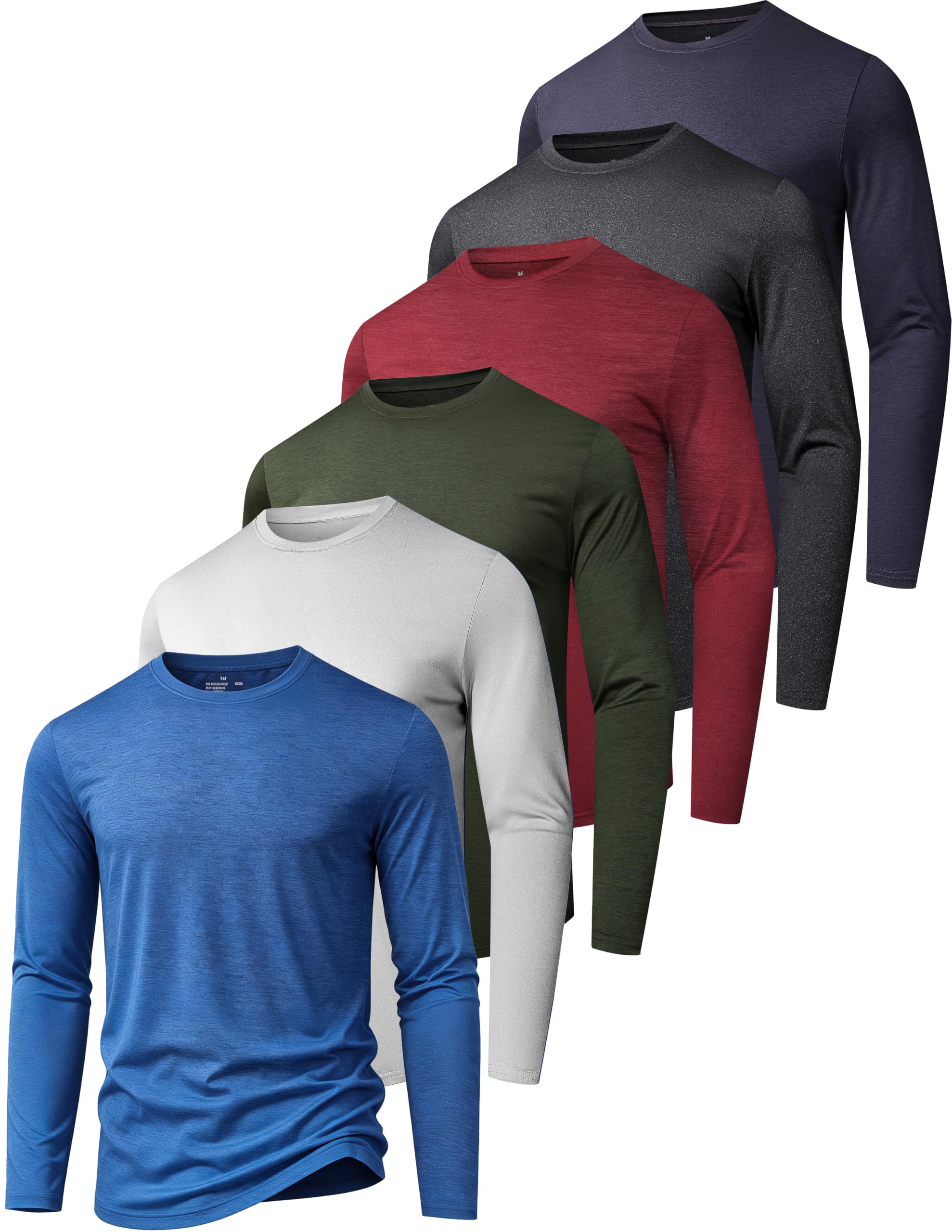
OYGSieg 6/7 Pack
Key Features
- Sleeve: Long sleeve
- Pack count: 6 or 7 shirts
- Sun protection: UPF50+
- Price: Midrange
Six or seven shirts for roughly the price of one premium top is the kind of math that changes a trip: no laundry every third night, no rationing the clean shirt, no disaster when a muddy section claims one. For a week-long walk or a family camping trip, that is the whole pitch.
The shirts themselves are better than the arithmetic suggests. They are soft and light, rated UPF50+, cool enough on a hot day, and the colors hold through repeated washing. Plain, comfortable long sleeves you stop thinking about by day two are exactly what a long trip wants, and quick-dry fabric means a sink wash in the evening has one ready by morning.
We pack these when the shirts are going to get abused rather than admired. The one change we wish for is a lighter color option, because the palette leans dark and a pale shirt is kinder on a shadeless midday climb. Beyond that there is not much to argue with at this price; they are not as cool or as finished as the button-down, but the whole pack costs less than that single shirt.
Pros
- A week of shirts for one premium price
- Soft, light fabric rated UPF50+
- Colors hold through repeated washing
Cons
- Palette runs dark for exposed days
Our pick for multi-day trips: a week of soft, UPF50+ long sleeves so you can skip laundry night. We just wish the colors ran lighter.
Best for Pack Backup
MAGCOMSEN Long Sleeve UPF 50+
Key Features
- Sleeve: Long sleeve
- Department: Men’s
- Sun protection: UPF 50+
- Price: Budget
This is the least expensive shirt in the guide, and it is the one we treat as equipment rather than clothing. It lives in the bottom of a pack for the day a shirt gets soaked, the day the weather turns, or the day someone in the group forgets theirs. At this price, losing one to a campfire spark or a thorny bush does not sting.
What you get for the money is genuinely good: UPF 50+, long sleeves, and a fabric so thin you can see daylight through a single layer. That thinness is why it feels cool rather than clammy on a humid climb, and why it packs down to nothing. It is also why you want a tee underneath when you are standing still in full sun.
Sizing is the weak point, with the cut varying between colorways, so check the chart rather than assuming your usual. And be clear about what this is: a plain, collarless, unvented long sleeve. It is a spare, not the shirt you plan a whole trip around. As the second one in the pack, it earns its space every time.
Pros
- Lowest price of any shirt in the guide
- UPF 50+ and long sleeves at that price
- Very light and cool in humid heat
Cons
- Thin fabric needs a layer underneath
The cheapest shirt here, and the one we keep in the pack as a spare: UPF 50+, long sleeves and almost no weight. Buy it as a backup.
Best for Layering
Opna Long Sleeve Wicking Shirt
Key Features
- Fabric: Moisture wicking
- Sleeve: Long sleeve
- Department: Men’s
- Item weight: 3.8 oz
- Price: Budget
Most hiking shirts get bought for July and worn in October. This one is why we keep a long-sleeve synthetic in the pack through shoulder season: pull it on at a cold trailhead, walk ten minutes, and it is comfortable enough to leave on when the sun comes over the ridge.
It is a thin, smooth knit that wicks rather than holds, and comfort is where it beats everything else in this guide. Soft, non-itchy and happy under a shell or on its own, it barely registers in a pack at 3.8 ounces, and it is the shirt we reach for on trips where the temperature swings between the valley floor and the summit.
It is a base layer at heart rather than a sun shirt: thin enough that a light color turns faintly see-through over the shoulders, with no collar and no venting. That is the trade for the weight, and if you wear it under something in bright sun, it is the right one. Where it does not match the dedicated sun shirts is the sleeve, which runs long on some sizes and short on others, so try it before a long trip.
For the money it is hard to beat as a layer: comfortable enough to sleep in, light enough to forget, and warm under a fleece on a cold morning. It is not a sun shirt in the way the baleaf is, so treat it as the layer you build the rest of your clothing around rather than the one that does everything.
Pros
- Soft and non-itchy for a full day
- Works alone or as a cold-weather layer
- Very light at 3.8 ounces
Cons
- Sleeve length varies between sizes
Our favorite layer in this guide: soft, light at 3.8 ounces and comfortable enough to wear all day under a shell or on its own. Check the sleeve length.
Best for Hot, Humid Hikes
Under Armour Tech 2.0
Key Features
- Style: Athletic T-shirt
- Sleeve: Short sleeve
- Department: Men’s
- Price: Midrange
No collar, no long sleeves. This is the shirt for the humid forest climb where you want as little fabric as possible and you are willing to handle sunscreen on your arms yourself. It is light, loose through the body and quick to dry, which is most of what a hot-weather hiking shirt needs to do.
We wear it on shaded, sweaty miles and on the drive home after, and it is the one in this guide that does not look out of place in town. The fabric moves air rather than clinging, and there are enough colors to treat it as a T-shirt rather than as kit.
Where it stops: this is a warm-weather shirt, and on a cold start you will want a shell over it or a different top altogether. For a humid five miles through trees, we take the short sleeves and a stick of sunscreen over a long-sleeve sun shirt every time.
Pros
- Light and quick-drying in humid heat
- Loose cut that does not cling when you sweat
Cons
- Runs small; size up
- Relaxed neckline sits wide
Our hot-weather short sleeve: loose, light and quick to dry, and the easiest shirt here to wear off the trail. Order a size up.
Best for Sweaty Climbs
Roadbox UPF 50+ Rash Guard

Key Features
- Sleeve: Long sleeve
- Department: Men’s
- Sun protection: UPF 50+
- Price: Budget
The first thing we noticed is how little there is of it. This is the lightest-feeling shirt in the guide, and unlike a soaked cotton tee it does not get heavy when it is wet. Wear it on a climb where you know you will sweat through and it keeps moving air instead of clinging.
On paper it is close to the baleaf: UPF 50+, long sleeves and a price near the bottom of this list, with a slightly looser feel in the hand. What separates them is the cut, which runs trimmer through the chest and shoulders here, so the size that fits your arms may not fit your back.
It is the shirt we take when the day involves water, whether that is a river crossing, a lake swim or an hour of rain, because it dries on your back while you walk rather than staying cold and damp. That is a narrow brief, and it fills it better than anything else here for very little money.
Pros
- Feels nearly weightless when worn
- UPF 50+ with long sleeves
- Does not get heavy when soaked
Cons
- Runs trim through chest and shoulders
The one we take near water: UPF 50+, barely there in the hand, and it dries while you walk. Size up if you are broad through the chest.
Best for Trail to Town
MAGCOMSEN Quick Dry Polo

Key Features
- Style: Performance polo
- Fabric: Pique jersey
- Sleeve: Short sleeve
- Price: Budget
Some hikers want a collar: it keeps the sun off the back of the neck, it looks deliberate at the trailhead, and it works for the drive home and the meal after. That is the case for this quick-dry polo, and it is a good one.
As a hiking shirt it is decent rather than outstanding. The knit is light and comfortable in heat, it dries fast, and the color holds up to washing. It is the kind of shirt you can wear for three days of driving and one day of walking without feeling scruffy at either end.
It is a knit rather than one of the thin sun fabrics, so it feels more like a shirt and less like a technical layer. That is what makes it useful off the trail and slightly less useful on a hard, sweaty climb, where the thin long sleeves here are cooler.
We keep it for days when the hike ends somewhere with a table and a menu, and it earns its place for that alone. Just do not buy it as your only sun layer: the short sleeves leave your arms to sunscreen and the knit is warmer than the dedicated sun shirts.
Pros
- Collar shades the neck and looks tidy
- Quick-dry knit that holds its color
Cons
- Runs large with a wide collar opening
- Fabric feel divides between colorways
If you want a collar on the trail and a shirt that still looks right in town, this quick-dry polo does both. Size down; the cut is generous.
How We Tested 12 Hiking Shirts
We started by pulling together more than 40 shirts — merino, polyester, and blends — and narrowing them by fabric weight, available size range, sleeve options, sun-protection claims, and price. We cut anything that only came in a narrow size run or that cost more than the trip itself, then ordered the final 12 in our regular sizes and wore them the way anyone actually would.
Testing ran six months, across day hikes with a loaded pack, two overnights, and short weekday walks. We noted where seams landed under shoulder straps, whether a collar rubbed when we turned to look at the trail, and whether the fabric went sheer across the back when we reached overhead — the easiest way to spot weak sun coverage. Each shirt was weighed dry, soaked and wrung out, then timed as it dried on a line and draped over a pack.
Fit got the closest look. We checked whether shoulders restricted our reach on scrambles, whether hems stayed put under a hipbelt, and whether the length held when we raised our arms. After repeated washes we inspected pilling, stretched collars, and fading, and we wore each one to coffee afterward to see whether it looked like a hiking shirt or just a shirt. Value came down to how it held up against its price, not how it looked on the hanger.
How to Choose a Hiking Shirt
The shirt is the piece of kit that decides whether a hot climb feels manageable, so we judge these on three things: how much sun they block, how fast they dry, and whether the size you order is the size you get.
Long sleeves, short sleeves, and what a UPF number covers
In direct sun, a loose long-sleeve shirt is cooler than bare skin: the fabric blocks radiant heat and sweat evaporates underneath it. That is why every serious sun shirt here reaches the wrist. The trap is coverage. A UPF rating describes the fabric, not the skin the fabric misses, so your hands, neck and face are still exposed unless you add a hat and sunscreen or a collar. If your neck burns easily, the button-down earns its weight. If your route runs through shaded forest, short sleeves and sunscreen are the more comfortable call.
Test how it dries before you trust the label
Nearly every shirt on this page claims to be quick-drying, and the claim matters less than the behavior. A simple test: wet the cuff in a sink, wring it out, and see how it feels ten minutes later. Thin sun fabrics like the baleaf and the Roadbox come back close to dry; a cheap knit still feels damp. On a multi-day route that difference decides whether you can sink-wash at night and hike in a clean shirt the next morning.
Fit: shoulders, sleeve length and body length
Sizing across this category is inconsistent, so order your usual size and be ready to exchange rather than guessing. Two measurements matter more than the label: the shoulders, which should let you reach forward without the hem lifting, and the body length, which needs to stay put under a pack hipbelt. Sleeves should reach the wrist bone with your arms down. Every pick here is listed in men’s sizes, so if you normally shop women’s cuts, check the sleeve and body length against a shirt you already own.
One good shirt or a pack of them?
A week of hiking needs about three shirts if you wash one every other evening, which is where multipacks earn their place: six or seven UPF50+ long sleeves for less than one premium button-down. The trade is refinement, since a pack shirt will not vent or fit like the Columbia. Our preference is a hybrid: one shirt you love for the hard days, plus a cheap pack for camp, sleeping and laundry rotation.
Weight, and what you give up for it
A long sleeve at 3.8 ounces disappears into a pack. A button-down with pockets and vents weighs more, and earns it on exposed, all-day routes. Ask what you need the shirt to do. If you will be moving fast and carrying little, take the lightest option. If you will be standing around in the sun, eating lunch on a shadeless ridge or waiting your turn on a rope, the collar, pockets and venting matter more than the grams.
Frequently Asked Questions
Can I hike in a rash guard?
Yes, and in hot weather it is often the better choice. Rash guards use the same UPF fabric as sun shirts, they are cut closer so they do not snag on brush or billow in wind, and they dry faster than most knits. Size for the trail rather than the pool: a swim-tight fit chafes under a pack, so order the size you would wear in a T-shirt.
Do these shirts work in cold weather?
Not on their own. A thin synthetic sun shirt adds almost no warmth, but it makes a good base layer under a fleece or a shell because it moves sweat away instead of holding it, which is how we use the Opna. Let the shirt manage moisture and let your midlayer handle the heat.
How should I wash a hiking shirt?
Cold water, a gentle cycle, and no fabric softener, which coats the fibers and blunts the wicking that makes the shirt worth packing. Skip the dryer for the thin ones and hang them up, and keep them away from velcro and open zippers, which snag lightweight knits and pull threads that turn into holes.
Final Verdict
Buy the Columbia PFG Tamiami if you want one shirt for a cold trailhead, a hot climb and a meal afterward. The venting and the roll-up sleeves are worth the premium, provided you size down.
If sun coverage on a budget is the priority, the baleaf does most of that job for a fraction of the money. For a week-long trip, take the OYGSieg pack and save the good shirt for the hardest day.